What Does a Forward Deployed Engineer Do? Key Responsibilities?

Written by Emily Hilton
- What Is a Forward Deployed Engineer?
- Why Forward Deployed Engineers Are in High Demand
- What Does a Forward Deployed Engineer Do?
- Forward Deployed Engineer Role Responsibilities
- Forward Deployed Engineer Job Description
- Essential Forward Deployed Engineer Skills
- OpenAI Forward Deployed Engineer Job Description: What Makes It Unique?
- Forward Deployed Engineer vs Software Engineer
- Forward Deployed Engineer Roadmap
- Why Forward Deployed Engineering Is Becoming One of the Most In-Demand Careers
- Why Consider GSDC's Certified Forward Deployed Engineer (FDE) Certification?
- Conclusion
Artificial Intelligence has transformed the way businesses build and deploy software. While creating AI models has become easier than ever, successfully implementing them in real business environments remains a challenge. Every organization has unique workflows, legacy systems, security requirements, and business goals that require customized AI solutions rather than one-size-fits-all products.
This is where the forward deployed engineer role has gained significant attention. Companies developing advanced AI platforms are increasingly hiring engineers who can work directly with customers, understand their business challenges, and build tailored solutions that deliver measurable outcomes.
Whether you're exploring a career in AI or wondering what does a forward deployed engineer do, understanding this role can help you identify one of the fastest-growing opportunities in modern technology.
In this guide, you'll learn the forward deployed engineer role definition, key responsibilities, essential skills, career outlook, and how this role differs from a traditional software engineering position.
What Is a Forward Deployed Engineer?
A Forward Deployed Engineer (FDE) is a software engineer who works directly with customers to design, develop, customize, and deploy technical solutions that solve real business problems. Unlike engineers who primarily build internal products, forward deployed engineers operate at the intersection of software engineering, consulting, solution architecture, and customer success.
Simply put, if you're wondering what is a forward deployed engineer role, think of it as a bridge between a company's engineering team and its customers. Instead of building generic software for millions of users, FDEs create tailored implementations that help organizations achieve specific business outcomes.
The forward deployed engineer role has become increasingly important as AI platforms, cloud technologies, and enterprise software require deep customization before they can generate value for customers.
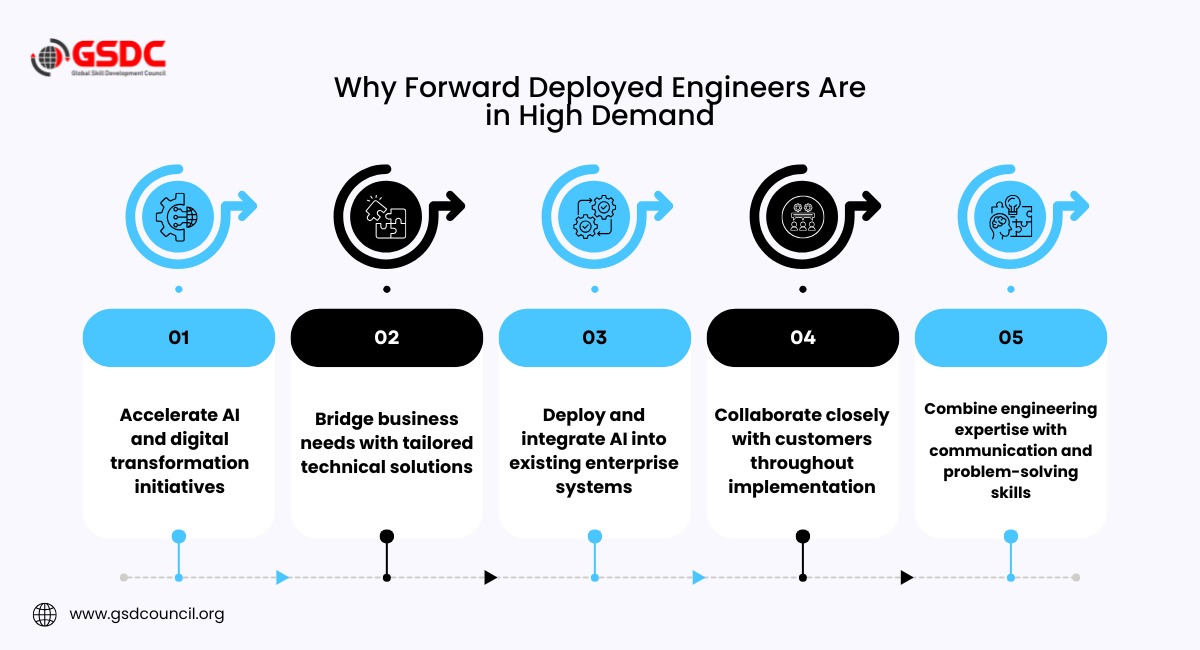
Why Forward Deployed Engineers Are in High Demand
Organizations today invest heavily in AI, automation, and data-driven decision-making. However, deploying these technologies successfully is rarely straightforward.
Every company has unique business processes, existing infrastructure, compliance requirements, and operational goals. Simply installing software is no longer enough.
Forward deployed engineers help organizations overcome these implementation challenges by translating business needs into scalable technical solutions. They collaborate with customers throughout the deployment lifecycle from identifying problems to integrating AI systems and optimizing performance after launch.
Leading AI companies, enterprise software providers, and technology consultancies increasingly rely on forward deployed engineers because they combine technical expertise with strong communication and problem-solving abilities.
What Does a Forward Deployed Engineer Do?
One of the most common questions aspiring professionals ask is "What does a forward deployed engineer do?"
Their work extends far beyond software development. They actively collaborate with customers to understand operational challenges, recommend technical approaches, implement customized solutions, and ensure successful adoption.
A typical day may include meeting with stakeholders, reviewing technical architectures, writing production-ready code, integrating APIs, deploying AI applications, troubleshooting issues, and coordinating with internal engineering teams.
Instead of remaining behind the scenes, forward deployed engineers become trusted technical advisors who help customers maximize the value of complex technologies.
Forward Deployed Engineer Role Responsibilities
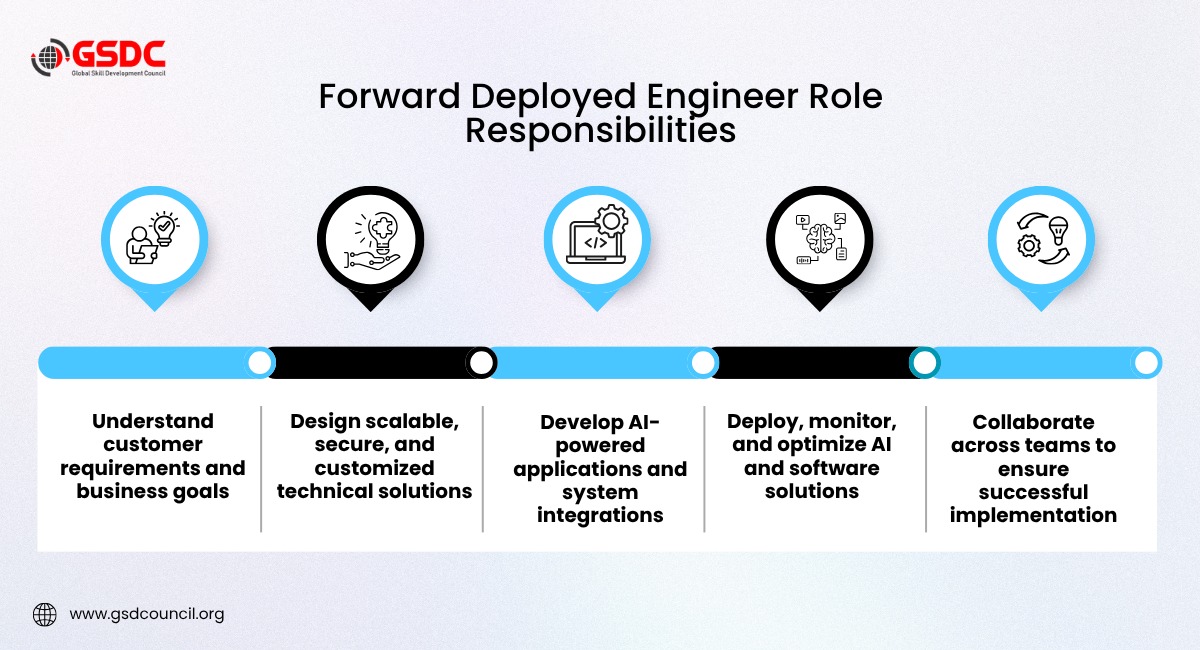
Although responsibilities vary by organization, the forward deployed engineer responsibilities generally include the following.
Understanding Customer Requirements
The first responsibility is understanding the customer's business.
Forward deployed engineers conduct discovery sessions with executives, product managers, operations teams, and technical stakeholders to identify challenges, workflows, and success metrics before proposing solutions.
Rather than immediately writing code, they focus on understanding how technology can improve business outcomes.
Designing Technical Solutions
After gathering requirements, FDEs design architectures that integrate with the customer's existing systems.
This involves selecting technologies, defining workflows, planning integrations, considering security requirements, and ensuring scalability for future growth.
Since every customer environment is unique, solution design often requires creativity and adaptability.
Developing Customized Applications
Unlike product engineers who build standardized features, forward deployed engineers frequently develop customer-specific functionality.
They create APIs, dashboards, automation workflows, AI-powered applications, data pipelines, and integrations that address unique operational requirements while maintaining high engineering standards.
Deploying AI and Software Solutions
Deployment is another major responsibility.
Forward deployed engineers configure cloud environments, integrate third-party services, manage deployments, monitor system performance, and resolve technical issues during implementation.
Their objective is to ensure that customers experience a smooth transition from planning to production.
Collaborating Across Multiple Teams
A successful deployment requires close collaboration between engineering, product management, sales, customer success, security, and customer stakeholders.
Forward deployed engineers act as the communication bridge between technical and non-technical teams, ensuring that everyone remains aligned throughout the project lifecycle.
Optimizing Solutions After Deployment
Deployment isn't the finish line.
FDEs continuously monitor solution performance, gather customer feedback, identify improvement opportunities, and refine implementations to maximize business value.
This ongoing partnership helps organizations achieve long-term success rather than simply completing a one-time implementation.
Forward Deployed Engineer Job Description
A typical forward deployed engineer job description combines software engineering expertise with customer-facing responsibilities.
Most organizations expect candidates to:
- Build and customize software solutions for enterprise customers.
- Collaborate directly with clients to understand technical and business requirements.
- Design scalable architectures for AI and software deployments.
- Integrate APIs, cloud platforms, databases, and enterprise systems.
- Troubleshoot production issues and optimize application performance.
- Work closely with product managers and engineering teams.
- Travel occasionally to customer locations when required.
- Deliver technical guidance throughout implementation projects.
Many employers also look for experience with Python, Java, TypeScript, cloud platforms like AWS or Azure, containerization technologies, SQL databases, and modern AI frameworks.
Strong communication skills are equally important because forward deployed engineers frequently interact with executives, technical teams, and business stakeholders.
Essential Forward Deployed Engineer Skills
Possessing strong technical knowledge alone isn't enough to succeed in this profession. The best forward deployed engineer skills combine engineering expertise with business understanding and interpersonal communication.
Software Development
Forward deployed engineers should be proficient in modern programming languages such as Python, Java, Go, JavaScript, or TypeScript.
They should also understand software architecture, testing methodologies, version control, and system design principles.
AI and Machine Learning Knowledge
As AI adoption accelerates, many forward deployed engineers work with large language models, retrieval-augmented generation (RAG), vector databases, prompt engineering, and machine learning pipelines.
Understanding how AI systems integrate into enterprise workflows is becoming an increasingly valuable skill.
Cloud Computing
Most enterprise applications run on cloud infrastructure.
Experience with AWS, Microsoft Azure, or Google Cloud Platform enables FDEs to deploy scalable and secure solutions efficiently.
Knowledge of Docker, Kubernetes, CI/CD pipelines, and Infrastructure as Code further strengthens deployment capabilities.
API Integration
Forward deployed engineers regularly connect multiple enterprise systems.
Strong knowledge of REST APIs, GraphQL, authentication mechanisms, webhooks, and third-party integrations allows them to build seamless workflows across different platforms.
Communication and Consulting
Perhaps the most distinctive skill is communication.
FDEs regularly explain technical concepts to non-technical stakeholders, facilitate workshops, gather requirements, and build trust with customers.
The ability to translate business objectives into technical solutions often distinguishes exceptional forward deployed engineers from average software developers.
Problem-Solving and Adaptability
Every customer environment presents unique technical challenges.
Forward deployed engineers must think critically, troubleshoot efficiently, adapt quickly to changing requirements, and remain comfortable working in fast-paced environments where priorities evolve frequently.
OpenAI Forward Deployed Engineer Job Description: What Makes It Unique?
The growing popularity of AI has brought significant attention to the OpenAI forward deployed engineer job description. While every organization defines the role differently, companies like OpenAI generally seek engineers who can bridge cutting-edge AI technology with real-world customer needs.
Rather than focusing solely on building AI models, forward deployed engineers help enterprise customers integrate AI into their existing workflows. This includes understanding customer requirements, designing secure AI-powered applications, implementing APIs, optimizing performance, and ensuring successful deployment.
The role also demands close collaboration with research teams, product managers, and customer stakeholders. Since AI adoption varies across industries, forward deployed engineers must be comfortable working in dynamic environments where every customer presents a different technical challenge.
This customer-centric approach makes the position both technically demanding and highly rewarding.
Forward Deployed Engineer vs Software Engineer
Many professionals compare the forward deployed engineer vs software engineer career paths because both involve software development. However, their day-to-day responsibilities differ considerably.
Aspect | Forward Deployed Engineer | Software Engineer |
| Primary Focus | Customer-specific solutions | Product development |
| Customer Interaction | High | Limited |
| Work Environment | Customer-facing and collaborative | Primarily internal engineering teams |
| Solution Type | Customized implementations | Standardized product features |
| Responsibilities | Deployment, consulting, integration, optimization | Software design, coding, testing, maintenance |
| Business Understanding | Essential | Helpful but not always required |
| Travel | Sometimes required | Rarely required |
| Success Metric | Customer outcomes and adoption | Product quality and feature delivery |
A software engineer primarily develops features that serve a broad user base, whereas a forward deployed engineer works directly with organizations to tailor those products to unique business requirements.
For professionals who enjoy solving diverse business problems while interacting with customers, the forward deployed engineer path often provides greater variety and exposure.
Forward Deployed Engineer Roadmap
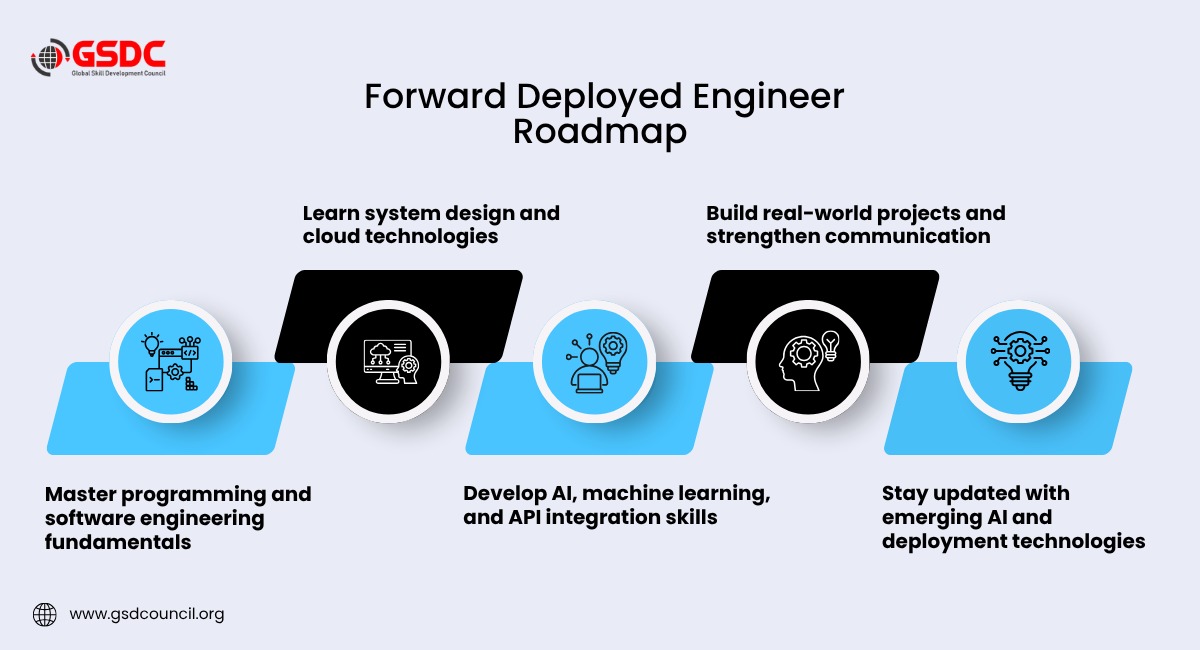
If you're interested in becoming an FDE, following a structured forward deployed engineer roadmap can help you build the right mix of technical and business skills.
1. Build Strong Programming Fundamentals
Start by mastering one or two widely used programming languages such as Python, Java, Go, or TypeScript. Learn data structures, algorithms, object-oriented programming, and software engineering best practices.
2. Learn System Design
Enterprise applications require scalable and reliable architectures. Study distributed systems, databases, microservices, caching, networking, and security fundamentals to understand how large-scale software is designed.
3. Gain Cloud Expertise
Become comfortable with cloud platforms like AWS, Microsoft Azure, or Google Cloud Platform. Learn deployment pipelines, Docker, Kubernetes, CI/CD, monitoring tools, and Infrastructure as Code.
4. Develop AI and Machine Learning Knowledge
As organizations increasingly deploy AI solutions, understanding large language models, prompt engineering, retrieval-augmented generation (RAG), vector databases, AI APIs, and model evaluation will make you significantly more valuable.
5. Strengthen Communication Skills
Technical expertise alone isn't enough. Practice requirement gathering, technical presentations, documentation, stakeholder management, and customer communication to become an effective bridge between business and engineering teams.
6. Build Real-World Projects
Create portfolio projects that demonstrate API integrations, AI-powered applications, workflow automation, dashboards, and cloud deployments. Employers value practical implementation experience as much as theoretical knowledge.
7. Stay Updated with Emerging Technologies
Forward deployed engineering evolves rapidly alongside AI and cloud computing. Continuously learning new tools, frameworks, and deployment practices will help you remain competitive throughout your career.
Why Forward Deployed Engineering Is Becoming One of the Most In-Demand Careers
Organizations no longer struggle with accessing technology they struggle with implementing it effectively.
Businesses need professionals who can understand operational challenges, customize AI solutions, integrate complex systems, and ensure measurable business outcomes. This growing demand has made forward deployed engineers increasingly valuable across industries including healthcare, finance, manufacturing, cybersecurity, retail, logistics, and government.
As enterprises continue investing in generative AI, automation, and digital transformation, the need for professionals who can successfully deploy these technologies is expected to grow further.
This combination of technical expertise, customer engagement, and business impact makes forward deployed engineering an exciting and future-focused career choice.
Why Consider GSDC's Certified Forward Deployed Engineer (FDE) Certification?
For professionals looking to enter this field or validate their expertise, earning a Forward Deployed Engineer Certification can strengthen both technical knowledge and career credibility.
The GSDC Certified Forward Deployed Engineer (FDE Certification) is designed to help learners understand the complete lifecycle of customer-centric AI and software deployments. The program covers topics such as solution architecture, AI implementation, cloud technologies, API integration, deployment strategies, stakeholder collaboration, and enterprise problem-solving.

Whether you're a software engineer, AI professional, solutions architect, DevOps engineer, consultant, or technology enthusiast, becoming a Certified Forward Deployed Engineer demonstrates your ability to bridge business requirements with technical implementation. As organizations continue to seek professionals capable of delivering successful AI deployments, certifications like this can help showcase your readiness for modern enterprise engineering roles.
Conclusion
The forward deployed engineer has emerged as one of the most impactful roles in today's technology landscape. By combining software engineering expertise with business understanding and customer collaboration, these professionals help organizations successfully implement AI and enterprise solutions that deliver measurable value.
As AI adoption continues to accelerate, the demand for engineers who can bridge technology and business will only increase. Whether you're exploring a new career path or expanding your existing technical expertise, investing in the right skills, practical experience, and a recognized certification can position you for long-term success in this rapidly evolving field.

Related Certifications
Frequently Asked Questions
A forward deployed engineer works directly with customers to design, customize, deploy, and optimize technology solutions that address specific business challenges.
They gather requirements, build custom solutions, integrate systems, deploy applications, collaborate with customers, and optimize performance after implementation.
Software engineers primarily build products, while forward deployed engineers customize and implement those products for individual customers.
Key skills include programming, cloud computing, AI technologies, API integration, system design, communication, and problem-solving.
Yes. A recognized FDE certification can validate your expertise, strengthen your resume, and demonstrate your readiness to deploy AI and enterprise solutions in real-world environments.
Stay up-to-date with the latest news, trends, and resources in GSDC
If you like this read then make sure to check out our previous blogs: Cracking Onboarding Challenges: Fresher Success Unveiled
Not sure which certification to pursue? Our advisors will help you decide!