Why Forward Deployed Engineer Certification Is Worth It in 2026?

Written by Emily Hilton
- What Is a Forward Deployed Engineer?
- Forward Deployed Engineer Meaning in Today's AI Era
- Why Are Forward Deployed Engineers in High Demand?
- Forward Deployed Engineer Role
- Forward Deployed Engineer Responsibilities
- Forward Deployed Engineer Roadmap
- How to Become a Forward Deployed Engineer
- Forward Deployed Engineer Salary
- Forward Deployed Engineer Jobs Are Growing
- Why a Forward Deployed Engineer Certification Is Worth It in 2026
- Is an FDE Certification Worth It?
- Final Thoughts
Artificial Intelligence is transforming the way businesses work but creating an AI model is only the beginning. The real challenge is making sure those AI solutions actually solve business problems and deliver results.
That's where Forward Deployed Engineers (FDEs) come in. Instead of working behind the scenes, they collaborate directly with clients, understand their goals, customize AI solutions, and ensure everything works smoothly in real-world environments. In simple terms, they bridge the gap between cutting-edge technology and practical business needs.
As more organizations adopt AI in 2026, the demand for professionals who can successfully deploy and scale AI solutions is growing rapidly across industries like healthcare, finance, manufacturing, retail, cybersecurity, and government. Companies are looking for people who can do more than build AI they need experts who can implement it where it matters.
This rising demand has also made Forward Deployed Engineer Certification a valuable credential for professionals who want to validate their skills and stand out in the job market. In this guide, we'll explore what a Forward Deployed Engineer does, the skills you need, career opportunities, salary expectations, and why this certification is worth considering in 2026.
What Is a Forward Deployed Engineer?
Before discussing certification, it's important to answer one of the most searched questions:
What is Forward Deployed Engineer?
A Forward Deployed Engineer (FDE) is a technical professional who works directly with customers to design, customize, implement, and optimize technology solutions according to business needs.
Think of an FDE as someone who combines the expertise of:
- Software Engineer
- AI Engineer
- Solutions Architect
- Technical Consultant
- Customer Success Engineer
Instead of simply delivering software, they ensure that the technology actually solves the customer's problem.
For example:
Imagine a hospital wants to use AI to predict patient readmission risks.
A traditional AI engineer may build the prediction model.
A forward deployed AI engineer, however, will:
- Understand hospital workflows
- Integrate the AI model into existing systems
- Customize dashboards
- Train medical teams
- Optimize performance
- Collect user feedback
- Improve deployment over time
This customer-centric approach is why organizations increasingly rely on FDEs for AI implementation projects.
Forward Deployed Engineer Meaning in Today's AI Era
The forward deployed engineer meaning has evolved significantly over the past few years.
Originally, the role focused on deploying enterprise software at client sites.
Today, it has expanded to include:
- AI deployment
- Large Language Models (LLMs)
- Machine Learning implementation
- Cloud infrastructure
- Data engineering
- Enterprise automation
- AI governance
- Business transformation
Rather than being "just another engineer," an FDE serves as the bridge between innovation and business impact.
Why Are Forward Deployed Engineers in High Demand?
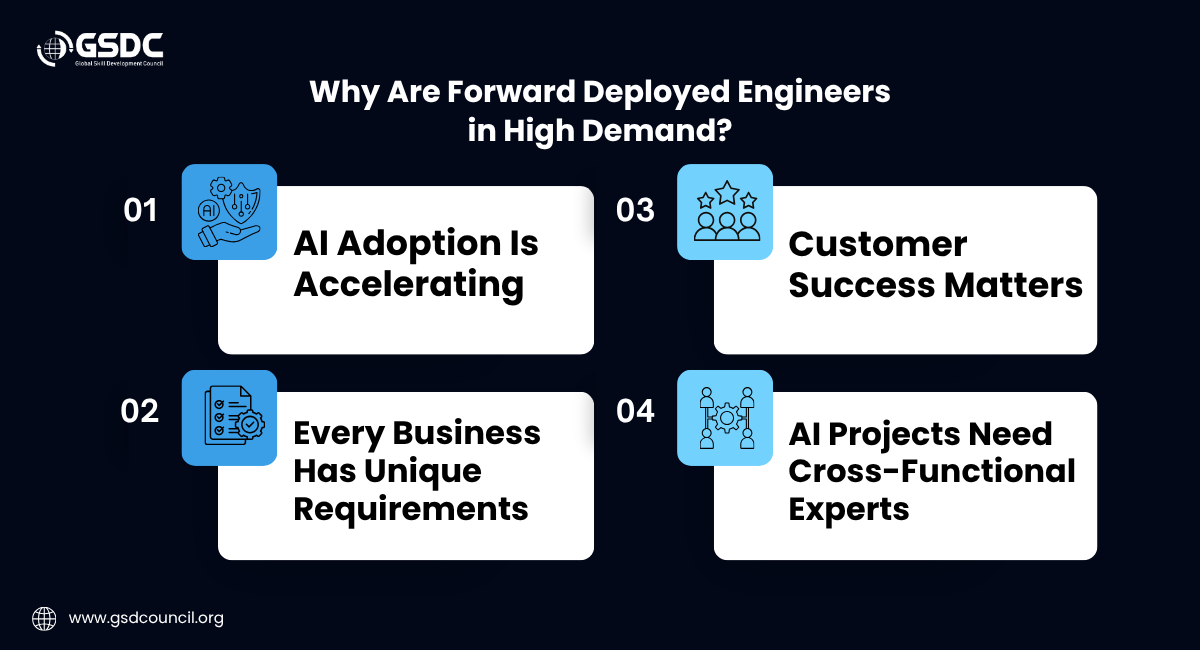
The demand for Forward Deployed Engineers (FDEs) has grown significantly as organizations move from experimenting with AI to implementing it at scale. While businesses are investing billions in artificial intelligence, many struggle to turn AI models into solutions that create measurable business value. This is exactly where Forward Deployed Engineers make the biggest impact.
1. AI Adoption Is Accelerating
Organizations are investing heavily in AI but often struggle with implementation.
Building AI is easier than deploying it effectively.
Companies need professionals who understand both technology and business. Forward Deployed Engineers bridge this gap by translating AI capabilities into practical business solutions, making them indispensable to organizations embracing digital transformation.
2. Every Business Has Unique Requirements
No two organizations operate exactly the same.
Forward Deployed Engineers customize AI solutions based on:
- Existing software
- Security policies
- Compliance needs
- Customer workflows
- Data infrastructure
Forward Deployed Engineers work closely with stakeholders to understand these unique requirements and tailor AI solutions accordingly. Their ability to adapt technology to real-world business environments ensures smoother implementation and long-term success.
3. Customer Success Matters
Businesses now measure success by outcomes rather than software delivery.
FDEs ensure:
- Faster implementation
- Higher adoption
- Better user experience
- Improved ROI
These Engineers help organizations achieve these outcomes by ensuring faster implementation, higher user adoption, seamless integration with existing systems, and a better overall user experience. Their involvement directly improves the return on investment (ROI) of AI initiatives.
4. AI Projects Need Cross-Functional Experts
Modern AI projects involve collaboration between:
- Executives
- Product teams
- Data scientists
- Software developers
- Cloud engineers
- End users
FDEs coordinate these teams to deliver practical solutions. They act as the bridge between these teams, translating business needs into technical solutions while keeping projects aligned with organizational goals. Their combination of technical expertise, communication skills, and customer-focused approach makes them one of the most valuable professionals in today's AI-driven workforce.
Forward Deployed Engineer Role
The forward deployed engineer role goes far beyond software development.
Typical responsibilities include:
- Understanding customer business problems
- Designing technical solutions
- Integrating AI into enterprise systems
- Deploying applications
- Working alongside customer teams
- Troubleshooting implementation issues
- Customizing workflows
- Building proof-of-concepts
- Providing technical guidance
- Monitoring system performance
Every day brings a new challenge because each customer environment is different.
Forward Deployed Engineer Responsibilities
Let's look more closely at common forward deployed engineer responsibilities.
Solution Discovery
Meeting customers to understand operational challenges.
Technical Design
Creating architectures tailored to business requirements.
AI Integration
Connecting AI models with enterprise applications.
Deployment
Implementing cloud-based or on-premise solutions.
Custom Development
Writing code to extend platform capabilities.
Customer Enablement
Helping users successfully adopt new technologies.
Continuous Improvement
Collecting feedback and refining deployed systems.
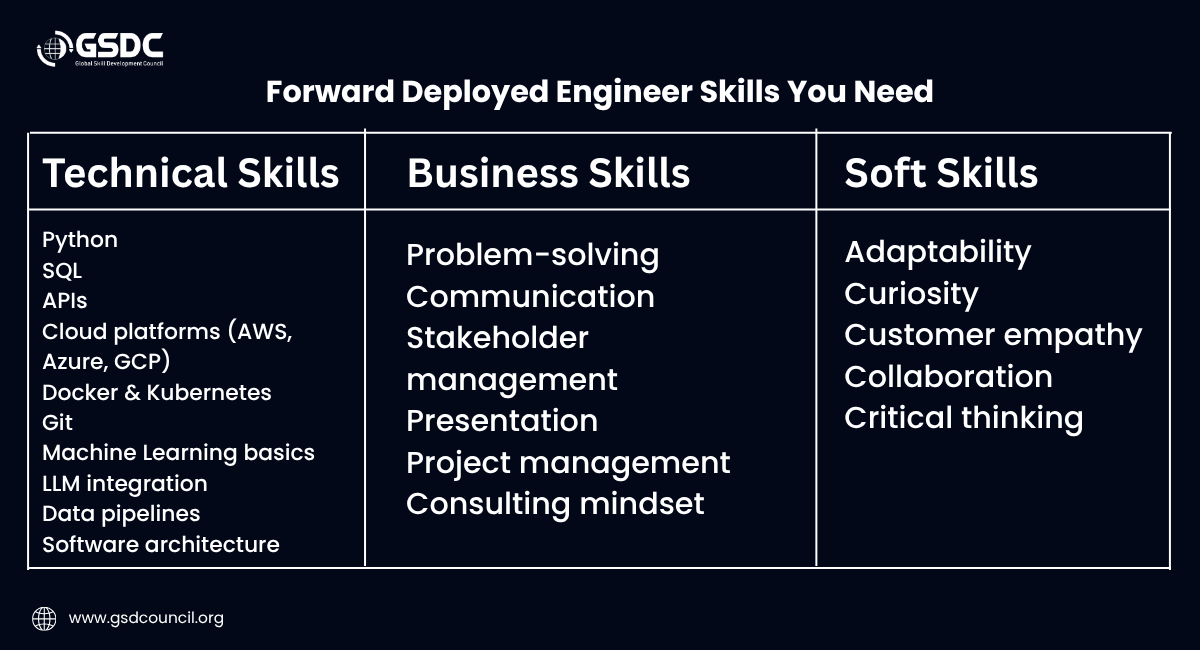
Forward Deployed Engineer Roadmap
Many aspiring professionals ask about the ideal forward deployed engineer roadmap.
A practical learning path looks like this:
Step 1: Build Programming Skills
Learn:
- Python
- SQL
- REST APIs
- Git
Step 2: Understand Cloud Platforms
Gain experience with:
- AWS
- Azure
- Google Cloud
Step 3: Learn AI Fundamentals
Focus on:
- Machine Learning
- Generative AI
- LLMs
- Prompt Engineering
Step 4: Study Enterprise Architecture
Understand:
- Microservices
- Databases
- Security
- Authentication
- APIs
Step 5: Improve Business Communication
Technical knowledge alone isn't enough.
Practice:
- Client communication
- Solution presentations
- Requirement gathering
Step 6: Earn a Forward Deployed Engineer Certification
Certification validates your knowledge and prepares you for real-world implementation scenarios.
How to Become a Forward Deployed Engineer
If you're wondering how to become a forward deployed engineer, here's a realistic approach.
For Software Engineers
Learn AI deployment and customer consulting.
For AI Engineers
Improve communication and solution architecture.
For Cloud Engineers
Gain AI integration experience.
For Consultants
Strengthen programming and technical implementation skills.
For Fresh Graduates
Build projects that combine software development, AI, and customer problem-solving.
Adding an industry-recognized certification can also demonstrate commitment and practical readiness to employers.
Forward Deployed Engineer Salary
One of the most searched questions is about forward deployed engineer salary.
While compensation varies based on location, experience, company size, and technical expertise, FDE roles are generally positioned among higher-paying engineering careers because they combine deep technical skills with customer-facing responsibilities.
Typical salary influencers include:
- Years of experience
- AI and cloud expertise
- Programming proficiency
- Consulting experience
- Industry specialization
- Geographic location
Professionals working with enterprise AI platforms, cloud-native technologies, and large-scale digital transformation projects often command premium compensation due to the specialized nature of the role.
Forward Deployed Engineer Jobs Are Growing
The demand for forward deployed engineer jobs continues to rise as organizations move from AI experimentation to production deployment.
Industries hiring FDEs include:
- Healthcare
- Financial Services
- Manufacturing
- Cybersecurity
- Retail
- Government
- Telecommunications
- SaaS
- Logistics
- Energy
Common job titles include:
- Forward Deployed Engineer
- Solutions Engineer
- AI Solutions Consultant
- Customer Engineer
- Deployment Engineer
- AI Implementation Engineer
- Technical Solutions Architect
Why a Forward Deployed Engineer Certification Is Worth It in 2026
The role demands expertise across software engineering, cloud computing, AI, customer engagement, and solution architecture. Building those competencies independently is possible, but a structured certification can significantly accelerate the learning process.
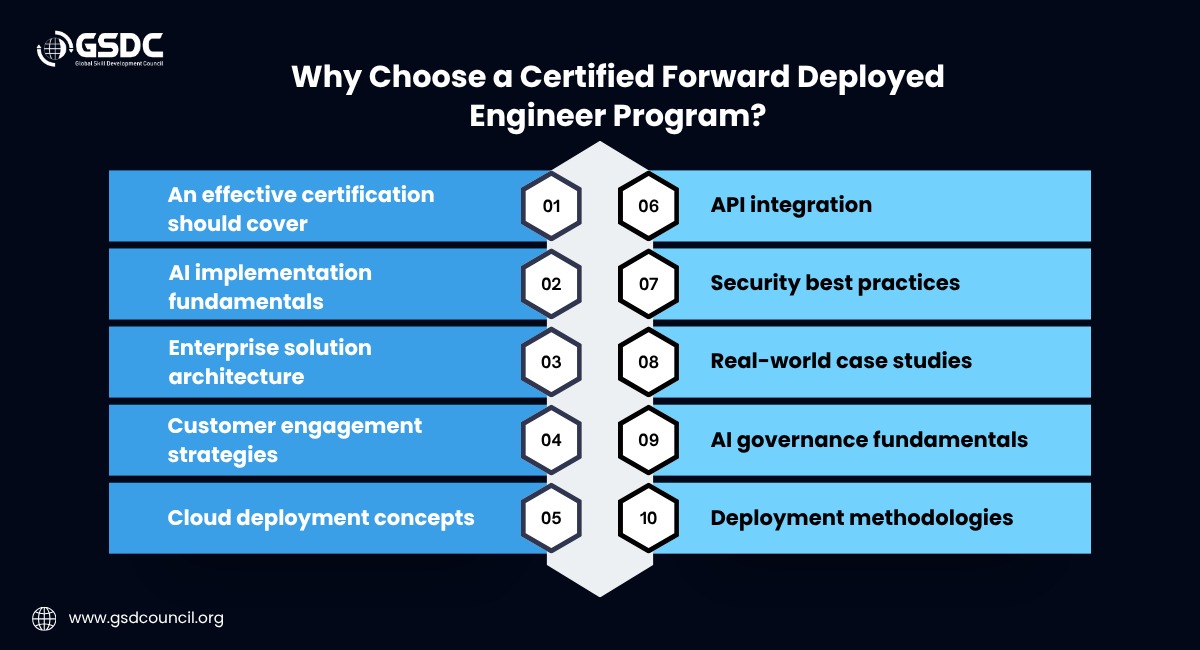
A quality forward deployed engineer certification typically offers:
Structured Learning
Instead of piecing together information from multiple sources, you follow a clear learning path covering the core skills required for the role.
Practical, Industry-Aligned Skills
Look for programs that include topics such as:
- AI deployment workflows
- Cloud-native architecture
- API integration
- Customer requirement analysis
- Solution design
- Security considerations
- Communication and stakeholder management
Increased Employer Confidence
Certification demonstrates that you've invested time in understanding the responsibilities and workflows associated with forward deployed engineering, making it easier for recruiters to assess your foundational knowledge.
Career Transition Support
For professionals moving from software development, DevOps, consulting, or cloud engineering, certification provides a structured bridge into customer-facing AI implementation roles.
Competitive Advantage
As more candidates enter the AI job market, validated credentials can help differentiate your profile, particularly when paired with hands-on projects and practical experience.
Is an FDE Certification Worth It?
For many professionals, the answer depends on their career goals. That's where the Certified Forward Deployed Engineer certification becomes important.
An FDE certification can be particularly valuable if you want to:
- Transition into AI implementation roles
- Strengthen your consulting skills
- Improve your understanding of enterprise deployments
- Enhance your credibility with employers
- Learn through a structured curriculum instead of scattered online resources

GSDC’s certification is not a substitute for experience, but when combined with projects and continuous learning, it can strengthen your professional profile and support career growth.
Final Thoughts
The future of AI isn't just about creating intelligent models, it's about deploying them successfully where they create measurable business value. That's exactly why the Forward Deployed Engineer role has become so important.
Professionals who can combine software engineering, AI, cloud technologies, business understanding, and customer collaboration are increasingly sought after across industries. As organizations continue to scale AI initiatives in 2026, the demand for skilled FDEs is expected to remain strong.
Whether you're a software engineer looking to specialize, an AI practitioner aiming to work more closely with customers, or a cloud professional exploring new career paths, investing in your skills can position you for emerging opportunities.
A well-designed Forward Deployed Engineer Certification offers a structured way to build those capabilities, validate your expertise, and prepare for one of the most impactful technology careers of the AI era.

Related Certifications
Stay up-to-date with the latest news, trends, and resources in GSDC
If you like this read then make sure to check out our previous blogs: Cracking Onboarding Challenges: Fresher Success Unveiled
Not sure which certification to pursue? Our advisors will help you decide!