Forward Deployed Engineer: The High-Paying AI Career in 2026

Written by Emily Hilton
- What Is a Forward Deployed Engineer?
- Why Are Forward-Deployed Engineers Suddenly in High Demand?
- Forward Deployed Engineer Salary and Job Opportunities
- Is This a Completely New Role?
- Why FDE Isn't Typically an Entry-Level Position
- The Three Careers Combined into One
- Technical Skills Every Forward Deployed Engineer Needs
- Non-Technical Skills Matter Just as Much
- The One Quality That Can't Be Taught
- Is Forward Deployed Engineering the Right Career for You?
- Final Thoughts
Artificial Intelligence is no longer won by the companies that build the best models; it's won by those that successfully deploy them.
As AI rapidly transforms industries, businesses are discovering that having access to powerful models like GPT or Claude isn't enough. The real competitive advantage comes from integrating AI into everyday operations, solving complex business problems, and delivering measurable results at scale.
This shift has given rise to one of the fastest-growing and highest-paying careers in technology: the Forward Deployed Engineer (FDE).
From Google and OpenAI to Palantir, Anthropic, and Cognition, some of the world's leading AI companies are aggressively hiring Forward Deployed Engineers to bridge the gap between cutting-edge AI research and real-world business applications. These professionals work directly with customers, understand their unique challenges, and build AI-powered solutions that create immediate business impact.
As organizations across healthcare, banking, finance, retail, manufacturing, and other industries accelerate AI adoption, the demand for engineers who can turn AI into business value is growing faster than ever.
So, what exactly does a Forward Deployed Engineer do? Why are companies willing to pay premium salaries for this role? And what skills do you need to become one in 2026? Let’s explore…
What Is a Forward Deployed Engineer?
A Forward Deployed Engineer is a customer-facing technical expert responsible for implementing, customizing, and deploying technology solutions within a client's environment.
Unlike traditional software engineers, who primarily build products within an organization, FDEs work directly with enterprise customers to ensure the company's technology integrates seamlessly into their existing business processes.
For example, imagine a large financial institution implementing an AI-powered solution. Simply purchasing access to an AI model isn't enough. The organization needs someone who understands both the technology and the business processes to integrate AI into daily operations. That responsibility belongs to the Forward Deployed Engineer.
An FDE works closely with customers to understand their workflows, identify opportunities for automation, build integrations, solve implementation challenges, and ensure the technology delivers real business outcomes.
Why Are Forward-Deployed Engineers Suddenly in High Demand?
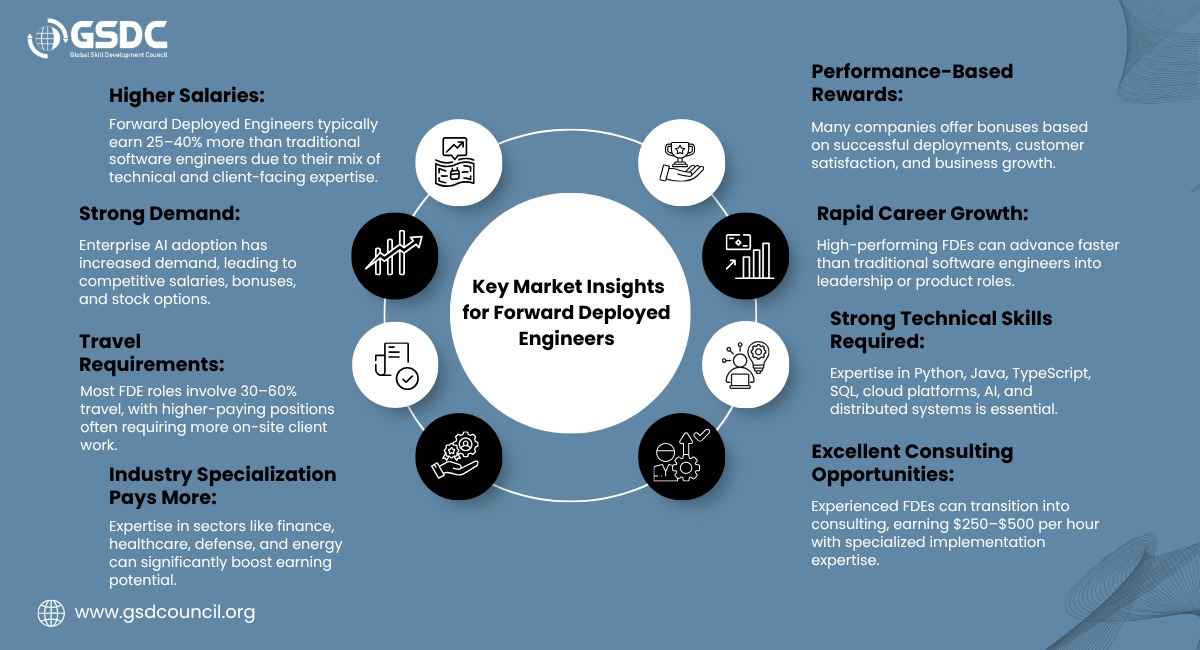
- Enterprise AI Adoption: Companies are rapidly adopting Generative AI to improve productivity and automate business processes.
- AI Needs Customization: AI platforms deliver the most value when integrated into an organization's existing systems and workflows.
- Industry-Specific Solutions: Every industry, from banking and healthcare to retail and manufacturing, requires tailored AI implementations.
- Bridging Business and Technology: Forward Deployed Engineers connect technical AI capabilities with real-world business needs.
- Complex Enterprise Environments: FDEs help organizations navigate legacy systems, compliance requirements, and cloud infrastructure.
- Driving Business Value: They ensure AI deployments solve practical problems and deliver measurable ROI.
- Growing Enterprise Demand: As businesses accelerate AI transformation, the need for skilled Forward Deployed Engineers continues to rise across industries.
Forward Deployed Engineer Salary and Job Opportunities
As enterprise AI adoption continues to grow, Forward Deployed Engineer jobs are increasing across startups and global technology companies. Organizations are actively hiring professionals who can bridge AI innovation with real-world business implementation.
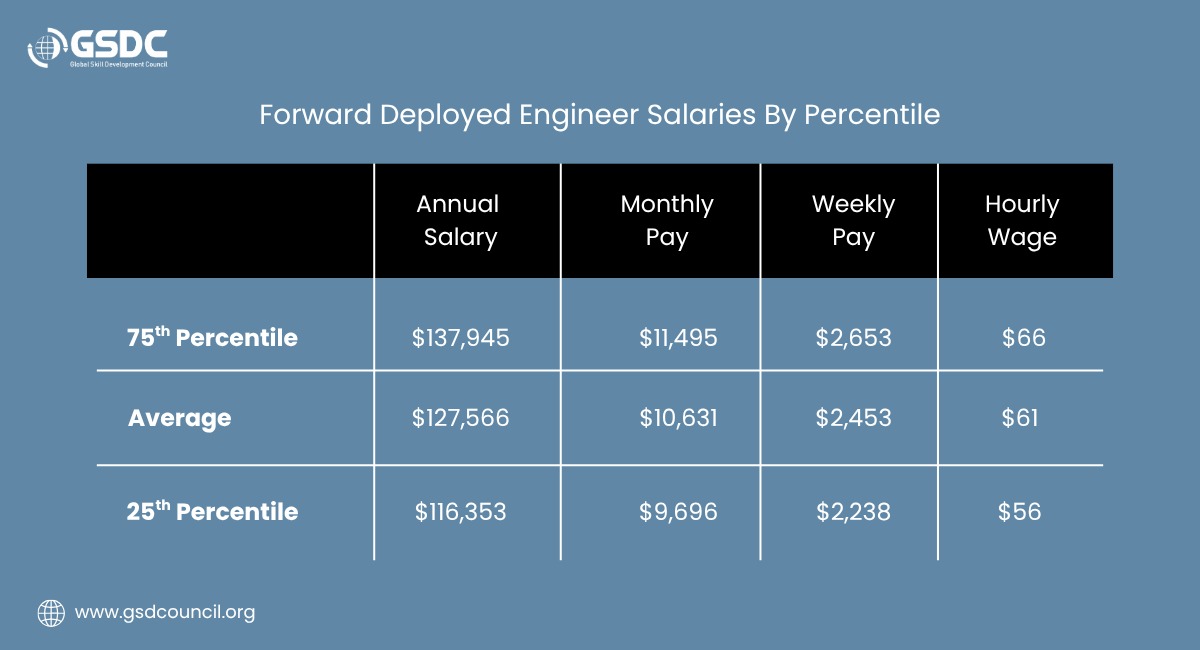
The Forward Deployed Engineer salary depends on experience, location, and employer. Because the role requires strong technical expertise along with customer-facing and consulting skills, compensation is often significantly higher than in many traditional software engineering positions.
One of the biggest reasons professionals are exploring this career path is the attractive Forward Deployed Engineer salary. Since FDEs combine software engineering expertise with customer-facing consulting and AI implementation, companies are willing to offer premium compensation. Based on the report, the table below shows the typical salary distribution for Forward Deployed Engineers in the United States:
Is This a Completely New Role?
Not exactly.
The concept of customer-facing technical engineers has existed for decades.
During the 1990s and early 2000s, enterprise software companies frequently deployed engineers directly to customer locations to help implement complex software systems. As software products became more standardized and cloud computing matured, these roles gradually became less common.
However, AI has changed the landscape once again.
Unlike traditional software, AI solutions often require extensive customization, workflow redesign, system integration, and ongoing optimization. This has brought the Forward Deployed Engineer role back into the spotlight, making it one of the fastest-growing careers in enterprise AI.
Why FDE Isn't Typically an Entry-Level Position
Although the role sounds exciting, Forward Deployed Engineering is generally not designed for fresh graduates.
An FDE is expected to work independently with enterprise clients, understand complex business requirements, challenge flawed technical decisions, and confidently recommend better solutions.
Imagine sitting in a meeting where senior architects from a global bank present their proposed AI implementation strategy.
An experienced FDE should immediately be able to identify potential weaknesses, anticipate implementation risks, suggest improvements, and explain why certain approaches may fail.
These abilities cannot be learned through certifications alone. They develop after years of solving real-world engineering problems across multiple industries and projects.
Experience is what allows an FDE to make informed decisions under pressure.
The Three Careers Combined into One
One reason Forward Deployed Engineers are so valuable is that they combine responsibilities from multiple professional roles.
First, they act as consultants by understanding business processes and identifying where technology can create the greatest impact.
Second, they function as product specialists by deeply understanding the capabilities of their company's platform and adapting customer workflows accordingly.
Finally, they serve as software engineers by building integrations, developing applications, and ensuring the technology functions correctly within the customer's infrastructure.
Balancing consulting, product expertise, and engineering makes this one of the most demanding roles in the technology industry.
Technical Skills Every Forward Deployed Engineer Needs
Full-Stack Development
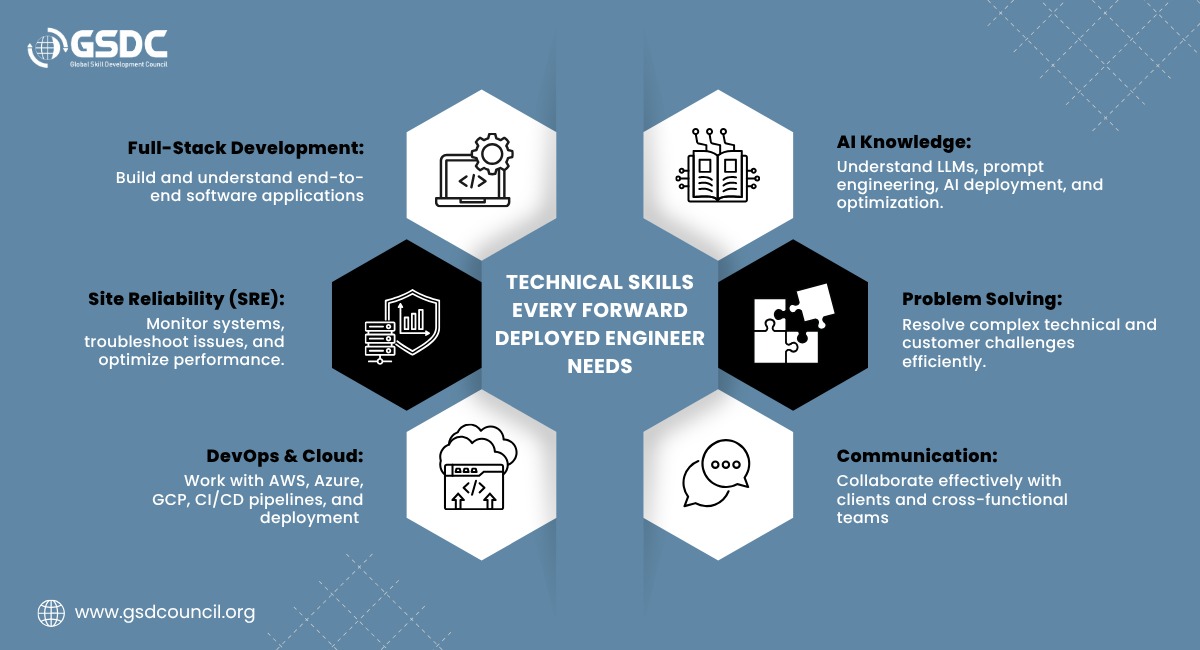
A Full-Stack Development (FDE) must understand how complete software systems work.
This includes frontend development, backend services, databases, APIs, authentication systems, and application architecture. Customers expect rapid implementation, making broad engineering knowledge essential.
DevOps and Cloud Infrastructure
Modern enterprise deployments rely heavily on cloud technologies.
Forward Deployed Engineers should understand continuous integration and deployment (CI/CD), infrastructure as code, cloud platforms, deployment pipelines, release management, and automation practices.
Site Reliability Engineering (SRE)
Reliability becomes critical when AI applications support business operations.
An FDE should be comfortable with Linux or Unix environments, scripting languages such as Python or Shell, monitoring systems, logging, troubleshooting, observability, and performance optimization.
The ability to distinguish meaningful operational signals from background noise is especially valuable.
AI Fluency
Perhaps the most important technical competency is understanding AI technologies themselves.
Forward Deployed Engineers should know how large language models work, understand prompt engineering, AI guardrails, model explainability, fine-tuning strategies, token optimization, AI routing, cost management, and deployment best practices.
While they may not build foundation models themselves, they should understand how to implement AI solutions effectively within enterprise environments.
Non-Technical Skills Matter Just as Much
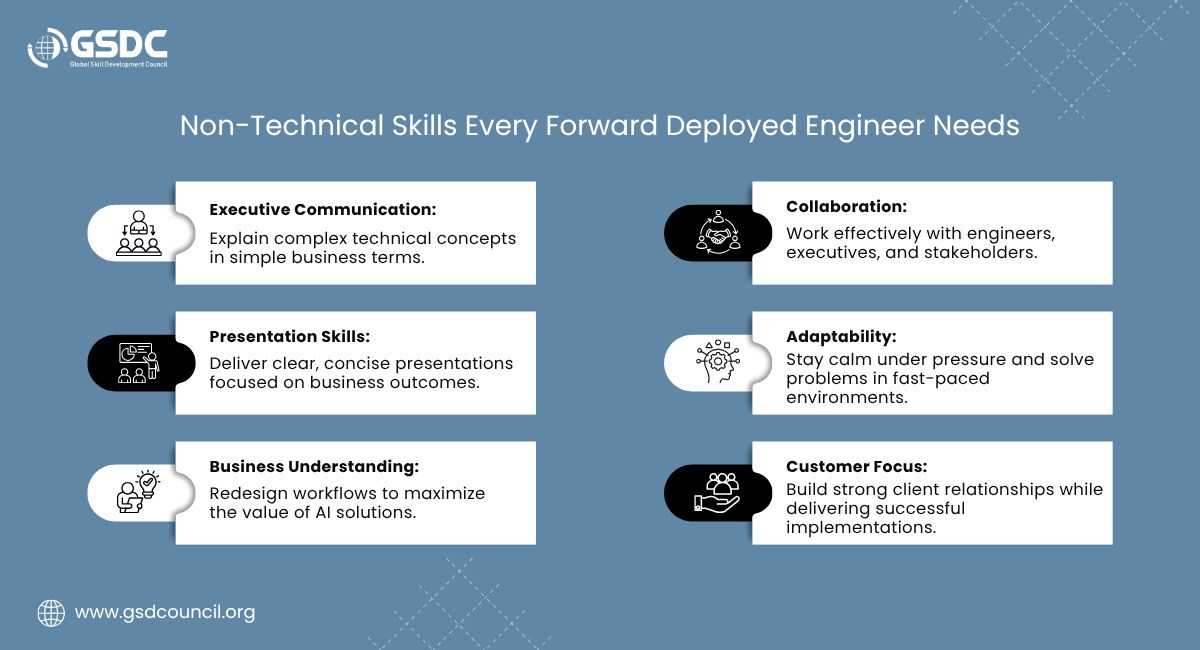
Technical expertise alone doesn't make a successful Forward Deployed Engineer. Communication, collaboration, and business awareness are equally important.
Executive-Level Communication
Enterprise executives rarely have time for lengthy technical explanations.
FDEs must communicate complex architectural decisions in just a few minutes by clearly explaining the problem, the proposed solution, the expected business impact, the associated risks, and the required decisions.
Being technically correct isn't enough; you must also communicate effectively.
Presentation Skills
Executives expect concise presentations rather than overloaded slides.
Successful FDEs can summarize technical strategies in two or three well-designed slides that focus on business outcomes rather than implementation details.
Business Process Reengineering
Many organizations have followed the same workflows for decades.
Introducing AI often requires redesigning those processes rather than simply automating them.
Forward Deployed Engineers help businesses rethink existing operations and build AI-powered workflows that improve efficiency without disrupting critical business functions.
Collaboration Over Ego
Enterprise projects involve architects, developers, managers, executives, security teams, and business stakeholders.
Disagreements are inevitable.
Successful FDEs prioritize collaboration over proving themselves right. Building trust with customers often matters just as much as technical expertise.
Handling Pressure
Customer deployments rarely go exactly as planned.
Tight deadlines, production issues, changing requirements, and multiple stakeholders create constant pressure.
The ability to stay calm, adapt quickly, and solve problems under challenging conditions is one of the defining characteristics of experienced Forward Deployed Engineers.
The One Quality That Can't Be Taught
Beyond technical knowledge and communication skills, there's one characteristic that consistently defines exceptional Forward Deployed Engineers: curiosity.
The best professionals genuinely enjoy solving difficult problems.
They continuously learn new technologies, explore emerging AI capabilities, understand customer businesses, and seek better ways to build solutions.
Technology evolves rapidly, especially in artificial intelligence. Without a genuine passion for learning and experimentation, keeping pace becomes extremely difficult.
Is Forward Deployed Engineering the Right Career for You?
Before pursuing this career, ask yourself three important questions….
If you enjoy building AI-powered solutions, collaborating with enterprise clients, and solving complex real-world challenges, a career as a Forward Deployed Engineer could be an excellent fit. The role combines technical expertise, problem-solving, and business communication, making it one of the most dynamic and rewarding careers in today's AI-driven technology landscape.

To accelerate your journey, consider earning the GSDC Certified Forward Deployed Engineer certification. Designed for aspiring and experienced professionals alike, the program covers production-ready AI systems, Python, APIs, LLMs, RAG, cloud deployment, MLOps, and client engagement through hands-on learning and expert-led sessions.
Benefits:
- Learn In-Demand AI Skills: Master LLMs, RAG, APIs, MLOps, and cloud deployment.
- Gain Hands-On Experience: Build practical skills through real-world projects.
- Earn a Recognized Credential: Validate your expertise with a globally recognized certification.
- Boost Career Growth: Improve your job prospects with industry-relevant skills.
- Stand Out in the AI Market: Demonstrate expertise in deploying enterprise AI solutions.
Final Thoughts
Forward Deployed Engineering is quickly becoming one of the most influential roles in enterprise AI. As organizations move beyond experimenting with artificial intelligence and begin integrating it into mission-critical business operations, the demand for professionals who can bridge technology and business will continue to grow.
This career isn't just about writing code; it's about understanding customers, solving business problems, implementing cutting-edge AI technologies, and driving digital transformation at scale.
Although it requires years of experience and a diverse skill set, it also offers one of the most exciting opportunities for engineers looking to work at the intersection of software development, AI, consulting, and enterprise innovation.
For professionals who enjoy tackling real-world challenges and building impactful AI solutions, the future of Forward Deployed Engineering looks brighter than ever.

Related Certifications
Frequently Asked Questions
A Forward Deployed Engineer works directly with customers to integrate, customize, and optimize AI or software solutions within existing business workflows. If you're wondering what is a Forward Deployed Engineer or the Forward Deployed Engineer meaning, it refers to a technical professional who bridges engineering and customer success.
Yes. The demand for Forward Deployed Engineer jobs is growing rapidly as enterprise AI adoption accelerates. Along with strong career growth, the Forward Deployed Engineer salary is highly competitive, making it one of the most attractive tech careers in 2026.
Most Forward Deployed Engineer jobs prefer candidates with software engineering or consulting experience. Understanding the Forward Deployed Engineer job description and gaining hands-on technical experience can significantly improve your chances of entering this role.
Essential Forward Deployed Engineer skills include full-stack development, cloud computing, DevOps, AI knowledge, problem-solving, and strong communication. If you're wondering how to become a Forward Deployed Engineer, building these technical and client-facing skills is the best place to start.
A Software Engineer primarily builds products, while a Forward Deployed Engineer works directly with customers to deploy, customize, and optimize those products. This customer-facing focus is a key part of the Forward Deployed Engineer meaning and distinguishes the role from traditional software engineering.
Stay up-to-date with the latest news, trends, and resources in GSDC
If you like this read then make sure to check out our previous blogs: Cracking Onboarding Challenges: Fresher Success Unveiled
Not sure which certification to pursue? Our advisors will help you decide!