Prompt Engineering Tips to Get Smarter AI Responses
Written by Emily Hilton
- What Is Prompt Engineering?
- Why Prompt Engineering Matters More Than Ever
- AI Adoption Statistics
- How AI Understands Your Prompt
- 12 Prompt Engineering Tips to Get Smarter AI Responses
- Before vs. After: Prompt Engineering in Action
- ChatGPT Prompt Engineering Tips That Actually Work
- Best ChatGPT Prompts You Can Start Using Today
- Prompt Engineering Jobs: Why Demand Is Growing
- Should You Take a Prompt Engineering Course?
- Conclusion
Artificial Intelligence has transformed how we work, learn, create, and solve problems. Whether you're generating marketing copy, writing code, analyzing data, creating lesson plans, or summarizing research, the quality of your results depends on one critical factor—the prompt you give the AI.
Many users assume AI tools like ChatGPT automatically understand exactly what they need. However, the difference between a generic response and an insightful, accurate one often comes down to prompt engineering. Learning how to communicate effectively with AI has become an essential skill for professionals, students, content creators, developers, and business leaders alike.
If you've ever searched what is prompt engineering, you're not alone. With organizations rapidly adopting generative AI, prompt engineering has emerged as one of the fastest-growing AI skills. Professionals who understand AI prompt engineering can save time, improve productivity, and generate significantly better outputs from modern AI systems.
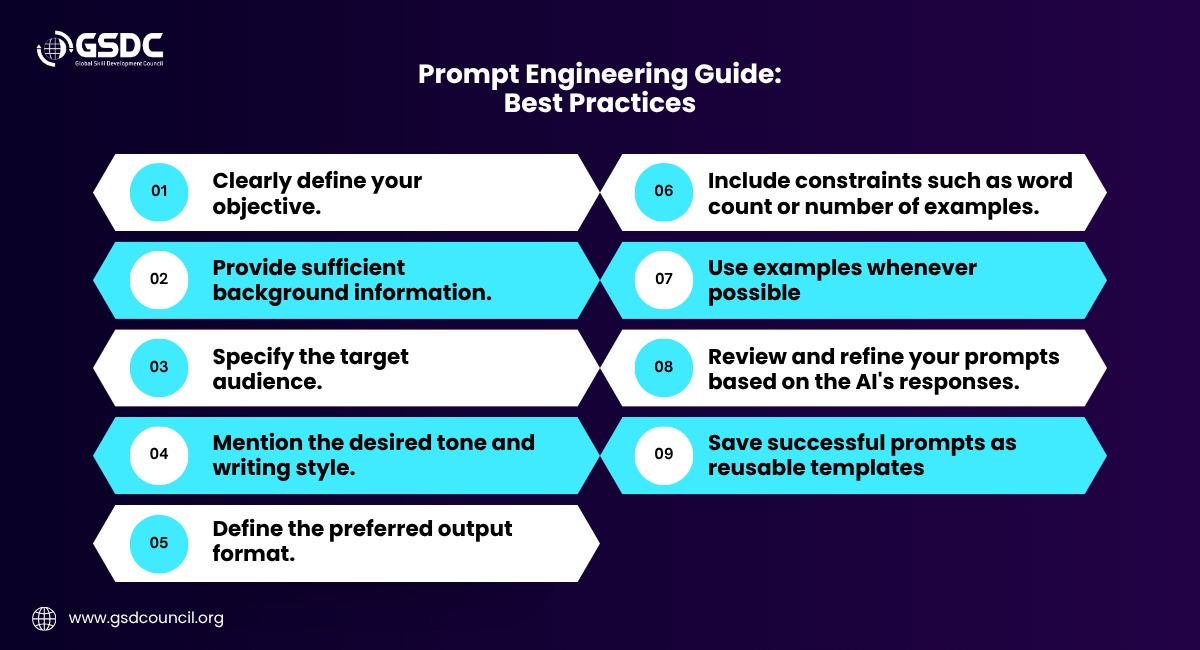
In this prompt engineering guide, you'll learn practical prompt engineering tips, understand what is prompt engineering, explore real-world examples, discover AI prompt engineering tips, and learn the prompt engineering guide best practices that professionals use to create smarter AI prompts and more effective ChatGPT prompts.
What Is Prompt Engineering?
One of the most common questions people ask is what is prompt engineering?
Prompt engineering is the process of designing clear, structured, and detailed instructions that guide an AI model toward generating the desired output. Instead of simply asking a question, prompt engineering involves providing context, objectives, constraints, examples, and formatting instructions so the AI can better understand your intent.
Think of an AI prompt as a project brief. If you hand a designer a vague instruction like "Create a logo," the results will likely vary. But if you specify the industry, audience, colors, typography, and style, the outcome is far more aligned with your expectations. The same principle applies to AI.
A simple example
Basic Prompt
Write about artificial intelligence.
Improved Prompt
Write a 700-word beginner-friendly blog explaining artificial intelligence for HR professionals. Include five practical workplace examples, recent adoption statistics, and conclude with key takeaways.
The second prompt gives the AI a clear objective, audience, length, tone, and structure, making it much easier to produce relevant content.
This is the essence of AI prompt engineering reducing ambiguity so AI can deliver precise and useful responses.
Why Prompt Engineering Matters More Than Ever
As generative AI becomes a standard workplace tool, knowing how to write effective prompts is no longer optional. It's becoming a core digital skill.
Organizations are using AI for:
- Content creation
- Customer support
- Software development
- Marketing campaigns
- HR automation
- Business analytics
- Research assistance
- Training and education
Yet many users still interact with AI using one-line instructions and wonder why the output feels generic. Following proven prompt engineering best practices helps users unlock the full capabilities of AI systems.
AI Adoption Statistics
The growing importance of prompt engineering is reflected in current industry research:
- McKinsey's State of AI (2024) found that 65% of organizations regularly use generative AI in at least one business function, nearly double the adoption reported a year earlier.
- The Microsoft Work Trend Index 2024 reported that 75% of knowledge workers now use AI at work, with many bringing their own AI tools to improve productivity.
- According to the IBM Global AI Adoption Index, organizations investing in AI training and structured workflows achieve better business outcomes than those relying on ad hoc AI usage.
- Research published by GitHub on AI coding assistants shows that developers complete programming tasks significantly faster when they provide detailed, context-rich prompts instead of minimal instructions.
These findings reinforce an important point: AI is powerful, but its effectiveness depends heavily on the quality of the prompts it receives.
How AI Understands Your Prompt
Many people think AI "understands" language the same way humans do. In reality, modern large language models analyze patterns in text and predict the most likely response based on the information you provide.
This means your prompt acts as the primary source of guidance.
A strong AI prompt usually answers several questions:
- What is the objective?
- Who is the audience?
- What tone should be used?
- What format is expected?
- Are there any constraints?
- Should examples or statistics be included?
The more relevant context you provide, the more accurate and useful the response is likely to be.
Example
Weak Prompt
Explain cybersecurity.
Possible outcome:
A broad, generic explanation with little depth.
Strong Prompt
Explain ransomware to small business owners using simple language. Write approximately 800 words, include two real-world examples, mention three prevention strategies, and finish with a checklist.
The second prompt removes ambiguity and gives AI a clear roadmap.
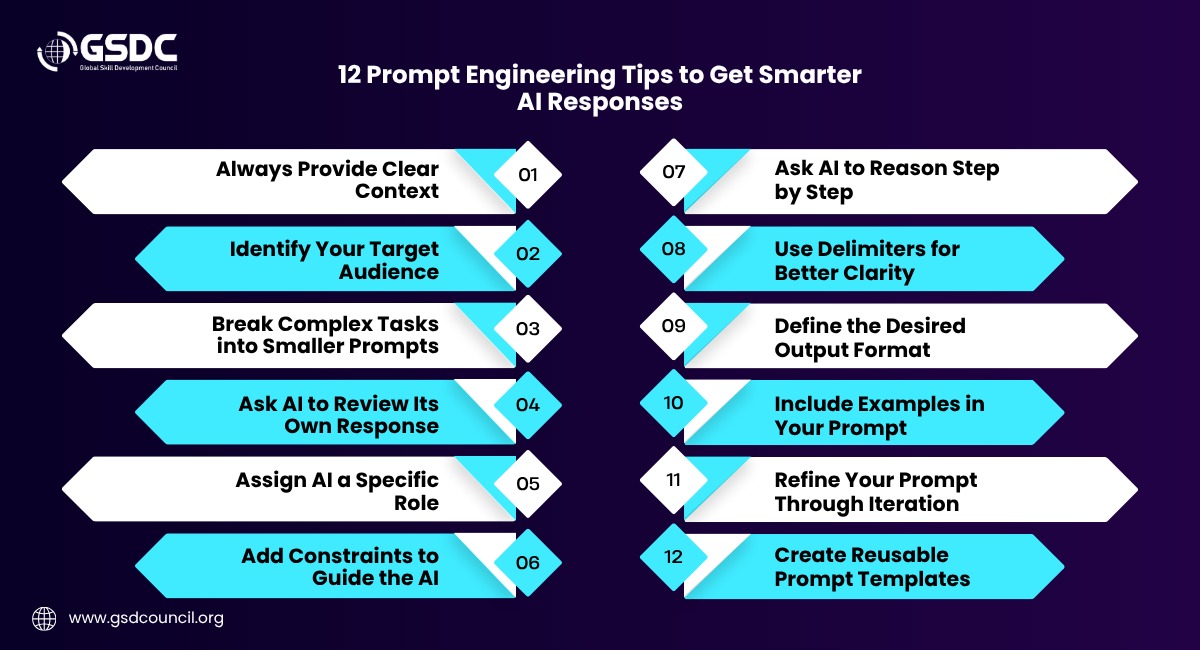
12 Prompt Engineering Tips to Get Smarter AI Responses
1. Always Provide Clear Context
One of the most valuable prompt engineering tips is to explain the background before asking for an answer.
Instead of assuming the AI knows your situation, describe it.
Poor Prompt
Write an email.
Better Prompt
Write a professional email to a client explaining that their software implementation will be delayed by three days due to additional security testing. Maintain a reassuring tone and suggest a revised timeline.
Notice how the improved prompt specifies the situation, audience, purpose, and tone.
2. Assign AI a Specific Role
One of the simplest AI prompt engineering tips is role prompting.
Giving AI a role changes the perspective from which it responds.
Examples include:
- Act as an SEO consultant.
- Act as a cybersecurity expert.
- Act as a university professor.
- Act as a financial analyst.
- Act as a senior HR manager.
Example
Instead of writing:
Explain cloud computing.
Try:
Act as an AWS Solutions Architect and explain cloud computing to business executives with no technical background. Use simple analogies and real-world examples.
The response is likely to be more focused and tailored to the intended audience.
3. Define the Desired Output Format
AI performs much better when you specify exactly how the information should be presented.
For example, instead of asking:
Explain prompt engineering.
Ask:
Explain prompt engineering in a table comparing beginner, intermediate, and advanced techniques. Include definitions, use cases, and examples.
You can also request outputs such as:
- Bullet lists
- Step-by-step guides
- Checklists
- FAQs
- Comparison tables
- Case studies
- Blog outlines
- JSON
- CSV
- Markdown
Specifying the format reduces unnecessary editing and improves consistency.
4. Identify Your Target Audience
Not every explanation should be written for the same reader.
One of the most overlooked prompt engineering tips is clearly defining who the content is for.
For example:
- Beginners
- CEOs
- Students
- Healthcare professionals
- Software developers
- HR managers
- Digital marketers
Example
Instead of:
Explain machine learning.
Write:
Explain machine learning to high school students using simple language, relatable analogies, and everyday examples.
The resulting content will be more engaging and easier for the intended audience to understand.
5. Add Constraints to Guide the AI
One of the most effective prompt engineering best practices is defining clear constraints. Constraints help the AI understand the boundaries within which it should generate content, making the output more relevant and reducing unnecessary revisions.
Examples of constraints include:
- Word count
- Tone of voice
- Reading level
- Target audience
- Number of examples
- Formatting style
- Sources or references
- Geographic focus
Weak Prompt
Write about remote work.
Better Prompt
Write a 1,000-word article about remote work for HR managers. Use a professional tone, include three productivity statistics from reputable organizations, provide practical examples, and end with five key takeaways.
The second prompt gives the AI a clear framework, resulting in a more focused and actionable response.
6. Include Examples in Your Prompt
AI learns from patterns. Including one or two examples in your prompt—often called few-shot prompting—helps the model understand the style, format, or structure you expect.
Example
Prompt
Generate three product descriptions similar to the example below.
Example:
"This wireless keyboard combines ergonomic comfort with long battery life, making it ideal for professionals and students."
The AI is far more likely to maintain the same tone, structure, and level of detail.
This technique is especially useful for:
- Marketing copy
- Email templates
- Customer support replies
- Social media captions
- Technical documentation
7. Break Complex Tasks into Smaller Prompts
Instead of asking AI to complete a large project in one request, divide it into logical steps.
Instead of
Write a complete business plan.
Use a sequence like:
- Create an executive summary.
- Conduct a market analysis.
- Develop a pricing strategy.
- Prepare a marketing plan.
- Estimate financial projections.
This step-by-step approach improves accuracy and gives you greater control over the final output.
8. Ask AI to Reason Step by Step
For analytical tasks, asking AI to explain its reasoning often leads to better responses.
Example
Instead of:
Solve this business problem.
Try:
Analyze this business problem step by step. Explain the assumptions, evaluate possible solutions, compare the pros and cons, and recommend the best option with justification.
This technique works well for:
- Data analysis
- Financial planning
- Coding
- Strategic decision-making
- Research
9. Refine Your Prompt Through Iteration
Your first prompt doesn't have to be your last.
Professional users continuously improve their AI prompts by refining instructions based on previous outputs.
For example:
First Prompt
Write a blog about cybersecurity.
Second Prompt
Expand the section on ransomware with recent statistics and include a comparison table.
Third Prompt
Rewrite the article for non-technical business leaders and simplify the language.
Each iteration improves quality and moves the response closer to your desired outcome.
10. Ask AI to Review Its Own Response
A powerful but often overlooked technique is asking AI to evaluate and improve its own work.
Example Prompt
Review your previous response for factual accuracy, grammar, clarity, and readability. Suggest improvements and rewrite the content accordingly.
This approach can help identify inconsistencies, improve structure, and enhance the overall quality of the output.
11. Use Delimiters for Better Clarity
When working with long documents or multiple inputs, separate different sections using clear delimiters.
Examples include:
###
or
"""
Example
Summarize only the text between the triple quotation marks.
"""
Insert article here.
"""
This helps the AI distinguish between instructions and reference material, reducing confusion.
12. Create Reusable Prompt Templates
Rather than writing new prompts from scratch every time, build reusable templates for recurring tasks.
Blog Template
Act as an experienced content writer.
Write a 1,500-word SEO-friendly blog on [TOPIC].
Target Audience: [AUDIENCE]
Include:
- Introduction
- Statistics
- Practical examples
- Best practices
- FAQs
- Conclusion
Reusable templates save time and ensure consistent quality across multiple projects.
Before vs. After: Prompt Engineering in Action
The difference between a basic prompt and a well-engineered prompt can dramatically improve AI-generated content.
Example 1: Blog Writing
Before
Write about cloud computing.
After
Write a 1,500-word beginner-friendly article explaining cloud computing for small business owners. Include current adoption statistics, real-world examples, advantages, challenges, and a conclusion with practical recommendations.
Example 2: Email Writing
Before
Write an email.
After
Write a polite email to a customer informing them that their product delivery has been delayed by two days due to severe weather conditions. Apologize sincerely, provide a revised delivery date, and offer a 10% discount on their next purchase.
Example 3: Social Media
Before
Write an Instagram caption.
After
Write a professional LinkedIn post announcing the launch of an AI certification program. Keep it under 180 words, include three relevant hashtags, maintain an informative tone, and end with a call to action.
ChatGPT Prompt Engineering Tips That Actually Work
While many AI tools use similar prompting techniques, these ChatGPT prompt engineering tips can help you generate more accurate and useful responses.
1. Be Specific
Avoid vague requests. Clearly explain what you want, who the audience is, and what outcome you expect.
2. Define the Tone
Specify whether the response should be:
- Professional
- Conversational
- Academic
- Persuasive
- Technical
- Friendly
3. Mention the Desired Length
Instead of saying "write an article," specify:
- 300 words
- 1,000 words
- Five paragraphs
- Ten bullet points
4. Request Examples
Example:
Explain prompt engineering with three real-world examples from marketing, education, and software development.
5. Ask for References
When appropriate, request:
Include recent statistics from reputable organizations such as McKinsey, Microsoft, Gartner, or IBM.
Best ChatGPT Prompts You Can Start Using Today
Professionals across industries rely on structured ChatGPT prompts to improve productivity. Below are some examples you can adapt for your own needs.
Content Marketing
Act as an SEO content strategist. Write a 2,000-word blog on AI governance. Include keyword optimization, statistics, examples, FAQs, and a compelling conclusion.
HR
Create a structured employee onboarding checklist for a technology company with 200 employees. Organize it by pre-joining, first day, first week, and first month.
Education
Explain quantum computing to undergraduate students using simple language, diagrams described in words, and everyday analogies.
Software Development
Review the following Python code for performance, readability, and security. Explain each recommendation with examples.
Business Strategy
Act as a management consultant and prepare a SWOT analysis for an AI startup entering the healthcare industry.
These are examples of best ChatGPT prompts because they provide sufficient context, define expectations, and guide the AI toward producing relevant results.
Prompt Engineering Jobs: Why Demand Is Growing
As organizations integrate AI into daily workflows, the demand for professionals with prompt engineering skills continues to grow.
Although dedicated prompt engineering jobs remain relatively specialized, employers increasingly expect AI literacy across many roles, including:
- AI Consultant
- Prompt Engineer
- AI Trainer
- Machine Learning Operations Specialist
- Content Strategist
- Technical Writer
- Business Analyst
- Product Manager
- Customer Success Manager
Rather than replacing existing roles, prompt engineering is becoming a valuable complementary skill that enhances productivity and decision-making.
Professionals who understand AI prompt engineering can often produce higher-quality work in less time by collaborating effectively with AI tools.
Should You Take a Prompt Engineering Course?
If you're serious about using AI professionally, enrolling in a prompt engineering certification can accelerate your learning. GSDC’s Certified Prompt Engineering Certification equips professionals with the knowledge and practical skills to design effective AI prompts for tools like ChatGPT and other generative AI models.
The Certified Prompt Engineering Certification provides best practices, real-world applications, and optimization techniques for prompt engineering. It helps learners improve AI-driven productivity and confidently apply prompt engineering across diverse industries.

A quality course typically covers:
- Fundamentals of prompt engineering
- Prompt design techniques
- Role prompting
- Few-shot and zero-shot prompting
- Chain-of-thought prompting concepts
- AI ethics and responsible use
- Industry-specific applications
- Hands-on practice with real-world scenarios
Whether you're a marketer, developer, HR professional, educator, or business leader, structured learning can help you move beyond basic prompting and develop repeatable workflows that deliver better results.
Conclusion
As artificial intelligence becomes an integral part of modern work, learning prompt engineering is no longer just an advantage, it's an essential professional skill. Understanding what is prompt engineering enables you to communicate more effectively with AI systems, resulting in responses that are more accurate, relevant, and actionable.
Throughout this prompt engineering guide, we've explored practical prompt engineering tips, effective AI prompt engineering techniques, examples, and proven best practices that can improve the quality of your interactions with AI. Whether you're creating AI prompts for business, experimenting with ChatGPT prompts, or looking for the best ChatGPT prompts to streamline daily tasks, success comes from providing clear context, defining objectives, and continuously refining your instructions.
As AI continues to evolve, the ability to craft thoughtful prompts will become an increasingly valuable workplace skill. By applying these prompt engineering guide best practices, you'll not only get smarter AI responses but also save time, improve productivity, and unlock the full potential of generative AI.

Related Certifications
Stay up-to-date with the latest news, trends, and resources in GSDC
If you like this read then make sure to check out our previous blogs: Cracking Onboarding Challenges: Fresher Success Unveiled
Not sure which certification to pursue? Our advisors will help you decide!