Full-Stack Developer Hiring in 2027: The 10 Roles Where Demand Is Highest
Written by Emily Hilton
- What Is a Full-Stack Developer?
- 10 Full-Stack Developer Roles With High Demand in 2027
- Full-Stack Developer Skills Employers Will Look For in 2027
- Building a Strong Full-Stack Developer Resume
- Full-Stack Developer Jobs for Freshers
- Full-Stack Developer Salary and Career Growth
- How the GSDC Full Stack Developer Certification Benefits You
- Conclusion
Full-stack development continues to be an important part of modern software development. As businesses build web applications, SaaS platforms, AI-powered products, e-commerce systems, and cloud-based solutions, they need developers who can work across both the front end and back end.
In 2027, organizations are expected to look beyond developers who simply know how to build websites. Employers will increasingly value professionals who understand cloud platforms, APIs, databases, cybersecurity, artificial intelligence, automation, and modern development workflows.
This shift is creating different opportunities across full stack developer jobs, from traditional web development to specialized roles involving AI, cloud, and enterprise applications.
For developers planning their careers, understanding these roles can help them choose the right technologies, build relevant projects, and prepare for the skills employers are looking for.
What Is a Full-Stack Developer?
A full-stack developer works on both the front-end and back-end parts of an application.
The front end includes everything users see and interact with, such as web pages, forms, dashboards, menus, and buttons. Technologies commonly used include HTML, CSS, JavaScript, and frameworks such as React, Angular, and Vue.
The back end handles application logic, databases, authentication, APIs, and server-side operations. Developers may work with technologies such as Java, Python, Node.js, .NET, and various database systems.
Modern full-stack developers may also work with cloud platforms, DevOps tools, containers, APIs, AI services, and security technologies.
10 Full-Stack Developer Roles With High Demand in 2027
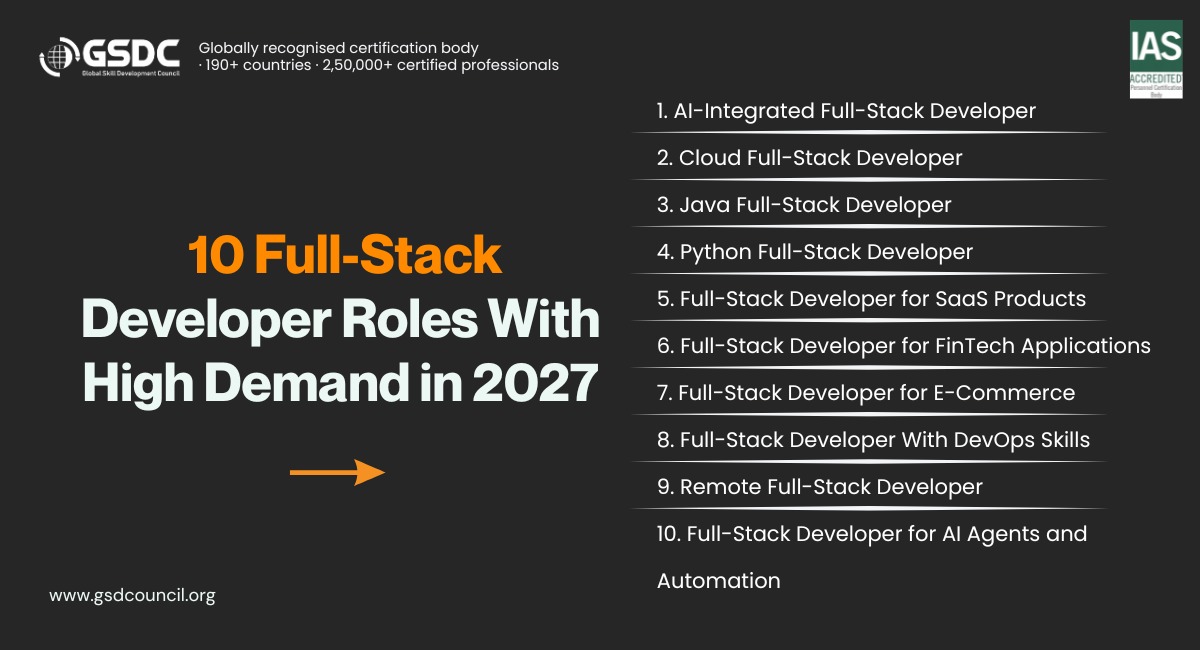
1. AI-Integrated Full-Stack Developer
Artificial intelligence is becoming part of many software products. Companies are adding AI assistants, recommendation systems, automated workflows, search capabilities, and generative AI features to their applications.
AI-integrated full-stack developers build the application layer around these AI capabilities.
They may develop the user interface, connect AI models through APIs, manage databases, and build authentication and backend services.
Important skills include:
- JavaScript or TypeScript
- React or another modern frontend framework
- Python or Node.js
- REST and API integration
- Databases
- Cloud platforms
- AI and machine learning APIs
This is likely to become one of the more attractive areas within full-stack development.
2. Cloud Full-Stack Developer
As organizations move applications to cloud environments, developers who understand cloud infrastructure can become increasingly valuable.
Cloud full-stack developers build applications that run on platforms such as AWS, Microsoft Azure, or Google Cloud.
Their responsibilities may include application development, cloud deployment, database management, APIs, monitoring, and scalability.
Knowledge of Docker, Kubernetes, CI/CD pipelines, and cloud security can provide an advantage.
3. Java Full-Stack Developer
Java remains widely used for enterprise applications, particularly in banking, insurance, healthcare, retail, and other large organizations.
This creates continued opportunities for java full stack developer jobs.
A Java full-stack developer may work with Java and Spring Boot on the backend and technologies such as React or Angular on the frontend. They may also work with SQL databases, REST APIs, microservices, and cloud platforms.
For developers interested in enterprise software, Java full-stack development can provide a strong career path.
4. Python Full-Stack Developer
Python is widely used for web development, automation, data applications, and AI-related solutions.
This makes python full stack developer jobs particularly relevant as organizations combine web applications with data and AI capabilities.
Python full-stack developers may use frameworks such as Django or Flask on the backend and React or another JavaScript framework on the frontend.
Knowledge of APIs, databases, cloud services, data processing, and AI integrations can further strengthen their profiles.
5. Full-Stack Developer for SaaS Products
Software-as-a-Service platforms require developers who can work across the entire application stack.
SaaS developers may build subscription systems, user dashboards, authentication systems, payment integrations, analytics features, and administrative tools.
Because SaaS businesses frequently release new features, full-stack developers can be involved in everything from designing an interface to deploying backend services.
Experience with cloud platforms, databases, APIs, security, and scalable application architecture is especially useful.
6. Full-Stack Developer for FinTech Applications
Financial technology companies need applications that are secure, reliable, and scalable.
Full-stack developers in FinTech may work on digital banking applications, payment platforms, investment platforms, financial dashboards, lending systems, or financial management tools.
In addition to standard full stack developer skills, developers in this area need to understand authentication, data protection, secure APIs, encryption concepts, and compliance requirements.
Security awareness can therefore become an important differentiator for candidates targeting FinTech development roles.
7. Full-Stack Developer for E-Commerce
E-commerce continues to depend on reliable digital experiences.
Developers in this area may work on product catalogs, search, shopping carts, payment processing, customer accounts, order management, recommendations, and analytics.
Full-stack e-commerce developers need strong frontend skills because user experience directly affects conversions. They also need backend knowledge to manage products, orders, databases, APIs, and integrations.
Experience with payment gateways, cloud infrastructure, and performance optimization can be valuable.
8. Full-Stack Developer With DevOps Skills
The traditional separation between development and operations is becoming less rigid. Many organizations expect developers to understand how their applications are deployed, monitored, and maintained.
Full-stack developers with DevOps knowledge can contribute to CI/CD pipelines, containerization, cloud deployments, monitoring, and application performance.
Useful technologies include Git, Docker, Kubernetes, Jenkins, GitHub Actions, and cloud services.
This combination can make developers more valuable because they can contribute across development and deployment workflows.
9. Remote Full-Stack Developer
Remote work continues to create opportunities for developers to work with companies outside their local market.
Remote full stack developer jobs can involve working with distributed engineering teams across different countries and time zones.
However, remote development requires more than technical skills. Employers may also look for strong communication, documentation, collaboration, time management, and problem-solving abilities.
Developers who can work independently while communicating clearly with designers, product managers, and other engineers can have an advantage in remote roles.
10. Full-Stack Developer for AI Agents and Automation
AI agents are moving beyond simple chat interfaces and can increasingly perform multi-step tasks using tools, APIs, and business systems.
This creates opportunities for full-stack developers who can build the applications around these systems.
For example, a developer may create a web interface for an AI agent, connect it with business APIs, manage user permissions, store interaction data, and build monitoring capabilities.
Understanding APIs, authentication, databases, cloud services, AI platforms, and application security can be particularly useful in this emerging area.
Full-Stack Developer Skills Employers Will Look For in 2027
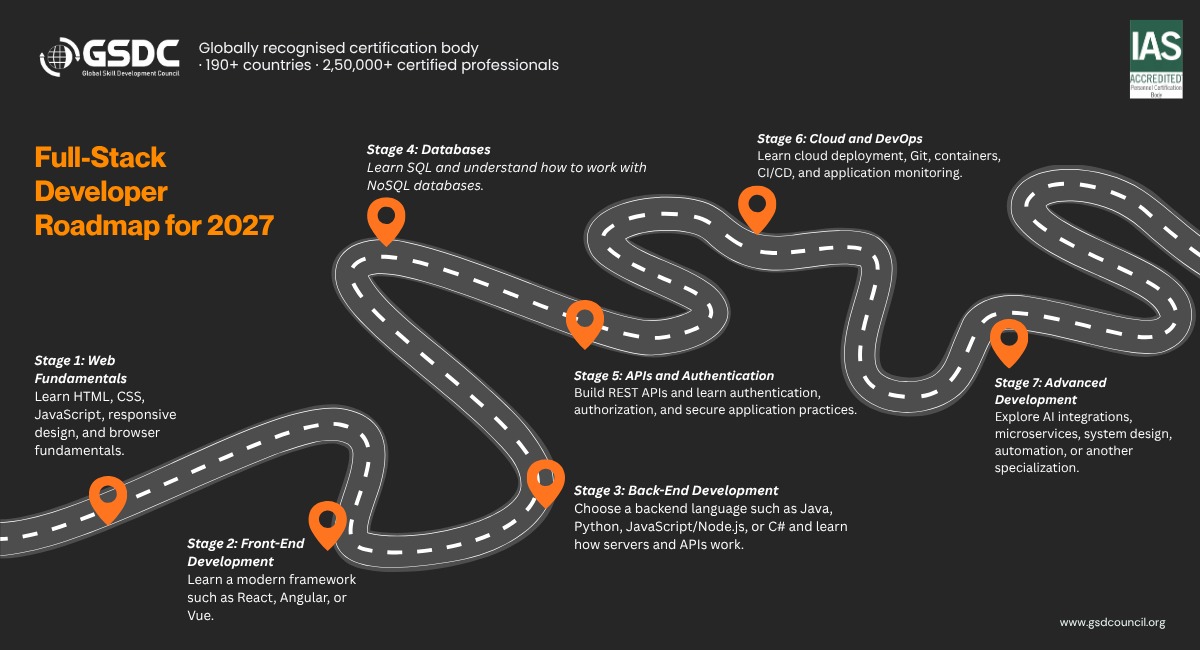
The technology landscape will continue to change, but some foundational full stack developer skills are likely to remain important.
These include:
- HTML, CSS, and JavaScript
- React, Angular, or Vue
- Backend development
- REST and API development
- SQL and NoSQL databases
- Git and version control
- Cloud computing
- Authentication and application security
- Testing and debugging
- CI/CD and deployment
- Basic AI and API integration
- Problem-solving and communication
Developers do not need to master every technology. Instead, they should build strong fundamentals and develop deeper expertise in a technology stack that matches their career goals.
Building a Strong Full-Stack Developer Resume
A good full stack developer resume should show what you can build, not just list technologies.
Instead of writing:
“Knowledge of React, Java, Python, and SQL.”
Show how you used those technologies:
“Built a full-stack e-commerce application using React, Python, and PostgreSQL with authentication, product management, and payment API integration.”
A strong resume should highlight:
- Technical skills
- Real-world projects
- Professional experience
- Measurable results
- GitHub or portfolio projects
- Relevant certifications
- Cloud and deployment experience
For fresh graduates, personal and academic projects can demonstrate practical ability when professional experience is limited.
Full-Stack Developer Jobs for Freshers
There are opportunities for candidates entering the field, but employers generally expect freshers to demonstrate practical skills.
Full stack developer jobs for freshers and entry level full stack developer jobs may include junior developer, associate software engineer, web developer, or graduate developer positions.
Freshers can improve their chances by building two or three complete applications rather than several small tutorials.
For example, a candidate could build an e-commerce platform, task management application, or AI-powered web application with a frontend, backend, database, authentication, and deployment.
This demonstrates an understanding of how different parts of an application work together.
Full-Stack Developer Salary and Career Growth
The full stack developer salary varies significantly depending on location, experience, technology stack, industry, company size, and specialization.
Entry-level developers generally earn less than experienced professionals, while developers with expertise in cloud computing, AI integration, cybersecurity, or enterprise architecture may have access to higher-paying opportunities.
Instead of focusing only on salary, developers should consider long-term career growth, technical exposure, project complexity, and opportunities to move into senior engineering or architecture roles.
How the GSDC Full Stack Developer Certification Benefits You
GSDC’s Java Full Stack Developer Certification helps you strengthen your understanding of full-stack development and build a foundation for career growth. It helps you improve your knowledge of front-end technologies, back-end development, databases, APIs, and application deployment.

As a fresher, you can use Java Full Stack Developer Certification to structure your learning and prepare for entry-level full-stack developer jobs. If you are an experienced professional, it can help you validate your knowledge and strengthen your professional profile. By combining the certification with hands-on projects, coding practice, and interview preparation, you can demonstrate your skills more effectively and improve your readiness for full-stack developer opportunities.
Conclusion
Full-stack development is evolving from traditional web development into a broader engineering discipline. In 2027, employers are likely to value developers who can combine frontend and backend expertise with cloud, AI, security, DevOps, and strong problem-solving skills.
Whether you are searching for full stack developer jobs, targeting remote full stack developer jobs, exploring java full stack developer jobs, or starting with entry level full stack developer jobs, the most important step is to build practical skills that match current business needs.
Developers who continuously learn, build real applications, and understand how modern technologies work together can position themselves strongly for the next generation of software development careers.

Related Certifications
Stay up-to-date with the latest news, trends, and resources in GSDC
If you like this read then make sure to check out our previous blogs: Cracking Onboarding Challenges: Fresher Success Unveiled
Not sure which certification to pursue? Our advisors will help you decide!