AI Is Changing the Developer’s Job - These 7 Trends Explain How
Written by Matthew Hale
- What Is the Future of AI? A Quick Answer
- Why AI Is Being Compared to an Industrial Revolution
- Top AI Trends Every Developer Should Know
- AI for Developers: How Your Role Is Changing
- A Practical Skill Roadmap
- How to Prove Your Agentic AI Skills
- Common Mistakes to Avoid
- Where Structured Learning Fits In
- Final Thoughts
If you write code for a living, you have probably noticed that your daily work looks very different from how it did two years ago. That is not your imagination. The biggest AI trends of 2026 are changing how software gets planned, written, tested, and shipped. Gartner predicts that 40% of enterprise applications will include task-specific AI agents by the end of 2026, up from less than 5% in 2025.
That is a huge jump in a very short time. So what does it mean for you? And more importantly, what should you learn next?
This blog covers the AI changes developers actually need to understand, and the skills worth building because of them. We keep it simple: what is changing, why it matters, and what to do about it.
What Is the Future of AI? A Quick Answer
If you are wondering what is the future of AI, here is the short version.
The future of AI is moving from tools that answer questions to systems that complete tasks. Earlier AI waited for your prompt and gave you a reply. The new generation can plan steps, use other software, check its own work and keep going until the job is done. People call this agentic AI.
For developers, this means AI is slowly shifting from "autocomplete on steroids" to something closer to a junior teammate. A teammate that still needs supervision, but one that can take real work off your plate.
Why AI Is Being Compared to an Industrial Revolution
You will often see people describe this moment as an AI industrial revolution. It is a comparison, not an official label, but it helps explain the scale of the change. The first industrial revolution replaced hand work with machines. This one is replacing repetitive thinking work with software that can reason, draft and decide within limits.
Here is where the comparison holds up:
- Speed: Work that took days (writing boilerplate, drafting tests, reviewing logs) now takes minutes.
- Scale: One developer can now manage output that once needed a small team.
- New roles: Just like factories created new jobs, AI is creating roles such as AI engineer, agent designer and AI governance lead.
- New risks: Faster output also means faster mistakes, so quality control matters more than ever.
The financial impact could be significant too. In its best-case scenario, Gartner expects agentic AI to drive about 30% of enterprise application software revenue by 2035, which is more than $450 billion, up from just 2% in 2025. Earlier revolutions took decades to reach that kind of scale. This one is unfolding in just a few years.
Top AI Trends Every Developer Should Know
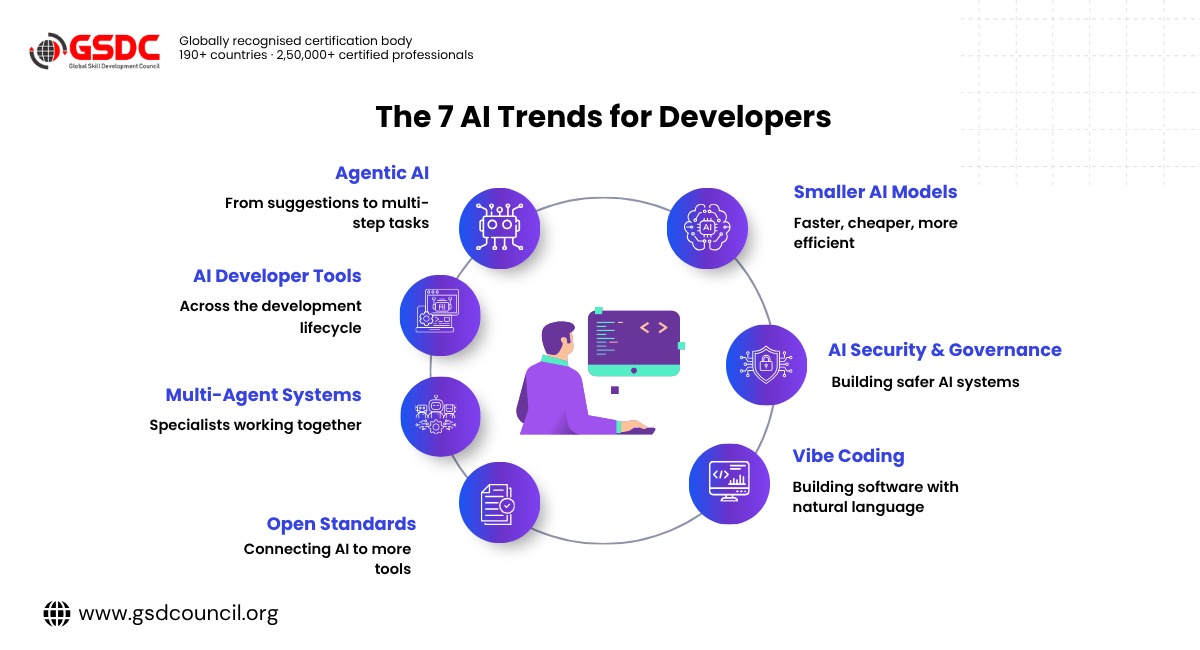
Here are the shifts shaping the year, from the agentic AI trends of 2026 to the tools and safeguards growing around them. Some of them sound alike, so each one starts with a single line that explains how it differs from the rest.
1. Agentic AI: From Suggestions to Multi-Step Tasks
The key idea: AI can now carry out a whole task, not just answer a question.
Agentic AI is one of the biggest AI trends shaping 2026. Instead of suggesting a line of code, an agent can open files, run commands, call APIs, fix errors and try again until the job is done.
What it means for you: You will spend less time typing and more time directing, reviewing and testing. Knowing how to set clear goals and guardrails for an agent becomes a core skill. Structured learning can speed this up, and organisations such as the Global Skill Development Council (GSDC) offer programs that cover how agentic systems are designed and managed.
2. AI Developer Tools: AI Joins the Whole Development Lifecycle
The key idea: AI is no longer one feature in your editor. It now touches every stage of building software.
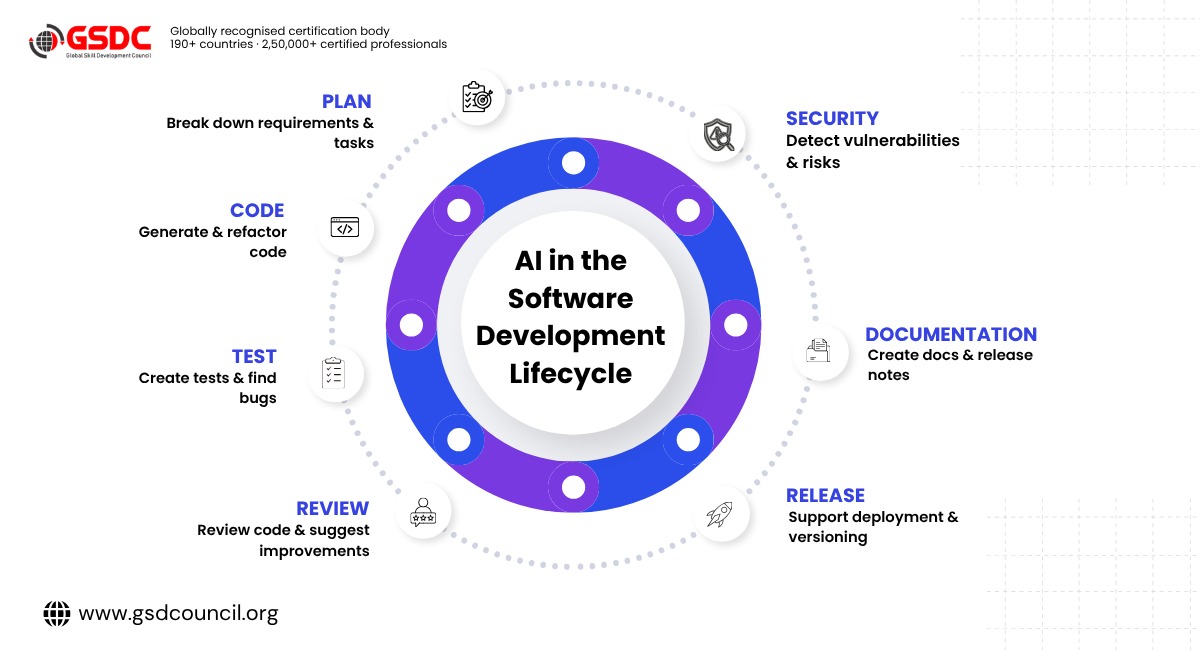
Not long ago, AI developer tools mostly meant a code suggestion as you typed. Now they cover the entire cycle:
- Planning and breaking down tickets
- Writing and refactoring code
- Generating unit and integration tests
- Reviewing pull requests
- Spotting bugs and security gaps
- Writing documentation and release notes
Developers have clearly noticed. In the Stack Overflow Developer Survey, 84% of respondents said they use or plan to use AI tools, up from 76% the year before, and about half of professional developers use them every day.
What it means for you: Pick two or three tools and learn them deeply instead of trying everything. Depth beats variety.
3. Multi-Agent Systems: Specialists Working Together
The key idea: Instead of one agent doing everything, several specialised agents collaborate.
One agent plans, one writes code, one tests, one reviews. Gartner expects agents to evolve from task-specific helpers into full multi-agent ecosystems by 2029.
What it means for you: Learn how agents pass information to each other, and how to stop one bad output from spoiling the whole chain.
4. Open Standards: Agents That Can Use Your Tools
The key idea: Agents become far more useful when they can connect to outside tools and systems in a standard way.
Developers are moving toward shared standards so agents can talk to databases, apps and services without custom glue code each time. This is what lets an agent do real work in real projects, instead of staying inside a chat window.
What it means for you: Understanding how agents connect to external tools will soon be as normal as understanding REST APIs.
5. Smaller, Faster, Cheaper Models
The key idea: The best model is not always the biggest one.
Many teams now run compact models on their own servers or even on devices, which cuts cost, speeds up responses and keeps sensitive data private.
What it means for you: Choosing the right model for the job is now an engineering decision, just like picking a database.
6. AI Security and Governance
The key idea: The more freedom an agent has, the more carefully it needs to be controlled.
Agents with access to code, data and systems can be tricked, misused or simply wrong. Companies are now asking for audit trails, permission limits and human approval steps. Trust is already a real concern. Only about a third of developers (33%) trust the accuracy of AI output, while 46% actively distrust it.
What it means for you: Secure-by-design thinking is a career advantage. Developers who can build safe AI systems will have an increasingly valuable skill set.
7. Vibe Coding Meets Reality
The key idea: Building from plain-language prompts is great for prototypes, but production work still needs engineering discipline.
Describing what you want and letting AI build it is fast and fun. But professional teams are cautious. Roughly 77% of developers in the Stack Overflow survey said vibe coding is not part of their professional work. Review, testing and clear architecture are not going away.
What it means for you: Use AI to move faster, but never ship what you do not understand.
AI for Developers: How Your Role Is Changing
The honest truth is that AI for developers is not about replacing programmers. It is about changing where your time goes.
Less time on | More time on |
Writing boilerplate code | Designing system architecture |
Searching for syntax and docs | Defining problems clearly |
Manual test writing | Reviewing and validating AI output |
Repetitive bug fixing | Security, quality and performance |
Simple documentation | Working with product and business teams |
The developers who thrive will be the ones who combine strong fundamentals with good judgment about when to trust AI and when to question it. Adoption is high, but confidence is still low. That gap is exactly where careful reviewers add value.
A Practical Skill Roadmap
You do not need to learn everything at once. Here is a simple path:
- Strengthen the basics: Data structures, system design, testing and security still matter. AI cannot fix a weak foundation.
- Learn prompt and context design: Clear instructions get better results. Practise writing them like a good ticket.
- Build one small agent: Even a simple one, such as an agent that triages bug reports, teaches you more than ten articles.
- Understand evaluation: Learn how to measure whether an AI system is actually doing a good job.
- Learn safety and governance basics: Permissions, logging, human review and data privacy.
- Show your skills: Turn what you learn into proof that others can see. The next section covers how.
How to Prove Your Agentic AI Skills
Many people now say they have AI skills, which makes it harder for employers to tell who can actually build and manage these systems. The good news is that you have several ways to show what you know.
- Build a portfolio: A few small, working projects (an agent that reviews pull requests, or one that triages support tickets) say more than any line on a CV.
- Contribute to open source: Fixing issues in agent frameworks or tooling shows you can work in real codebases.
- Write about what you learn: Short posts on what worked and what failed show your thinking.
- Earn a recognised credential: An Agentic AI certification gives employers a clear, standard signal that you understand how autonomous systems are designed, controlled and evaluated. An Agentic AI Developer Certification adds a hands-on focus on building agents, connecting tools and managing risk.
None of these replaces the others. The strongest profiles usually combine real projects with a credential that confirms the fundamentals.
If you do choose a certification, look for a few things:
- A curriculum that is updated often, since this field moves fast
- Practical projects, not just theory
- Coverage of security, ethics and governance
- Recognition from industry bodies and employers
Common Mistakes to Avoid
- Trusting AI output blindly: Most developers are still cautious. Be one of them.
- Chasing every new tool: Master a few instead.
- Skipping the basics: Strong fundamentals make you better at using AI, not less needed.
- Ignoring security: One careless agent permission can cause a serious incident.
- Waiting for the "perfect time" to learn: The window to build an early advantage is open now.
Where Structured Learning Fits In
Teaching yourself is a great start, but it can leave gaps, especially in areas like testing, evaluation and safety. Some developers fill those gaps with a structured program that covers the whole picture in a set order.
Programs like the Agentic AI Developer Certification from the Global Skill Development Council (GSDC) are built for this. They focus on how AI agents are designed, built, tested and managed, rather than just how to use AI tools. If you already use AI day to day and want to understand what happens underneath, that kind of structure can save you time.
Whichever route you choose, the same rule applies. Use what you learn to build something real, and let any credential support the work rather than replace it.

Final Thoughts
The AI revolution is not a distant promise anymore. It is already inside the tools you open every morning. The future of AI looks less like robots taking over and more like capable software partners that need smart humans to guide them.
If you remember only one thing, make it this: adoption is the easy part. Skill is what sets you apart. Learn how agents work, practise with real projects, protect what you build, and find a way to show your skills to others.
The advantage will not go to developers who use the most AI tools. It will go to those who know what to delegate, what to verify, and what should never be left to AI alone.

Related Certifications
Stay up-to-date with the latest news, trends, and resources in GSDC
If you like this read then make sure to check out our previous blogs: Cracking Onboarding Challenges: Fresher Success Unveiled
Not sure which certification to pursue? Our advisors will help you decide!