Why a Full Stack Developer Needs More Than Coding
Written by Matthew Hale
- What Is a Full Stack Developer?
- Why Coding Alone Isn't Enough Anymore
- Full Stack Web Development: How the Pieces Actually Fit Together
- Full Stack Developer Skills You Actually Need
- Full Stack Developer Roadmap: A Realistic Path
- Full Stack Developer Salary: What the Data Actually Shows
- Full Stack Developer Jobs: Is the Demand Real?
- How to Become a Full Stack Developer: Courses, Bootcamps, and Certification
- Is Full Stack Development Still a Good Career Choice?
- Thinking About Validating Your Full Stack Skills?
- Conclusion
A full stack developer is usually the first job title people search for when they start thinking seriously about a career in tech, and it's not hard to see why. The role sits at the center of almost every product team, and the pay reflects that: in the United States, software developers earned a median annual wage of $135,980 in May 2025, according to the U.S. Bureau of Labor Statistics. But here's the part most "learn to code" advice leaves out: the developers earning that kind of pay today are rarely the ones who can only write code. Ask ten working full stack developers what their job actually looks like day to day, and you'll get ten different answers, and very few of those answers are "I just write JavaScript and Pyth02on all day."
That's the real story behind full stack development right now. Coding is still the entry ticket. It stopped being the whole job a while ago, and every future tech professional building a career around this role needs to understand why, because the skills that get you hired today aren't quite the same ones that get you promoted, or even kept, tomorrow.
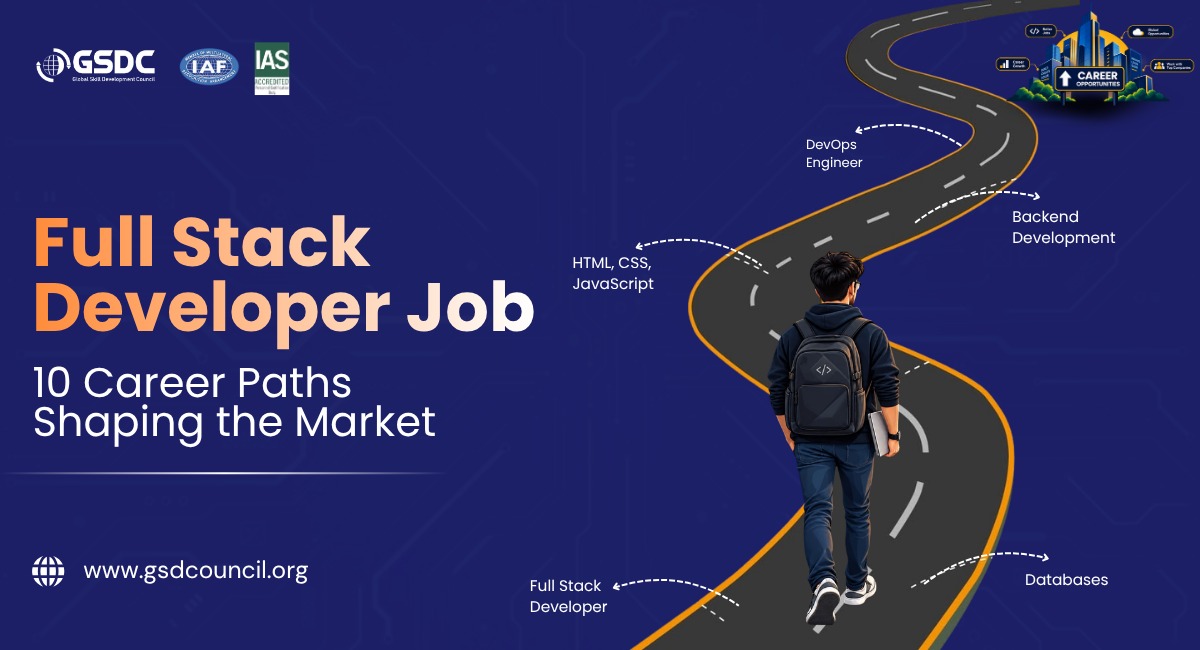
What Is a Full Stack Developer?
A full stack developer builds both what users see and interact with (the front end) and what runs behind the scenes, like servers, databases, and business logic (the back end). Think of a web app as a restaurant: the front end is the dining room and menu, the back end is the kitchen and supply chain keeping it running.
Front-end specialists handle layout and interactivity with HTML, CSS, and JavaScript. Back-end specialists handle servers and logic, often in Python, Java, or Node.js. A full stack developer works across both, with enough grasp of deployment and infrastructure to take a feature from idea to production.
In short: full stack development means working across the entire stack, client side, server side, and database, to build a working application from start to finish.
Why Coding Alone Isn't Enough Anymore
This is really the heart of the matter, and it's worth slowing down on, because it changes how you should actually prepare for this career. A decade ago, "full stack" mostly meant you could handle both ends of the code and little else was expected of you. That bar has moved, and it's moved for reasons that aren't going away.
1. AI has taken over a large share of routine code writing
According to the 2025 Stack Overflow Developer Survey, over 80% of developers now use AI tools in some part of their workflow, and that number is only rising. What hasn't kept pace is trust: most developers in the same survey said they still don't fully trust AI-generated code, and the biggest complaint is that AI output is "almost right, but not quite," which makes debugging and validation take longer, not shorter. The practical upshot is that writing boilerplate code is worth less than it used to be, while judgment, debugging, and the ability to catch what the AI got wrong is worth more. A future tech professional who only knows how to produce code, and not evaluate it, is competing directly with a tool that never gets tired.
2. Systems are more connected, not less
A full stack developer today is expected to have at least a working understanding of cloud hosting (AWS, Azure, or Google Cloud), containerization (Docker), version control workflows, and basic CI/CD pipelines. You don't need to be a dedicated DevOps engineer, but you do need to know how your code actually reaches a live server, because the days of handing a finished feature off to a separate deployment team are largely gone at most companies.
3. Employers hire for problem solving, not just syntax
Most hiring managers now assume candidates can look up syntax. What they're screening for is whether someone can translate a vague business requirement into a working system, communicate trade-offs to non-technical stakeholders, and make sensible architecture decisions under time pressure. Those are judgment skills, not coding skills, and they're the reason "learn to code" has become an incomplete piece of career advice.
4. The role now sits closer to the business than it used to
Full stack developers increasingly sit in the same conversations as product managers and business stakeholders, because they're the ones who understand what's technically realistic within a deadline. That means reading a user story critically, asking the right clarifying questions before writing a line of code, and understanding roughly how a feature ties back to a business metric. None of that shows up in a coding test, but it shows up constantly in performance reviews.
The pattern across all four: the technical floor for entering full stack development hasn't dropped. It's the ceiling that's changed. Coding fluency now gets you an interview. Everything above that line, systems thinking, communication, and judgment, is what gets you hired, promoted, and kept around when a team gets leaner.
Full Stack Web Development: How the Pieces Actually Fit Together
Before going further into the skills that go beyond code, it helps to be clear on what the code itself actually covers. Full stack web development typically breaks down into three layers that all have to talk to each other cleanly:
- Front end (client side): what the user sees and clicks. Built with HTML, CSS, JavaScript, and frameworks like React, Vue, or Angular.
- Back end (server side): the logic that processes requests, handles authentication, and talks to the database. Built with languages and frameworks like Node.js, Python/Django, Java/Spring, or .NET.
- Database and storage: where the application's data lives. This could be a relational database like PostgreSQL or MySQL, or a non-relational one like MongoDB.
Most job postings and courses bundle these layers into a named "stack," which is really just a shorthand for a particular combination of tools that work well together:
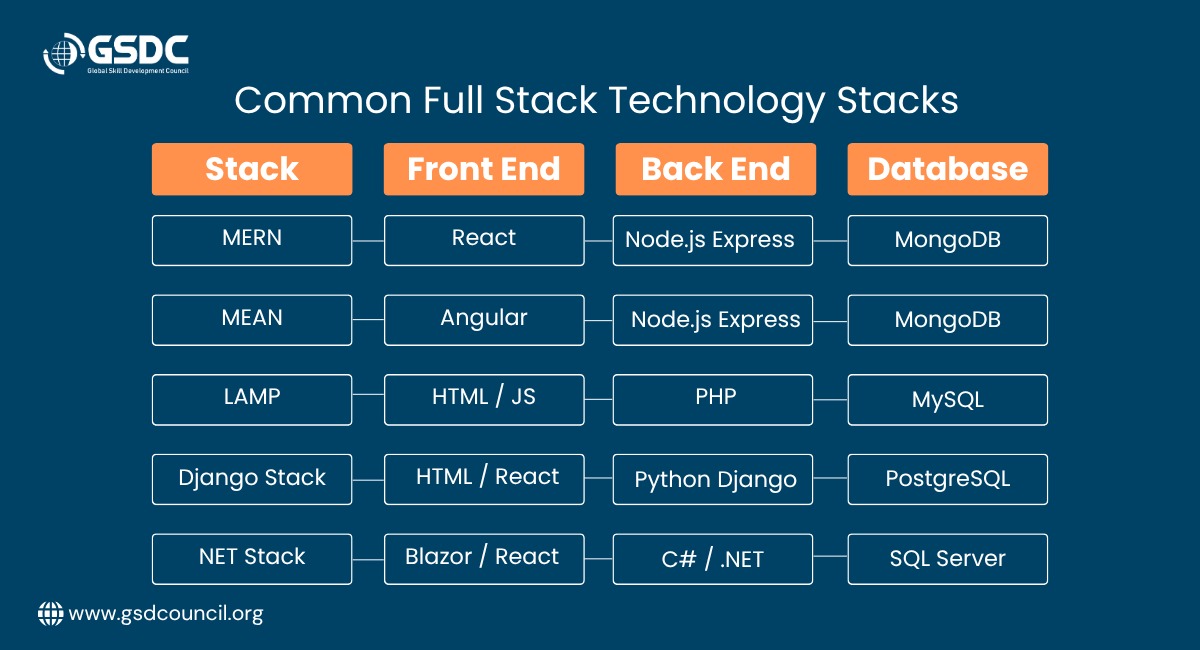
None of these stacks is objectively "the best." Employers pick one based on their existing systems, hiring pool, and performance needs, and most full stack developers end up learning two or three combinations over the course of their career instead of staying locked to one. But knowing the stack is only ever half the job description now, which is exactly why the skills below matter as much as the table above.
Full Stack Developer Skills You Actually Need
A useful way to think about this is in two buckets: the technical skills that get your resume noticed, and the practical skills that keep you employed once you're in the room.
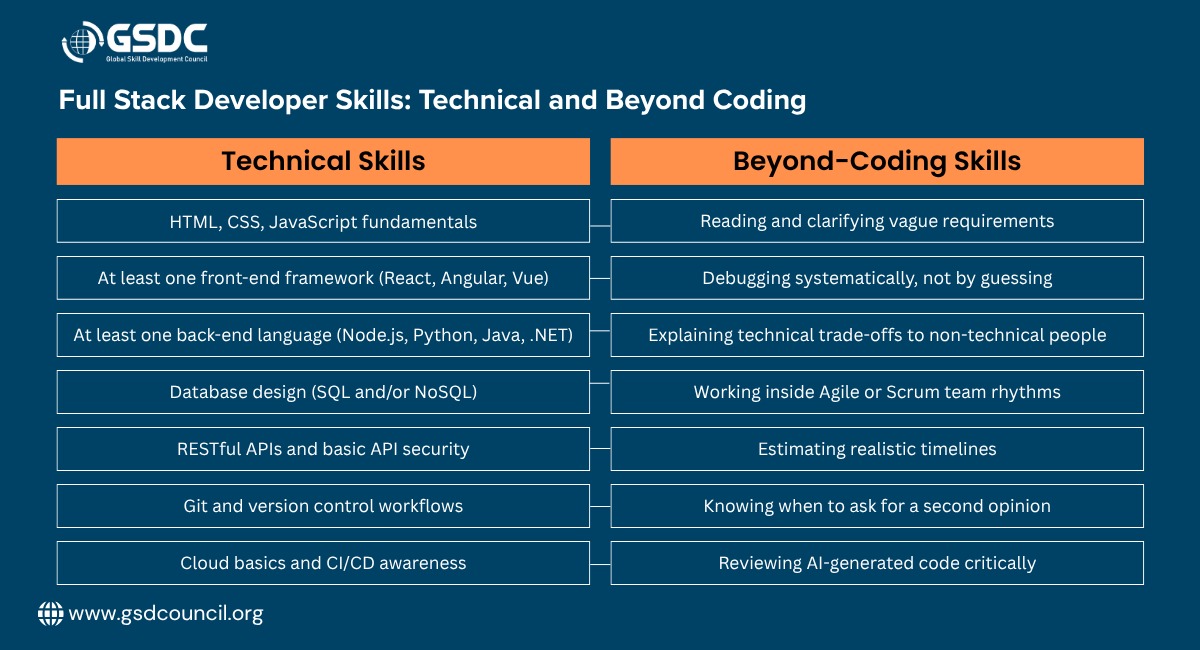
Notice that the right-hand column is arguably harder to teach yourself than the left one. That's exactly why full stack web developer skills training has shifted toward project-based learning and mentorship rather than pure syntax drills.
Full Stack Developer Roadmap: A Realistic Path
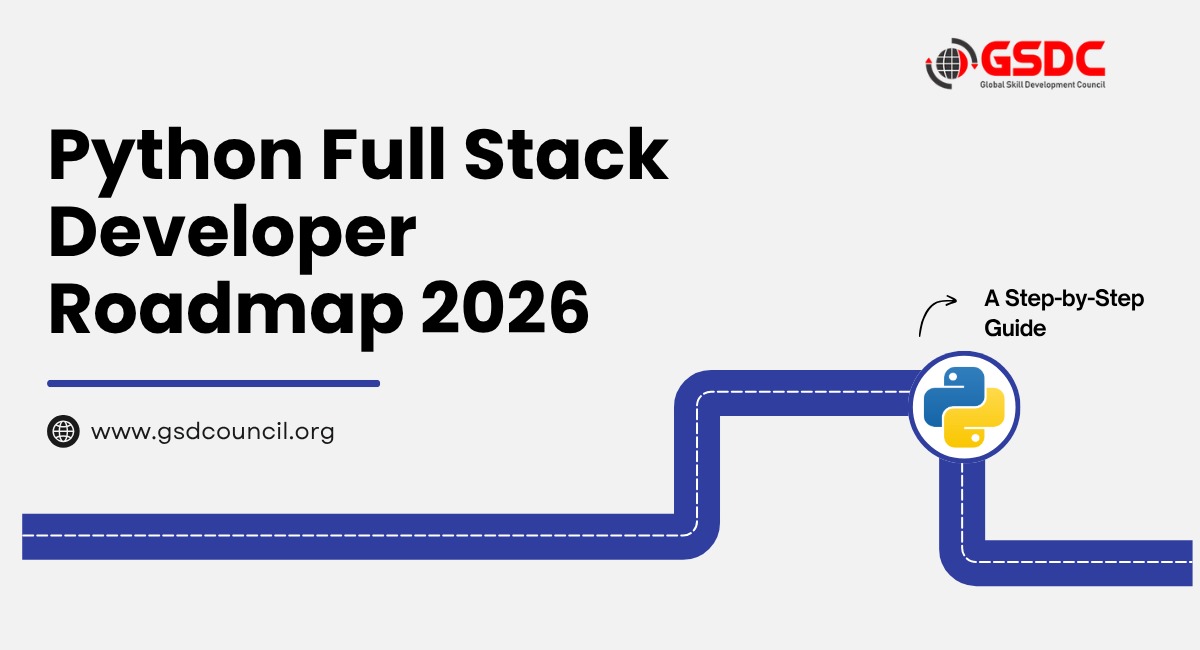
There's no single correct order, but most people who successfully break into the field follow a version of this sequence:
- Learn the fundamentals - HTML, CSS, and JavaScript first. Resist the urge to jump straight to a framework before you understand the language underneath it.
- Pick one front-end framework and go deep - React is the most widely requested in job postings, but Angular and Vue both have strong niches.
- Learn a back-end language and build real APIs - Node.js is the natural pairing with React, but Python and Java both open different job markets.
- Get comfortable with databases - Learn to design schemas, write queries, and understand when to use relational versus non-relational storage.
- Build 3 to 5 full projects, not tutorials - A weather app copied from a video is not a portfolio piece. A project with your own data model, authentication, and deployment is.
- Learn deployment and basic cloud hosting - Put your projects on a live URL. Employers notice the difference between "I built this" and "I built this and it's running."
- Validate and communicate your skills: Practice explaining technical decisions through mock interviews, code reviews, or by pursuing a Certified Full Stack Developer credential.
Most people move through this roadmap in 6 to 12 months of consistent, focused work, though the timeline stretches depending on whether you're learning alongside a full-time job.
Full Stack Developer Salary: What the Data Actually Shows
In the U.S., full stack developers earned an average salary of $138,000 in 2025, up from $130,000 in 2024, according to the 2025 Stack Overflow Developer Survey.
For comparison, the U.S. Bureau of Labor Statistics reports a $135,980 median annual wage for software developers as of May 2025. Full stack developers' salaries vary by experience, location, and specialization, but full stack development continues to offer strong career opportunities.
Full Stack Developer Jobs: Is the Demand Real?
Yes, and the government data is unusually clear on this point. The Bureau of Labor Statistics projects that employment for software developers will grow 10% between 2025 and 2035, which it classifies as "much faster than average" compared to all occupations, translating to roughly 174,700 new software developer positions over that decade, plus over 106,000 annual openings across the broader category once retirements and career changes are factored in.
What's driving it isn't a single trend. It's the fact that software now underpins healthcare records, logistics tracking, retail personalization, fraud detection in banking, and manufacturing robotics all at once. That spread means full stack developer jobs aren't concentrated in one industry or one country anymore, which is good news for anyone building a career outside the traditional tech hubs.
How to Become a Full Stack Developer: Courses, Bootcamps, and Certification
There isn't one "correct" path into full stack development, and that's actually good news if you're switching careers later in life. Most people take one of four routes, often combining more than one:
- A full stack developer course: structured, self-paced or instructor-led programs that walk through front end, back end, and databases in sequence. Good for people who want flexibility and a clear curriculum.
- A full stack development bootcamp: intensive, short-format programs (typically 3 to 9 months) built around projects and job placement support. Good for people who can commit significant weekly hours and want structure and accountability.
- A computer science degree: the traditional academic route, useful for roles that specifically require formal credentials, and for the deeper theoretical grounding it provides in algorithms and systems.
- Self-taught, project-led learning: the hardest path to stay consistent with, but a real one, especially when paired with open-source contributions and a public portfolio.
Whichever route you choose, a recognized full stack developer certification can help validate your skills to employers, especially if you're coming from a non-traditional background or switching careers without a computer science degree on your resume. It won't replace a strong project portfolio, but it does give hiring managers a faster, standardized way to confirm you understand both ends of the stack. GSDC's Full Stack Developer certification tracks are built around exactly that gap, giving learners a structured way to demonstrate both front-end and back-end proficiency alongside their project work.
Is Full Stack Development Still a Good Career Choice?
Based on the numbers, yes, with a caveat. The job growth is real, the pay is competitive, and the role sits at the center of almost every digital product being built right now. The caveat is that the bar for entry has risen. Employers aren't just looking for someone who can code both ends of an app anymore. They're looking for someone who can reason about the whole system, adapt to new tools quickly, and take ownership of a problem from start to finish. That's a higher bar than it was five years ago, but it's also a more resilient one, because those skills don't go out of date every time a new framework or AI tool arrives.
Thinking About Validating Your Full Stack Skills?
If you're ready to take your skills beyond projects and add a recognized credential to your profile, explore the GSDC Certified Full Stack Developer certification. It validates knowledge across front-end development, back-end technologies, databases, APIs, and the systems thinking needed to build complete applications.
With GSDC, you can formally validate your Full Stack development skills and strengthen your professional profile with a certification designed for today's development landscape.

Conclusion
Full stack development is no longer just about knowing how to write code. It is about understanding how different parts of an application work together, solving problems thoughtfully, making sound technical decisions, and taking ownership from development to deployment.
The fundamentals still matter, but staying relevant means continuing to build beyond them. Work on real projects, strengthen your systems thinking, learn to use AI tools critically, understand cloud and deployment basics, and develop the communication skills needed to work effectively with teams and stakeholders.
The developers who stand out won't necessarily be the ones who write the most code. They will be the ones who understand the bigger picture and know how to turn ideas into reliable, useful products.

Related Certifications
Frequently Asked Questions
A full stack developer is a software professional who can build and maintain both the front end (what users see) and the back end (servers, databases, and application logic) of a website or application, rather than specializing in only one side.
Full stack development is the practice of building an application across every layer it needs to function: the interface users interact with, the server logic that processes their actions, and the database that stores the data, all handled by the same person or team.
Full stack web development refers to the same practice applied specifically to websites and web applications, typically using a combination of front-end frameworks, a server-side language, and a database, bundled together as a "stack" like MERN or LAMP.
Most learners following a structured course or bootcamp reach an entry-level, job-ready skill level in 6 to 12 months of consistent study, though this varies based on prior experience and whether you're learning full time or alongside other commitments.
No single certification is universally required, but a recognized full stack developer certification course can meaningfully strengthen a resume, particularly for career changers or self-taught developers without a formal computer science degree, by giving employers a standardized way to verify your skills.
The data supports it. The U.S. Bureau of Labor Statistics projects much-faster-than-average job growth for software developers through 2035, and full stack developers specifically have seen steady salary growth in recent years, though staying competitive now requires more than coding skills alone, including system thinking, cloud basics, and the ability to work alongside AI tools rather than against them.
Stay up-to-date with the latest news, trends, and resources in GSDC
If you like this read then make sure to check out our previous blogs: Cracking Onboarding Challenges: Fresher Success Unveiled
Not sure which certification to pursue? Our advisors will help you decide!