Governing Generative AI in Enterprise PMO: A Framework for Risk and Accountability
Written by Emily Hilton
- Generative AI Overview for Project Managers
- How to Use Generative AI in Project Management
- Why Does an AI Governance Framework Matters?
- Enterprise AI Governance Framework for PMOs
- AI Governance Framework Development Process
- AI Governance Framework Diagram
- Model AI Governance Framework for Project Environments
- Agentic AI Governance Framework
- Risk and Accountability in the Enterprise PMO
- Building AI Skills for Project Professionals
- Conclusion
Generative AI is changing how organizations plan, manage, and deliver projects. Project Management Offices (PMOs) are increasingly using AI tools to create project documents, summarize meetings, analyze risks, generate reports, support resource planning, and improve communication. These capabilities can save time, but they also introduce new risks related to data privacy, accuracy, security, accountability, and decision-making.
This makes governing generative AI in enterprise PMO an important organizational priority. A PMO needs more than a list of rules for using AI. It needs a structured approach that defines who can use AI, what it can be used for, what information can be shared with AI systems, and who remains responsible for the final decision.
A well-designed governance approach allows enterprises to benefit from Generative AI while keeping project delivery controlled, transparent, and accountable.
Generative AI Overview for Project Managers
Generative AI refers to AI systems that can create new content based on patterns learned from existing data. These systems can generate text, summaries, plans, ideas, reports, code, and other forms of content.
For project managers, Generative AI can become a productivity and decision-support tool. It can help draft project plans, summarize stakeholder meetings, generate status updates, identify potential risks, and prepare communications.
However, project managers should understand that AI-generated content is not automatically correct. AI systems can produce inaccurate information, misunderstand project context, or present assumptions as facts.
A useful Generative AI Overview for Project Managers should therefore cover both its benefits and limitations. Project managers need to understand when AI can support their work and when human judgment must take priority.
How to Use Generative AI in Project Management
Organizations should establish clear guidelines for how to use generative ai in project management. The objective should be to use AI for appropriate tasks while maintaining human control over important project decisions.
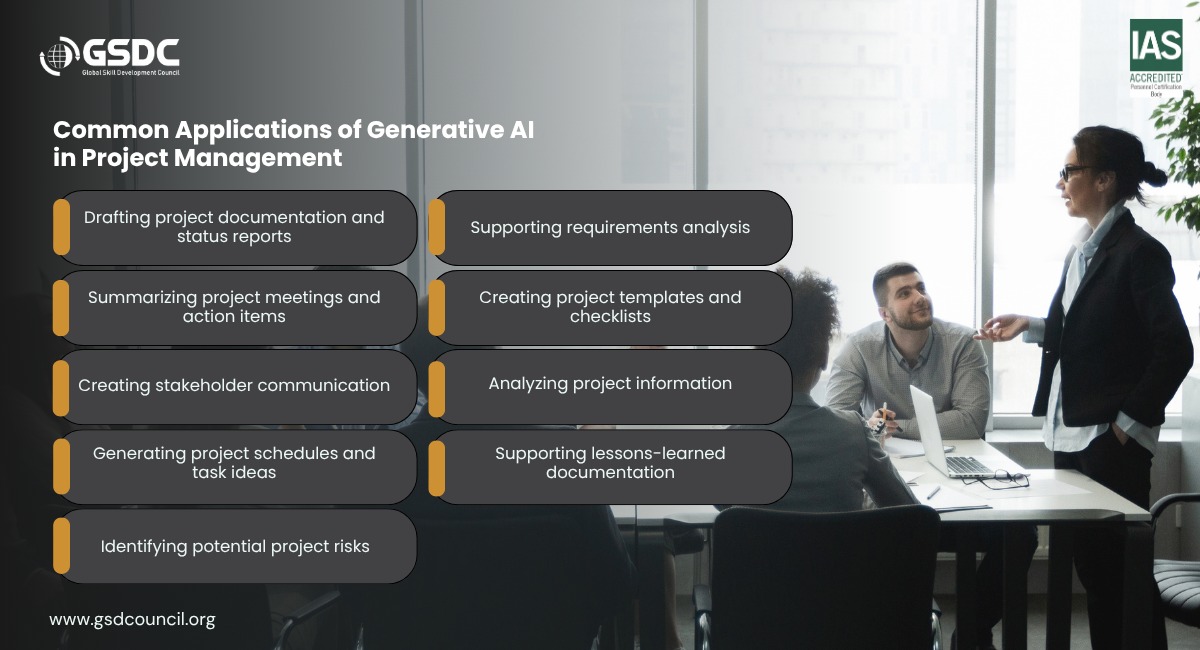
For example, a project manager could provide approved project information to an AI tool and ask it to create a first draft of a weekly status report. The project manager can then review the content, correct errors, and approve the final version.
This approach keeps AI in a supporting role rather than allowing it to make important project decisions independently.
Why Does an AI Governance Framework Matters?
An ai governance framework provides the structure organizations need to manage AI responsibly. It defines policies, roles, controls, processes, and responsibilities throughout the AI lifecycle.
Within an enterprise PMO, the framework should answer questions such as:
- Which AI tools are approved?
- What project data can be entered into AI systems?
- Who is responsible for reviewing AI-generated content?
- Which AI use cases require additional approval?
- How should AI-related risks be reported?
- How should AI performance be monitored?
- What happens when an AI system produces incorrect information?
Without clear governance, individual project teams may adopt AI tools independently. This can create inconsistent practices and increase security, compliance, and operational risks.
Enterprise AI Governance Framework for PMOs
An enterprise ai governance framework extends governance beyond individual projects. It creates common standards that can be applied across departments, programs, and portfolios.
For example, an enterprise framework can establish:
- AI policies: Define acceptable and prohibited uses of AI.
- Roles and accountability: Identify who owns AI systems, reviews outputs, manages risks, and approves use cases.
- Data governance: Define how sensitive, confidential, and personal information should be handled.
- Risk management: Establish methods for identifying, assessing, and monitoring AI-related risks.
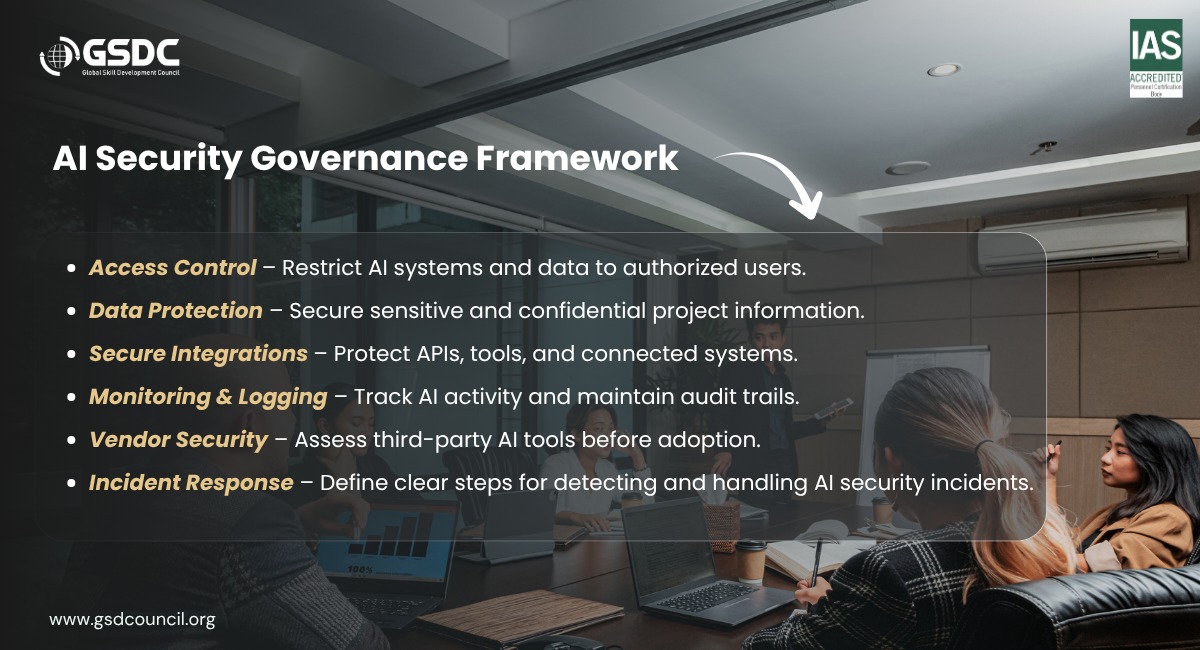
- Security controls: Protect AI systems, prompts, outputs, integrations, and project information.
- Human oversight: Require human review for important decisions and high-impact outputs.
- Monitoring: Track AI performance, incidents, changes, and emerging risks.
This enterprise approach prevents each PMO or project team from creating completely different AI practices.
AI Governance Framework Development Process
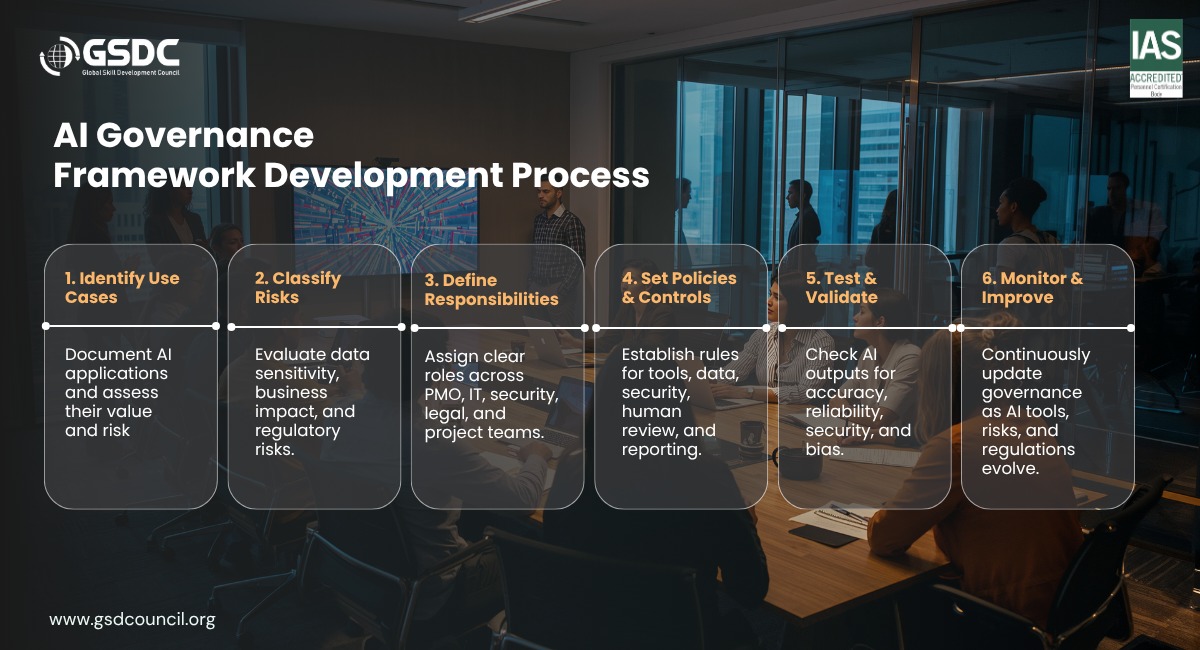
Developing governance should be treated as an ongoing process rather than a one-time policy exercise. An effective ai governance framework development process can include the following steps:
1. Identify AI Use Cases
Start by documenting how project teams currently use or plan to use Generative AI. Categorize use cases according to their potential value and risk.
2. Classify AI Risks
Evaluate risks based on factors such as data sensitivity, business impact, decision authority, and regulatory requirements.
3. Define Roles and Responsibilities
Establish clear ownership. The PMO, IT, cybersecurity, legal, compliance, project managers, and business teams may have different responsibilities.
4. Establish Policies and Controls
Create rules for approved tools, data usage, human review, security, documentation, and incident reporting.
5. Test and Validate
Before introducing AI into important workflows, test its accuracy, reliability, security, and potential bias.
6. Monitor and Improve
AI governance must evolve as models, tools, regulations, and project requirements change.
AI Governance Framework Diagram
A simple ai governance framework diagram for an enterprise PMO can be organized around six connected layers:
AI Strategy → Risk & Compliance → Data Governance → Security → Human Oversight → Monitoring
At the center of these layers is Accountability.
The strategy layer defines why AI is being used. Risk and compliance identify potential problems. Data governance controls the information used by AI systems. Security protects systems and information. Human oversight ensures people remain responsible for important decisions. Monitoring evaluates whether the controls continue to work.
This structure helps PMOs visualize governance as a connected system rather than a collection of isolated policies.
Model AI Governance Framework for Project Environments
A model AI governance framework should consider the complete lifecycle of an AI system.
This includes:
- Planning: Identify the business purpose and expected outcomes.
- Selection: Evaluate AI models and vendors before adoption.
- Testing: Assess accuracy, security, bias, and reliability.
- Deployment: Introduce the AI system with appropriate controls.
- Monitoring: Continuously evaluate performance and incidents.
- Review or Retirement: Update, replace, or retire systems that no longer meet requirements.
For project environments, this lifecycle should also include documentation. PMOs should maintain records of approved AI tools, use cases, owners, risk assessments, and review requirements.
Agentic AI Governance Framework
The governance challenge becomes more complex when organizations introduce AI agents. Unlike a basic chatbot, an AI agent may be able to plan tasks, use tools, access systems, retrieve information, and take actions.
An agentic ai governance framework should therefore include additional controls for permissions, tool access, action approval, audit logs, and human intervention.
For example, an AI agent may be allowed to prepare a project status report but not send it externally without human approval. Similarly, an agent may access project data but should not automatically modify budgets, contracts, or project schedules without appropriate authorization.
The greater the autonomy of an AI system, the stronger the governance controls should be.
Risk and Accountability in the Enterprise PMO
Governance is ultimately about accountability. AI should not create uncertainty about who is responsible for a project decision.
If an AI tool generates an incorrect risk assessment, the project manager should still be responsible for reviewing and acting on that information. Similarly, if AI generates a project plan, the project team must validate whether the plan is realistic.
A simple accountability model can assign:
- Business owners: Define objectives and acceptable risk.
- PMO: Establish standards and monitor adoption.
- Project managers: Ensure responsible day-to-day use.
- IT and security teams: Manage technical and cybersecurity controls.
- Legal and compliance teams: Address regulatory and contractual requirements.
- Employees: Follow approved AI policies and report incidents.
Building AI Skills for Project Professionals
Effective governance requires professionals who understand both project management and AI risks. Project managers do not necessarily need to become AI developers, but they should understand AI capabilities, limitations, risks, and governance principles. GSDC’s AI Project Management Certification can help professionals build knowledge at the intersection of AI and project management.
The AI Project Management Certification focuses on helping professionals understand how to manage AI-driven projects, assess AI-related risks, support responsible AI adoption, and align AI initiatives with business goals.
This certification can be valuable for project managers, PMO leaders, program managers, business professionals, and teams involved in planning and delivering AI initiatives.
Conclusion
Generative AI can significantly improve productivity across enterprise PMOs, from documentation and reporting to risk analysis and project planning. However, its benefits can only be sustained when organizations establish clear rules for responsible use.
An effective governance approach combines an AI governance framework with strong data controls, security practices, human oversight, accountability, and continuous monitoring. As organizations move from simple Generative AI tools toward autonomous AI agents, governance will become even more important.
The goal is not to prevent project teams from using AI. It is to create an environment where AI can be used confidently, securely, and responsibly while keeping people accountable for the decisions that matter.

Related Certifications
Frequently Asked Questions
Agentic AI, multi-agent systems, smarter AI developer tools, smaller efficient models and stronger AI security are the main ones.
Developers will write less repetitive code and spend more time on design, review, security and guiding AI agents.
Unlikely. AI is taking over routine tasks, but human judgment, design thinking and accountability remain essential.
It can be, if you want a recognised way to prove practical skills in building and managing autonomous AI systems. It works best alongside real projects.
Stay up-to-date with the latest news, trends, and resources in GSDC
If you like this read then make sure to check out our previous blogs: Cracking Onboarding Challenges: Fresher Success Unveiled
Not sure which certification to pursue? Our advisors will help you decide!