Measuring Business Impact of AI Solutions
Written by Pravena K
- Why Measuring AI Impact Is More Difficult Than It Seems
- Start With a Baseline Before Implementing AI
- Measure Business Outcomes, Not Just AI Usage
- Four Major Types of AI Business Impact
- Build a Practical AI KPI Framework
- KPIs Should Match the AI Use Case
- Use Leading and Lagging Indicators
- Calculating AI ROI With the Full Cost in Mind
- Use Before-and-After Comparisons Carefully
- Become a Certified Forward Deployed Engineer
- Conclusion
Artificial intelligence is becoming part of everyday business operations. Organizations are introducing AI assistants, chatbots, automation tools, generative AI solutions, and other AI systems across departments. However, adopting an AI solution is only the beginning. The more important question is whether that solution is creating measurable business value.
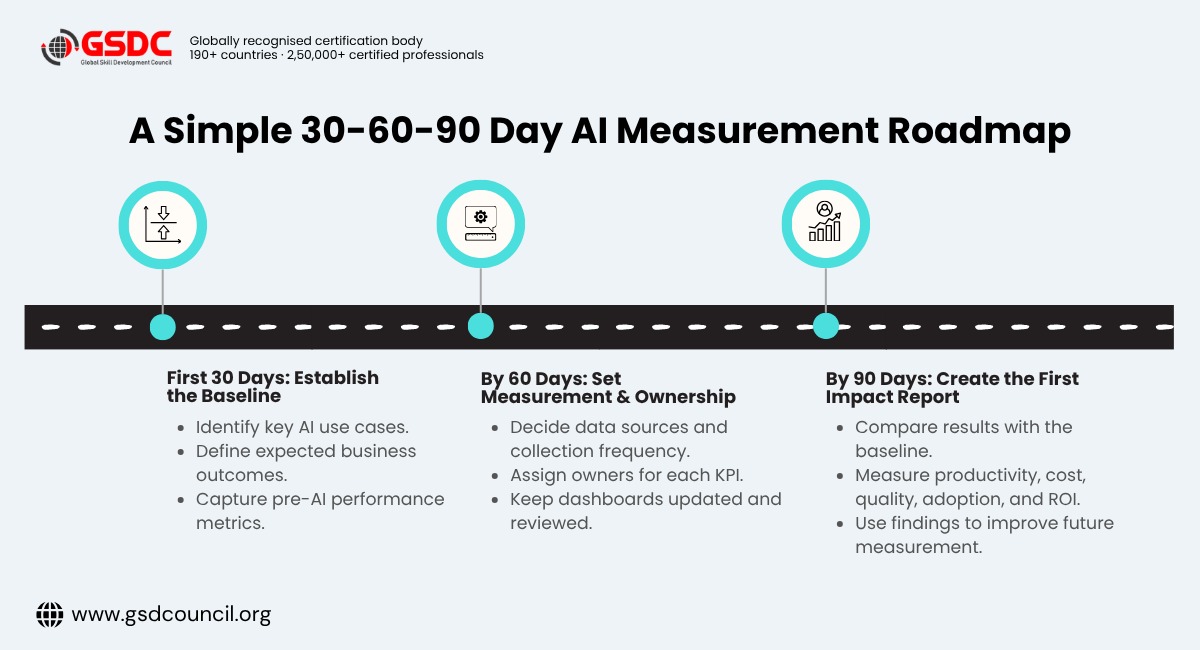
The webinar “Measuring Business Impact of AI Solutions” focused on this shift from AI adoption to AI value realization. The session explored how organizations can measure AI impact, select meaningful KPIs, calculate ROI, establish baselines, and report results to different stakeholders.
The central message was simple: AI usage does not automatically equal business impact. Organizations need reliable measurements that connect AI initiatives to outcomes such as productivity, quality, revenue, cost, risk reduction, and customer or employee experience.
Why Measuring AI Impact Is More Difficult Than It Seems
One of the biggest challenges in AI measurement is confusing usage with impact.
For example, imagine that an organization introduces an AI writing assistant to 100 employees and 90 employees start using it. A 90% adoption rate sounds positive, but it does not answer whether the organization is actually benefiting from the tool.
Employees might save only a few seconds each day. They might also produce content faster but require managers to spend additional time reviewing and correcting AI-generated work.
Therefore, adoption metrics are useful as early signals, but they cannot be treated as final evidence of business value.
Another challenge is timing. Some AI benefits can be seen quickly. Automating a repetitive task may reduce processing time almost immediately. Other outcomes, such as customer retention, employee productivity, or revenue growth, may take months to become visible.
This is why organizations need to measure both short-term signals and longer-term outcomes.
Start With a Baseline Before Implementing AI
A reliable measurement process begins before the AI solution is launched.
Without a baseline, organizations may struggle to determine whether a change was actually caused by AI. For example, if a company claims that AI increased productivity by 30%, an important question is: 30% compared with what?
Organizations should understand how the workflow performed before AI was introduced. Depending on the use case, the baseline could include:
- Time required to complete a task
- Error or complaint rates
- Cost per unit of output
- Customer satisfaction
- Current workflow or cycle time
- Existing productivity levels
The baseline does not have to become a large research project. Even two to four weeks of reliable data can provide a useful comparison.
The key is to capture the existing process before implementation rather than trying to reconstruct it months later.
Measure Business Outcomes, Not Just AI Usage
AI systems can generate large amounts of data. Organizations can track logins, prompts, chatbot conversations, satisfaction scores, and other usage information.
These numbers can help determine whether people are engaging with an AI solution, but they do not necessarily show whether the business is better because of it.
Instead, measurement should focus on what changed in the actual workflow.
For example, suppose document processing takes 20 minutes without AI and eight minutes after AI implementation. The 12-minute reduction provides a much clearer measure of impact. If thousands of documents are processed every month, those time savings can become financially meaningful.
Similarly, an organization could measure whether:
- Rework has decreased
- Error rates have improved
- Conversion rates have increased
- Customer response times have fallen
- Employees can handle more work with the same resources
The strongest AI metrics usually connect to business numbers that leaders already understand, such as revenue, cost, time, quality, and delivery performance.
Four Major Types of AI Business Impact
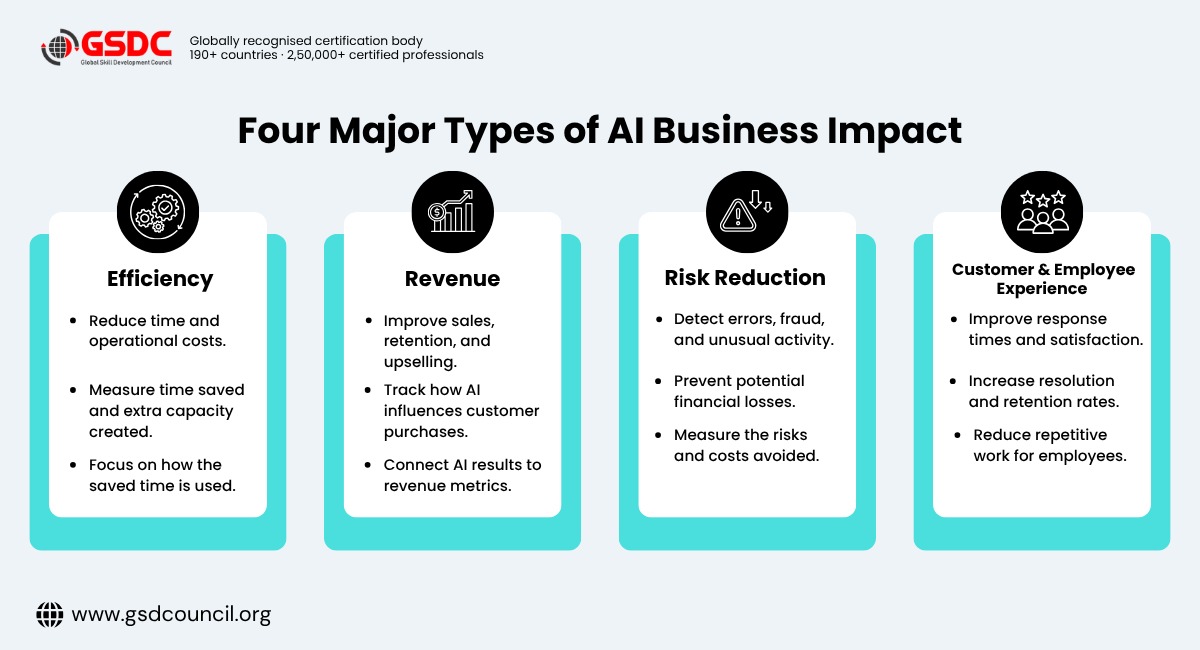
The webinar presented four broad areas organizations can consider when defining AI outcomes: efficiency, revenue, risk reduction, and experience.
1. Efficiency
Efficiency is often one of the easiest AI benefits to measure because it can be connected to time and cost.
For example, if an AI assistant helps a customer service employee reduce average handling time from 10 minutes to six minutes, the organization can measure the additional capacity created by that improvement.
The important question is not simply how much time AI saved, but what the organization was able to do with that additional capacity.
2. Revenue
AI can also influence revenue through areas such as sales conversion, customer retention, and upselling.
Recommendation systems provide one example. When an AI-powered recommendation helps a customer discover relevant products or services, it may influence purchasing behavior.
In such cases, organizations need to connect AI performance with relevant revenue metrics rather than simply reporting how many recommendations the system generated.
3. Risk Reduction
Risk reduction can be harder to see because the value comes from preventing negative outcomes.
An AI system that identifies duplicate invoices, unusual transactions, or other potential issues before payment may help an organization avoid financial losses.
In these situations, the measurement should consider the costs or risks that were potentially avoided.
4. Customer and Employee Experience
AI can also influence customer and employee experience.
For customers, organizations may measure response times, satisfaction, resolution rates, or retention. Internally, AI may reduce repetitive administrative work and allow employees to spend more time on higher-value activities.
Not every AI project needs to achieve all four types of impact. The first question should be: What business outcome was this AI solution designed to improve?
Build a Practical AI KPI Framework
There is no single KPI that works for every AI system. The right measurement depends on what the AI solution is actually doing.
The webinar grouped AI KPIs into four areas:
Productivity: Measures such as time saved per task, throughput, or cycle time.
Quality: Metrics such as accuracy, errors, rework, and escalations.
Financial performance: Cost per transaction, revenue influence, cost savings, and ROI.
Adoption: Measures whether employees or customers are actually using the solution.
A useful KPI framework should remain focused. Instead of creating a dashboard with 25 different metrics, organizations may benefit from three to five measures that clearly answer whether the AI solution is delivering its intended purpose.
Three useful questions are:
- Which number shows whether people are using the solution?
- Which number shows whether performance has improved?
- Which number shows whether the improvement is financially or strategically meaningful?
KPIs Should Match the AI Use Case
Different AI applications create different types of value, so they should not be measured in the same way.
For document automation, time or cost per document may be important. For decision-support systems, organizations may focus more on decision accuracy or outcome quality.
For customer-facing chatbots, useful measures can include resolution rate, customer satisfaction, response time, and human escalation rates.
For generative AI used to create reports, proposals, or marketing content, organizations can measure output quality and the amount of human editing required.
This use-case-based approach prevents organizations from reducing every AI initiative to a single number such as “hours saved.”
Use Leading and Lagging Indicators
AI measurement should also consider when different metrics become meaningful.
Leading indicators provide early signals. They can show whether employees are using a system, whether tasks are being completed successfully, and whether requests are being resolved.
These indicators are particularly useful shortly after launch because organizations should not expect complete ROI results within the first few weeks.
Lagging indicators show whether the investment is actually producing business outcomes. These may include cost reduction, revenue changes, improved error rates, or customer retention.
A practical reporting approach is therefore to focus on leading indicators shortly after implementation and introduce stronger lagging indicators as sufficient data becomes available.
Calculating AI ROI With the Full Cost in Mind
The basic ROI formula discussed in the webinar is:
ROI = (Value − Cost) ÷ Cost
The challenge is not the formula itself. The difficult part is determining what should be included in both value and cost.
AI investment can include much more than a software subscription. Organizations may also need to consider implementation, integrations, training, change management, maintenance, monitoring, security reviews, and ongoing governance.
On the value side, organizations may consider time savings, cost avoidance, additional capacity, revenue impact, reduced errors, avoided penalties, and risk reduction.
However, time saved should not automatically be treated as direct payroll savings. If employees save 10 hours, the organization needs to understand what happened to that capacity. Did employees serve more customers? Did they avoid overtime? Did the organization avoid hiring additional staff?
A trustworthy ROI calculation should reflect what actually happened rather than using assumptions simply to create a larger number.
Do Not Ignore Human Oversight
AI systems often operate as part of a human-plus-AI workflow.
For example, an AI system may complete a task in five minutes, but if a manager spends four minutes reviewing every output, the effective time saving is closer to one minute.
This is why human intervention must be included when measuring productivity, quality, and ROI.
Organizations should also consider training and change management. Purchasing an AI platform does not automatically create adoption. Employees need onboarding, workflows may need to change, and managers may need new skills to review AI-assisted work.
Use Before-and-After Comparisons Carefully
An improvement after AI implementation does not automatically prove that AI caused the improvement.
Other factors may have changed at the same time. Organizations may have hired experienced employees, experienced seasonal changes, changed processes, or seen changes in demand.
Where possible, organizations can use approaches such as A/B testing, before-and-after comparisons, or cohort comparisons.
For example, two comparable groups could operate during the same period, with one using the AI-supported process and the other continuing with the traditional process. A branch or business unit could also adopt AI while another comparable unit continues with the existing workflow.
The goal is not to make every AI project an academic experiment. Instead, organizations should ask a simple question before claiming AI caused an improvement:
What else could have caused this result?
Combine Quantitative and Qualitative Evidence
Numbers can show what happened, but conversations with employees can help explain why it happened.
For example, a dashboard may show that employees stopped using a particular AI feature after three weeks. Speaking with those employees might reveal that the feature produced unreliable answers or did not work well for certain cases.
This combination of quantitative and qualitative information can help organizations identify problems that numbers alone may not reveal.
Report AI Impact Differently to Different Stakeholders
Not every stakeholder needs the same AI dashboard.
Senior leadership may want to understand the investment, business value, ROI, and connection to strategic objectives.
Operational teams may need information about resolution rates, failed queries, escalations, and areas where the AI system is struggling.
AI operations or governance teams may need deeper information about accuracy trends, errors, unusual usage, and potential model-related issues.
Reporting frequency should also match the speed of decision-making. Leadership may need quarterly business-impact reporting, while operational teams may require weekly visibility into system performance.
Become a Certified Forward Deployed Engineer
Organizations need professionals who can turn AI solutions into practical business outcomes. GSDC’s Forward Deployed Engineer (FDE) Certification helps professionals build the skills needed to work closely with enterprise teams, understand business requirements, and implement AI solutions in real-world environments.

The Forward Deployed Engineer (FDE) Certification covers key areas such as AI deployment, system integration, problem-solving, enterprise workflows, and collaboration with technical and business stakeholders. It is designed for professionals who want to bridge the gap between AI technology and business needs while delivering measurable results. The certification can help strengthen your ability to support AI adoption and drive meaningful business impact.
Conclusion
Measuring AI impact means looking beyond adoption and focusing on real business value. Organizations should establish a baseline, choose KPIs based on the AI use case, consider productivity, quality, and financial outcomes, and account for human involvement. Comparing the traditional workflow with the AI-supported workflow helps identify actual impact and ongoing value.

Related Certifications
Frequently Asked Questions
AI adoption measures usage, while business impact measures improvements in productivity, quality, cost, revenue, risk, or experience.
A baseline shows how the process performed before AI, making it easier to measure actual improvements afterward.
KPIs should match the use case and may include productivity, quality, financial performance, and adoption metrics.
ROI = (Value − Cost) ÷ Cost. Include costs such as licensing, implementation, training, maintenance, and monitoring, along with measurable business value.
Compare AI-supported workflows with traditional ones using before-and-after, A/B, or cohort comparisons while considering other factors that may have influenced the results.
Stay up-to-date with the latest news, trends, and resources in GSDC
If you like this read then make sure to check out our previous blogs: Cracking Onboarding Challenges: Fresher Success Unveiled
Not sure which certification to pursue? Our advisors will help you decide!