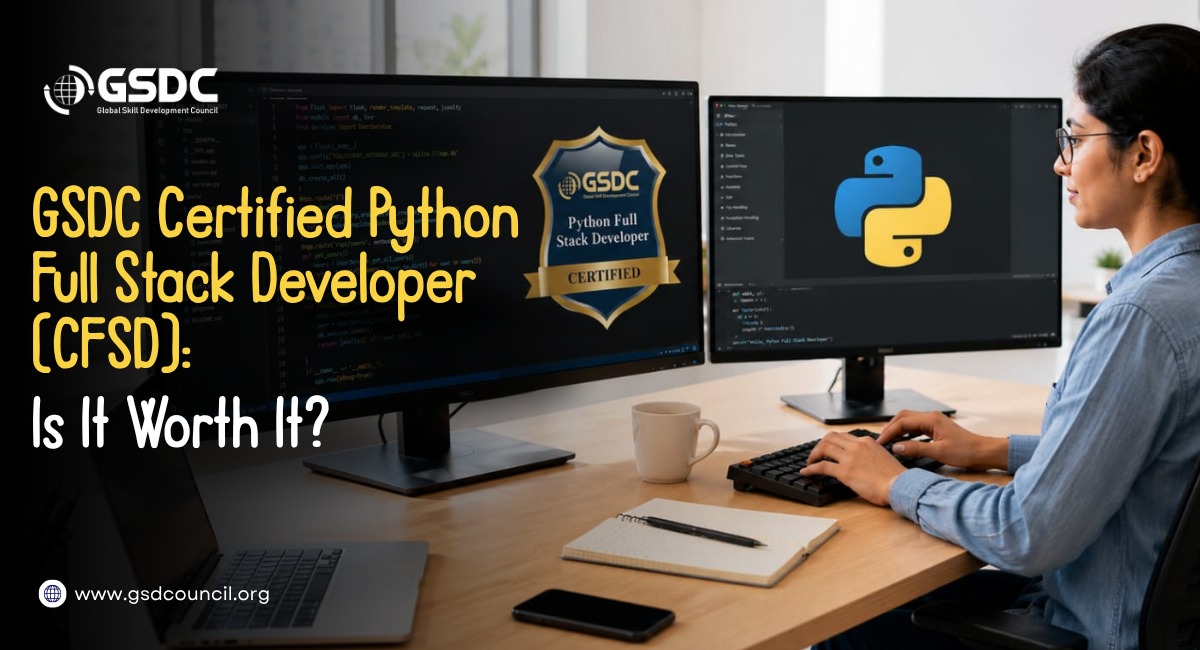
GSDC Certified Python Full Stack Developer (CFSD): Is It Worth It?
Written by Emily Hilton
- What Is a Python Full Stack Developer?
- How to Be a Python Full Stack Developer
- Why Is Python Popular for Full-Stack Development?
- What Does GSDC's Certified Python Full Stack Developer Cover?
- GSDC Certified Python Full Stack Developer: Key Benefits
- Is Python Full Stack Developer Certification Worth It?
- Who Should Consider the GSDC Certification?
- What Does the GSDC Certification Include?
- Certification vs. Practical Experience
- How to Get the Most Value From the Certification
- Final Verdict: Is the GSDC Certified Python Full Stack Developer Worth It?
Full-stack development is no longer just about knowing one programming language. Modern developers are expected to understand how the frontend, backend, databases, APIs, security, testing, and deployment work together.
Python has become a popular choice for backend development because of its readable syntax, extensive ecosystem, and frameworks such as Django, Flask, and FastAPI. But if you're planning to build a career in this area, you may be wondering: Is a Python Full Stack Developer certification worth it?
The answer depends on what you expect from a certification.
A certificate alone won't make you a full-stack developer. However, a well-structured Python Full Stack Developer certification can give you a learning roadmap, validate your knowledge, and encourage you to build practical skills.
GSDC's Certified Python Full Stack Developer (CFSD) is designed around this broader approach, covering Python, databases, APIs, backend frameworks, frontend development, and application development.
What Is a Python Full Stack Developer?
Before discussing certification, let's understand the role.
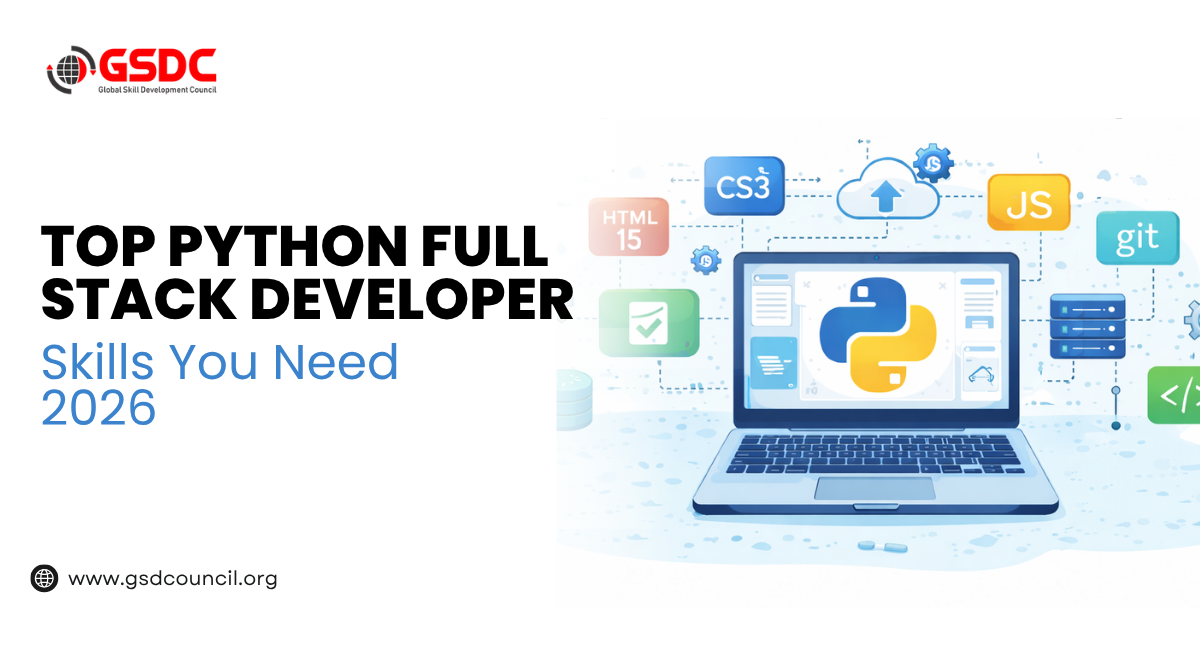
A Python full stack developer works across both the frontend and backend of a web application. Python is typically used for backend development, while technologies such as HTML, CSS, JavaScript, and modern frontend frameworks handle the user-facing side.
A developer may also work with:
- Python programming
- Django, Flask, or FastAPI
- HTML, CSS, and JavaScript
- React or other frontend frameworks
- SQL and databases
- REST APIs
- Git and GitHub
- Authentication and security
- Testing
- Cloud and deployment
In simple terms, a full-stack developer should be able to understand how the different parts of an application connect and contribute to building a working product.
How to Be a Python Full Stack Developer
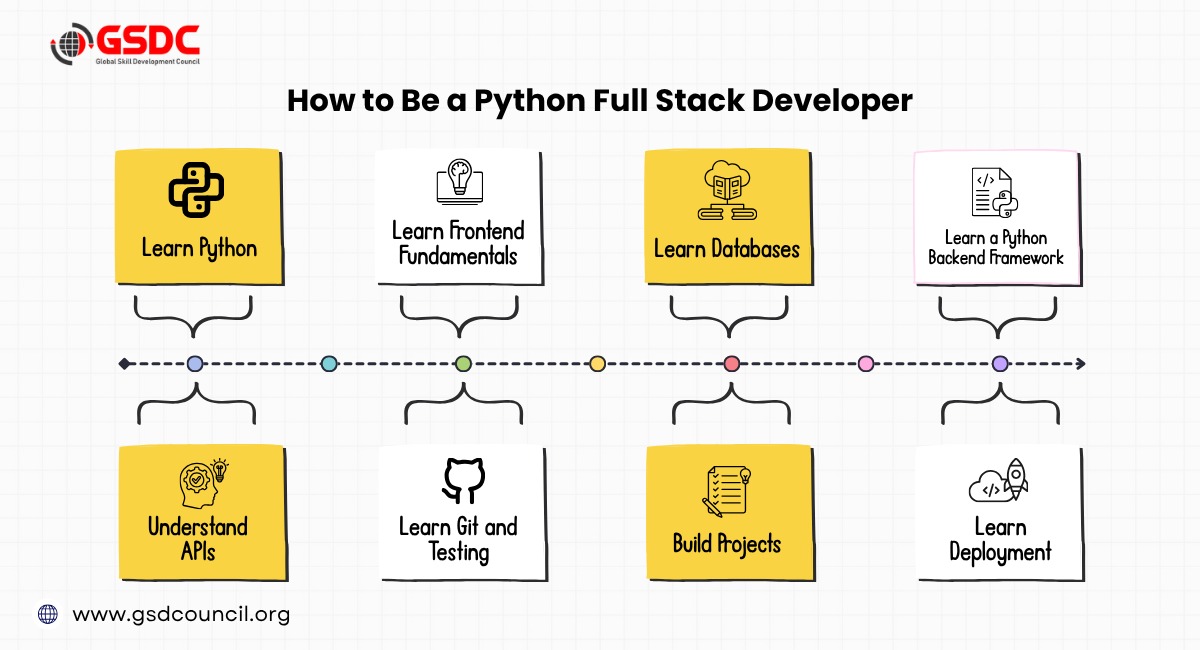
If you're wondering how to be a Python full stack developer, don't try to learn every technology at once.
A practical learning path looks something like this:
Step 1: Learn Python
Start with Python fundamentals, including functions, data structures, modules, exception handling, object-oriented programming, and virtual environments.
Step 2: Learn Frontend Fundamentals
Understand HTML, CSS, and JavaScript. You don't necessarily need to become a frontend specialist, but you should know how browsers interact with backend applications.
Step 3: Learn Databases
Learn SQL and understand how applications store, retrieve, update, and manage information using databases such as PostgreSQL, MySQL, or SQLite.
Step 4: Learn a Python Backend Framework
Explore Django, Flask, or FastAPI. Learn how to build routes, APIs, authentication, and business logic.
Step 5: Understand APIs
Learn how REST APIs allow frontend applications and external services to communicate with your Python backend.
Step 6: Learn Git and Testing
Version control and testing are essential for collaborative and reliable software development.
Step 7: Build Projects
Create practical applications such as an e-commerce platform, blog, task management system, portfolio website, or AI-powered application.
Step 8: Learn Deployment
Understand the basics of Docker, cloud platforms, environment configuration, application servers, and monitoring.
The important thing is to connect these skills through projects rather than learning them as isolated technologies.
Why Is Python Popular for Full-Stack Development?
Python's popularity comes partly from its simplicity and extensive ecosystem.
Developers can use Python for backend logic, automation, data processing, APIs, and AI integration. Frameworks such as Django provide a more complete development environment, while Flask and FastAPI can be used for lighter or API-focused applications.
Python is also increasingly relevant to AI-powered applications. A developer can build a web application with a Python backend and integrate machine learning models or generative AI services into the product.
This combination of web development and AI creates another reason to consider Python when building a modern development skill set.
What Does GSDC's Certified Python Full Stack Developer Cover?
GSDC's Certified Python Full Stack Developer (CFSD) program is designed to cover both frontend and backend development while connecting those skills with databases, APIs, and cloud technologies.
The curriculum includes areas such as:
- Python programming
- Object-oriented programming
- Python data structures and collections
- Database connectivity
- SQLAlchemy and Django ORM
- Django, Flask, and FastAPI
- REST API development
- Authentication
- HTML and CSS
- JavaScript
- TypeScript basics
- React or Vue
- Frontend and backend integration
The program also includes hands-on components such as a capstone project and practice exams, giving learners opportunities to apply concepts rather than focusing only on theoretical knowledge.
GSDC Certified Python Full Stack Developer: Key Benefits
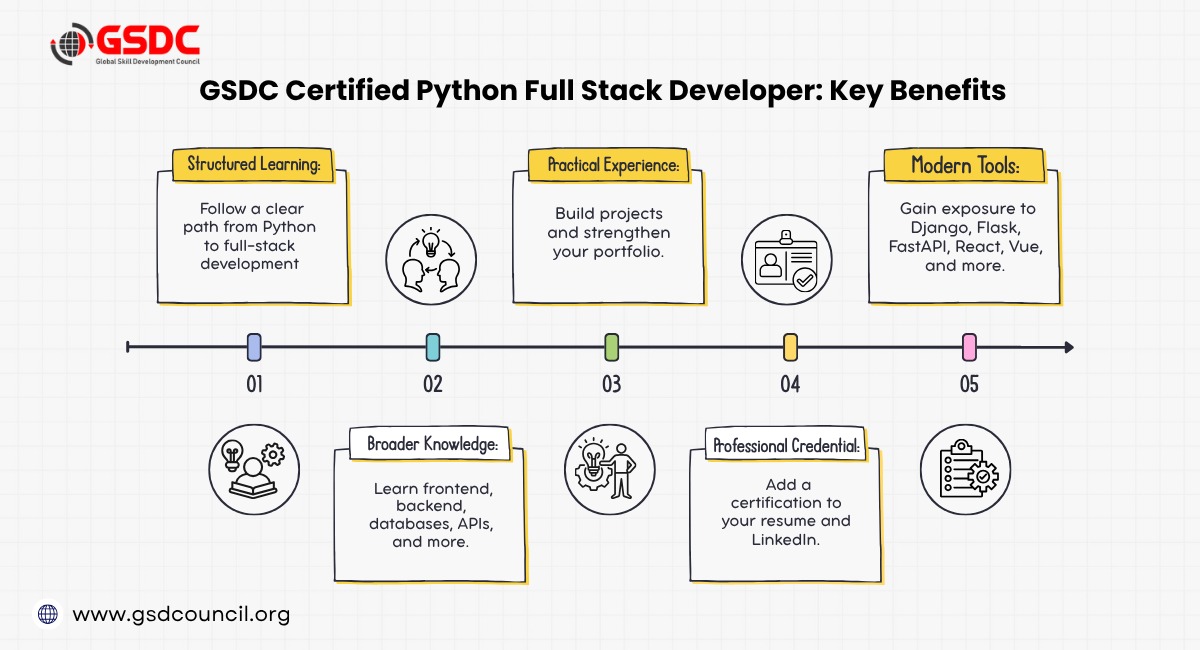
So, what can you actually gain from the certification?
1. A Structured Learning Path
One of the biggest challenges when learning full-stack development independently is knowing what to learn next.
A structured certification can give you a defined path from Python fundamentals to frontend development, databases, APIs, frameworks, and application development.
This can make learning less overwhelming, particularly for beginners and professionals transitioning into development.
2. Broader Full-Stack Knowledge
Learning only Python doesn't automatically make you a full-stack developer.
The GSDC program covers both frontend and backend technologies, along with databases, APIs, and application development.
This broader perspective can help you understand how different application components work together.
3. Practical Project Experience
Projects are one of the best ways to demonstrate development ability.
GSDC includes a capstone project as part of the program, allowing learners to apply their knowledge in a practical development context.
When combined with additional personal projects, this can help you build a portfolio that demonstrates what you can actually do.
4. A Credential for Your Professional Profile
A Certified Python Full Stack Developer credential can add another qualification to your resume and LinkedIn profile.
However, it should supportn ot replace, your practical experience.
A strong developer profile is better represented by:
Skills + Projects + Portfolio + Experience + Certification
rather than certification alone.
5. Exposure to Modern Development Tools
The program covers multiple backend frameworks and frontend technologies, including Django, Flask, FastAPI, JavaScript, TypeScript, and React/Vue.
This can give learners a broader understanding of the modern web development ecosystem.
Is Python Full Stack Developer Certification Worth It?
This is probably the most important question.
It Can Be Worth It If You:
- Need a structured learning path
- Are transitioning into full-stack development
- Want to strengthen your Python development foundation
- Prefer guided learning over completely self-directed study
- Want to validate your knowledge with a certification
- Need practical project experience
- Want to build a broader understanding of frontend and backend development
It May Not Be Enough If You:
- Expect certification alone to get you a job
- Don't plan to build projects
- Already have extensive full-stack experience
- Want to specialize exclusively in frontend or backend development
- Are unwilling to practice coding outside the course
The key distinction is simple: certification can validate learning, but projects demonstrate capability.
Who Should Consider the GSDC Certification?
The program can be relevant to several types of learners.
Beginners
If you're starting your development career, a structured curriculum can help you understand what technologies to learn and in what order.
Python Developers
If you already know Python but haven't worked much with frontend technologies, databases, APIs, or deployment, full-stack training can broaden your skill set.
Backend Developers
Backend developers can use the program to understand the frontend and become more comfortable working across the entire application.
Frontend Developers
Frontend developers who want to understand what happens behind the API can benefit from learning Python backend development, databases, and server-side logic.
Software Engineers
Experienced developers may use certification as a way to formalize or refresh their knowledge of modern Python full-stack technologies.
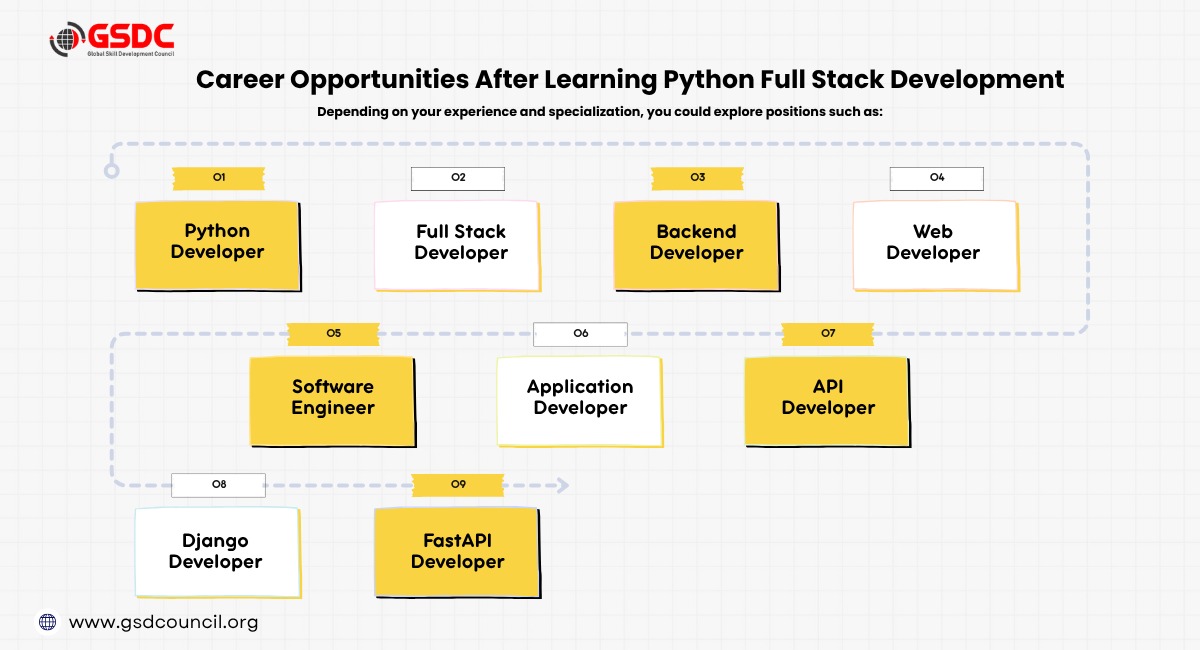
GSDC specifically lists Python developers, Java developers, full-stack developers, software engineers, web developers, backend developers, frontend developers, technical leads, application developers, and IT professionals among its target audience.
What Does the GSDC Certification Include?
According to GSDC's current certification page, the program includes 40+ hours of learning, two practice exams, a capstone project, and an AI interview practice platform.
The certification exam currently consists of:
- 40 multiple-choice questions
- 90-minute duration
- 65% passing score
- English language
- 5-year certification validity
- One complimentary retake
These details can make the certification useful for learners who want a defined assessment alongside their learning journey.
Certification vs. Practical Experience
Here's something worth remembering: employers generally want developers who can solve problems.
You may have a certification, but during an interview, you could still be asked:
- Can you build a REST API?
- How would you design a database?
- How does authentication work?
- How would you debug a slow application?
- Can you connect a frontend to a Python backend?
- How would you deploy the application?
- How would you secure an API?
That's why practical experience matters.
After completing a Python Full Stack Developer certification, build projects that demonstrate your skills.
For example:
Beginner: To-do application → Blog → Expense tracker
Intermediate: E-commerce application → Booking system → REST API
Advanced: AI-powered application → Cloud-deployed SaaS application → Full-stack platform with authentication and role-based access
These projects give you something concrete to discuss during interviews.
How to Get the Most Value From the Certification
If you decide to pursue the GSDC Certified Python Full Stack Developer, don't treat the certificate as the final destination.
Use it as a framework for building real capability.
A good approach is:
Learn → Practice → Build → Test → Deploy → Document → Showcase
After each major topic, create something.
Learn APIs? Build an API.
Learn databases? Connect your application to a database.
Learn frontend integration? Build a complete interface.
Learn deployment? Put your application online.
This approach turns a Python Full Stack Developer certification into a practical career-building experience rather than simply another credential on your resume.
Final Verdict: Is the GSDC Certified Python Full Stack Developer Worth It?
The GSDC Certified Python Full Stack Developer (CFSD) can be worth considering if you want structured learning, broader full-stack knowledge, practical project exposure, and a professional credential.
Its value ultimately depends on how you use it.
If you complete the lessons, build projects, practice coding, develop a portfolio, and apply what you learn to real-world problems, the certification can become one part of a stronger professional profile.

If you only complete the exam and add the certificate to your resume without developing practical skills, its value will be much more limited.
So, if you're asking “Is Python Full Stack Developer certification worth it?”, the most useful answer is:
Yes, when certification is combined with practical skills, projects, and continuous learning.
For professionals looking to build these capabilities in a structured way, GSDC's Certified Python Full Stack Developer program provides coverage across Python, backend frameworks, databases, APIs, frontend development, and practical application development.

Related Certifications
Frequently Asked Questions
It can be valuable for learners who want structured training, skill validation, and practical exposure. However, certification should be combined with projects and hands-on development.
Start with Python, then learn HTML, CSS, JavaScript, databases, APIs, backend frameworks, Git, testing, deployment, and practical project development.
Core skills include Python, frontend development, databases, backend frameworks, APIs, version control, testing, security, deployment, and problem-solving.
Yes. The program begins with Python fundamentals and progresses through object-oriented programming, databases, backend frameworks, APIs, and frontend development.
Yes. The program includes a capstone project alongside learning resources and practice exams.
No certification can guarantee employment. Practical skills, projects, problem-solving ability, interview preparation, and relevant experience are important parts of becoming job-ready.
Stay up-to-date with the latest news, trends, and resources in GSDC
If you like this read then make sure to check out our previous blogs: Cracking Onboarding Challenges: Fresher Success Unveiled
Not sure which certification to pursue? Our advisors will help you decide!