Python with AI: How Python Powers Modern Artificial Intelligence
Written by Emily Hilton
- What Is Python with AI?
- Why Is Python Used for AI?
- Python's Growing Role in AI Development
- How Python Powers Modern Artificial Intelligence
- Python in AI Application Development
- Python and AI: A Practical Example
- Python vs. Other Languages for AI
- Can Python Skills Lead to Full-Stack AI Development?
- The Future of Python with AI
- Final Thoughts
Artificial intelligence is no longer limited to research labs or highly specialized technology companies. AI now powers recommendation systems, chatbots, fraud detection, image recognition, predictive analytics, automation, and many other applications we interact with every day.
Behind many of these systems is a programming language that has become closely associated with AI development: Python.
So, why is Python used for AI? The answer is not just because the language is easy to learn. Python combines simple syntax with a huge ecosystem of libraries, frameworks, tools, and communities that make it easier to build, test, and deploy intelligent applications.
This is why python with ai has become such an important combination for developers, data professionals, and technology teams.
What Is Python with AI?
Python with AI refers to using Python programming capabilities to develop, train, integrate, and deploy artificial intelligence systems.
Python can be used across different stages of the AI development lifecycle, including:
- Collecting and preparing data
- Building machine learning models
- Training and evaluating AI systems
- Developing neural networks
- Processing text and images
- Connecting applications to AI models
- Creating AI-powered APIs and applications
- Automating AI workflows
- Deploying models into production
This flexibility makes Python useful for both beginners exploring AI and experienced developers building production-level solutions.
The combination becomes even more powerful because developers do not need to build every AI capability from scratch. Python provides access to mature libraries and frameworks that simplify complex tasks.
Why Is Python Used for AI?
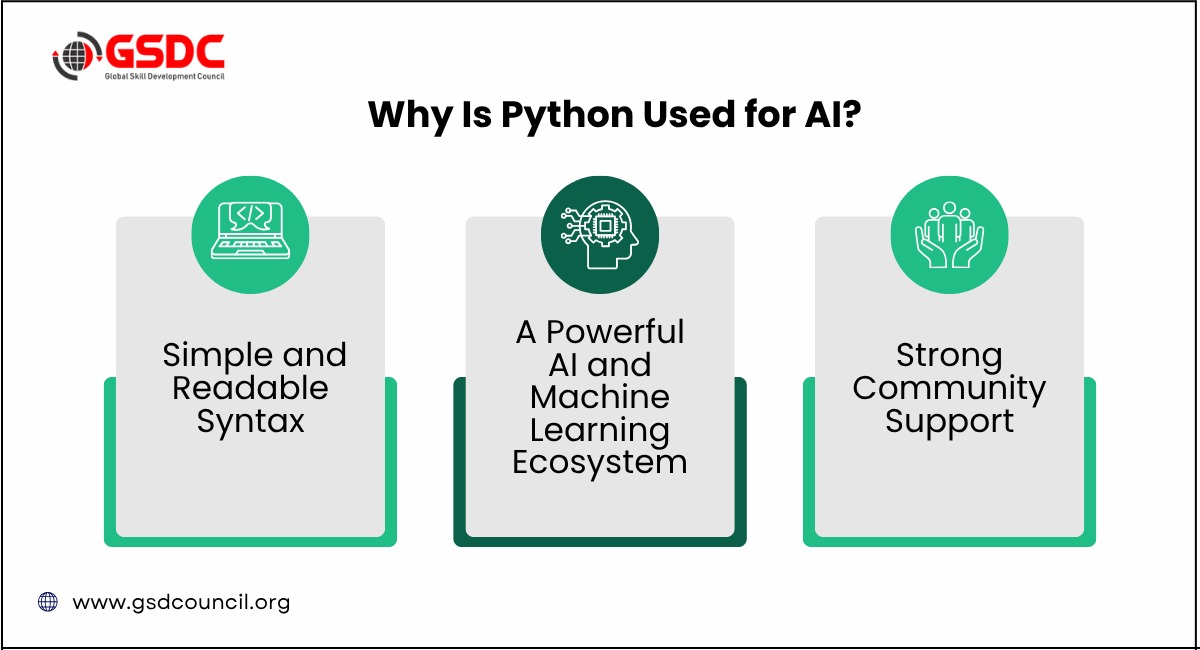
One of the most common questions beginners ask is, why is Python used for AI?
There are several reasons.
1. Simple and Readable Syntax
AI development can already involve complex concepts such as algorithms, statistics, neural networks, and model evaluation. Python's relatively simple syntax allows developers to focus more on solving the problem and less on writing complicated code.
For beginners, this reduces the learning curve. For experienced developers, it can speed up experimentation and prototyping.
2. A Powerful AI and Machine Learning Ecosystem
Python has an extensive ecosystem for artificial intelligence and data science.
Popular tools include:
- NumPy for numerical computing
- Pandas for data manipulation
- Matplotlib for visualization
- scikit-learn for traditional machine learning
- PyTorch for deep learning
- TensorFlow for machine learning and neural networks
- Transformers for working with modern language and AI models
For example, scikit-learn provides tools for classification, regression, clustering, and predictive data analysis, making it useful for many machine learning applications.
Instead of developing algorithms from the ground up, developers can use these libraries to experiment, train models, and solve practical problems much faster.
3. Strong Community Support
Python has one of the largest programming communities, which means developers can find documentation, tutorials, open-source projects, forums, and development resources for almost every stage of an AI project.
This matters because AI development often involves troubleshooting unfamiliar problems. A strong ecosystem makes it easier to find examples, understand errors, and learn from existing solutions.
Python's Growing Role in AI Development
The popularity of Python is also reflected in developer data.
According to Stack Overflow's 2025 Developer Survey, Python's adoption increased by 7 percentage points from 2024 to 2025. Stack Overflow specifically notes Python's role as a go-to language for AI, data science, and back-end development.
The same survey found that 84% of respondents use or plan to use AI tools in their development process, compared with 76% in 2024.
These numbers highlight an important trend: AI is becoming part of everyday software development, while Python continues to play a significant role in that ecosystem.
How Python Powers Modern Artificial Intelligence
So, how exactly does Python power modern AI?
Think of an AI application as a pipeline rather than a single model. Python can support many parts of that pipeline.
Data Preparation
AI models need data, and that data often needs to be cleaned, transformed, structured, and analyzed before it can be used.
Python libraries such as Pandas and NumPy make these processes easier.
For example, a company developing a customer churn model might use Python to:
- Import customer records
- Remove incomplete or duplicate data
- Transform variables
- Analyze customer behavior
- Prepare datasets for training
- Feed the processed data into a machine learning model
The quality of this preparation can directly affect the quality of the final AI system.
Machine Learning
Python is widely used for developing traditional machine learning applications.
With tools such as scikit-learn, developers can build models for:
- Classification
- Regression
- Clustering
- Recommendation
- Prediction
- Anomaly detection
For example, a financial organization could use machine learning to identify unusual transaction patterns, while an e-commerce company could use predictive models to recommend products.
Deep Learning
Modern AI applications often rely on neural networks and deep learning.
Python frameworks such as PyTorch and TensorFlow provide tools for developing and training these models.
Deep learning can support applications such as:
- Computer vision
- Speech recognition
- Natural language processing
- Image classification
- Generative AI
- Recommendation systems
Developers can therefore move from traditional machine learning to more advanced AI applications without leaving the Python ecosystem.
Python and Generative AI
The growth of generative AI has created another major use case for Python.
Developers can use Python to connect applications with large language models, process model outputs, build retrieval systems, create AI agents, and integrate AI capabilities into existing software. For example, consider a customer-support application.
A Python-based system could:
- Receive a customer question
- Retrieve relevant information from a knowledge base
- Send context to an AI model
- Process the generated response
- Apply validation rules
- Return the answer to the customer
This demonstrates how artificial intelligence with Python goes beyond simply training models. Python can act as the bridge between AI models, data, business logic, APIs, and users.
Python in AI Application Development
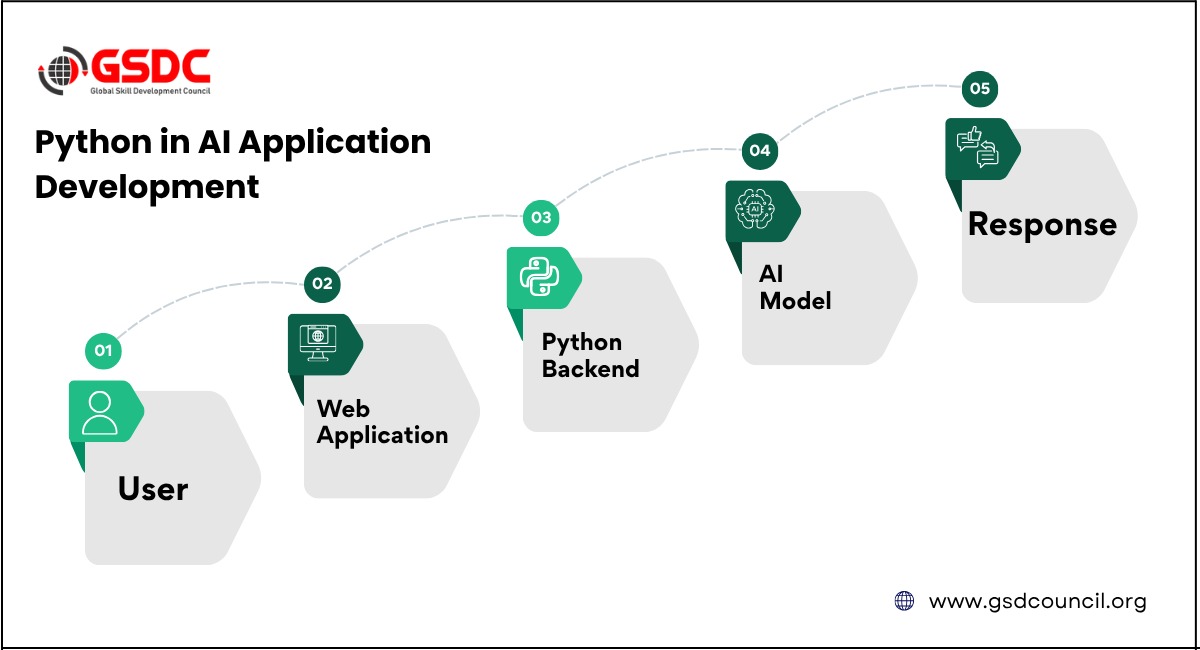
One of Python's biggest advantages is that AI does not have to exist as a standalone model.
Developers can integrate AI into real applications using Python frameworks and APIs.
For example, Python can be used with web frameworks such as Flask, Django, or FastAPI to create applications that use AI models behind the scenes.
A simple architecture might look like:
User → Web Application → Python Backend → AI Model → Response
This makes Python particularly useful for businesses that want to move from AI experimentation to usable products.
A developer could build an AI-powered:
- Chatbot
- Recommendation engine
- Document analyzer
- Fraud detection system
- Predictive dashboard
- Content assistant
- Customer-support platform
- Business automation tool
Python and AI: A Practical Example
Imagine a company wants to build an AI system that predicts whether customers are likely to leave.
The development process might look like this:
Step 1: Collect data
Gather customer information such as purchase history, engagement, support interactions, and subscription details.
Step 2: Prepare the data
Use Python libraries to clean and organize the dataset.
Step 3: Explore patterns
Analyze customer behavior using statistical methods and visualizations.
Step 4: Train a model
Use a machine learning library such as scikit-learn to train a predictive model.
Step 5: Evaluate performance
Test the model using appropriate evaluation metrics.
Step 6: Integrate the model
Connect the trained model to a business application through a Python-based API.
Step 7: Monitor results
Track how the model performs after deployment and update it when necessary.
This example shows How Python Powers Modern Artificial Intelligence across the complete workflow rather than just the model-training stage.
Python vs. Other Languages for AI
Python is not the only language used for AI.
Languages such as Java, C++, JavaScript, R, and Julia also have important roles in AI and data-intensive applications.
However, Python has a major advantage: its ecosystem brings together programming, data science, machine learning, visualization, AI frameworks, APIs, and automation in one environment.
This makes it particularly attractive for experimentation and rapid development.
In some production environments, organizations may combine languages. For example, Python might handle model development and AI services while another language handles performance-critical components.
The goal is not to prove that Python is always the best language. Instead, it is to understand why Python has become one of the most practical choices for modern AI development.
Can Python Skills Lead to Full-Stack AI Development?
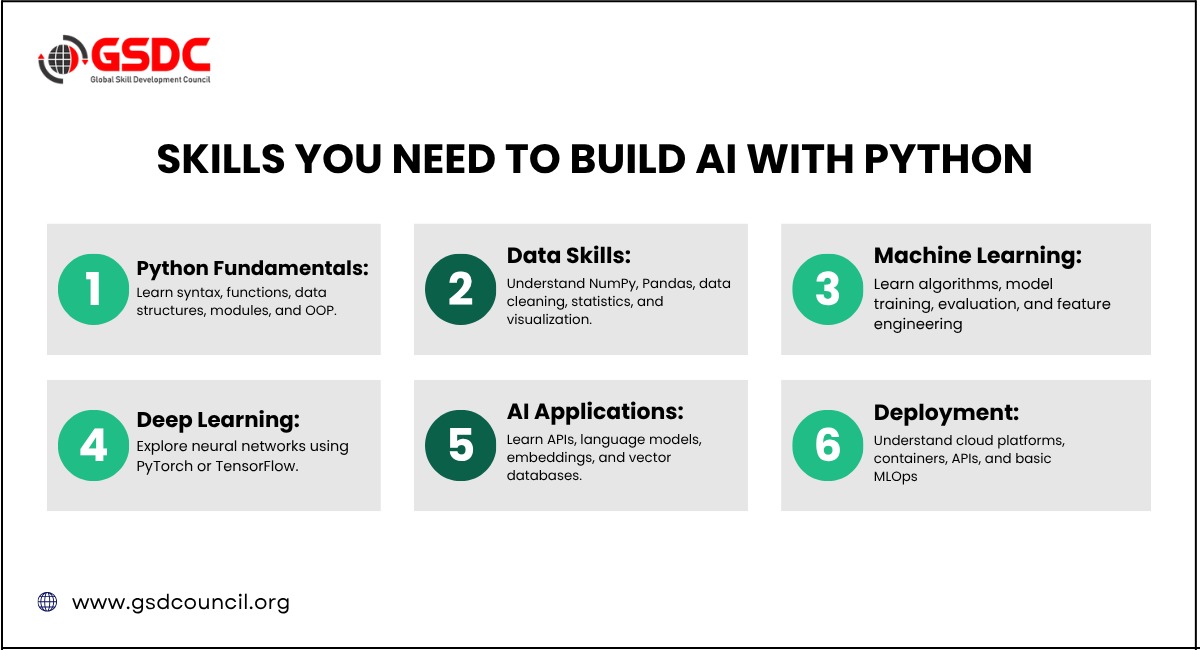
Yes. Python can also become part of a broader full-stack development skill set.
A developer may combine:
Frontend + Python Backend + Database + APIs + AI
For example, the frontend could provide the user interface, while a Python backend manages business logic, database interactions, authentication, and AI services.
Professionals interested in this broader path may also explore a Python Full Stack Developer Certification to build skills across application development rather than focusing only on AI models.
This can be particularly useful for developers who want to build complete AI-powered applications rather than work exclusively on machine learning research.
The Future of Python with AI
AI development is moving quickly, but the fundamentals remain important.
Developers increasingly need to understand not only how to write code but also how to evaluate AI outputs, manage data, integrate models, and build reliable applications.
Stack Overflow's 2025 survey found that 46% of developers distrust the accuracy of AI tool outputs, while only 33% trust them.
That is an important reminder: AI tools can accelerate development, but developers still need technical judgment.
The future therefore isn't simply about Python with AI replacing traditional programming. It is about developers using Python, AI tools, data, and software engineering practices together.
Final Thoughts
Python has become an important foundation for modern artificial intelligence because it combines readable syntax, a mature ecosystem, strong community support, and powerful AI and data science libraries.
Whether you're interested in machine learning, generative AI, automation, data analytics, or AI-powered applications, learning Python can give you a flexible foundation to explore these areas.
The key is not to learn Python in isolation. Combine Python with data, machine learning concepts, AI tools, APIs, and real-world projects. That's where the real value of python with ai begins.

Related Certifications
Frequently Asked Questions
Python is widely used for AI because of its simple syntax, extensive libraries, strong community, and frameworks for machine learning and deep learning.
Yes. Python supports machine learning, deep learning, generative AI, data processing, automation, and AI application development.
Yes. Python's relatively simple syntax makes it a practical starting point, although learners should also develop basic mathematics, statistics, and data skills.
Popular options include NumPy, Pandas, scikit-learn, PyTorch, TensorFlow, and other specialized AI and data science libraries.
Python is an important foundation, but AI developers also need knowledge of machine learning, data, model evaluation, APIs, deployment, and software engineering.
Yes. Python can power backend services and AI functionality while working with frontend technologies, databases, APIs, and cloud platforms.
Stay up-to-date with the latest news, trends, and resources in GSDC
If you like this read then make sure to check out our previous blogs: Cracking Onboarding Challenges: Fresher Success Unveiled
Not sure which certification to pursue? Our advisors will help you decide!