Full Stack Developer Jobs: 10 Career Paths Shaping the Market
Written by Emily Hilton
- Why Full Stack Developer Jobs Are Booming Right Now
- Full Stack Developer Skills That Employers Actually Want
- 10 Full Stack Developer Career Paths to Know
- Full Stack Developer Salary: What to Expect
- How to Hire Full Stack Developer Talent the Right Way
- Building a Full Stack Developer Resume That Gets Noticed
- Common Full Stack Developer Interview Questions
- Full Stack Developer Roadmap: How to Get There
- Do You Need a Full Stack Developer Certification?
- Final Thoughts
Full stack development used to mean knowing a little bit of everything. That is no longer enough. If you have been scrolling through job boards lately, you have probably noticed the same title popping up again and again, but with a twist: full stack developer jobs are branching into AI, cloud, industry-specific, and seniority-based paths faster than the title itself has changed.
That shift is backed by real numbers. The U.S. Bureau of Labor Statistics projects that employment of software developers, quality assurance analysts, and testers, the broad occupation category that covers most full stack roles, will grow 10% between 2025 and 2035, much faster than the average for all occupations, adding roughly 106,100 job openings every year. That means companies are not just replacing developers who leave, they are actively expanding teams.
But "full stack developer" is no longer one job. It has quietly split into several career paths, each with its own skill expectations and, often, its own pay band. This blog walks through 10 career paths within the full stack umbrella, along with the skills, salary data, and certifications that actually move the needle.
Why Full Stack Developer Jobs Are Booming Right Now
A few forces are pushing this demand at the same time:
Leaner engineering budgets.
Many startups and mid-size companies favor hiring one developer who can build an entire feature end to end over hiring two specialists, especially when budgets are tight.
AI-assisted coding.
Tools like GitHub Copilot and similar assistants are speeding up routine coding work, which can let a single full stack developer cover more ground than before.
Cloud-first products.
Cloud infrastructure has become a standard part of modern application development, increasing the value of developers who understand both application code and deployment.
Remote hiring.
Distributed hiring has widened the pool of remote full stack developer jobs, giving companies access to talent well beyond their local market.
Note: "full stack developer" is not its own line item in BLS data, so it falls under the broader software developer category. As of May 2025, the median annual wage for software developers was $135,980, a number that reflects just how much weight companies are putting behind this kind of end-to-end technical role. Full stack pay typically sits close to this figure, adjusted up or down based on stack, seniority, and location.
Full Stack Developer Skills That Employers Actually Want
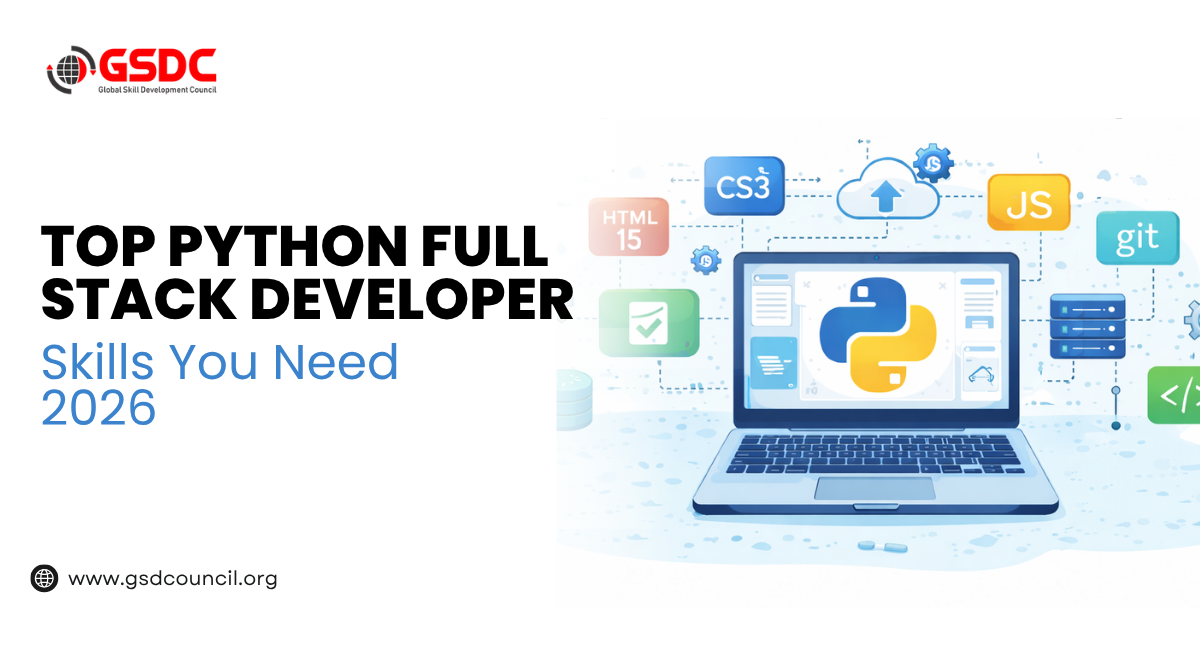
Before we get into specific roles, it helps to understand the baseline. Recruiters today are not just looking for someone who "knows HTML and a bit of backend." The bar has moved up. Here are the full stack developer skills that show up most often in current job postings:
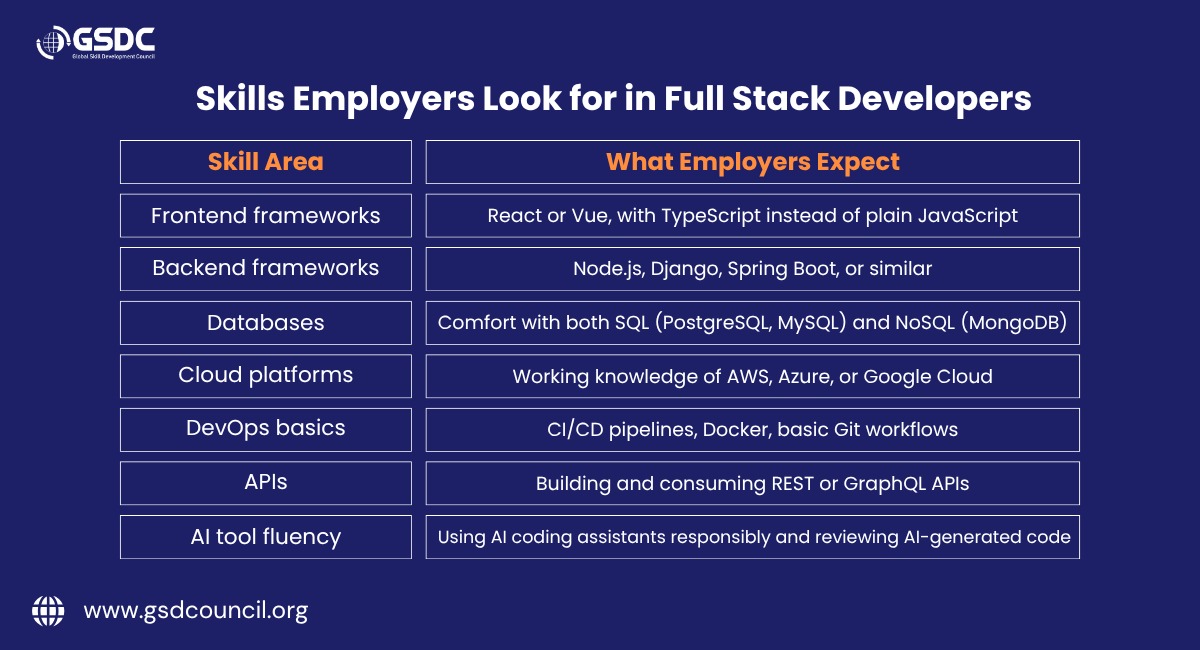
A quick data point worth noting: the Stack Overflow 2024 Developer Survey found that TypeScript is used by 43.4% of professional developers, up from under 30% just a few years ago. That shift is worth factoring into how you position your frontend skills on a resume or in an interview, since TypeScript proficiency has become a common baseline expectation in many job postings rather than a nice-to-have extra.
If you are still building toward this skill set, a structured credential like Certified Full Stack Developer can help you cover these areas in a logical order instead of piecing them together from scattered tutorials, especially if you are coming from a non-technical background or switching careers.
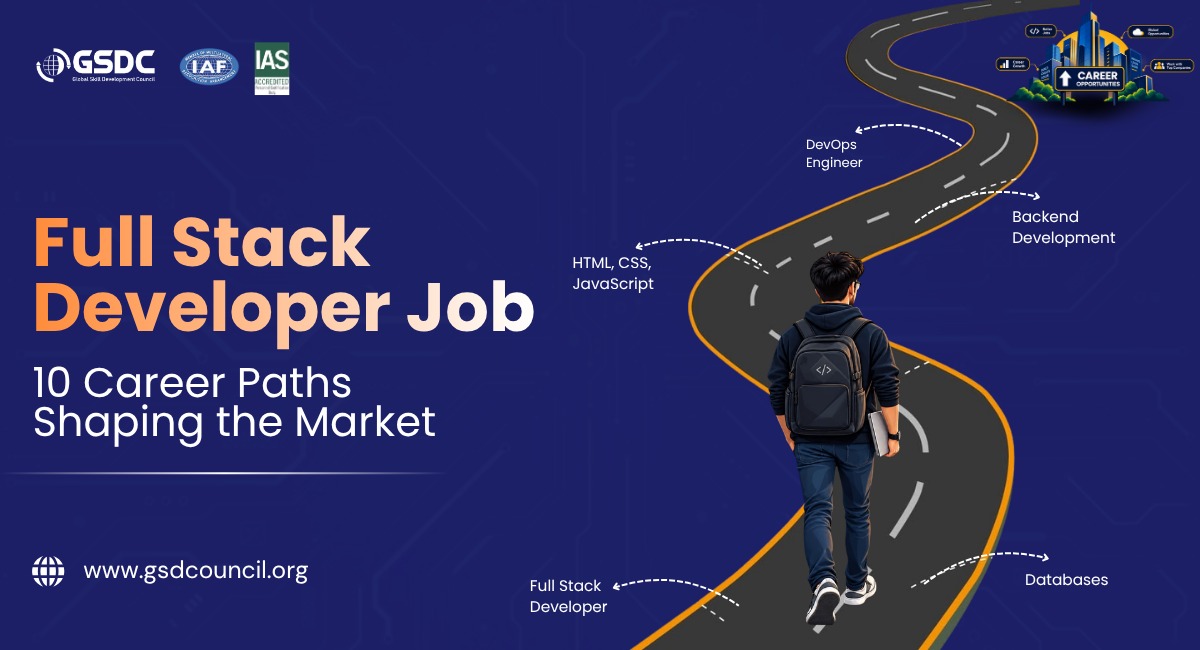
10 Full Stack Developer Career Paths to Know
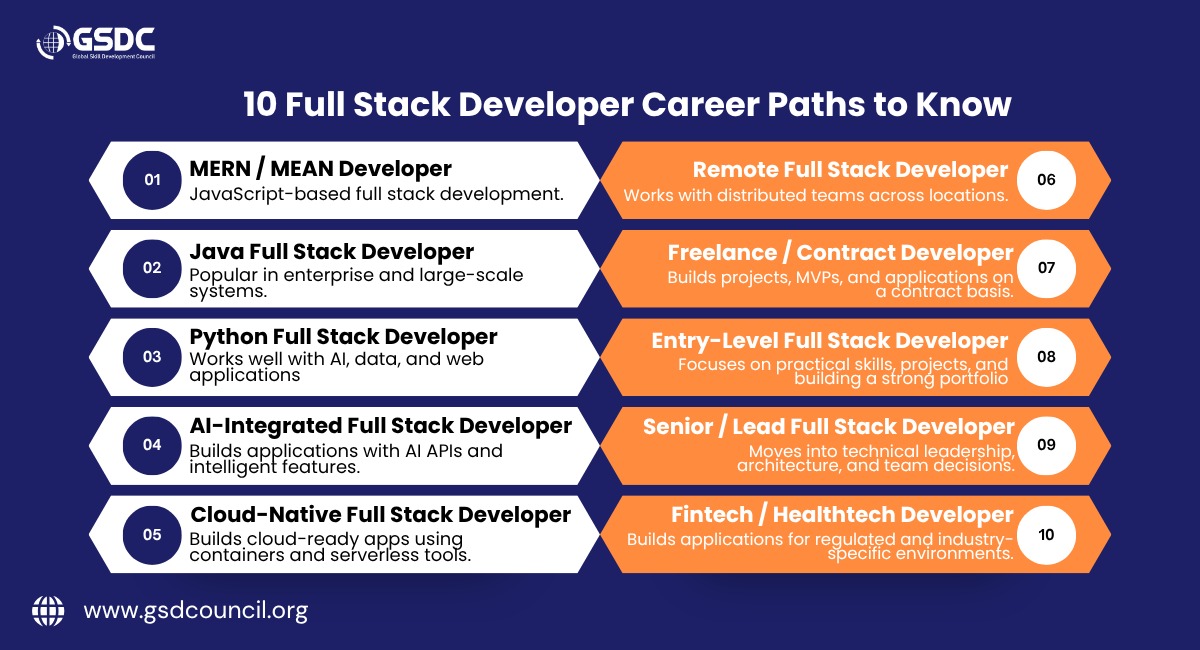
Here is where things get specific. These 10 career paths sit under the full stack umbrella, and they span technology stack, industry, seniority, and work arrangement rather than one single ranking. Together, they map out where the title is heading.
These are not separate job titles at every company. Think of them instead as common ways full stack careers are currently being shaped, whether by technology, industry, seniority, or work model, and most developers will touch more than one of these paths over a career.
1. MERN or MEAN Stack Developer
For many developers, MERN or MEAN remains a familiar entry point into full stack development. MERN is popular because it lets developers work across the application stack using a largely JavaScript-based technology ecosystem.
2. Java Full Stack Developer
Java full stack developer jobs remain one of the steadiest categories, especially in banking, insurance, and large enterprise systems. Azul's 2025 State of Java Survey, run by Dimensional Research across more than 2,000 qualified respondents, found that 99% of organizations surveyed actively use Java somewhere in their systems, and nearly seven in ten said more than half of their applications run on Java or the JVM. If you are targeting a large, established company, Java is far from outdated.
3. Python Full Stack Developer
Python full stack developer jobs have grown quickly because Python pairs naturally with AI and data-heavy products. A developer who can build a Django or Flask backend and also understand basic machine learning workflows is in a strong position right now, particularly in fintech, healthtech, and analytics-driven companies.
4. AI-Integrated Full Stack Developer
This is one of the newer specializations emerging within full stack development. Companies want developers who can wire AI APIs (like language models or recommendation engines) directly into web applications, not just use AI tools to write code faster.
5. Cloud-Native Full Stack Developer
These developers build applications designed for the cloud from the start, using containers, serverless functions, and managed databases. As cloud infrastructure has become the default for new products, this combination of skills has become increasingly valuable.
6. Remote Full Stack Developer
Remote full stack developer jobs have become their own hiring category, with companies actively building distributed teams across countries. This has opened doors for skilled developers outside major tech hubs, as long as they can prove strong communication and self-management skills alongside technical ability.
7. Freelance and Contract Full Stack Developer
Platforms and agencies are increasingly hiring full stack developers on a project basis rather than full time, especially for short-term product builds, MVPs, and startup prototypes. This can be a flexible path for developers who prefer project-based work.
8. Entry-Level Full Stack Developer
Entry level full stack developer jobs and full stack developer jobs for freshers are still widely available, but the expectations have shifted. Employers now expect freshers to arrive with a working portfolio, not just theoretical knowledge from a course. Practical, project-based learning matters more than ever here.
9. Senior or Lead Full Stack Developer
With experience, full stack developers naturally move into technical lead, architect, or engineering manager roles. Their broad understanding of both frontend and backend systems makes them a natural fit for decisions that touch the whole product.
10. Fintech or Healthtech Full Stack Developer
Industry-specific full stack roles are growing fast because regulated industries need developers who understand both the technology and the domain, whether that is payment systems, compliance, or patient data handling.
Whichever of these paths you are aiming for, the underlying skill set overlaps more than it differs. This is where a body like the Global Skill Development Council (GSDC) can be useful, since its structured certification tracks are built around the same core competencies (frontend, backend, databases, cloud) that show up across almost every path on this list, rather than locking you into just one of them.
Full Stack Developer Salary: What to Expect
Salary is usually the first question on everyone's mind, so let us keep it simple. Rather than guessing at experience-level bands, here is what the BLS Occupational Outlook Handbook actually reports for software developers nationally, as of May 2025:
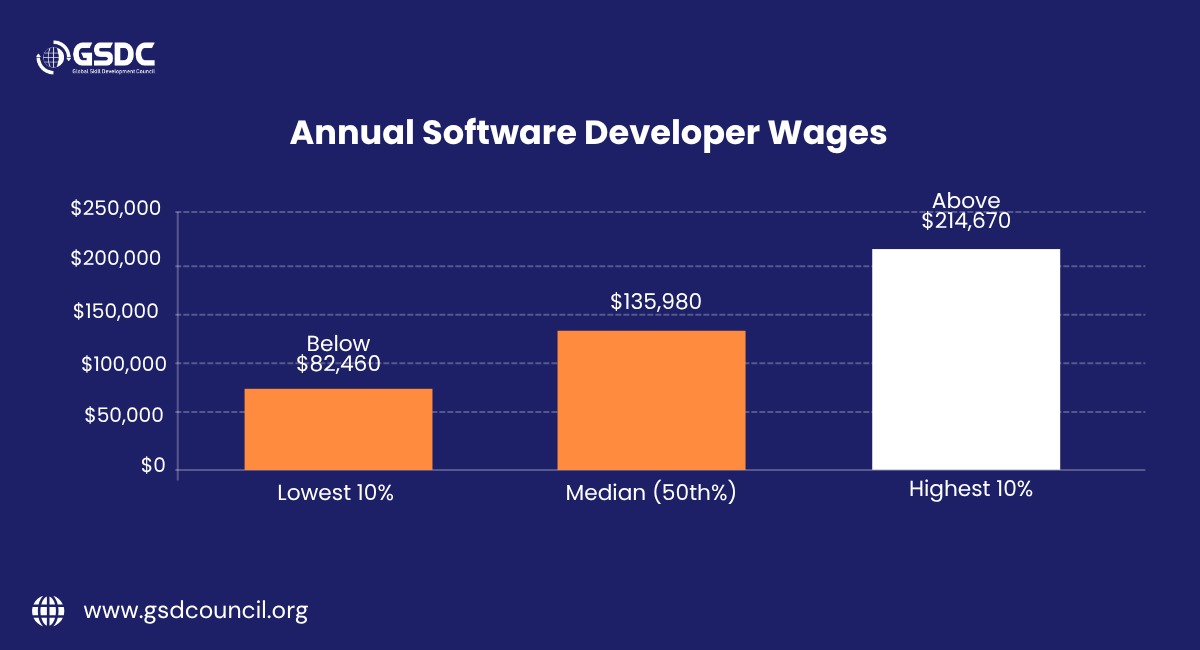
In practice, that spread roughly maps to career stage: developers near the start of their career tend to land closer to the lower end, mid-career developers cluster around the median, and senior, staff, or specialized full stack developers (particularly those with cloud, AI, or architecture skills, or those at well-funded startups offering equity) push toward the top. Location matters too: pay in major tech hubs like the Bay Area, Seattle, or New York typically runs above the national figures shown here, while smaller markets often run below them.
Outside the US, ranges obviously look different, but the pattern holds everywhere: full stack developer salary grows fastest for those who combine strong technical depth with cloud or AI-related skills, not just years of experience alone.
How to Hire Full Stack Developer Talent the Right Way
If you are on the hiring side rather than the job-seeking side, a few practices consistently separate good hires from bad ones:
- Test real scenarios, not trivia - Ask candidates to walk through a small project end to end rather than answering theory questions.
- Check both ends of the stack - Someone strong in React but weak on databases is not truly full stack, even if the resume says so.
- Value communication - Especially for remote full stack developer jobs, the ability to explain decisions clearly matters as much as code quality.
- Look for adaptability - Given how fast tools change, a developer who has learned three frameworks in five years is a safer bet than one who has only ever used one.
Companies that want to hire full stack developer talent quickly are also increasingly relying on structured assessments and certification checks to shortlist candidates faster, rather than reading through hundreds of resumes manually.
Building a Full Stack Developer Resume That Gets Noticed
A strong full stack developer resume needs to do a few things well:
- Lead with projects, not job titles. Recruiters want to see what you actually built.
- Mention the full stack clearly. List both frontend and backend technologies, not just one side.
- Add measurable outcomes. "Reduced page load time by 40%" says more than "worked on frontend performance."
- Include cloud and deployment experience. Even basic AWS or Docker knowledge stands out.
- Keep it to one or two pages. Long resumes get skimmed, not read.
- Add a link to your GitHub or portfolio. For developers, this often matters more than the resume itself.
Common Full Stack Developer Interview Questions
If you are preparing for interviews, expect a mix of technical and practical questions such as:
- Walk me through how you would build a simple application from scratch, front end to back end.
- How do you handle state management in a React application?
- What is the difference between SQL and NoSQL, and when would you choose one over the other?
- How would you design a REST API for a given use case?
- How do you approach debugging an issue that spans both frontend and backend?
- What is your process for reviewing or improving AI-generated code?
- How do you handle authentication and authorization in a web application?
The pattern across most full stack developer interview questions is simple: interviewers care less about memorized definitions and more about how you think through a real problem.
Full Stack Developer Roadmap: How to Get There
If you are starting from scratch, here is a simplified full stack developer roadmap that reflects what is actually working right now:
- Learn the fundamentals. HTML, CSS, and JavaScript (with TypeScript soon after).
- Pick one frontend framework. React remains a widely used frontend framework, making it a practical option for developers entering full stack development.
- Pick one backend language and framework. Node.js, Python with Django, or Java with Spring Boot are all solid options.
- Learn databases. Start with one SQL database and one NoSQL database.
- Understand APIs. Build and consume REST APIs comfortably.
- Get comfortable with Git and basic DevOps. Version control, simple CI/CD, and Docker basics.
- Learn cloud fundamentals. Even a basic understanding of AWS or Azure adds real value.
- Build real projects. Three to five solid, deployed projects matter more than ten tutorials.
- Practice with AI tools. Learn to use them well, not blindly.
- Keep learning. The stack that is popular today will shift in two to three years, and adaptability is the real long-term skill.
Do You Need a Full Stack Developer Certification?
Once you have the technical foundation and a few real projects behind you, certification can be another way to document what you have learned. It will not replace hands-on project experience, but it does help in a few specific ways:
- It signals structured learning to recruiters who are scanning hundreds of resumes.
- It fills gaps for self-taught developers who may have missed foundational concepts.
- It can shorten the learning curve when paired with real projects rather than used alone.
- It helps career switchers build credibility faster in a competitive market.
The most useful certifications combine practical, project-based learning with recognized industry validation, rather than relying only on video lectures and quizzes. This is exactly the gap the Global Skill Development Council (GSDC) is built to close. Its Certified Full Stack Developer credential is designed around the skills employers actually screen for, covering frontend and backend frameworks, databases, APIs, and cloud fundamentals in one structured path rather than something you have to piece together yourself. For freshers, it is a credible way to stand out. For working developers, it formalizes skills picked up on the job and signals readiness for a senior or lead-level path.

Final Thoughts
Full stack developer jobs are not disappearing, they are evolving. The developers who will do best are the ones who treat "full stack" as a foundation, not a finish line, and keep adding cloud, AI, and specialization skills on top of it.
Whether you are a fresher trying to land your first role, a working developer aiming for a salary jump, or a company trying to hire full stack developer talent that will actually deliver, the career paths and data in this blog should give you a realistic starting point.

Related Certifications
Frequently Asked Questions
A frontend developer focuses on what users see and interact with, such as layout, design, and browser behavior. A backend developer focuses on servers, databases, and application logic. A full stack developer works across both sides, which is why full stack developer skills usually span a frontend framework, a backend framework, and a database, rather than deep specialization in just one layer.
Not necessarily. Many full stack developers are self-taught or come from bootcamps and build their case through projects and a portfolio rather than a degree alone. That said, a degree can still help at larger, more traditional employers where formal education is part of the screening process. What tends to matter most across the board is demonstrated, working project experience.
This varies a lot by starting point and effort, but most structured, project-based learning paths take somewhere in the range of several months to about a year to reach a job-ready level. The full stack developer roadmap earlier in this blog is a reasonable sequence to follow, and consistency in building real projects tends to matter more than the total calendar time spent.
Based on current BLS projections, yes. The broader software developer category, which includes most full stack roles, is projected to grow faster than average through 2035, with well over 100,000 openings expected each year. That said, as this blog covers, the field is specializing, so developers who pair full stack fundamentals with a focus area like cloud, AI integration, or a specific industry tend to be better positioned than pure generalists.
Yes, and remote full stack developer jobs have become a well-established hiring category rather than an exception. Many companies now hire full stack developers across countries and time zones, though remote candidates are often evaluated more heavily on communication, self-management, and the ability to work with minimal supervision, alongside technical skill.
Stay up-to-date with the latest news, trends, and resources in GSDC
If you like this read then make sure to check out our previous blogs: Cracking Onboarding Challenges: Fresher Success Unveiled
Not sure which certification to pursue? Our advisors will help you decide!