Generative AI in Algorithmic Trading and Wealth Management: Advanced Applications
Written by Emily Hilton
- What Is Generative AI in Financial Markets?
- Generative AI and Algorithmic Trading
- Advanced Applications of Algorithmic Trading AI
- Generative AI in Wealth Management
- Generative AI for Personalized Investment Strategies
- Generative AI in Finance and Accounting
- Generative AI Applications in Banking
- Managing Algorithmic Bias in Generative AI
- Risk and Governance Considerations
- Building Generative AI Skills for Finance Professionals
- Conclusion
Financial markets are becoming increasingly data-driven. Every day, banks, investment firms, hedge funds, and wealth managers process large volumes of market data, financial reports, economic indicators, customer information, and news. Traditional analytics and automation can process much of this information, but Generative AI is opening new possibilities for understanding data, generating insights, and supporting financial decisions.
The use of generative AI in finance is moving beyond chatbots and document summarization. Financial institutions are exploring Generative AI for market research, investment analysis, portfolio management, risk assessment, trading strategy development, and personalized wealth management.
When combined with algorithmic trading systems, Generative AI can help financial professionals analyze complex information and develop more adaptive approaches to decision-making. However, these opportunities also come with challenges involving accuracy, security, explainability, and algorithmic bias in generative AI.
What Is Generative AI in Financial Markets?
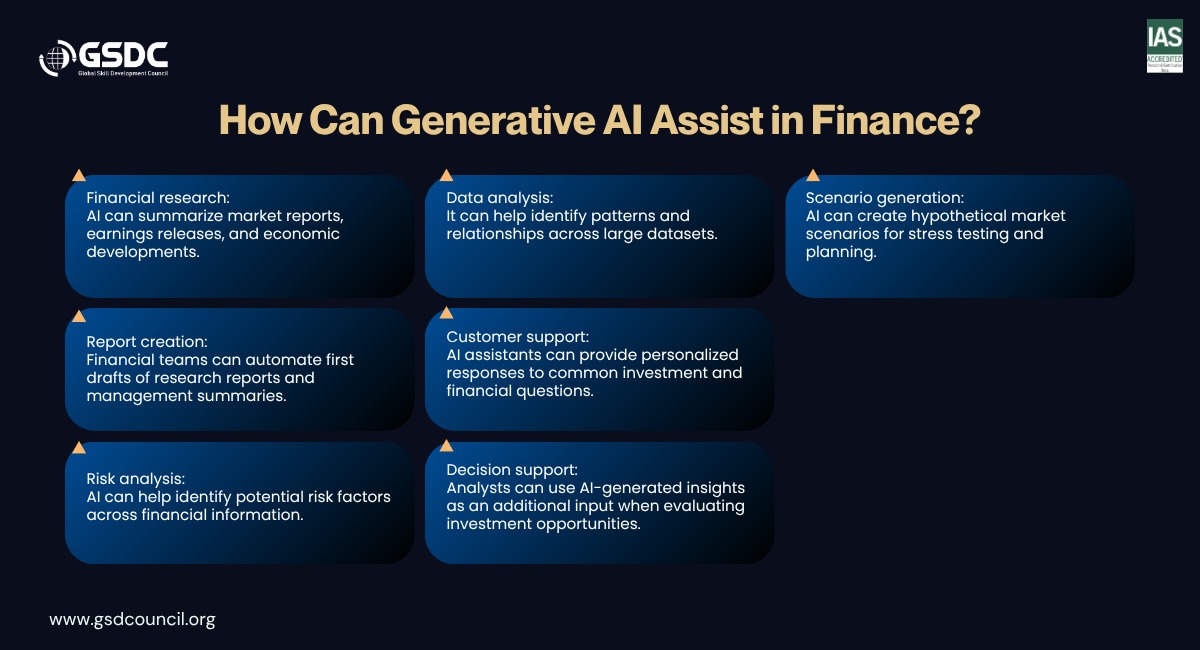
Generative AI refers to AI systems that can create new content based on patterns learned from large datasets. This content can include text, summaries, scenarios, code, reports, and structured insights.
In financial markets, Generative AI can analyze information from earnings reports, financial statements, economic announcements, market news, research reports, and historical market data. Instead of simply presenting raw information, AI systems can help transform it into understandable insights.
For example, an investment analyst could use an AI system to summarize hundreds of company filings, identify changes in financial performance, compare companies, and generate questions for further analysis.
This makes Generative AI particularly useful in environments where professionals need to process information quickly.
Generative AI and Algorithmic Trading
Algorithmic trading uses computer systems to execute trading strategies according to predefined rules or models. These systems can process market information much faster than humans and can execute trades based on specific conditions.
The combination of ai algorithmic trading and Generative AI can introduce additional capabilities.
Traditional algorithmic systems usually depend on predefined strategies. Generative AI can help financial teams explore new strategies, generate hypotheses, analyze unstructured information, and explain complex market signals in natural language.
For example, an AI system could analyze financial news, earnings announcements, and analyst reports alongside structured market data. It could then identify potential factors that may influence market sentiment.
This does not mean Generative AI should independently decide when to buy or sell an asset. Instead, it can act as an intelligent layer supporting existing trading systems.
Advanced Applications of Algorithmic Trading AI
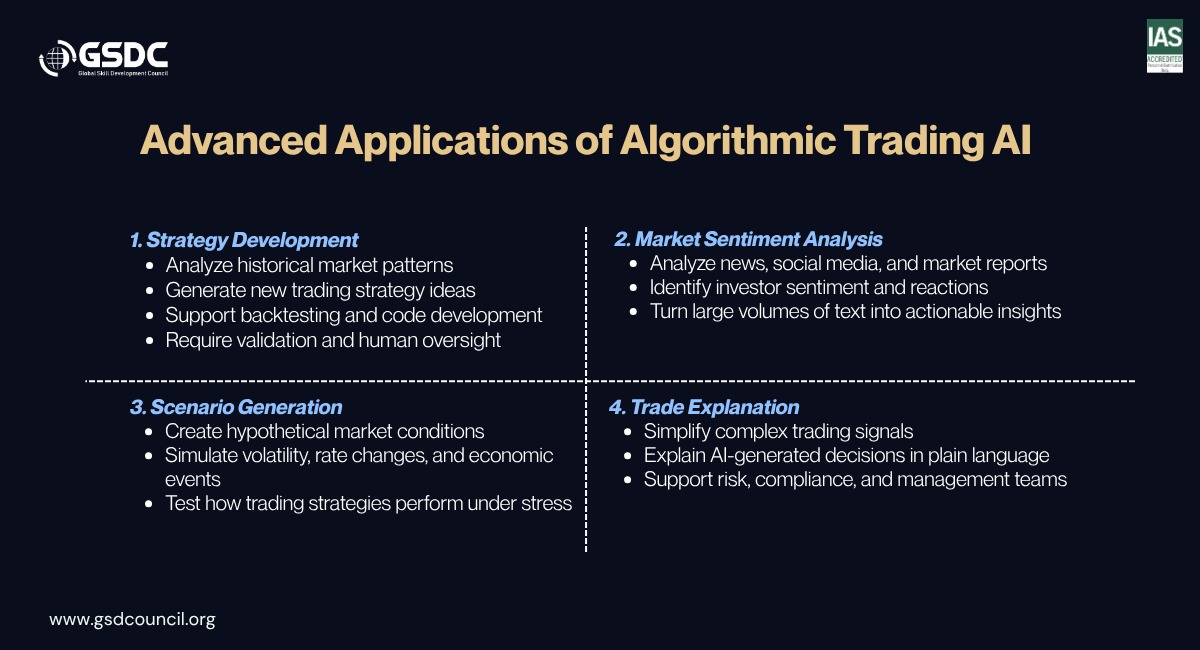
The role of algorithmic trading AI can extend across several stages of the trading lifecycle.
1. Strategy Development
Generative AI can help analysts explore potential trading strategies by examining historical patterns and generating strategy ideas. It can also assist developers in writing or modifying code used for backtesting.
For example, a trader may ask an AI system to develop a strategy based on momentum indicators, volatility levels, and market sentiment. The proposed strategy can then be tested using historical data.
The AI-generated strategy should not automatically be considered reliable. Backtesting, validation, risk assessment, and human review remain essential.
2. Market Sentiment Analysis
Market sentiment is influenced by news, social media, corporate announcements, economic events, and investor expectations.
Generative AI can process large volumes of unstructured text and summarize sentiment across different sources. This can help traders understand how market participants may be reacting to a particular event.
3. Scenario Generation
Generative models can create hypothetical market conditions for testing trading strategies.
For example, financial institutions can simulate scenarios involving sudden interest-rate changes, market volatility, economic slowdowns, or unexpected corporate events.
These scenarios can help organizations understand how trading strategies may behave under different conditions.
4. Trade Explanation
Complex algorithmic systems can sometimes be difficult for non-technical stakeholders to understand.
Generative AI can translate technical signals and model outputs into plain-language explanations. This can make it easier for risk teams, managers, and compliance professionals to understand why a particular strategy generated a signal.
Generative AI in Wealth Management
Wealth management is another area where Generative AI can have a significant impact. Wealth managers need to understand client goals, financial situations, risk preferences, investment horizons, and changing market conditions.
Generative AI can support advisors by helping them prepare personalized investment communications, summarize portfolios, and generate research-based insights.
For example, an advisor could use AI to create a simple explanation of how market movements affected a client's portfolio. Instead of providing a technical report filled with financial terminology, the AI system can generate an easier-to-understand summary.
Generative AI can also support portfolio reviews by comparing asset allocations against predefined investment objectives and identifying areas that may require further attention.
The final investment recommendation, however, should remain under appropriate human oversight.
Generative AI for Personalized Investment Strategies
Personalization is becoming increasingly important in wealth management. Different investors have different objectives, risk tolerances, investment horizons, and financial circumstances.
Generative AI can help advisors create customized financial content and investment scenarios for different client profiles.
For example, a wealth manager could generate separate explanations for a conservative investor and a growth-oriented investor when discussing the same market event.
AI can also help automate routine communications such as portfolio updates, market summaries, educational content, and meeting preparation.
This allows advisors to spend more time on complex financial planning and client relationships.
Generative AI in Finance and Accounting
The applications of AI are not limited to trading and investments. Generative AI in finance and accounting can support financial reporting, reconciliation, forecasting, documentation, and analysis.
Finance teams can use AI to summarize financial statements, explain changes in expenses, prepare management reports, and identify unusual patterns for further investigation.
For accounting professionals, Generative AI can reduce time spent on repetitive documentation and information retrieval.
This broader adoption of AI demonstrates how generative AI in banking and financial services is becoming part of everyday business operations rather than being limited to experimental projects.
Generative AI Applications in Banking
Banks handle enormous amounts of structured and unstructured information. This makes generative AI applications in banking particularly valuable.
Potential applications include:
- Customer service and AI-powered banking assistants
- Fraud and risk investigation support
- Credit analysis and document review
- Financial report generation
- Regulatory and compliance documentation
- Personalized financial education
- Internal knowledge management
- Employee productivity tools
Banks can also use Generative AI to help employees retrieve information from internal policies and procedures. However, sensitive financial information requires strong access controls, privacy safeguards, and governance.
Managing Algorithmic Bias in Generative AI
One of the major concerns when using AI in financial decision-making is algorithmic bias in generative AI.
AI models learn from data, and historical financial data can contain biases or incomplete representations. If these patterns are not identified, an AI system could produce unfair or unreliable recommendations.
For example, an AI-supported financial assessment system may unintentionally produce different outcomes for different customer groups if the underlying data contains historical bias.
Financial institutions should therefore implement regular model testing, bias monitoring, data-quality controls, human oversight, and clear governance policies.
Explainability is equally important. Organizations should be able to understand how AI-generated outputs are being used in important financial decisions.
Risk and Governance Considerations
The benefits of Generative AI must be balanced against its risks. Financial institutions operate in highly regulated environments, making governance especially important.
Key considerations include:
- Data privacy and security
- Model accuracy
- Hallucinated or fabricated information
- Regulatory compliance
- Model explainability
- Bias and fairness
- Human oversight
- Auditability
- Third-party AI risks
Organizations should establish clear rules for where Generative AI can be used and where human approval is mandatory.
A strong AI governance framework can help financial institutions adopt new technology while maintaining accountability and regulatory control.
Building Generative AI Skills for Finance Professionals
As financial organizations expand their use of AI, professionals need to understand both financial concepts and AI capabilities.
GSDC’s generative AI certification can help professionals build structured knowledge of Generative AI concepts, applications, risks, and governance. For professionals working specifically across financial services, Generative AI in Finance and Banking Certification provides targeted learning around AI use cases in banking, investments, financial operations, risk management, and decision-making.
These learning paths can be useful for finance professionals, technology teams, risk managers, business leaders, and professionals involved in AI transformation.
Conclusion
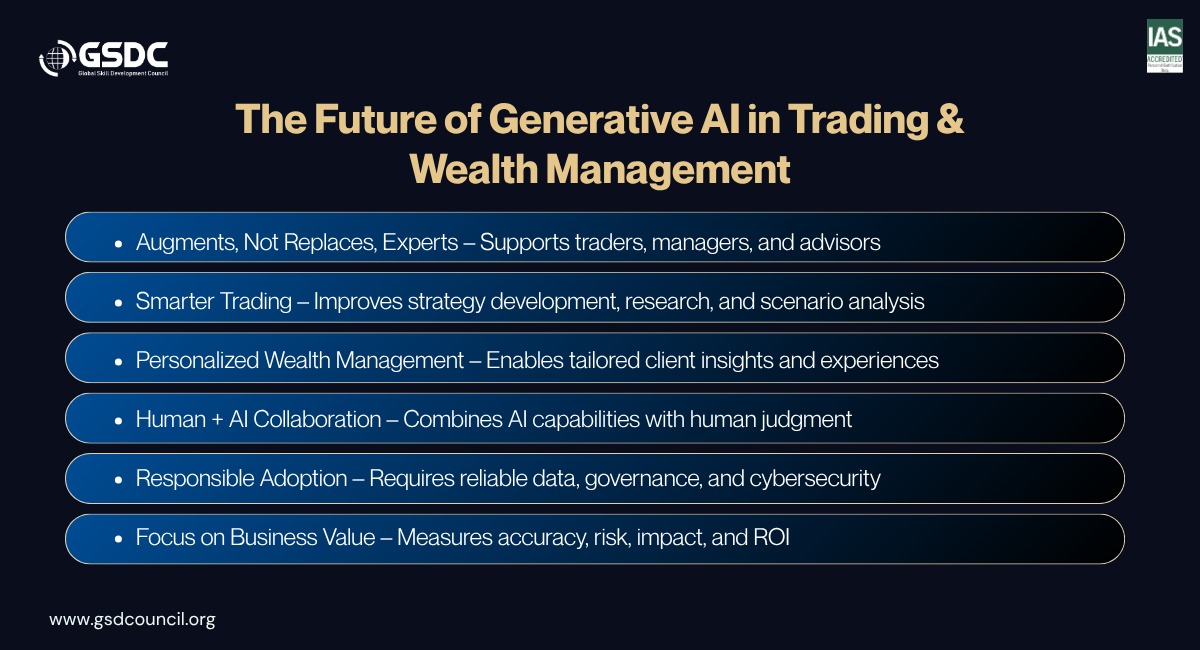
Generative AI is creating new opportunities across algorithmic trading and wealth management. From market sentiment analysis and trading strategy development to personalized investment communication and financial reporting, its applications are expanding rapidly.
At the same time, financial institutions must recognize that AI-generated outputs are not automatically accurate or unbiased. Strong governance, human oversight, data controls, and responsible AI practices are essential for safe adoption.
Organizations that combine Generative AI with financial expertise and effective governance can use the technology to improve productivity, strengthen decision support, and create more personalized financial services. The goal is not simply to automate financial decisions, but to build smarter systems that help professionals make better-informed decisions.

Related Certifications
Stay up-to-date with the latest news, trends, and resources in GSDC
If you like this read then make sure to check out our previous blogs: Cracking Onboarding Challenges: Fresher Success Unveiled
Not sure which certification to pursue? Our advisors will help you decide!