Agentic AI Is Changing How Software Gets Built
Written by Matthew Hale
- What Is Agentic Coding?
- What an agentic workflow looks like
- Using AI Every Day Is Not the Same as Trusting It
- Why AI code review is a smart place to start
- Choosing AI Tools for Software Development
- Outsourcing: The Question Has Changed
- What is changing in the outsourcing model
- How to compare outsourcing partners
- Cloud Apps: Go Fast Where It's Safe
- Mobile Delivery: Faster Updates, Same Standards
- What Is the Future of Software Development?
- Skills That Show You Can Work With Agents
- Final Thoughts
The biggest change in software development may not be that AI can write code. It's that AI is starting to take on the work around the code: planning it, testing it and fixing it when it breaks.
That shift is happening fast. In Stack Overflow's 2025 survey, 84% of developers said they use or plan to use AI tools, up from 76% the year before. For anyone following AI software development, the real question is no longer whether teams will use AI. AI is becoming ordinary. The advantage is shifting from having it to knowing how to use it and govern it.
This blog looks at what that means in practice. We will cover what agentic coding actually is, how it changes day-to-day development, what to ask when you hire an outsourcing partner, how cloud and mobile projects are affected, and which skills will matter most in the years ahead.
What Is Agentic Coding?
So what exactly is agentic coding? It's when an AI system takes a goal, breaks it into steps, writes the code, runs tests, fixes errors, and reports back, with very little hand-holding.
The easiest way to see the difference is this. A code assistant is like handing someone a better tool. An AI coding agent is closer to handing someone a ticket and letting them work through it.
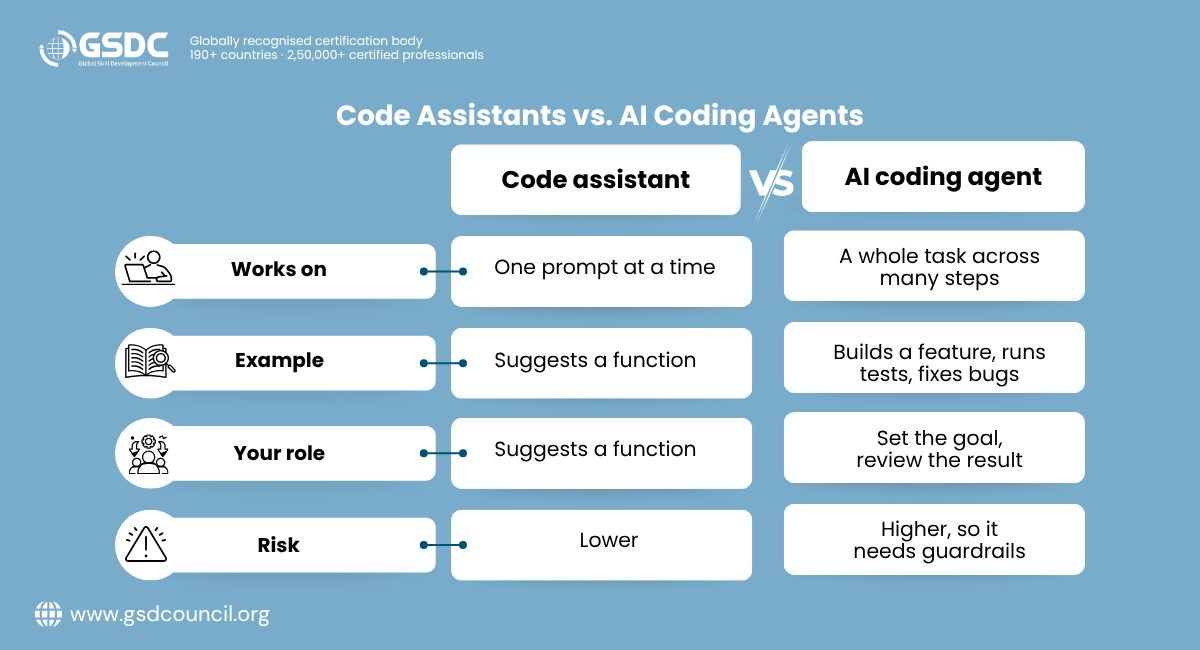
Agents are still early, and most developers haven't adopted them yet. But those who have tend to report that they save time on repetitive work, which is why interest keeps growing.
What an agentic workflow looks like
Imagine a team needs a new "forgot password" feature. In the old way of working, a developer writes the code, writes the tests, checks for errors and opens a pull request. With an agent, the flow looks more like this:
- A person describes the goal and the rules, such as security requirements and coding standards.
- The agent reads the existing code to understand how the project is built.
- It writes the new code, adds tests and runs them.
- If something fails, it tries to fix the problem and runs the tests again.
- It opens a pull request with a short summary of what it changed.
- A human reviews the work, asks for changes and approves it.
The important part is step six. The agent does the legwork, but a person still owns the decision. Teams that skip that step are the ones who run into trouble.
It also shows why the developer's role is shifting. Steps one and six, setting a clear goal and judging the result, are now the skills that matter most, and they are not learned by simply switching on a tool. This is the kind of ground a programme like an Agentic AI Developer Certification tends to cover, from writing precise instructions for agents to reviewing what they produce and keeping the process safe.
Using AI Every Day Is Not the Same as Trusting It
Plenty of developers now lean on AI daily, yet trust hasn't kept pace. The same Stack Overflow survey found that 46% of developers don't trust the accuracy of AI output, a clear jump from the year before. People like the speed, but they still want a human to check the work.
The most common complaint is easy to understand. AI answers are often almost right, and almost right can be more time-consuming than clearly wrong, because the mistake is hard to spot. That is exactly why review matters so much.
Why AI code review is a smart place to start
If your team is new to AI, AI code review is one of the safest and most useful starting points. A review tool reads each change before a human does and flags things such as:
- Missing input checks and weak error handling
- Repeated code that should be simplified
- Common security mistakes, such as exposed keys or unsafe queries
- Style problems that slow down reviews
This does not replace a senior engineer. It clears away the routine problems so that experienced people can spend their time on design, logic and the questions only a human can answer, such as "Is this the right way to build it?"
Choosing AI Tools for Software Development
There is no single winner, and the market changes every few months. Most teams end up using a mix of AI software development tools, depending on the job:
- Code assistants that suggest lines or functions as you type
- AI coding agents that take a task, edit several files and open a pull request
- Review tools that scan changes for bugs and security gaps
- Testing tools that generate test cases and spot weak areas
- Documentation tools that keep technical docs in step with the code
Rather than chasing the newest tool, ask a few simple questions before you commit:
- Does it fit our stack and our cloud setup?
- Can we control exactly what code and data it can see?
- Does it show its work so a person can verify it?
- Does it keep our code private?
- Will our team actually use it every week?
That last question gets overlooked. A modest tool that your team uses well is worth more than a powerful one that sits unused.
It also shows why the developer's role is shifting. Steps one and six, setting a clear goal and judging the result, are now the skills that matter most, and they are not learned by simply switching on a tool. Learning bodies such as the Global Skill Development Council (GSDC) are focused on building exactly these skills, from writing precise instructions for agents to reviewing what they produce and keeping the process safe.
Outsourcing: The Question Has Changed
Almost every vendor now says they use AI. That makes "Do you use AI?" a useless question. The better one is "How do you use it, and how do you check it?"
This is where one software development outsourcing partner can really separate itself from another. Strong partners can answer four things clearly:
- How AI-written code is reviewed before it reaches you
- Who owns the code and the data
- What security checks run automatically
- What delivery results they can show from past projects
What is changing in the outsourcing model
Agentic AI also changes what you are paying for. A few skilled engineers working with agents can cover work that once needed a bigger team, so the best software development outsourcing services are moving away from selling hours and toward selling outcomes.
For buyers, that brings a few real shifts:
- Faster early drafts: Prototypes and first versions of features can appear in days rather than weeks.
- Smaller, more senior teams: Less time goes on routine coding, so experience matters more.
- Pricing tied to results: Fixed scopes and milestone-based contracts become easier to offer.
- A higher bar for quality: When everyone has the same tools, process and testing are what set partners apart.
Having AI is no longer the edge. Governing it well is.
How to compare outsourcing partners
If you are shortlisting a software development outsourcing company, a few direct questions will tell you more than any brochure:
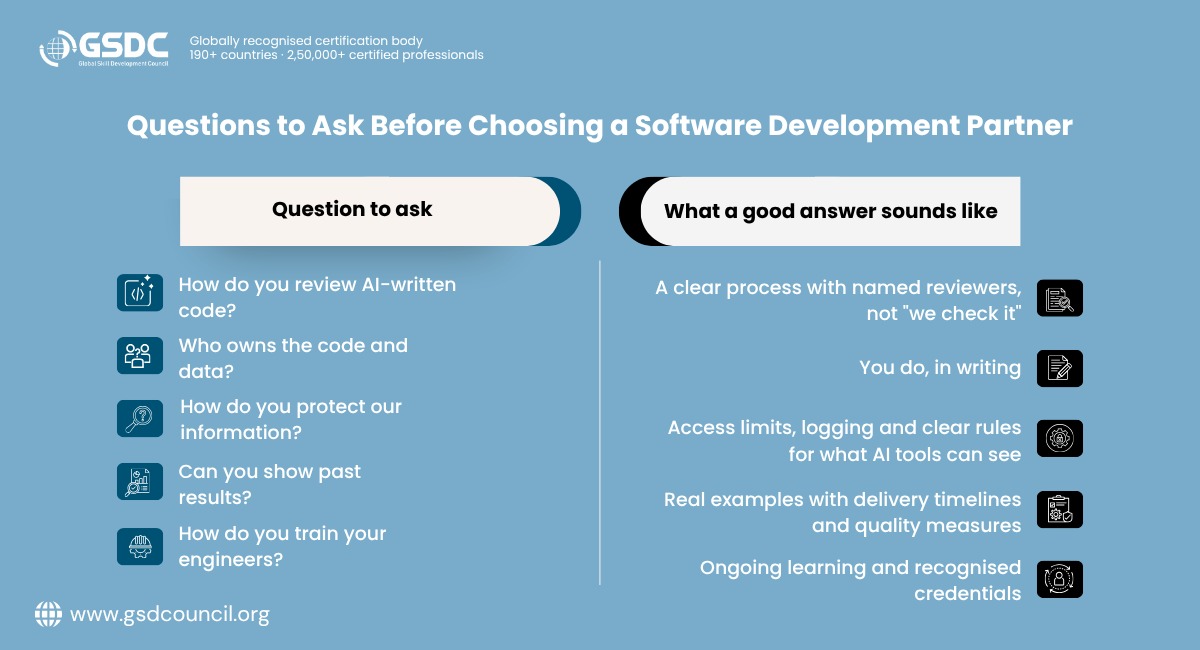
A word of caution about agentic claims: Gartner has warned that many vendors are overstating what their products can do. Gartner calls the practice of relabelling older products, such as chatbots, as agentic "agent washing." So if a provider offers agentic AI software development services, ask to see a working example, not just a demo. A real project, with real constraints, tells you far more than a polished presentation.
Cloud Apps: Go Fast Where It's Safe
Cloud and AI now go together, and building on an AI cloud platform is becoming normal for many teams. Agentic AI is changing the relationship further. Agents can help teams build, test and manage cloud applications, and they are especially useful for the repetitive parts of cloud application development:
- Writing and updating infrastructure code
- Generating tests for APIs and small services
- Flagging resources that cost more than they should
- Suggesting fixes when a deployment fails
- Keeping documentation in step with the code
But the closer they get to production, the more important human oversight becomes. Developers seem to feel the same way. In the Stack Overflow survey, deployment and monitoring was the task they were most reluctant to hand over to AI. That caution makes sense. A bad suggestion in a test file is a small problem. A bad change in a live system is not.
A simple safety approach for cloud teams
Teams that get good results tend to follow a few plain rules:
- Sandbox first: Let agents work in a safe test environment before they touch anything real.
- Human approval before release: Nothing goes live without a person signing off.
- Least access: Give an agent only the permissions the task needs, and nothing more.
- Keep a record: Log what the agent did and why, so problems are easy to trace.
- Make rollback easy: Assume something will go wrong sometimes, and be ready to undo it quickly.
None of this slows a team down much, and it prevents most of the painful mistakes.
Mobile Delivery: Faster Updates, Same Standards
Mobile teams juggle a lot: two main platforms, many screen sizes, strict app store rules and constant release cycles. That makes the work well suited to agents, because so much of it is repeatable. Agents can help with:
- Building screens from design files
- Writing unit and interface tests
- Spotting crash patterns and suggesting fixes
- Preparing release notes
- Checking basic accessibility
This is a big reason mobile app development outsourcing is getting attention. A partner that pairs strong mobile engineers with well-managed AI workflows can ship updates faster while you stay in control of the product direction.
Speed still isn't quality, though. Users and app store reviewers care about performance, battery use and privacy, and no agent can tell you how an app feels in someone's hand. Testing on real devices and listening to real user feedback stays non-negotiable.
What Is the Future of Software Development?
Nobody can predict it exactly, but Gartner's forecasts point in two directions at once. It expects 33% of enterprise software applications to include agentic AI by 2028, up from less than 1% in 2024. In the same report, it predicts that more than 40% of agentic AI projects will be canceled by the end of 2027 because of cost, unclear business value or weak risk controls.
Both can be true. The future of software development will likely bring more automation and more failed experiments, and the projects that last will be the ones with clear goals and careful review.
For developers, that points to a few changes:
- Less boilerplate, more judgment: More time on design, trade-offs and quality.
- Review as a core skill: Questioning AI-written code will matter as much as writing it.
- Testing and security matter more: Faster code means mistakes can spread faster too.
- Smaller, more senior teams: Experience counts for more when routine work is automated.
The Risks Worth Taking Seriously
Agentic AI is promising, but it is not magic. The same few risks come up again and again:
- Quiet errors: Code that looks right but fails in edge cases.
- Security gaps: Insecure patterns, exposed secrets or too-wide permissions.
- Over-reliance: Teams stop understanding code an agent wrote.
- Hype-driven projects: Starting an agent project because it sounds impressive, not because it solves a real problem.
The answer to all of them is the same: clear goals, human review and honest measurement of results.
Skills That Show You Can Work With Agents
When tools change this quickly, employers care less about which tool you used and more about whether you can direct it, check it and keep it safe. "I use AI tools" is no longer much of a signal.
The skills that stand out are fairly consistent:
- Writing clear goals and instructions for AI agents
- Reviewing AI-generated code for bugs and security risks
- Testing, monitoring and rolling back changes safely
- Following responsible AI and data privacy practices
Engineers can show these through hands-on work with agents. Product and project leaders can show them by knowing how to plan and govern agent-based projects. Structured learning helps in both cases, because it gives a hiring manager something clearer than a claim. The Global Skill Development Council (GSDC) offers an Agentic AI Developer Certification and a broader Agentic AI Certification for this purpose.

Final Thoughts
AI software development isn't about replacing developers. It's about changing where their time goes. As AI becomes standard, the teams that stand out will be the ones that guide agents well and check their work honestly.
The tools will keep changing, but the habits that matter stay the same: set clear goals, keep a person responsible for the final decision and measure what actually works. Teams that build those habits now will be ready for whatever comes next.

Related Certifications
Frequently Asked Questions
It means using AI tools to help plan, write, test, review and maintain software, which saves time and catches errors earlier.
They are tools that take a goal, work through several steps, edit code, run tests and report back. A human still reviews the final result.
An assistant answers one request at a time. An agent works through a whole task across many steps and decides what to do next along the way.
Unlikely. It changes the job more than it removes it, with more reviewing, designing and decision making.
Yes, if the partner uses AI responsibly, can show proven results and protects your code and data.
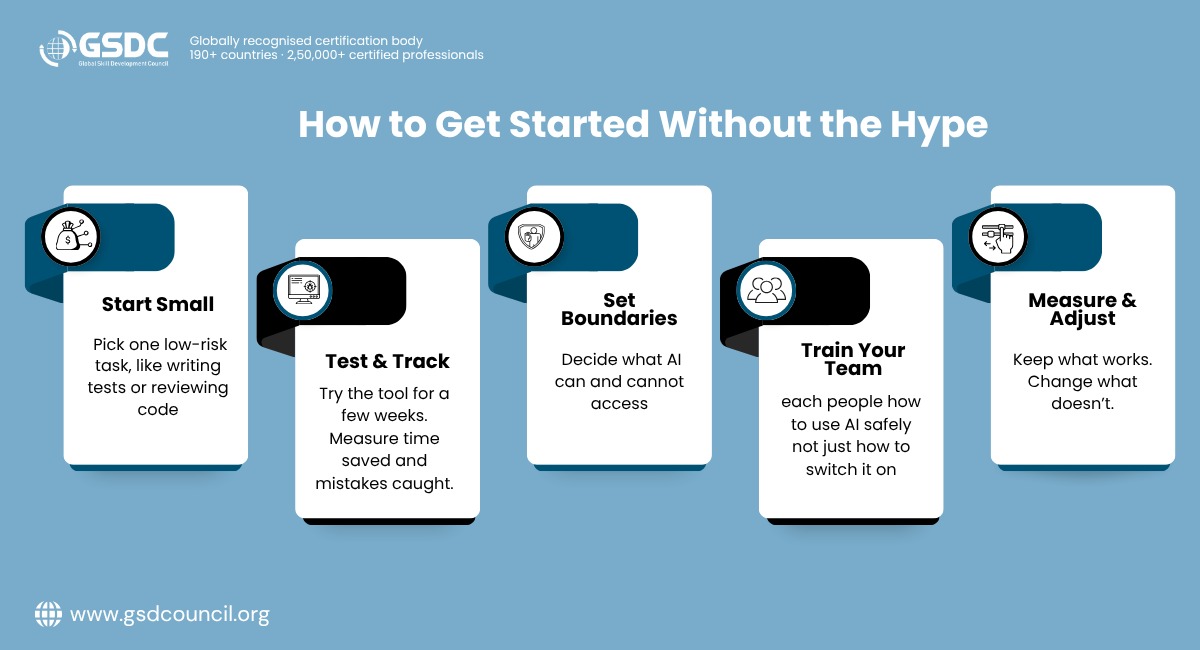
Begin with a low-risk task such as code review or test writing, measure the results for a few weeks and expand only if it helps.
Stay up-to-date with the latest news, trends, and resources in GSDC
If you like this read then make sure to check out our previous blogs: Cracking Onboarding Challenges: Fresher Success Unveiled
Not sure which certification to pursue? Our advisors will help you decide!