How Generative AI Expertise Fuels Innovation and Career Growth in 2025?
Written by Matthew Hale
- Understanding Generative AI and Its Expanding Role in Innovation
- How AI is Transforming Industries in 2025
- The Rise of AI-Powered Productivity and Digital Transformation
- Career Growth in the Age of Generative AI
- Generative AI as a Catalyst for Innovation
- Navigating the Future of Work with AI
- Generative AI in Business: From Strategy to Execution
- Regional Growth and Global Impact
- Preparing for the AI-Driven Career Future
- The Convergence of Innovation and Opportunity
Generative Artificial Intelligence (AI), in 2025, is no longer a technological breakthrough, but it is a revolution that is reshaping industries, creativity, and career building around the world.
Generative AI knowledge used to be perceived as a niche skill that only data scientists and AI engineers could possess, but it has now become a part of professional competence.
From marketing to software engineering and finance to healthcare, AI-based productivity is changing the way organizations work and the way professionals are moving up the career ladder.
The new digital fluency is the understanding of how Generative AI functions and its implementation on real-life issues. With the expansion of the applications of Generative AI, companies are rethinking complete work processes in terms of Content Creation and product design, process automation, and strategic decision-making.
Lightcast 2025 statistics indicate that the number of job openings that demand Generative AI-related skills has increased by an incredible margin, with most of them being published in the first half of 2021, which is 55 positions, but by mid-2025, the number of openings that demand these skills has almost doubled, reaching up to 10,000 positions.
Understanding Generative AI and Its Expanding Role in Innovation
So, what is Generative Artificial Intelligence, and why has it become the cornerstone of digital transformation?
At its core, Generative AI refers to machine learning systems capable of producing new content, text, code, music, images, or data that mimics human creativity.
Unlike traditional AI models focused on classification or prediction, generative systems create.
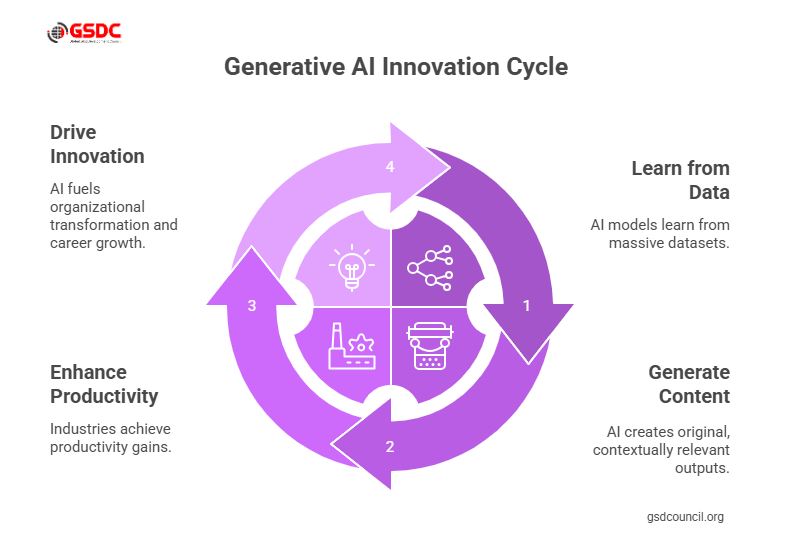
They use deep learning architectures such as transformers and diffusion models to learn from massive datasets and generate original, contextually relevant outputs.
This evolution marks a turning point in AI and digital transformation, where automation is no longer about efficiency alone but about creativity, adaptability, and innovation.
As McKinsey notes, industries embracing AI-driven innovation are achieving productivity gains between 15% and 40%, largely due to the integration of generative models into design, communication, and analytics workflows.
In other words, Generative AI technology is fueling both organizational transformation and career growth, redefining what it means to innovate in the modern economy.
How AI is Transforming Industries in 2025
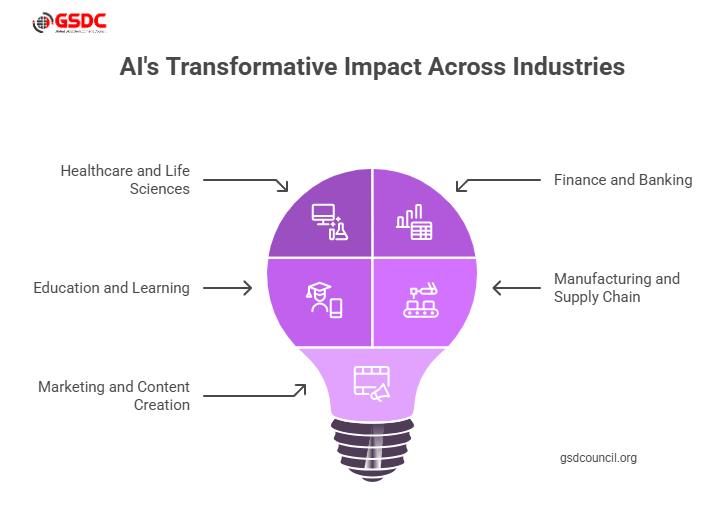
The impact of Generative AI innovation reaches every corner of the global economy. From design studios to manufacturing plants, AI is reshaping workflows, product cycles, and customer experiences.
a. Healthcare and Life Sciences
Generative AI solutions are enabling medical researchers to simulate protein structures, accelerate drug discovery, and predict patient outcomes. By processing vast biomedical datasets, AI helps clinicians develop personalized treatments faster than ever before.
b. Finance and Banking
Financial institutions are using AI for automated risk modeling, fraud detection, and personalized advisory services. AI-powered assistants can analyze millions of transactions in real-time, improving compliance and enhancing customer trust.
c. Education and Learning
AI-powered platforms personalize learning experiences by adapting content to each learner’s pace and style. Instructional designers are integrating Generative AI tools to create adaptive assessments and interactive materials, reshaping online education.
d. Manufacturing and Supply Chain
Generative AI applications are used to optimize design prototypes, forecast demand, and identify process inefficiencies. Predictive algorithms now generate new product configurations, reducing waste and accelerating innovation cycles.
e. Marketing and Content Creation
From automated video scripting to campaign optimization, Generative AI use cases in marketing are revolutionizing how brands communicate. Tools for Changing Creative Execution allow marketers to produce multiple campaign versions tailored to micro-segments, turning creativity into a scalable process.
These examples illustrate how AI is transforming industries by merging human expertise with algorithmic precision, ushering in a new era of AI-driven innovation and adaptive work models.
Speaking of creation, Gen AI Tools are getting quite a traction. Why not enroll in our GSDC Gen AI Expert Certification and not just compete but lead?
The Rise of AI-Powered Productivity and Digital Transformation
One of the most immediate benefits of Generative AI solutions is the dramatic increase in productivity and efficiency across functions.
Organizations are no longer limited by the speed of human labor; they’re augmented by intelligent systems capable of generating insights, drafts, or prototypes in seconds. Whether it’s summarizing reports, coding scripts, or drafting legal contracts, AI-powered productivity tools enable professionals to shift from repetitive tasks to higher-value strategic work.
McKinsey’s Future of Work with AI report estimates that up to 30% of work hours can be automated by 2030 through generative technologies. This doesn’t just reduce costs, it amplifies creative potential and accelerates innovation cycles.
This shift defines the new AI career path: professionals who learn how to work alongside AI are moving from “task executors” to “AI collaborators,” capable of designing, prompting, and validating intelligent outputs.
Career Growth in the Age of Generative AI
a. The Expanding Job Market
According to StartUs Insights, the global Generative AI market employs over 944,000 professionals, with 151,000 new jobs added in 2024 alone. Roles like AI Product Manager, Prompt Engineer, Data Strategist, and Generative AI Consultant are now in high demand.
LinkedIn also reports a 21x increase in job postings referencing generative AI tools like ChatGPT since late 2022. These aren’t limited to tech sectors; marketing, law, education, and design are seeing the fastest adoption.
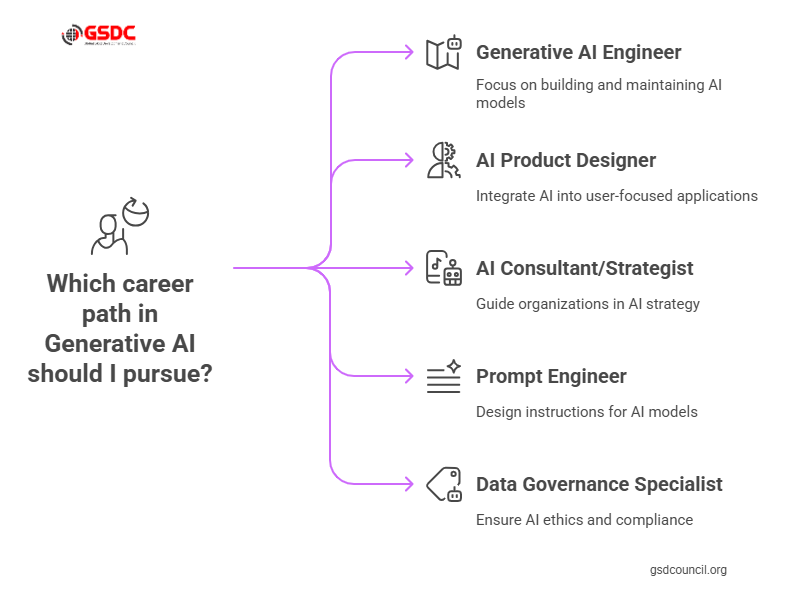
b. Top Career Opportunities in AI
Here are some of the fastest-growing careers in AI for 2025 and beyond:
- Generative AI Engineer – builds, fine-tunes, and maintains generative models.
- AI Product Designer – integrates AI capabilities into user-focused applications.
- AI Consultant or Strategist – guides organizations in building Generative AI strategies.
- Prompt Engineer – designs optimized instructions for AI models to produce desired outputs.
- Data Governance Specialist – ensures AI model transparency, ethics, and compliance.
These roles illustrate how Generative AI companies are reshaping talent demand by combining creativity with computation.
c. Skills that Define Success
Employers now seek AI skills for professionals who combine technical understanding with
strategic thinking. The most valuable skills include:
- Understanding how Generative AI works and the ability to evaluate model outputs.
- Prompt engineering and AI literacy.
- Knowledge of data management, model tuning, and bias mitigation.
- Familiarity with tools for building a Generative AI solution or workflow.
- Business intelligence and storytelling translate AI insights into actionable decisions.
Gartner predicts that by 2027, four out of five engineers will need Generative AI proficiency to stay competitive.
Actionable insights: Learn how to integrate AI tools into your workflow for higher productivity. Skill roadmaps: Identify the most relevant AI skills for your role and career path. Practical frameworks: Access step-by-step methods to build smarter, automated processes.Download this ultimate curation guide for:
Generative AI as a Catalyst for Innovation
Innovation has always been the engine of progress, and Generative AI has supercharged that engine. The combination of human creativity and machine generation is creating new frontiers of AI-driven innovation across all sectors.
AI is not replacing creative professionals; it’s expanding their capabilities. Whether designing user interfaces, writing marketing copy, or developing new software features, Generative AI innovation allows individuals and organizations to test more ideas faster.
Patent growth supports this: the rate of new generative AI-related patents rose 147% annually between 2022 and 2025, reflecting rapid global investment and experimentation.
In design, engineering, and architecture, Generative AI models can now build thousands of prototypes based on defined constraints, helping teams identify the best solutions in minutes.
This ability to explore vast design spaces is redefining the limits of creativity and problem-solving.
The benefits of artificial intelligence now extend far beyond automation; they are redefining the creative process itself.
Generative AI in Business: From Strategy to Execution
As enterprises mature in their digital transformation journey, Generative AI solutions have moved from experimentation to large-scale deployment.
Leading organizations now maintain cross-functional teams dedicated to exploring Top Generative AI applications, from intelligent design assistants to predictive analytics. According to StartUs Insights, over 13,000 investors are currently active in the generative AI ecosystem, with average funding rounds exceeding $30 million.
Companies are embedding AI and digital transformation frameworks into every level of operation, driving measurable business outcomes such as:
- Accelerated product design cycles.
- Real-time customer insights and personalization.
- Enhanced content development workflows.
- Reduced operational costs through automation.
The most forward-thinking companies use AI-powered productivity to free employees from repetitive tasks and empower innovation. This alignment of AI with human creativity is becoming the foundation of future business competitiveness.
Regional Growth and Global Impact
While Generative AI is a global phenomenon, regional dynamics reveal interesting trends. The United States, India, the UK, and Germany are emerging as AI innovation hubs.
India, for instance, boasts one of the highest AI adoption rates globally, with a projected demand for 1 million AI-skilled professionals by 2026. U.S.-based enterprises lead in patent filings and startup funding, while Europe focuses on ethical AI and regulatory frameworks.
This global distribution of expertise ensures that Generative AI innovation is not confined to Silicon Valley; it’s a worldwide collaboration driving both inclusion and economic growth.
Preparing for the AI-Driven Career Future
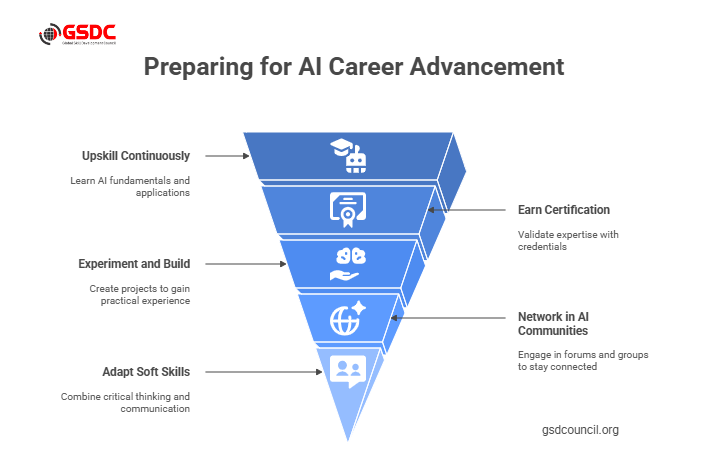
As AI redefines professional landscapes, AI career paths are expanding in scope and diversity. Professionals can pursue multiple entry points from technical roles in data science and model engineering to creative and strategic positions in marketing, learning, or consulting.
Practical Steps for Career Advancement:
- Upskill Continuously: Learn the fundamentals of how AI models function and apply them within your industry.
- Earn a Certification: Programs like GSDC’s or other leading institutions’ credentials validate expertise and enhance career credibility.
- Experiment and Build: Create small projects using public AI APIs or no-code tools to strengthen your practical experience.
- Network in AI Communities: Engage in forums, hackathons, and LinkedIn groups to stay connected with evolving industry trends.
- Adapt Soft Skills: Combine critical thinking, communication, and ethical reasoning with technical knowledge.
As the future of work with AI unfolds, adaptability and creativity will become as valuable as technical proficiency.
Think you have what it takes to leverage your expertise and lead the world of Gen AI? Then enroll in our GSDC Gen AI Expert and validate your skills, and let your credentials speak for themselves.
The Convergence of Innovation and Opportunity
Generative AI is no longer a fad in technology but is already a paradigm shift in the economy. Its capability to generate ideas, streamline business processes, and accelerate the discovery process is driving AI-powered innovation across all industries.
This is a breaking point for professionals. The introduction of AI-related careers and the development of AI-related skills among professionals are changing the way people learn, develop, and contribute.
Domination in Generative AI technology not only increases productivity it also places the professionals at the frontline of innovation where human wisdom intersects with machine wisdom.
The entities and the people that adopt this change are not simply fitting into the future; they are creating it.
Generative AI is not taking away human creativity. It is transforming the creative potential into quantifiable advancement and opening up new frontiers of development.

Related Certifications
Stay up-to-date with the latest news, trends, and resources in GSDC
If you like this read then make sure to check out our previous blogs: Cracking Onboarding Challenges: Fresher Success Unveiled
Not sure which certification to pursue? Our advisors will help you decide!