Generative AI in Financial Services: Benefits & Banking Impact
Written by Matthew Hale
- What Is Generative AI in Financial Services and Banking?
- Generative AI Use Cases in Financial Services and Banking
- Strategic Benefits of AI in Banking and Financial Services
- Challenges in Generative AI Adoption
- The Road Ahead: Balancing Innovation, Market Growth, and Governance
- Build Practical Generative AI Skills for Modern Finance
- Final Thought
- FAQs
When a global bank launched a generative AI model for customer queries, work that previously took hours was done in minutes with better accuracy and compliance. Staff used less time on repetitive tasks, the risk team got real-time insights, and the customers were given faster, more appropriate support thus setting a pilot to a way of working.
That is where generative AI in financial services is taking us. Generative AI in banking, unlike traditional automation, understands the context, interprets complex data, and produces human-like insights, thus enabling banks to cut costs, enhance customer satisfaction, enforce compliance, and control risks.
By using generative AI, banks that were first to adopt it in a digital-first market will gain a significant advantage over generative AI in the financial services market.
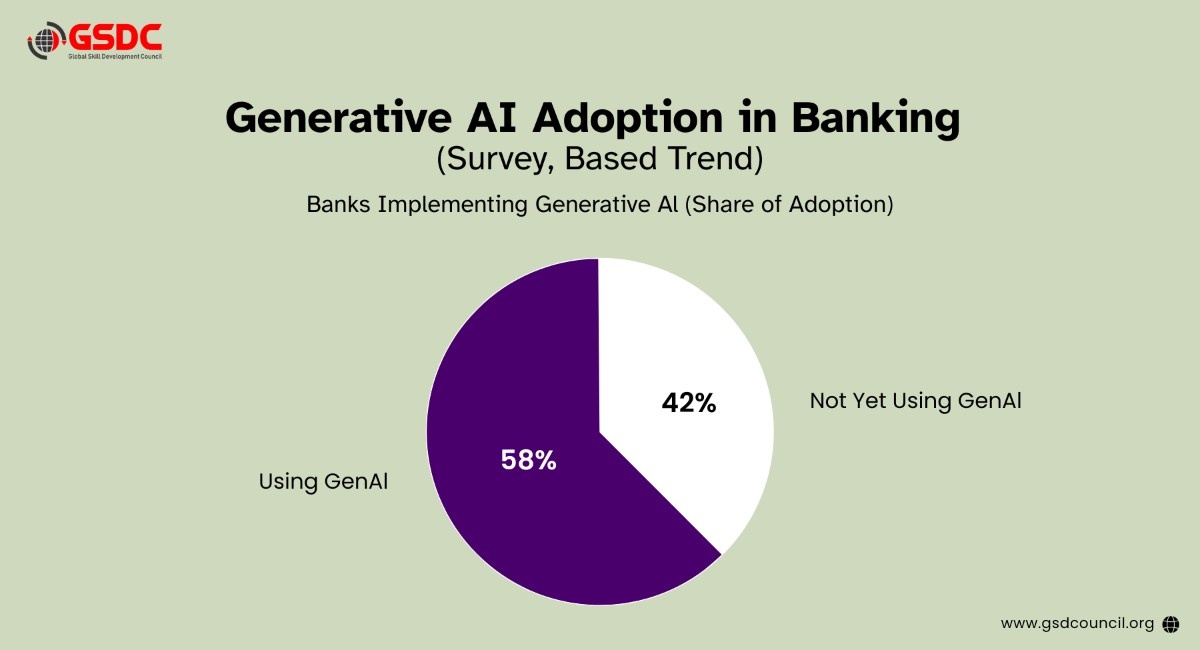
Adoption is growing fast as banks are progressing from pilots to production.
What Is Generative AI in Financial Services and Banking?
In order to understand generative AI use cases in financial services, it is important first to clarify two questions: what is generative AI, and what is AI in finance. Generative AI is a term used to describe advanced models, e. g., large language models (LLMs), that produce new content, insights, and predictions based on patterns learned from massive datasets.
In these sectors, financial services is one step further from static rules, based on automation towards adaptive systems that understand unstructured data, write reports and insights, do simulations, and treat one's queries, providing informative answers. Altogether, these features constitute a breakthrough in the influence of AI in finance; they make it possible to make faster and more intelligent decisions across the main banking processes.
Generative AI Use Cases in Financial Services and Banking
The most valuable generative AI use cases in financial services are moving from pilots to production across banking operations, compliance, risk management, and investment workflows - changing not just speed, but how work gets done through intelligent, context-aware models.
-
Intelligent Customer Support in Banking
Banks use generative AI–powered virtual assistants to resolve complex queries and provide personalized support. For example, HSBC has deployed generative AI across service functions to improve response quality and reduce handling time - delivering clear benefits of AI in banking.
-
Smarter Loan Processing and Credit Decisions
Generative AI can automatically analyze documents and assist in underwriting. For instance, Wells Fargo has taken a look at some of these tools with an aim to cut down the time it takes to get an approval, providing them with a competitive edge in the generative AI banking market.
-
Dynamic Risk and Fraud Detection
JPMorgan Chase applies advanced AI to detect anomalies and emerging risks, reflecting the growing impact of AI in finance on proactive risk management.
-
Streamlined Compliance and Regulatory Reporting
ING uses generative AI to summarize regulatory updates and streamline compliance workflows, reducing manual effort and improving audit readiness.
-
Generative AI in Investment Banking
Firms such as Goldman Sachs deploy firmwide AI assistants to support research and content creation, improving productivity and advisory quality in generative AI in investment banking.
-
Personalized Product Innovation
Digital-first banks, including Capital One, use generative AI in financial services to personalize offers and strengthen customer loyalty across the evolving generative AI in financial services market.
For deeper, practical insight into these applications, the GSDC (Global Skill Development Council) runs expert-led sessions exploring real-world generative AI use cases in financial services and banking.Strategic Benefits of AI in Banking and Financial Services
Organizations that are using generative AI in financial services are gaining structural advantages that are not limited to just efficiency on a small scale.
-
Operational Efficiency
The automation of complex workflows leads to less turn, around time and releases the team for more valuable activities.
-
Improved Decision-Making
Insights driven by AI make the impact of AI in finance even greater by allowing decisions to be made quickly with data and thus made more easily across various workflows of risk, credit, and investment.
-
Enhanced Customer Experience
By allowing for personalization at scale, generative AI in banking makes the product more relevant and consistent, leading to better customer satisfaction of the customer
-
Stronger Risk and Compliance
Through generative AI, regulatory interpretation becomes more accessible, and risk detection is earlier, whereby the efforts of manual compliance are reduced.
-
Competitive Advantage
Those who first took up generative AI in banking are now able to distinguish themselves from others in the market through services that are faster and product innovations that are smarter.
Besides operational improvements, generative AI in banking is set to become a major contributor to the economic value.
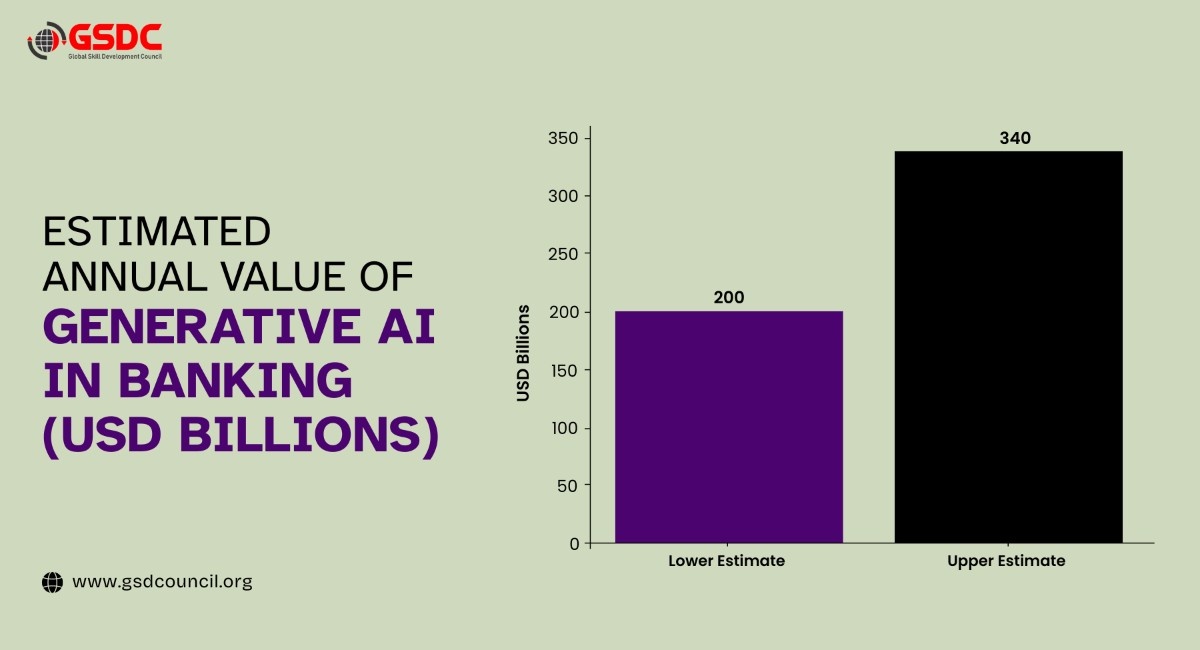
By combining these results, they mirror the genuine returns of AI in banking in the midst of the continuously changing generative AI in the financial services market.
Challenges in Generative AI Adoption
Implementation of generative AI in financial services, especially in a responsible way, is still facing operational and governance challenges.
- Handling confidential financial information means that there should be very strong privacy, security, and governance controls.
- For AI-driven decisions, model transparency helps gain trust, makes the process audit-friendly, and is accepted by regulators.
- It is still a big challenge, complicated, and costs a lot of resources to integrate generative AI in banking with the existing systems of banks.
- Regulatory expectations around AI in finance continue to evolve, creating ongoing compliance uncertainty.
- Bias and fairness risks must be addressed to prevent unintended harm in lending and risk decisions.
- Insufficient skills locally and change management can be the reasons why companies do not move very quickly towards the full potential of AI initially.
It is these kinds of challenges that determine the pace at which the generative AI in the banking sector market evolves and also the extent of the impact of AI on the whole finance sector is gradually realized.
The Road Ahead: Balancing Innovation, Market Growth, and Governance
Financial institutions will determine the trajectory of generative AI in financial services based on the degree to which they combine innovation with responsibility. As the generative AI in the financial services market grows, those banks that establish governance frameworks backed by strong investments will gain the confidence of customers, regulators, and their own teams on a long term basis.
Although usage is increasing, several banks are still in very initial phases of generative AI implementation.
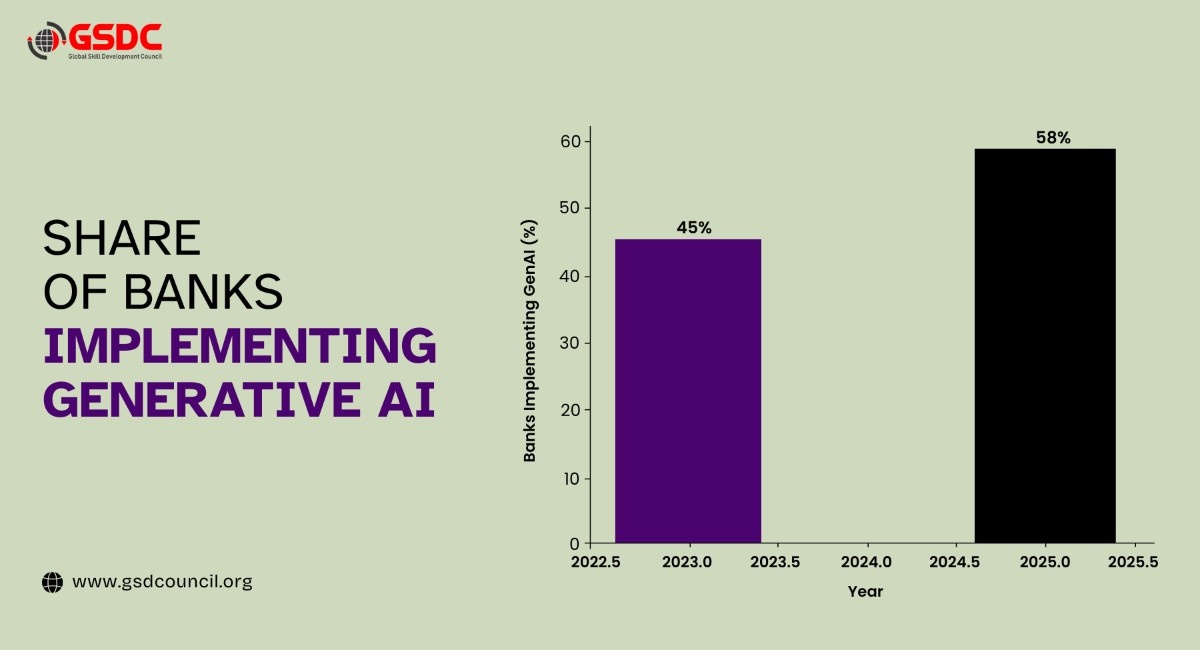
Moreover, companies are focusing on the human side as well by training their employees through programs such as generative AI finance and banking certification to not only enhance their skills but also to help them deploy the technology responsibly.
Eventually, the progress of AI applications in finance will be determined not only the quality of models but also by the clarity and morality of embedding these systems into the main banking processes.
Build Practical Generative AI Skills for Modern Finance
As generative AI in banking revolutionizes finance, upgrading skills is turning into an imperative of the business. The Global Skill Development Council (GSDC )'s Certification in Generative AI in Finance and Banking is designed to help finance, risk, compliance, and technology professionals not only understand the theory behind generative AI but also to be able to implement different generative AI use cases in financial services from a banking perspective. In addition, they develop skills in ethical AI implementation, data governance, and understanding the changing role of AI in finance.
Final Thought
Generative AI is no longer a trial run in banking; it is turning into the backbone of the industry. As generative AI in financial services grows to be the norm, the ones that will get the most value out of this across customer experience, compliance, risk management, and growth will be those who combine innovation with governance.
Trust in a market is what gives the success of a company. So generative AI in banking will be the tool by which it is decided who the leaders are and who the followers are. Those who will take the initiative in the responsible adoption will be able to both enjoy the benefits of AI in banking over the years and cope with the changing influence of AI on finance more skillfully as the generative AI in the financial services market continues to grow.
FAQs
1. What is generative AI in financial services?
Generative AI in financial services refers to the use of highly sophisticated models that output insights and innovate by processing large datasets, thus enabling automated contextual and adaptive processes in banking, risk, and compliance.
2. How is generative AI used in banking today?
Generative AI in the banking sector enhances the area of customer service, streamlines document handling, aids in fraud identification, eases compliance reporting, and facilitates investment banking research, thus accelerating the core workflows and enhancing their accuracy.
3. What are the benefits of AI in banking?
AI in banking brings about the benefits of quicker operations, more informed decision-making, enhanced risk identification, and increased personal experiences of clients.
4. What is the impact of AI in finance on risk and compliance?
AI in finance helps to significantly improve the handling of risk, quickly identify issues, and reduce the manual work involved in compliance and reporting.
5. What skills are needed to work with generative AI in finance and banking?
The essential skills for working with generative AI in the financial sector encompass having knowledge of the finance domain, being familiar with the basics of AI, understanding data governance, and gaining practical experience with real-world scenarios in banking.

Related Certifications
Stay up-to-date with the latest news, trends, and resources in GSDC
If you like this read then make sure to check out our previous blogs: Cracking Onboarding Challenges: Fresher Success Unveiled
Not sure which certification to pursue? Our advisors will help you decide!