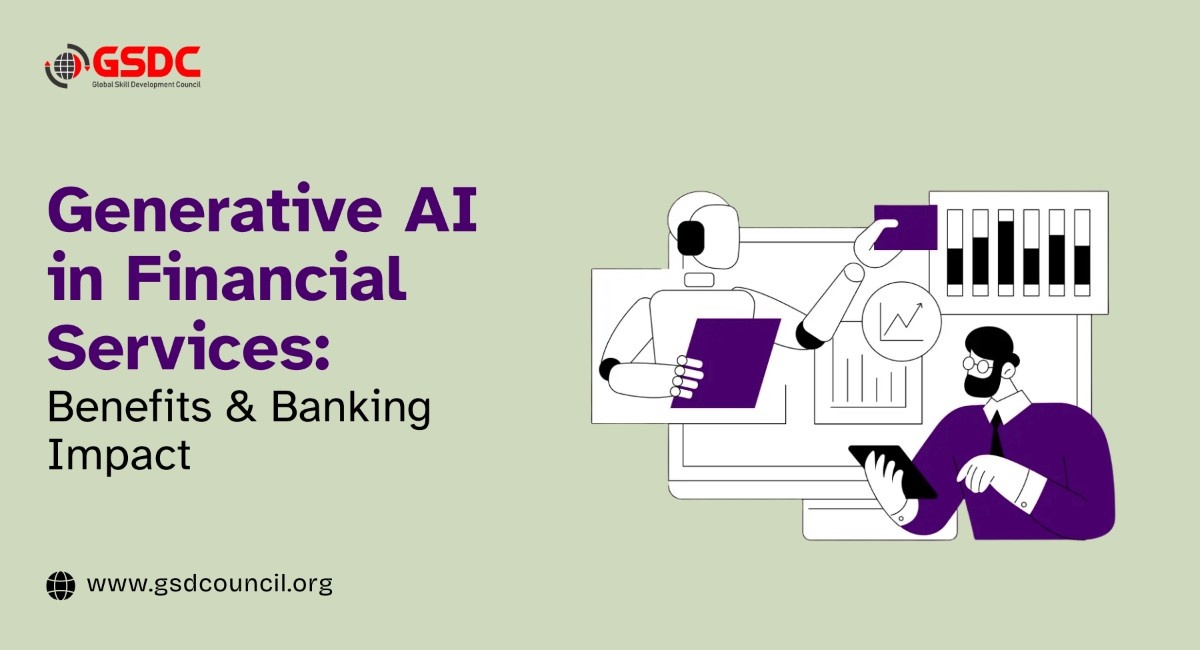
Generative AI in Finance and Banking: AI, Risk, and Compliance Insights
Written by Matthew Hale
The financial services sector is changing faster than ever, driven by the rise of AI technologies that are reshaping how banks and financial institutions operate. Imagine a bank branch where transaction monitoring, portfolio analysis, and risk assessment happen in real time without human delay-this is now possible with AI in financial services.
For years, finance teams relied on historical data and predictive models to make decisions, often reacting to trends after they occurred. Today, AI allows them to anticipate market shifts, detect unusual transactions instantly, and generate insights that guide strategic decisions. For example, real-time AI systems can flag suspicious account activity as it happens, recommend adjustments to investment portfolios based on emerging trends, and even simulate various market scenarios to help executives plan ahead.
In this blog, you will see how generative AI goes beyond simple predictions, transforming financial reporting, risk management, fraud detection, compliance, and digital banking. You’ll also understand how these tools give finance professionals the ability to make faster, smarter, and more strategic decisions-turning complex data into actionable insights in everyday operations.
Understanding Generative AI in Finance
AI in financial services goes beyond traditional data analysis by helping institutions process vast datasets, detect patterns, and generate actionable insights. From machine learning in finance to advanced analytics, AI enables banks to anticipate risks, optimize portfolios, improve compliance, and deliver personalized services.
For instance, Mastercard’s generative AI system processes up to one trillion transaction data points annually, improving fraud-detection accuracy by up to 300%. This demonstrates how AI not only analyzes past data but also identifies emerging patterns, helping financial institutions make proactive, strategic decisions.
By leveraging AI, finance professionals can shift their focus from manual data processing to interpreting insights, making faster, more accurate, and strategically informed decisions that drive operational efficiency and innovation.
Applications of Generative AI in Banking and Finance
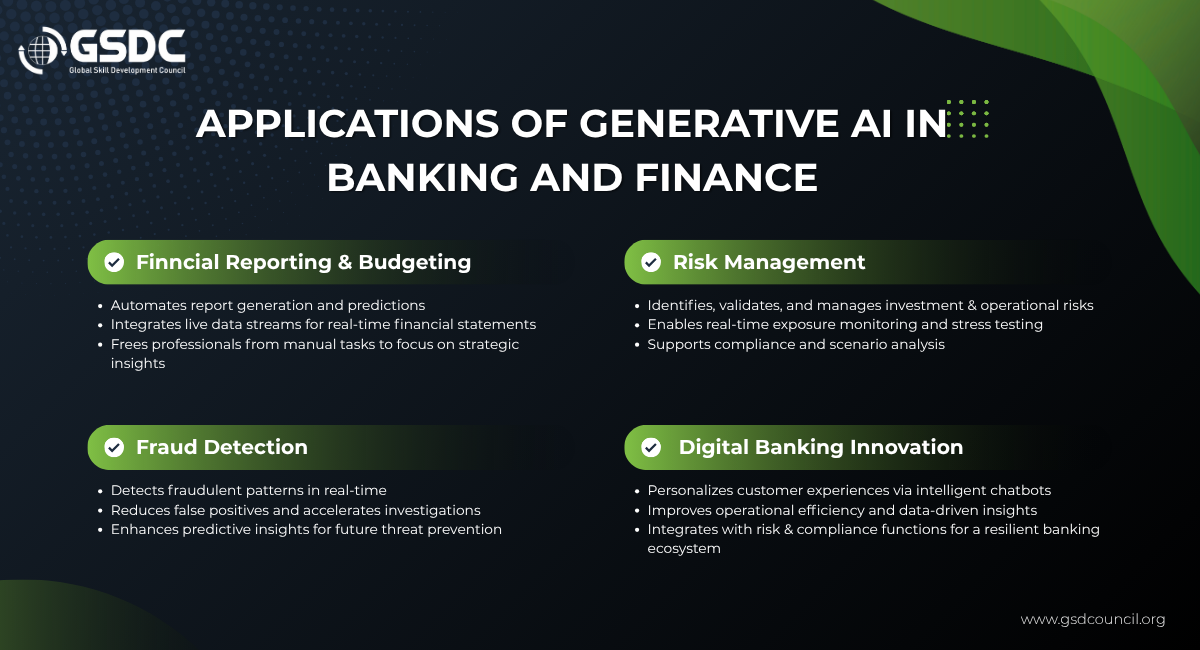
Generative AI is not just a concept anymore; it is actively reshaping core functions across AI in financial services. Its applications bridge operational efficiency and strategic decision-making, creating tangible benefits across multiple domains.
1. Financial Reporting and Budgeting
- The system automatically generates reports and predictions.
- It also combines live data streams to produce up-to-the-minute financial statements.
- Without the need for human intervention and with great speed, financial reports become available thus reaction to market changes is expedited.
By streamlining reporting, generative AI frees finance professionals to focus on analysis and strategic decision-making rather than manual tasks.
2. Risk Management
- By locating, authenticating, and regulating risks in investment and operational areas, the activity vastly improves the model risk management frameworks.
- Besides that, real-time exposure monitoring, stress testing, and anomaly detection in credit, market, and operational risk areas are facilitated by the system.
- Risk management using AI allows financial institutions to enhance governance, compliance, and scenario analysis.
Through AI-enhanced risk management, institutions can maintain resilience against volatility while ensuring compliance with regulatory frameworks.
To work confidently with these AI-driven risk models, many teams strengthen their fundamentals through a Generative AI Foundation Certification before progressing to domain-specific training.
3. Fraud Detection
- The AI-based fraud detection systems analyze transactions and recognize fraudulent patterns in real-time.
- More than 91% of the banks in the U.S. are implementing AI for fraud detection, and over 70% are using AI/ML for risk mitigation.
- That helps to reduce the number of false alarms, accelerate the investigative processes, and recognize the emerging threats beforehand.
Integrating AI into fraud detection systems strengthens financial security while providing predictive insights to prevent future incidents.
4. Digital Banking Innovation
- Enables digital banking innovation by personalizing services, implementing intelligent chatbots, and using automated support systems.
- Moreover, it fosters operational efficiency and generates the insights that help in risk and fraud prevention.
- When linked with compliance and risk departments, these innovations result in a more agile, resilient banking ecosystem.
Digital banking innovations powered by generative AI not only improve customer experiences but also reinforce institutional agility and responsiveness.
AI-Driven Impact on Finance Professionals
AI is shifting the role of finance professionals from simply collecting and processing data to interpreting AI-generated insights. This transformation enables faster, more accurate, and efficient decision-making. Professionals can now anticipate risks, uncover new strategic opportunities, and contribute proactively to business growth.
By leveraging these AI insights, finance teams can drive measurable outcomes, optimize strategies, and enhance overall operational efficiency. For those looking to fully harness these capabilities, the Certified in Generative AI in Finance and Banking provides the skills to implement AI-driven solutions effectively and strategically.Enhancing Compliance and Governance with AI
Compliance is central to maintaining transparency, ethical standards, and operational integrity in financial institutions. It refers to the adherence to laws, regulations, internal policies, and industry standards that govern financial activities. With AI in compliance and AI for regulatory compliance, banks can move from reactive monitoring to proactive governance, ensuring that operations remain lawful and transparent.
Key Applications
- Automated compliance monitoring: Monitors transactions, identifies irregularities, and maintains compliance with regulations automatically and in real-time.
- AI for regulatory compliance: Helps in understanding complex regulations, creating reports, and forecasting that vulnerabilities may arise.
- Policy enforcement: Guarantees that internal norms are being implemented uniformly throughout the organization.
Benefits
- Efficiency: Takes over from the human side the monotonous compliance work that has to be done repeatedly.
- Accuracy: Less chance of mistake when it is the machine (rather than a person) that detects anomalies or breaches which are hard to recognize.
- Audit readiness: Keeps very detailed records that are always at the disposal of auditors and in case of reporting to the regulatory bodies.
⚙️ Implement AI in Your Finance Processes Today!
Strategic Impact of Generative AI in Financial Services
1. Decision-Making and Forecasting
- Generative AI in finance enables scenario planning, stress testing, and predictive simulations.
- Helps finance leaders anticipate market trends and design robust strategies.
- Enhances speed and accuracy of forecasts for proactive responses to emerging risks and opportunities.
2. Competitive Advantages
- Automates complex processes, reducing operational costs and improving product innovation.
- Enables personalized financial solutions, smarter portfolio management, and better customer experiences.
- Early adopters gain strategic advantages in risk mitigation, regulatory compliance, and decision-making agility.
3. Potential Challenges
- Ethical considerations: Risk of bias and need for transparency in AI-driven decisions.
- Data quality: Effective AI models depend on accurate, comprehensive datasets.
- Governance: Strong oversight frameworks are essential to ensure AI reliability and compliance.
Addressing these challenges is essential for maximizing the benefits of generative AI in financial services.
Certification and Career Advancement
To stay competitive in this evolving landscape, professionals can pursue the Certification in Generative AI in Finance and Banking. This equips them to:
- Implement AI-driven risk management, fraud detection, and compliance solutions effectively.
- Take on specialized roles in AI strategy, risk analytics, and digital banking innovation.
- Lead organizations through AI adoption while ensuring ethical and regulatory compliance.
By mastering generative AI in finance, professionals can future-proof their careers and drive transformative impact across financial services.
GSDC provides professionals with resources and training to harness these generative AI capabilities effectively.

Conclusion
Generative AI in finance is revolutionizing banking and financial services, reshaping decision-making, risk management, fraud detection, compliance, and customer experiences. Institutions embracing these technologies gain operational efficiency, innovation, and competitive advantage, while those slow to adapt risk falling behind.
For finance professionals, mastering AI in financial services and generative AI in banking is no longer optional; it is essential for leading in an increasingly AI-driven industry.

Related Certifications
Stay up-to-date with the latest news, trends, and resources in GSDC
If you like this read then make sure to check out our previous blogs: Cracking Onboarding Challenges: Fresher Success Unveiled
Not sure which certification to pursue? Our advisors will help you decide!