The 6 Highest Paying AI Jobs-And How to Land Them

Written by Matthew Hale
- Why Generative AI Jobs Are Paying So Much Right Now
- The highest paying Generative AI Jobs in 2026, Ranked
- How Generative AI Actually Works (And Why Employers Pay for It)
- Generative AI Benefits Driving the Hiring Boom
- Does Generative AI Certification Actually Increase Your Salary?
- A Realistic Career Path Into High-Paying Generative AI Jobs
- Where to Build These Skills
- The Bottom Line
A year ago, "generative AI engineer" was a job title that barely showed up on LinkedIn. Today, it's one of the fastest-growing - and best-paid - careers in the American tech market. If you've been scrolling job boards and wondering why the salary numbers keep climbing, you're not imagining it.
This isn't another recycled listicle. We pulled real 2026 compensation data from recruiting firms, university career centers, and verified salary platforms to rank the highest paying AI jobs by what people are actually being offered right now - not what a headline promises.
A quick note on scope: every figure in this blog reflects U.S. compensation data. Generative AI salaries vary significantly by country and even by region within the U.S. - a senior LLM engineer role that pays $250K in San Francisco or New York may pay considerably less in a lower cost-of-living market, and considerably less still outside the U.S. Use these numbers as a U.S. benchmark, not a global standard.
Why Generative AI Jobs Are Paying So Much Right Now
Companies stopped treating generative AI as a side experiment somewhere around 2025. Now it's core infrastructure - the thing that powers customer support, drafts contracts, writes code, and forecasts risk. That shift changed hiring overnight.
LinkedIn ranked AI engineer the number one fastest-growing job title in the United States for 2026, with year-over-year growth of around 143%, and salary ranges stretching from roughly $90,000 at the entry level to $400,000-plus at the staff level. That kind of growth in a single job category is rare, and it explains why "generative AI jobs salary" has become one of the most-searched career phrases of the year.
The short version: there are far more open generative AI jobs than there are people qualified to fill them. Basic economics does the rest.
The highest paying Generative AI Jobs in 2026, Ranked
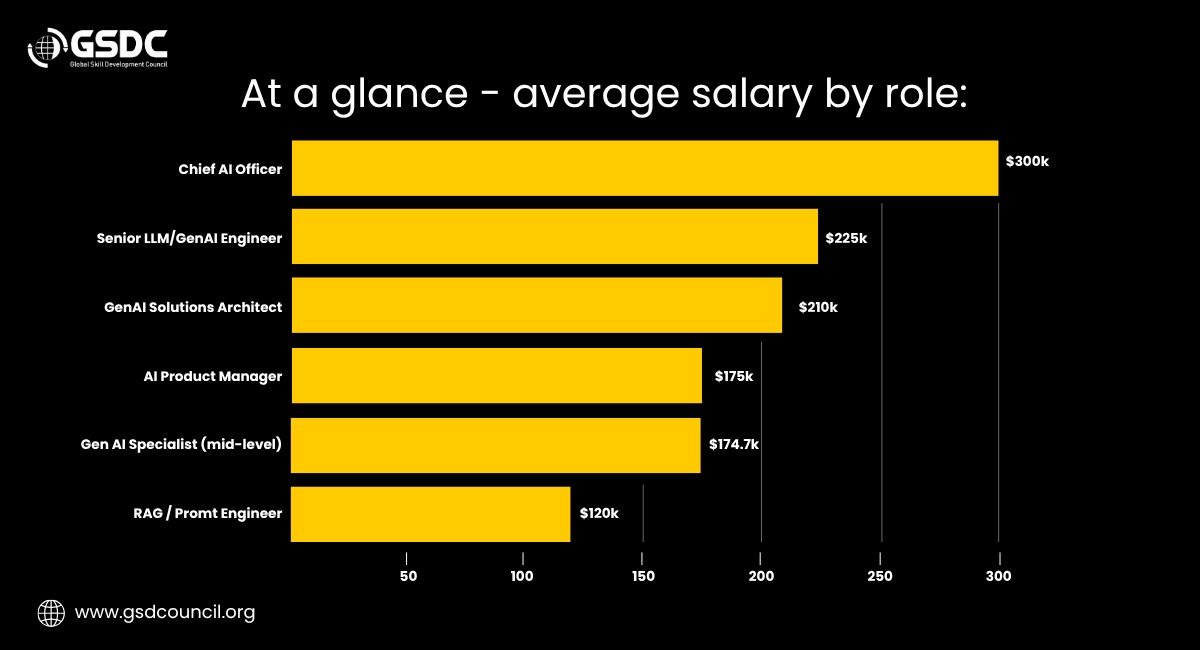
Here's how the top roles stack up, based on verified base salary and total compensation data from recruiting and salary research firms.
| Rank | Role | Average Salary | Top Salary | Core Skills Needed | Typical Experience |
| 1 | Chief AI Officer (CAIO) | $300,000 | $500,000+ | AI governance, enterprise strategy, board communication | 15+ years, 5–7 in senior AI leadership |
| 2 | Senior LLM / Generative AI Engineer | $225,000 | $310,000 | LLM fine-tuning, RAG, MLOps, distributed systems | 6–10 years |
| 3 | Generative AI Solutions Architect | $210,000 | $280,000 | Cloud architecture, system design, AI integration | 7–10 years |
| 4 | AI Product Manager | $175,000 | $250,000+ | Product strategy, AI literacy, ROI modeling | 5–8 years |
| 5 | Generative AI Specialist / Engineer (mid-level) | $174,727 | $211,000 | LoRA/QLoRA fine-tuning, instruction tuning, Python | 3–5 years |
| 6 | RAG / Prompt Engineer | $120,000 | $160,000 | Prompt design, retrieval pipelines, vector databases | 1–4 years |
Senior ML and LLM engineer base salaries now floor at around $255,000 in major U.S. tech markets, with total compensation at top-tier employers clearing $310,000 to $350,000 once stock and bonuses are included, according to 2026 recruiting data compiled by KORE1. At the very top of the ladder, Chief AI Officer pay can run into seven figures at large enterprises, and the role itself is spreading fast - adoption jumped from 11% of organizations in 2023 to roughly 26% in 2025.
1. Chief AI Officer - The New C-Suite Seat
This is the highest paying generative AI job on the list, and for good reason: a CAIO doesn't just understand AI; they own the business risk and the upside. They decide which generative AI initiatives get funded, manage cross-functional teams, and report directly to the CEO. It typically takes 15+ years of experience, including several years in senior AI leadership, plus an advanced degree, to land this seat.
A day in the life: Mornings often start with a budget review for AI initiatives across departments, followed by a meeting with legal and compliance on responsible-AI policy. Afternoons are spent presenting AI ROI to the board, and evenings might involve reviewing a vendor pitch for a new enterprise LLM platform: less hands-on coding, far more decision-making about where the company's AI dollars go.
Skills to build:AI governance frameworks, enterprise architecture, risk management, regulatory awareness, and the ability to translate technical capability into board-level business language.
2. Senior Generative AI / LLM Engineer
This is the role most people picture when they search "generative ai engineer salary." These engineers fine-tune large language models, build retrieval-augmented generation (RAG) pipelines, and ship production systems - not research demos. Glassdoor places the national average around $200,000 for senior LLM engineers, with the highest premiums going to engineers who can prove they've deployed agentic pipelines or fine-tuned models on real production workloads.
A day in the life: A senior LLM engineer might spend the morning evaluating model outputs against accuracy benchmarks, the afternoon optimizing a retrieval pipeline that's returning irrelevant context, and the evening pushing a fine-tuned model update through a CI/CD pipeline before monitoring it in production overnight.
Skills to build: Python, PyTorch, Transformers, LangChain, RAG architecture, vector databases, AWS or Azure, and Kubernetes for deployment at scale.
3. Generative AI Solutions Architect
Think of this person as the city planner of an organization's AI systems. They decide which models go where, how data flows between services, and which cloud platform supports it all. It's one of LinkedIn's top five fastest-growing roles in 2026 because most large companies have AI ambitions but lack the in-house expertise actually to execute them.
A day in the life: Expect a morning whiteboarding session mapping how a new generative AI feature will move data between systems, a midday call with the security team about access controls, and an afternoon spent comparing cloud-hosted model costs to decide where a workload should actually run.
Skills to build: AWS Bedrock or Azure AI, cloud architecture, API design, security best practices, and cost optimization across multi-cloud environments.
4. AI Product Manager
The AI product manager's salary has climbed sharply because this role sits at the intersection of technical capability and business outcomes - exactly where generative AI lives. Strong AI PMs typically earn between $120,000 and $250,000, with senior product leaders at large tech companies often exceeding $300,000 in total compensation. As AI tools make building faster and cheaper, deciding what to build has become the harder - and more valuable - problem.
A day in the life: Mornings often involve reviewing user feedback on an AI feature's accuracy, midday is spent in a roadmap meeting weighing a new model integration against engineering capacity, and afternoons might mean presenting usage metrics to leadership to justify the next quarter's AI investment.
Skills to build: Product strategy, working AI literacy (enough to question an engineer's technical tradeoffs), data analysis, stakeholder communication, and ROI modeling.
5. Generative AI Specialist / Mid-Level Engineer
This is the most common entry point into the high-paying side of the field. According to Analytics Vidhya research, generative AI specialists average around $174,727 annually in the U.S. The work centers on adapting foundation models for specific business use cases using techniques like LoRA, QLoRA, and instruction tuning - skills that are currently among the most in demand in applied AI hiring.
A day in the life: A typical day might include cleaning a domain-specific dataset in the morning, running a fine-tuning job in the afternoon, and spending the evening writing evaluation scripts to confirm the new model version actually performs better than the last one.
Skills to build: Python, Hugging Face Transformers, LoRA/QLoRA fine-tuning, data preprocessing, and experiment tracking tools. Since most people land this role before they've shipped a production model on the job, a structured credential like GSDC's Certified Generative AI Professional is a common way candidates prove they've actually done the fine-tuning work, not just read about it.
6. RAG / Prompt Engineer
Prompt engineering has matured from a buzzword into a legitimate, well-paid specialization. Demand for the role surged more than 135% in recent quarters, with a projected annual growth rate of close to 33% through 2030. RAG-pipeline skills specifically have gone from a niche capability to a near-essential one in under two years, since almost every company now wants its AI tools to "know" their own internal data.
A day in the life: Mornings might be spent testing prompt variations to reduce hallucinations in a customer support bot, the afternoon goes toward tuning a retrieval pipeline so the model pulls the right internal documents, and the day often wraps up documenting which prompt patterns worked so the rest of the team can reuse them.
Skills to build: Prompt design and testing frameworks, vector databases (Pinecone, Weaviate, FAISS), retrieval pipeline construction, and basic Python scripting.
Where the Hiring Is Actually Happening
Salary numbers only tell half the story - readers also want to know who's hiring and how.
Industries leading the hiring boom: Healthcare is currently the single largest creator of AI jobs, generating more than 640,000 positions tied to automated diagnostics, predictive analytics, and virtual patient support. Manufacturing follows closely with roughly 620,000 AI roles built around quality control automation and predictive maintenance, and financial services has added approximately 470,000 roles focused on fraud detection, algorithmic trading, and risk assessment.
Who's hiring: Global tech leaders like NVIDIA, Meta, OpenAI, Google, Microsoft, and Amazon continue to hire for core model and platform roles, often at the top of the pay scale. Consulting and enterprise firms - Accenture, Deloitte, and IBM among them - hire generative AI consultants and solution architects to help other companies adopt AI responsibly. Meanwhile, high-growth AI startups offer lower base pay but compensate with equity and faster career acceleration.
Remote vs. onsite: Generative AI roles remain among the most remote-friendly in tech, particularly for engineering and prompt/RAG specialties. Architecture, product, and executive-level roles are more likely to require at least partial on-site presence, especially at regulated enterprises in finance and healthcare.
Startup vs. enterprise demand: Enterprises pay more in base salary and offer more stability; startups pay less in cash but often move faster on title and scope, putting early-career professionals into senior-sounding roles years ahead of the enterprise track. Professionals who combine AI engineering skills with deep domain knowledge in healthcare, finance, or manufacturing can command a 30–50% salary premium over generalist AI talent - a gap that's widening as these industries compete harder for talent.
How Generative AI Actually Works (And Why Employers Pay for It)
Generative AI Benefits Driving the Hiring Boom
The salary surge isn't happening in a vacuum - it's a direct response to what generative AI is doing for businesses. The most commonly cited generative ai benefits driving adoption (and hiring) include:
- Faster time-to-market for products and content
- Lower operational costs through automated workflows and customer support
- Better decision-making, with AI surfacing patterns in data humans would miss
- Personalization at scale, from recommendation engines to tailored marketing
- Reduced manual workload, freeing skilled employees for higher-value work
Industries that weren't traditionally "tech" are now among the biggest hirers. Healthcare alone is generating hundreds of thousands of AI-linked roles tied to diagnostics and patient support, and professionals who combine AI engineering skills with deep domain knowledge in healthcare, finance, or manufacturing can command a 30–50% salary premium over generalist AI talent.
Does Generative AI Certification Actually Increase Your Salary?
Short answer: yes, especially if you're switching from a non-AI background. A generative ai certification won't replace hands-on project experience, but it shortens hiring cycles and signals to recruiters that you understand applied skills - not just theory.
Specific technical certifications carry measurable wage premiums in 2026: AWS Certified Machine Learning Specialty adds roughly a 20% salary premium, and Google's Professional Machine Learning Engineer certification adds closer to 25%. Domain-specific generative AI certifications - covering large language models, prompt design, and model deployment - are increasingly used by employers as a fast filter when shortlisting candidates for generative ai jobs.
Professionals entering the field often combine hands-on projects with structured certification programs to demonstrate practical, job-ready skills. One example is the Global Skill Development Council's Generative AI Salary Guide, which breaks down how salaries scale from entry-level prompt engineering roles up to Head of AI positions, with a focus on applied, enterprise use cases rather than theory.
A Realistic Career Path Into High-Paying Generative AI Jobs
You don't need to start at the top. Most professionals who land six-figure generative AI roles follow a similar progression:
- Foundational stage - Learn prompt engineering basics and how generative AI works through structured courses or certifications.
- Applied stage - Move into roles like Generative AI Specialist or Junior AI Engineer, working hands-on with real workflows and tools like LangChain, PyTorch, or vector databases.
- Specialization stage - Pick a lane: LLM fine-tuning, RAG architecture, MLOps, or a domain like healthcare or finance.
- Leadership stage - Move into AI Product Manager, Solutions Architect, or eventually Head of AI / CAIO roles, where business judgment matters as much as technical skill.
The skills carrying the biggest salary premiums right now are concrete and learnable: machine learning fundamentals, TensorFlow, PyTorch, and hands-on RAG-pipeline experience are appearing in the majority of new generative AI job postings.
Where to Build These Skills
A fair question after reading all this: where do you actually start?
Most people don't land a $200K generative AI role on their own. They follow some kind of structured path - courses, real projects, and a credential that tells a hiring manager "this person has actually done the work."
That's the gap the Global Skill Development Council's Certified Generative AI Professional program is built for. It focuses on the same skills employers are paying for in this article - prompt engineering, model fine-tuning, RAG architecture, and applying generative AI to real business problems, not toy examples. Pair it with hands-on projects, and it's a solid way to shorten the path into the field.

The Bottom Line
The highest paying AI professionals aren't simply the people who know the most about models - they're the ones who can solve real business problems with AI. As organizations continue investing in enterprise AI, practical implementation skills, not hype, will determine who earns the biggest salaries over the next decade.
If you're mapping out your next move, build toward production-level skills, get certified where it actually moves the needle, and specialize in a domain where AI is creating measurable business value. That combination, more than any single job title, is what's driving the highest paying AI jobs of 2026.

Related Certifications
Frequently Asked Questions
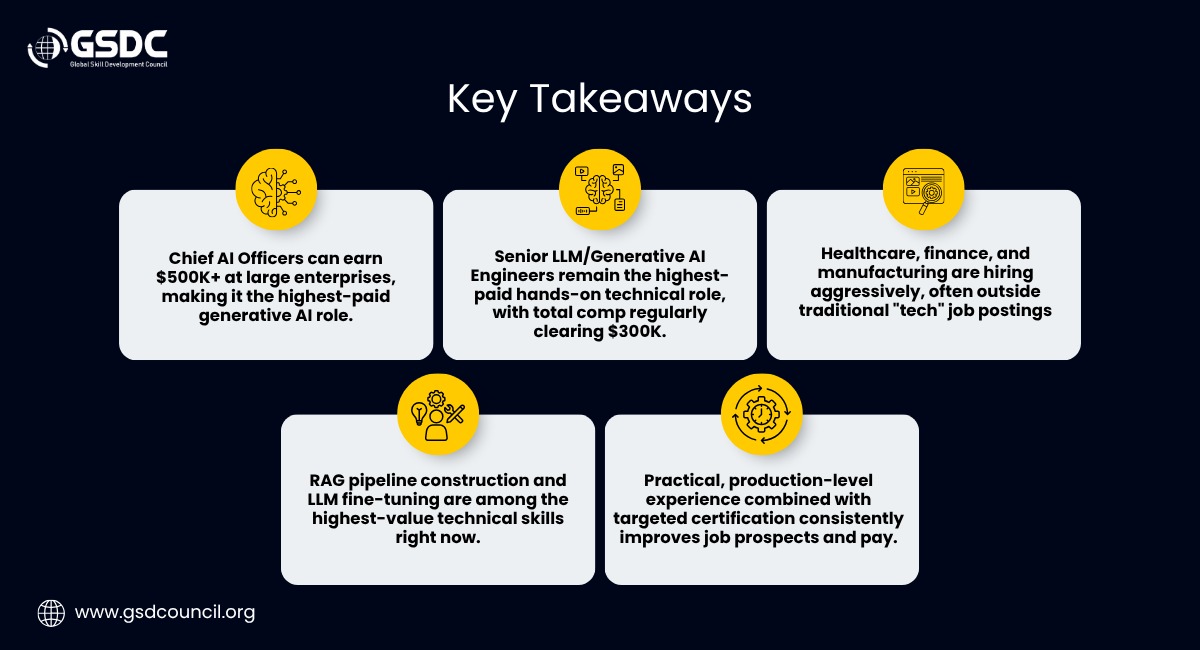
That'd be Chief AI Officer - total comp can blow past $500,000 at the bigger enterprises. If you'd rather stick to a hands-on technical role, though, Senior LLM/Generative AI Engineer is your ceiling, usually landing somewhere between $225,000 and $310,000 once everything's added up.
Honestly, it swings a lot based on experience and location. Someone just starting out might see $90,000 to $140,000, while a senior engineer working in a major U.S. tech hub could be pulling $225,000+ in base alone - closer to $300,000 once you factor in stock and bonuses.
Not strictly, no. But it helps more than people assume, especially if you're coming from a different field or don't have a CS degree on paper. A certification won't substitute for real project work, but it does speed up hiring conversations and gives a recruiter something solid to point to.
An AI engineer's scope is broader - computer vision, predictive models, general machine learning work. A generative AI engineer narrows in specifically on large language models: fine-tuning them, building RAG pipelines, optimizing prompts, getting GPT-style systems into production and keeping them running.
Kind of a gray area, honestly. You're not writing production code day to day, but you do need enough technical grounding to push back on an engineer's tradeoffs and understand where a model's limitations actually are. That mix of business and technical fluency is a big part of why AI product manager salary has gone up so much.
Healthcare, manufacturing, and financial services, which catches some people off guard since none of them are "tech" in the traditional sense. Healthcare on its own is responsible for hundreds of thousands of AI-linked jobs, mostly tied to diagnostics and patient support tools.
Yes - plenty of people have. It gets harder past a certain pay level, though. Self-taught folks with a strong portfolio can land roles, but without formal credentials, most end up topping out somewhere around $150,000 to $180,000.
Python's basically table stakes at this point. After that, what actually moves the needle is RAG architecture, vector databases, fine-tuning techniques like LoRA and QLoRA, and being comfortable deploying models in the cloud. Those four show up constantly in job postings right now.
A lot of them are, yeah, especially the engineering and prompt/RAG-heavy roles. Once you move toward architecture, product leadership, or anything executive-level, expect more pressure to be in the office, particularly at regulated companies in finance or healthcare.
Nobody can say for sure, but the demand doesn't look like hype right now - companies are running these systems in production, not just running pilots. As long as there are more open roles than qualified people to fill them, pay should stay high, even if the growth curve eventually flattens out.
Stay up-to-date with the latest news, trends, and resources in GSDC
If you like this read then make sure to check out our previous blogs: Cracking Onboarding Challenges: Fresher Success Unveiled
Not sure which certification to pursue? Our advisors will help you decide!