Agentic AI vs Generative AI: How AI Evolved in 3 Years
Written by Matthew Hale
- A Brief History of Generative AI: The Milestones That Built This Moment
- The Four Eras of AI Interaction (And Where We Stand Now)
- What Is Agentic AI? (The Definition That Actually Makes Sense)
- Agentic AI vs Generative AI: The Differences That Change Everything
- Types of Intelligent Agents in AI: A Practical Map
- ChatGPT Agents: What They Can Actually Do in 2026
- Agentic AI Examples Across Industries in 2026
- The AI Evolution Framework: Five Stages at a Glance
- Why a Generative AI Certification Matters Now
- What This Evolution Means for Your Career in AI
Three years. That's all it took to go from a text box that impressed us by writing a cover letter, to AI systems that can independently research a problem, write code to solve it, test that code, deploy it, monitor the result, and email you a summary - all without a single human prompt in between.
If you've been watching this space, you've probably noticed that the conversation shifted somewhere in 2023 and 2024. "Generative AI" started feeling like last year's phrase. The new word everyone was using was "agentic." And if you're not entirely sure what that means or how we got there, you're not alone - and you're in the right place.
This blog maps the entire journey. From the moment ChatGPT went viral on November 30, 2022, to the emergence of autonomous AI agents reshaping enterprise workflows in 2026. We'll look at the milestones that mattered, what agentic AI actually is, how it differs from the generative AI you already know, and what the whole thing means for professionals building careers in this space.
Why this matters for you: The history of generative AI is not just an interesting story - it's the context you need to understand where the biggest career and business opportunities are right now. Every inflection point in this evolution opened new job categories, new skill requirements, and new competitive advantages for the people who understood it early.
A Brief History of Generative AI: The Milestones That Built This Moment
Generative AI didn't arrive overnight. The research that powers today's models spans decades - but the inflection from lab curiosity to global phenomenon happened in a remarkably compressed window. Here are the moments that matter.
- Google publishes "Attention Is All You Need" (June 2017)
The paper that introduced the Transformer architecture - the technical foundation that makes modern LLMs possible. Without this, there's no ChatGPT, no GPT-4, no Claude. It's the most cited AI paper of the last decade.
- GPT-3 launches - 175 billion parameters (May 2020)
OpenAI's GPT-3 shocked the research community with its scale and capability. It could write poetry, answer questions, summarize documents, and write code. Access was limited to API, but developers quickly realized this was something different.
- ChatGPT launches - the moment everything changed (November 30, 2022)
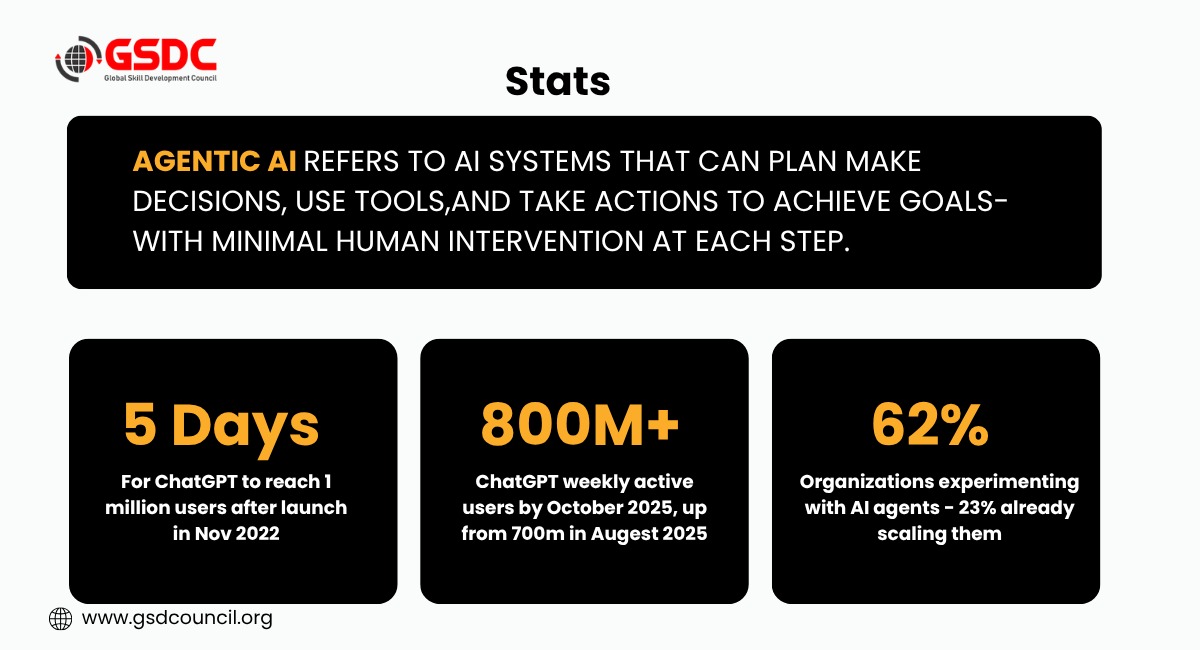
OpenAI wraps GPT-3.5 in a clean chat interface and releases it to the public for free. One million users in five days. One hundred million in two months - faster than any consumer app in history. The AI era, for the general public, begins here.
- GPT-4 arrives - multimodal reasoning takes off (March 14, 2023)
GPT-4 could accept both text and image input and reasoned more reliably across complex tasks. The same month, Anthropic launched Claude and Google launched Bard. The AI assistant wars began in earnest.
- Plugins, then custom GPTs - the first steps toward agency (March–November 2023)
ChatGPT launched plugins in March 2023, letting it interact with external services for the first time. By November, OpenAI replaced plugins with custom GPTs - personalized AI assistants with specific skills and knowledge bases. The idea of AI as a configurable agent began to take shape.
- GPT-4o - multimodal model, multimodal by default (May 2024)
GPT-4o (the "o" stands for omni) processed text, audio, and vision natively in a single model. Crucially, OpenAI made it free to all users, dramatically lowering the barrier to advanced AI capabilities. ChatGPT reached 700 million weekly active users by August 2025, crossing 800 million by October 2025.
- AI stops answering and starts acting (2025 - The Agentic Turn)
OpenAI launched its o1 reasoning model series in late 2024, capable of multi-step chain-of-thought reasoning. In 2025, full agentic frameworks - where AI models plan, use tools, and execute tasks autonomously - moved from research to enterprise deployment. GPT-5 launched in August 2025. The paradigm shift from generative to agentic was complete.
The Four Eras of AI Interaction (And Where We Stand Now)
The history of generative AI is really the story of four distinct generations - each one building on the last, each one expanding what "possible" means. Understanding where agentic AI came from requires understanding the full arc.
Era 1: Rule-Based Chatbots (1990s – 2010s)
These were the ancestors of everything that followed. Rigid decision trees, keyword matching, predetermined responses. They weren't "intelligent" in any meaningful sense - they followed scripts. If a user went off-script, the system failed and escalated to a human.
Their real value was simple: available 24/7, consistent, and cheap to run at scale for repetitive tasks like password resets and FAQ responses. Think IVR phone systems ("Press 1 for billing") and basic web chat widgets.
For Example:
- IVR Phone Systems
- Basic Web Chat
- FAQ Bots
Only handled scripted inputs - any deviation triggered failure
Era 2: Conversational AI (2010s – 2020)
The leap from Era 1 was significant: these systems could finally understand what you meant, not just what exact words you used. Powered by machine learning trained on large labeled datasets, they could handle multi-turn conversations, recognize intent, and operate without a rigid script.
For enterprises, this meant real containment improvements - bots could handle moderately complex interactions without handing off to a human. Customer experience improved. Support teams could focus on genuinely difficult cases.
For Example:
- Amazon Alexa
- Google Assistant
- IBM Watson
- Siri
Still reactive - waited for prompts, couldn't operate outside its domain
Era 3: Generative AI (2020 – 2023)
This is where the world changed for everyone, not just enterprise IT. Large language models trained on massive unstructured datasets could now create - original text, code, analysis, creative writing - on demand, across virtually any domain. The barrier to entry collapsed: you didn't need data science skills to use it. You needed clear thinking and good questions.
ChatGPT's arrival in late 2022 made this real for the general public. Within months, every knowledge-work profession was either using it, debating it, or banning it. The productivity gains were immediate and visible - and the demand for structured knowledge around these tools gave rise to credentials like the Certified Generative AI Professional, designed for practitioners who needed more than just hands-on familiarity.
For example:
- ChatGPT
- GPT-4
- Claude
- GitHub Copilot
- Midjourney
Could produce brilliant outputs - but couldn't act on them. Humans still had to implement everything.
Era 4: Agentic AI (2023 – Present)
This is the current frontier. Agentic AI doesn't just generate an answer - it pursues a goal. It can plan a sequence of steps, use tools (APIs, databases, code interpreters, browsers), adapt when something goes wrong, and persist across a complex multi-hour workflow until the task is done. No human in the loop at each step required.
The shift from Era 3 to Era 4 can be summarized in one sentence: generative AI moves from read-only to read-write. It no longer just produces text for humans to act on. It takes actions itself - modifying systems, triggering workflows, deploying code, sending communications.
For example:
- ChatGPT Agents
- OpenAI o1/o3
- AutoGPT
- Microsoft Copilot Agents
- Salesforce Agentforce
- Google Agentspace
New risk: autonomous systems can also scale failures - requires strong governance and identity controls
What Is Agentic AI? (The Definition That Actually Makes Sense)
Here's the simplest definition that holds up under scrutiny: agentic AI is AI that pursues goals, not just answers questions.
A generative AI model waits for a prompt, produces an output, and stops. An agentic AI system receives an objective, figures out what steps are needed to achieve it, executes those steps using whatever tools are available, evaluates whether it succeeded, and either continues or adjusts course. It doesn't stop at the edge of a text box.
Four capabilities separate agentic systems from regular generative AI:
1. Multi-step planning and reasoning
Rather than producing a single response, agentic AI breaks a complex goal into a sequence of sub-tasks and executes them in order. The o1 and o3 model series from OpenAI were specifically designed for this kind of extended chain-of-thought reasoning.
2. Tool use and external system integration
Agentic systems can call APIs, query databases, browse the web, run code, read and write files, and interact with third-party software. This is what transforms them from text generators into active participants in real workflows.
3. Memory and persistent context
Unlike a standard chat model that forgets everything when the session ends, agentic systems maintain context across extended tasks - tracking progress, storing intermediate results, and picking up where they left off.
4. Proactive and adaptive behavior
When a step fails or conditions change, an agentic system adjusts its approach rather than stopping. It can also initiate actions based on triggers or schedules - not just in response to a human prompt.
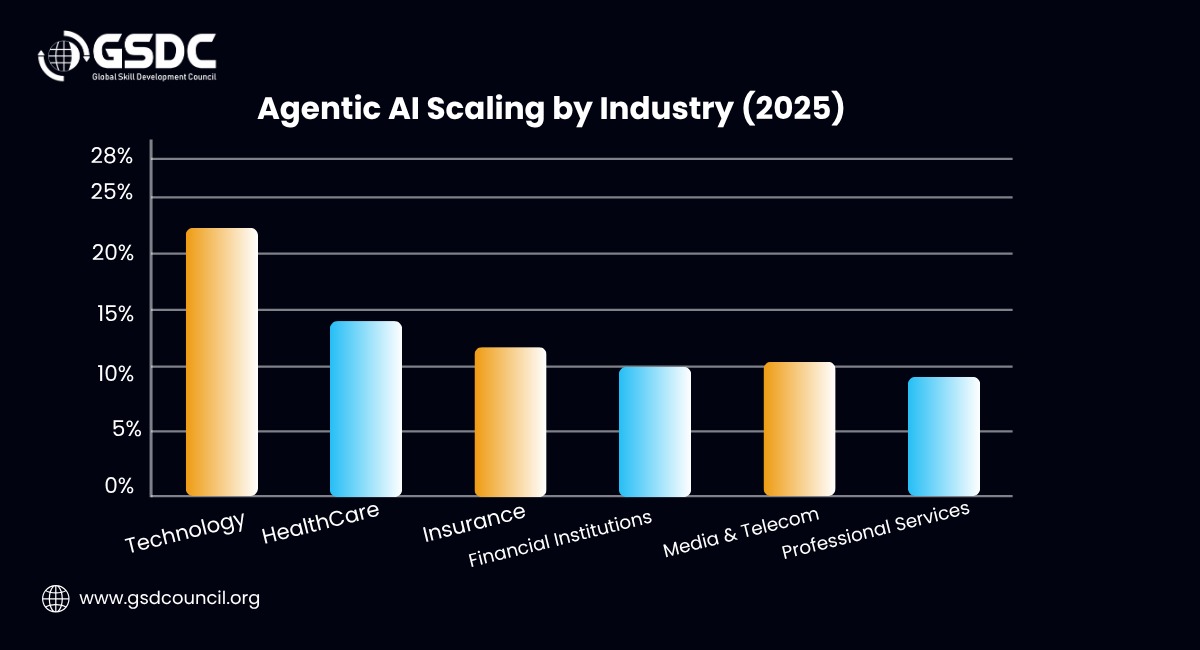
McKinsey's State of AI 2025 (survey of 1,993 organizations across 105 countries) found that 62% of enterprises are already experimenting with AI agents, with 23% actively scaling them in at least one function. Technology, knowledge management, and software engineering are leading adoption - but the gap between experimenters and scalers is wide, and it's widening fast. For professionals looking to close that knowledge gap, the Global Skill Development Council (GSDC) has built its AI curriculum specifically around the capabilities this shift demands.
Agentic AI vs Generative AI: The Differences That Change Everything
Both categories use large language models at their core. That's where the similarity ends. The differences in how they operate, what they can do, and what risks they introduce are significant enough that they require fundamentally different strategies for adoption, governance, and skill development.
Dimension | Generative AI | Agentic AI |
| Core Behavior | Responds to a single prompt | Pursues multi-step goals autonomously |
| Output Type | Generates text, images, or code for human review | Takes actions in real systems |
| Human Involvement | Required at each step (review → implement) | Minimal; handles execution end-to-end |
| Tool Access | Limited or no access to external tools | Uses APIs, databases, browsers, file systems, and code environments |
| Memory | Session-based; context typically resets between conversations | Maintains context and memory across extended workflows |
| Risk Profile | Hallucinations, inaccurate responses, biased outputs | Hallucinations plus autonomous errors that can scale across systems |
| Governance Needs | Output review, validation, and fact-checking | Identity controls, permission boundaries, monitoring, and audit trails |
| Best Suited For | Content creation, Q&A, summarization, coding assistance | Process automation, workflow execution, decision support, and monitoring |
The practical implication: if generative AI was about individual productivity, agentic AI is about organizational transformation. A single generative AI tool can make one knowledge worker significantly more effective. A well-deployed agentic AI system can replace entire chains of sequential human tasks - research, drafting, review, sending, tracking - and run them continuously.
Generative AI stops at the point of suggestion. Agentic AI crosses the line into execution - and that changes everything about how you deploy it, govern it, and build skills around it.
Types of Intelligent Agents in AI: A Practical Map
Not all AI agents are the same. The term "agentic AI" covers a spectrum of systems with different levels of autonomy, capability, and complexity. Here's a practical taxonomy of the main types of intelligent agents in AI that professionals should know in 2026.
- Reflex Agents
React to immediate inputs with pre-defined rules. No memory or planning. Fast and predictable - used in simple automation, alert triggers, and real-time monitoring systems.
- Model-Based Agents
Maintain an internal model of the world to handle situations their rules don't directly cover. More flexible than reflex agents - common in adaptive recommendation systems and dynamic routing.
- Goal-Based Agents
Plan sequences of actions to achieve a specified goal. Can evaluate trade-offs and choose paths. The core architecture of most enterprise agentic AI systems - research agents, coding agents, data analysis agents.
- Utility-Based Agents
Go beyond goal achievement to optimize for a quality outcome - not just "did I complete the goal" but "did I complete it in the best way." Used in resource optimization, financial modeling, and complex scheduling.
- Learning Agents
Improve performance over time through reinforcement learning or feedback loops. They get better at the job the more they do it. Used in personalization engines, autonomous trading, and adaptive security systems.
- Multi-Agent Systems
Networks of specialized agents that coordinate to complete complex tasks. One agent researches, another drafts, another reviews, another sends. The most powerful and increasingly common architecture in enterprise deployments.
In practice, most production agentic AI systems in 2026 combine multiple types - typically a goal-based planning layer coordinating a set of specialized reflex or utility-based sub-agents, each responsible for a specific tool or domain.
ChatGPT Agents: What They Can Actually Do in 2026
For most professionals, ChatGPT is the front door to this evolution. And while the chat interface looks similar to what launched in 2022, what's happening behind that interface has changed dramatically. Here's what ChatGPT agents can do today - and how to use them.
- OpenAI's Operator and Agent Capabilities
OpenAI's agentic capabilities inside ChatGPT have evolved through several layers. Custom GPTs (launched November 2023) allowed specialized assistants with their own knowledge and instructions. The o1 and o3 reasoning models (2024–2025) introduced extended planning and chain-of-thought execution. The full Agents API and Operator framework allow developers to build fully autonomous agents that can use tools, browse the web, execute code, and manage files across sessions.
How to Use Agentic AI in ChatGPT
For non-developers, the practical entry points are:
1. Enable Advanced Tools in ChatGPT Plus / Team
With a Plus or Team subscription, you get access to web browsing, code interpreter (data analysis and chart generation), and file reading - the foundational tool stack for agentic tasks. Enable them in your settings and use them explicitly in prompts.
2. Give it an objective, not just a question
The shift to agentic use is a mindset change as much as a technical one. Instead of "summarize this document," try "analyze this document, identify the three most important trends, search for supporting data online, and give me a one-page briefing with sources." You're delegating a workflow, not asking a question.
3. Use custom GPTs as specialized agents
The GPT Store contains thousands of custom GPTs optimized for specific tasks - financial analysis, legal review, market research, content strategy, code review. Rather than using a general model for everything, treat these like specialized members of a team.
4. For developers: use the Agents API
OpenAI's Agents SDK allows developers to build production-grade agentic systems with tool definitions, memory management, handoffs between agents, and monitoring. This is the path for organizations building serious automation infrastructure - not just individual productivity tools.
Agentic AI Examples Across Industries in 2026
The fastest way to understand what agentic AI actually means in practice is to look at what it's doing in real organizations right now. These aren't speculative use cases - they're deployed systems in production.
- Software Engineering
Autonomous Code Review & Deployment - Agents write, test, and review code - then submit pull requests for human sign-off. OpenAI's Codex agent and GitHub's Copilot Workspace handle end-to-end coding tasks from issue to PR. McKinsey reports 10–20% cost reductions in software engineering from scaled agentic deployment.
- Customer Operations
End-to-End Support Resolution - An agent receives a support ticket, looks up account history, diagnoses the issue, implements a fix, and sends a confirmation email - no human involved. Salesforce Agentforce is already running this workflow at scale for enterprise support teams, pushing containment rates toward 90%.
- Financial Services
Compliance Monitoring & Reporting - Agentic systems monitor transactions against regulatory rules in real time, flag anomalies, pull supporting documentation, draft a preliminary report, and route for human review. Microsoft Copilot Agents integrated into compliance workflows are already shortening analyst cycle times from days to minutes.
- Healthcare
Clinical Documentation Agents - AI agents listen to or read patient encounters, generate structured clinical notes, pull in relevant lab results, and populate EHR systems. Google Agentspace - deployed in healthcare knowledge management - is one example of agents eliminating documentation overhead that consumed up to 35% of physicians' working hours.
- Marketing & Sales
Research-to-Outreach Pipelines - An agent researches a prospect - LinkedIn, company news, recent earnings - synthesizes a profile, drafts personalized outreach, schedules delivery, and triggers follow-up sequences. OpenAI Agents connected to CRM systems via API are enabling sales teams to run 10x their previous outreach volume per rep.
- IT & DevOps
Infrastructure Monitoring & Self-Healing - Agents monitor system health continuously, diagnose incidents when alerts fire, attempt automated remediation, and page a human only when they cannot resolve it. Microsoft Copilot Agents in IT service management and ServiceNow's AI agents are leading deployments in this space, with mean time to resolution dropping dramatically.
The AI Evolution Framework: Five Stages at a Glance
Here's the simplest way to remember the entire arc - from first-generation chatbots to the multi-agent systems now running inside enterprise workflows.
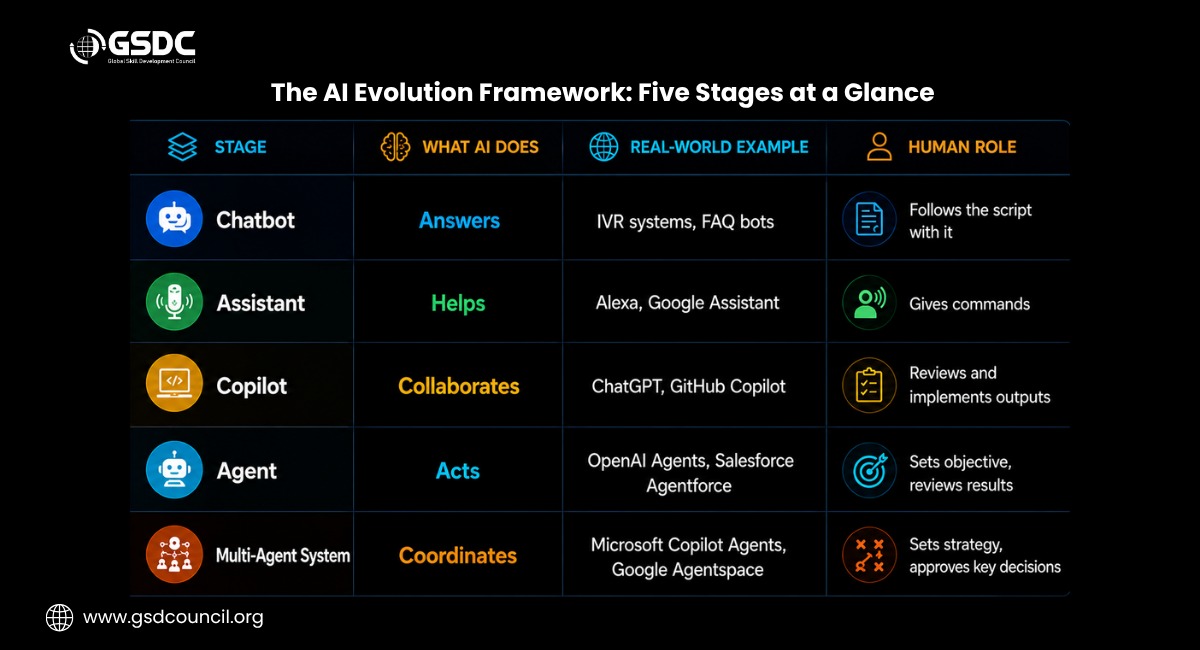
Generative AI multiplied what one person could produce. Agentic AI multiplies what one team can execute - without proportionally growing the team.
Why a Generative AI Certification Matters Now
The pace of this evolution - four paradigm shifts in three years - makes formal learning more valuable, not less. It's increasingly difficult to distinguish genuine AI competency from surface-level familiarity with a few tools. The Global Skill Development Council (GSDC) addresses exactly this gap with their Certified Generative AI Professional credential - built for working professionals who need structured, validated knowledge covering how LLMs and agentic systems work, how to apply them responsibly, and how to evaluate outputs critically.
According to Gartner's August 2025 press release, 40% of enterprise applications will be integrated with task-specific AI agents by the end of 2026 - up from less than 5% in 2025. That's a hiring landscape shifting faster than any in recent memory. A recognized certification is how you get ahead of it rather than catch up to it.
The professionals winning in this market aren't necessarily the ones who know the most about how LLMs work internally. They're the ones who understand the full arc - from chatbots to agentic AI - well enough to make sound decisions about which tools to use, where to apply them, and how to govern them responsibly. That combination of strategic understanding and hands-on skill is what a generative AI certification is designed to build.
What This Evolution Means for Your Career in AI
Every era in the history of generative AI opened new skill requirements and new roles. The agentic turn is doing the same - but faster, and with higher stakes for those who adapt versus those who don't.
Skills That Become More Valuable
Prompt engineering is evolving into agent orchestration - the ability to design, configure, and manage multi-agent systems. The people who can define objectives clearly enough for an agent to execute them reliably, set appropriate guardrails, and evaluate agent outputs critically are increasingly rare and increasingly compensated.
Understanding AI governance and safety also becomes a premium skill. When AI agents can autonomously modify databases and trigger workflows, the question of "what is this agent allowed to do?" becomes a critical business question - not just a technical one.
Finally, domain expertise combined with AI fluency is the most durable combination. An agent can execute tasks, but it needs human expertise to know which tasks are worth executing, how to evaluate quality, and when to override. A financial analyst who understands both derivative pricing and how to configure an agentic research assistant operates at a level that pure AI literacy or pure finance expertise alone cannot match.

Related Certifications
Stay up-to-date with the latest news, trends, and resources in GSDC
If you like this read then make sure to check out our previous blogs: Cracking Onboarding Challenges: Fresher Success Unveiled
Not sure which certification to pursue? Our advisors will help you decide!