Generative AI vs Traditional AI: 5 Key Differences Explained
Written by Matthew Hale
- What Is Traditional AI? (The Engine That Already Runs Your World)
- What Is Generative AI? (The Part Everyone's Actually Talking About)
- Traditional AI vs Generative AI: The 30-Second Snapshot
- How Does Generative AI Work? (Without the PhD)
- The 5 Differences That Actually Matter in the Generative AI vs Traditional AI Debate
- Side-by-Side: Generative AI vs Traditional AI
- Where Each Approach Falls Short
- Generative AI Examples and Traditional AI Examples by Industry
- The Top Generative AI Tools in 2026 (And What They're Actually Good For)
- So Which Should You Focus On - and When?
- Where Do You Go From Here?
- Conclusion
Let's be honest for a second. Most articles that compare generative AI vs traditional AI either go too deep into math or stay so surface-level they leave you more confused than before. You came here because you want clarity - and you deserve it.
By the time you finish reading this, you'll know exactly what separates these two categories of AI, why the difference changes what skills you need, and how real companies are using both right now. No hype. No jargon spiral.
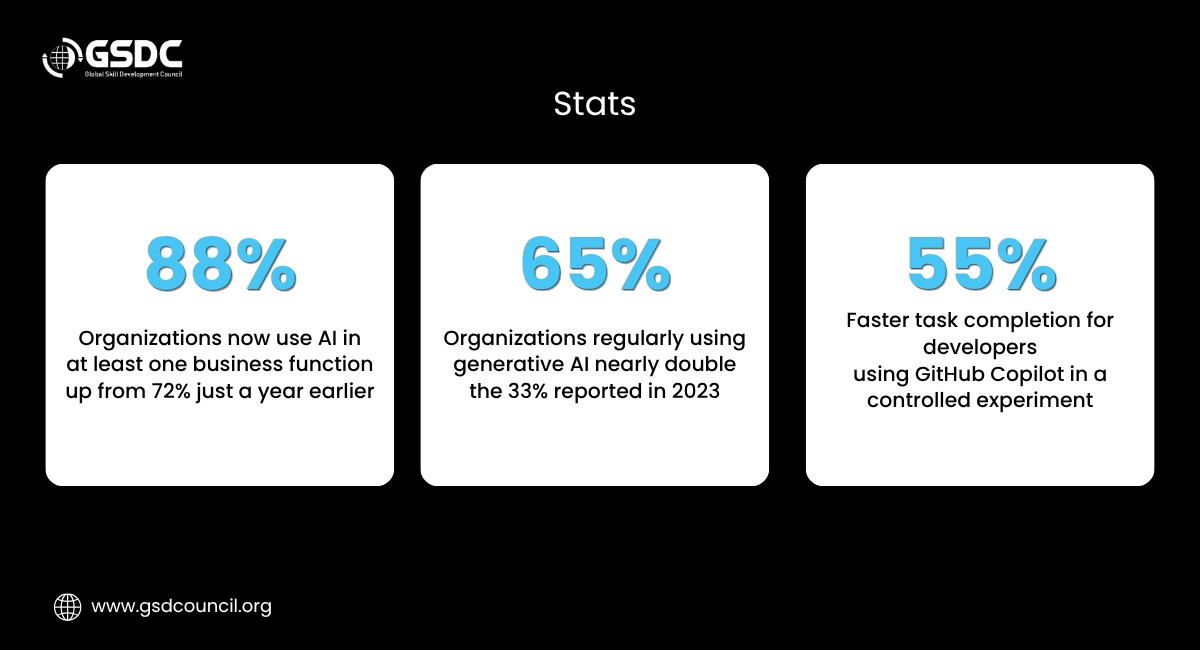
Here's why this question matters so much right now. McKinsey's 2025 State of AI research found that 88% of organizations now use AI in at least one business function - and that number includes both traditional predictive AI (fraud detection, forecasting, quality control) and generative AI working side by side. Understanding what each type actually does is what separates strategic AI adoption from expensive pilots that go nowhere
The core question isn't "which AI is better?" It's "which type of AI is right for the specific problem I'm trying to solve?" That mindset shift is what separates strategic AI adoption from expensive noise.
What Is Traditional AI? (The Engine That Already Runs Your World)
Traditional AI - also called narrow AI, predictive AI, or discriminative AI - has been the quiet workhorse of modern business for over two decades. It's the reason your bank texts you about a suspicious charge within seconds, why Spotify knows your Friday mood, and why a logistics company can predict exactly when a machine on its floor is about to break down.
At its core, traditional AI learns patterns from labeled historical data and uses those patterns to make predictions or decisions about new data. Think of it like this: you show a model millions of past examples tagged as "fraud" or "not fraud." Over time, the system builds a mental map of what fraud looks like, and it flags similar patterns going forward.
Where Traditional AI Shines
- Fraud detection in financial transactions
- Demand forecasting for retail and supply chain
- Customer churn prediction for SaaS companies
- Image classification in manufacturing quality control
- Recommendation engines (Netflix, Amazon, Spotify)
- Credit scoring and loan risk assessment
The defining trait? It's narrow by design. A model trained to detect credit card fraud cannot suddenly write product descriptions. Every model is built for one task, and it can be extraordinarily good at that task - often better than any human - but it cannot generalize beyond what it was trained to do.
Traditional AI is also significantly more transparent and auditable than its newer cousin. In regulated industries - banking, healthcare, insurance - being able to explain why a model made a specific decision isn't optional. It's a legal requirement. Traditional AI, especially decision trees and logistic regression models, holds a real advantage here.
Important: Traditional AI isn't going away. In 2026, the majority of revenue-generating AI systems inside large enterprises are still traditional models. Fraud detection, supply chain optimization, credit scoring - these are traditional AI domains, and they're not being replaced. They're being augmented.
What Is Generative AI? (The Part Everyone's Actually Talking About)
So if traditional AI predicts, generative AI creates. That one sentence is the most honest summary of the difference between AI and generative AI.
Generative AI doesn't analyze existing data to classify it - it learns the underlying structure and language of data, and then uses that knowledge to produce entirely new content that looks, reads, or functions like the real thing. That content could be text, images, audio, code, or even synthetic data.
The models doing this - large language models (LLMs) like GPT-4o, Claude, and Gemini; image generation systems like DALL-E and Stable Diffusion; code assistants like GitHub Copilot - are trained on trillions of tokens of human-created content. Through that training, they develop a deep statistical intuition for how language, visuals, and code are structured.
Then, when you give them a prompt, they generate a response token by token, word by word, building output that follows the patterns they've internalized. It's not retrieved from a database. It's made.
The moment that changed everything came in late 2022 with the public release of ChatGPT. Within five days, it had one million users. Today, generative AI is embedded in everything from enterprise knowledge management to student homework - for better or worse.
The real unlock is that generative AI runs on plain language. You don't need a data pipeline or a machine learning background. You need clear thinking and the ability to ask the right questions - which is exactly why it's moving through non-technical business functions faster than any AI technology before it. It's also why credentials like the Certified Generative AI Professional exist: because knowing how to use these tools is one thing, knowing how to use them well - and responsibly - is what actually sets people apart.
Traditional AI vs Generative AI: The 30-Second Snapshot
Before we dig into each difference in depth, here's the essential comparison at a glance. If you're short on time, this table alone tells you what you need to know about the difference between AI and generative AI.
Dimension | Traditional AI | Generative AI |
Core Function | Predicts and classifies data | Creates and generates new content |
Training Data | Labeled, structured datasets | Massive unstructured datasets |
Scope | One task per model | Multiple tasks with a single model |
Output | Scores, categories, probabilities | Text, images, code, audio, video |
Explainability | High; often auditable and transparent | Lower; often considered a black box |
Primary Goal | Analyze existing data and make decisions | Create new content based on learned patterns |
Best Use Cases | Fraud detection, forecasting, risk scoring | Content creation, summarization, coding assistance |
Human Interaction | Typically through applications and workflows | Often through natural language prompts |
Hallucination Risk | Low due to bounded outputs | Higher; requires validation and guardrails |
Examples | Credit scoring, recommendation engines, demand forecasting | ChatGPT, Claude, Gemini, DALL·E, Midjourney |
We'll unpack each of these rows in detail below - including the trade-offs that don't show up in a table like this.
One thing worth noting: understanding this table is the starting point, not the finish line. Knowing which AI type fits which problem - and being able to apply that in a real business context - is a separate skill entirely. It's the kind of practical fluency that GSDC's certifications are specifically built around, for professionals who want to move beyond surface-level familiarity.
How Does Generative AI Work? (Without the PhD)
You don't need to understand transformer architecture to use generative AI well - but a basic mental model helps you know what it's good at, where it fails, and why. Here's the short version.
- Pre-training on massive datasets
An LLM ingests hundreds of billions of words from books, websites, and academic papers. It doesn't memorize text - it builds a statistical map of how language (or code, or images) is structured. This is why one model can write a legal brief and debug Python in the same conversation.
2. Fine-tuning for helpfulness and safety
Through a process called RLHF (Reinforcement Learning from Human Feedback), the raw model is shaped to be helpful, coherent, and less prone to harmful outputs. This is what separates a polished AI assistant from a raw language model.
3. Generating responses - and why hallucinations happen
When you submit a prompt, the model predicts the most statistically probable next token, then the next - building a response from patterns it learned during training, not from a live lookup. It generates what sounds right, not what's verified as true. That's the root cause of hallucinations - and why output validation remains essential in high-stakes workflows.
The most sophisticated enterprise deployments in 2026 add Retrieval-Augmented Generation (RAG) on top of this - connecting the LLM to a verified knowledge base so it pulls in accurate, current information before generating a response. This dramatically reduces hallucination rates in production systems.
The 5 Differences That Actually Matter in the Generative AI vs Traditional AI Debate
There are dozens of technical distinctions between these two types of AI, but most of them only matter if you're building models from scratch. The following five are the ones that shape business decisions, career choices, and real-world outcomes in 2026.
- Purpose: Prediction vs Creation
Traditional AI answers questions about existing data - Is this transaction fraudulent? Which customers will churn? What's the demand forecast for Q3? It reasons from data to conclusions. Generative AI does something categorically different: it creates something that didn't previously exist. A document, an image, a piece of code, a summary, a conversation. If traditional AI is a detector, generative AI is a generator. Neither is superior - they solve fundamentally different problems.
- Output Type: Structured Answers vs Open-Ended Content
A traditional AI model outputs a number, a category, or a probability. A fraud model returns "fraud" or "not fraud." A demand model returns a sales figure. That structured output is exactly what regulated, high-stakes systems need. Generative AI outputs open-ended content - a paragraph, an image, a block of code. That creative, flexible output is exactly what content, communication, and knowledge work needs. The output type determines the use case, and the use case should determine the tool.
- Training Data: Labeled vs Massive Unstructured
Building a traditional AI model requires carefully curated, human-labeled datasets. Someone has to tag thousands of emails as "spam" or "not spam." This labeling process is expensive, time-consuming, and a real bottleneck for organizations without data infrastructure. Generative AI models are pre-trained on trillions of tokens of raw, unlabeled content scraped from across the internet. This gives them broad, general knowledge across countless domains without any custom labeling - which is why they can write about tax law, recipe development, and Python debugging in the same conversation.
- Scope: Narrow Specialist vs General Generalist
A traditional AI model is a specialist. It does one thing extremely well and nothing else. A generative AI model - particularly a large language model - is a generalist. One model can draft a legal brief, analyze a financial report, translate languages, explain a scientific concept, write marketing copy, and debug code. This generality is unprecedented in AI history, and it's exactly what drives the rapid adoption across non-technical business functions. But generality comes with trade-offs: specialists beat generalists on narrow, high-precision tasks where accuracy and auditability are non-negotiable.
- Transparency: Explainable vs Black Box
Traditional AI models - especially regression models, decision trees, and gradient boosting methods - can often be examined to understand why they made a specific decision. This explainability is legally required in sectors like banking and healthcare. Generative AI models, with billions or trillions of parameters, are substantially harder to interpret. They can also hallucinate - producing confident-sounding but incorrect outputs. Organizations deploying generative AI need to invest in output validation layers, human review processes, and techniques like RAG to manage this risk. The transparency gap is real, actively being researched, and shouldn't be dismissed.
Side-by-Side: Generative AI vs Traditional AI
Dimension | Traditional AI | Generative AI |
Primary Function | Predict, classify, detect | Create, generate, synthesize |
Training Data | Labeled, domain-specific datasets | Vast unstructured text, images, and code |
Output Type | Numbers, categories, probabilities | Text, images, code, audio |
Scope | Narrow - one task per model | General - many tasks, one model |
How You Use It | Code, pipelines, APIs | Natural language prompts |
Explainability | Often high (model-dependent) | Lower - active research area |
Compute Cost | Moderate and predictable | Higher (5–20× traditional AI per query) |
Hallucination Risk | Low (bounded output) | Real - requires guardrails and validation |
Best For | Risk scoring, forecasting, anomaly detection | Content creation, Q&A, summarization, coding |
Where Each Approach Falls Short
One thing most AI comparisons gloss over: both traditional AI and generative AI have real, meaningful weaknesses. Understanding them isn't pessimism - it's how you avoid expensive mistakes and deploy the right tool with the right guardrails.
Traditional AI Limitations
- Struggles with unstructured data (free text, images without labeling, audio)
- Cannot create content - only classify or predict from what it's seen
- Requires expensive, time-consuming data labeling for every new task
- No flexible reasoning - can't adapt to a question outside its training domain
- Building a new model for each use case adds significant time and cost
Generative AI Limitations
- Hallucinations - confidently generating inaccurate or fabricated information
- Poor explainability - hard to audit why a specific output was produced
- Not suited for high-stakes decisions requiring verifiable, bounded outputs
- Higher per-query compute cost (5–20x traditional AI at equivalent scale)
- Prompt-sensitive - small wording changes can dramatically shift outputs
The practical takeaway: Don't use generative AI where you need a verifiable, bounded answer under regulatory scrutiny. Don't use traditional AI where you need flexible reasoning, language understanding, or content generation. Both have a ceiling - the skill is knowing where that ceiling sits.
Generative AI Examples and Traditional AI Examples by Industry
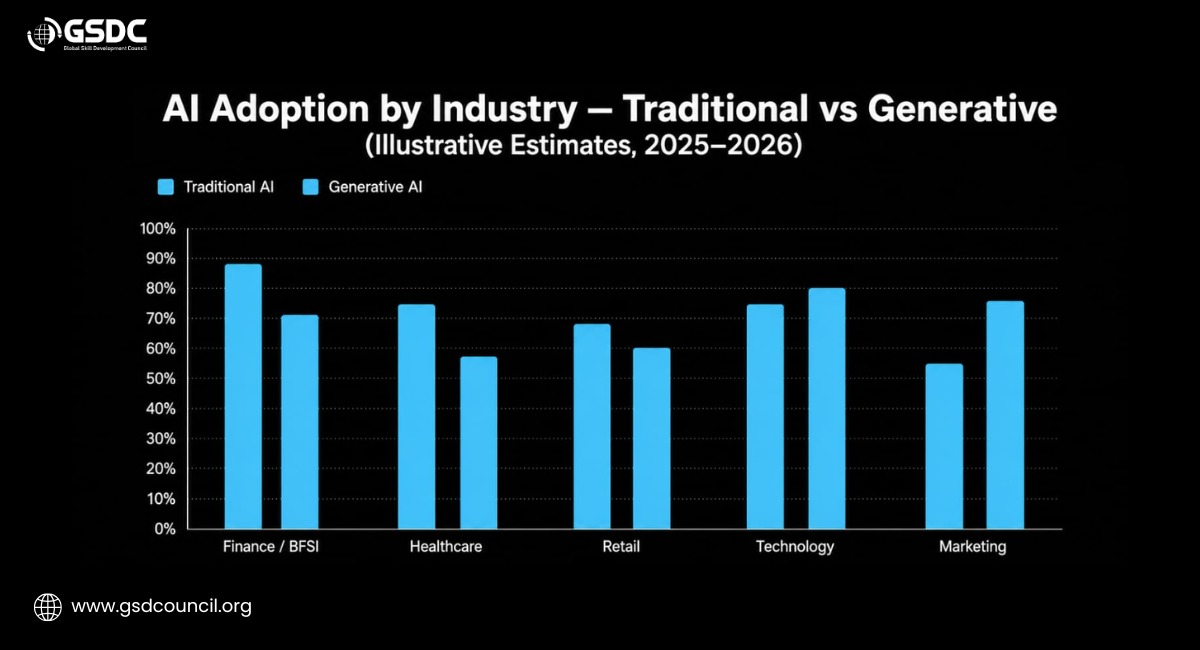
The clearest way to understand the difference between predictive AI vs generative AI isn't through definitions - it's by seeing them side by side, solving real problems in real industries. Notice that the traditional AI examples handle structured, repetitive decisions in the background, while the generative AI examples handle communication, content, and customer-facing work at the front.
| Industry | Traditional AI Examples | Generative AI Examples |
| Finance | • Real-time transaction fraud detection • Credit risk scoring at loan application • Algorithmic trading and portfolio optimization• AML (anti-money laundering) monitoring | • Automated financial report drafting • AI advisory chatbots for wealth clients • Regulatory document summarization • Personalized investment summaries |
| Healthcare | • Tumor detection in medical imaging • Patient readmission prediction models • Genomics pattern analysis • Clinical decision support systems | • Generating clinical notes from doctor dictation • Discharge summary drafting • Synthetic medical data for research • Drug discovery hypothesis generation |
| Retail | • Product recommendation engines • Inventory demand forecasting • Dynamic pricing algorithms • Customer lifetime value modeling | • AI-generated product descriptions at scale • Personalized marketing email copy • Virtual try-on and visual search • Conversational shopping assistants |
Notice the pattern: traditional AI handles precision-critical, structured decision-making in the background. Generative AI handles communication, content, and customer-facing interaction at the front. Both are essential. Neither replaces the other.
"The best AI strategy in 2026 isn't choosing between traditional and generative AI. It's knowing exactly where each one creates the most value - and building systems that use both."
The Top Generative AI Tools in 2026 (And What They're Actually Good For)
The generative AI tools landscape has matured considerably. Here's a grounded look at what's out there and what each one is genuinely best suited for - not a marketing rundown, but a practical orientation.
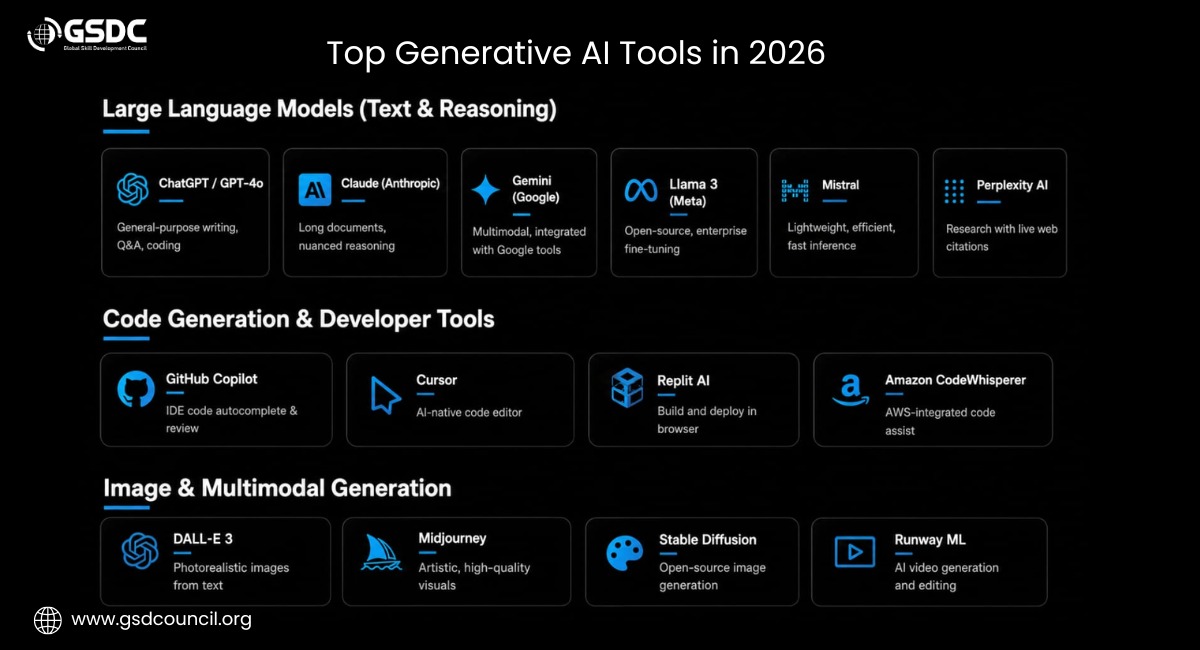
The productivity evidence behind these tools is real - and verified. A controlled experiment by GitHub and Microsoft Research found developers using Copilot completed a coding task 55% faster than those working without it. A separate large-scale survey of over 2,000 developers found 88% felt more productive when using the tool. Both figures are from separate studies measuring different things - one is objective task speed, the other is self-reported experience - and both point in the same direction.
For organizations, the broader picture is also positive. McKinsey's 2025 State of AI report found that 39% of companies already attribute measurable EBIT impact to AI use, with the gap between early movers and the rest of the market widening every quarter.
So Which Should You Focus On - and When?
The honest answer: in 2026, the professionals and organizations that understand both are the ones creating the most value. But the path you take depends entirely on where you're starting from and what problems you're trying to solve.
Choose Traditional AI Skills If…
- Your problem is structured, repeated, and measurable (fraud detection, churn prediction, forecasting)
- You work in a regulated industry where explainability is non-negotiable
- You have clean, labeled data and want reliable, auditable outputs
- You need high-volume, real-time decisions at predictable cost
Choose Generative AI Skills If…
- You want to build conversational AI, content engines, or knowledge assistants
- Your work involves unstructured data - documents, emails, reports, code, customer queries
- You're in marketing, product, support, legal, or any knowledge-intensive function
- You want to dramatically expand your output without proportionally expanding your team
Combine Both If…
You're building a production AI system that needs to both decide and communicate. A loan assessment system that uses traditional AI to calculate risk probability, then uses generative AI to draft the plain-English explanation for the applicant. A retail platform that uses a traditional recommendation engine to surface products, then uses generative AI to write personalized descriptions for each user. This is the architecture of sophisticated AI in 2026 - and understanding where each type fits is the literacy that matters.
Where Do You Go From Here?
Understanding the difference between traditional and generative AI is the foundation. Being able to prove it is what moves your career forward.
The Global Skill Development Council (GSDC) offers the Certified Generative AI Professional certification - a vendor-neutral, internationally recognised credential designed for working professionals who want more than just theoretical knowledge. It covers how generative AI works, how to apply it, and how to govern it responsibly in real business environments.
If you're serious about making AI a core part of what you do, this is a practical next step.
Explore the Certified Generative AI Professional →
Conclusion
Understanding the types of AI matters beyond just these two. Reinforcement learning (AI that learns via trial and reward), agentic AI (AI that plans and executes multi-step tasks autonomously), and multimodal AI (processing text, images, and audio together) are all shaping enterprise strategy in 2026. But mastering the traditional vs generative distinction is the essential foundation - everything else builds on it.

Related Certifications
Frequently Asked Questions
Traditional AI looks at existing data and makes a call - fraud or not, churn risk or not, high demand or low. Generative AI produces something new: a draft, an image, a block of code. One decides. The other creates.
No. Traditional AI still runs the most critical systems in banking, healthcare, and logistics. Generative AI adds a new layer on top. The smartest organisations aren't choosing between the two - they're using both.
Less than you'd think. Most tools today run on natural language. That said, understanding how these systems work, their limits, and how to use them responsibly does give you a real edge over someone who's just prompting blindly.
A vendor-neutral certification from GSDC that validates your ability to work with generative AI in real business contexts - how models work, how to apply them, and how to govern them responsibly. Built for professionals, not just students.
Because in banking, insurance, and healthcare, "the model said so" isn't good enough. Regulators want to know why a loan was denied or a patient was flagged. Traditional AI can often be audited. Generative AI is much harder to interpret.
RAG stands for Retrieval-Augmented Generation. It connects a generative AI model to a verified knowledge base before generating a response - so instead of guessing, it pulls in accurate, current information first. It's now standard in serious enterprise deployments.
Prompt engineers, AI content strategists, LLM fine-tuning specialists, AI governance leads, generative AI product managers - roles that barely existed three years ago. Existing roles in marketing, legal, and product are also being reshaped fast.
Ask yourself: does my problem involve creating or communicating something? And can I tolerate an occasional error? If yes to both, generative AI likely fits. If you need verifiable, bounded answers every time, traditional AI is the safer call.
Treating it like a smarter search engine. It doesn't retrieve facts - it generates responses from patterns. Without proper guardrails and human review, you get confident-sounding outputs that are simply wrong.
Pick a task you do every week and run it through Claude or ChatGPT. See where it helps, where it doesn't, and why. If you want something more structured, the GSDC Certified Generative AI Professional programme is a solid place to go deeper.
Stay up-to-date with the latest news, trends, and resources in GSDC
If you like this read then make sure to check out our previous blogs: Cracking Onboarding Challenges: Fresher Success Unveiled
Not sure which certification to pursue? Our advisors will help you decide!