Why Prompt Engineers in Tech Hubs Earn More Than ML Engineers

Written by Matthew Hale
- What Is a Prompt Engineer, Really?
- Why Companies Are Suddenly Hiring Prompt Engineers
- The Salary Gap, By the Numbers
- Why Tech Hubs Specifically?
- Prompt Engineer vs. ML Engineer: Why the Title Confusion Costs You Money
- Skills That Separate a $120K Prompt Engineer From a $300K Prompt Engineer
- How to Become an AI Prompt Engineer
- Is the Premium Sustainable?
- Closing the Gap: Where Structured Learning Fits In
- The Bottom Line
A senior machine learning engineer in Denver pulls in a respectable base. A prompt engineer working out of San Francisco, New York, or Seattle, doing work that sounds almost identical on paper, can out-earn that ML engineer by six figures. Same AI boom, same skill family, wildly different paychecks.
That gap isn't random, and it isn't hype either. It comes down to three things: where the frontier AI labs are physically clustered, how thin the qualified talent pool actually is, and how the market has started pricing a role that barely existed three years ago. If you're weighing a move into AI, deciding between prompt engineering jobs and a traditional ML track, or just trying to make sense of the numbers you're seeing on job boards, this breakdown will give you a clear, source-backed picture.
What Is a Prompt Engineer, Really?
Before getting into salaries, it helps to settle what a prompt engineer is actually paid to do - because the job has moved well past "type clever questions into ChatGPT."
What does a prompt engineer do day to day? In practice, the role blends a few disciplines: understanding how large language models interpret instructions, designing and testing prompt structures that produce reliable output, building evaluation frameworks to catch regressions, and often working alongside retrieval-augmented generation (RAG) pipelines and agent orchestration tools. It's part linguist, part systems thinker, part QA engineer.
That cross-disciplinary nature is exactly why the role commands a premium. A good prompt engineer needs a working understanding of how models like GPT-4 or Claude actually process language, the patience to iterate and test relentlessly, and enough technical range to debug why a prompt that performed perfectly in a sandbox falls apart under real production traffic
Why Companies Are Suddenly Hiring Prompt Engineers
The salary numbers only make sense once you see what's actually driving the hiring. This isn't a speculative bet on AI's future - it's companies solving immediate, expensive problems with LLM-powered systems and needing people who can make those systems reliable. A few examples show how broad the demand has become:
Customer support copilots.
Enterprises are deploying LLMs to draft or fully handle support responses, which means someone has to design prompts and guardrails that keep the AI accurate, on-brand, and unable to make promises the company can't keep.
Legal document review.
Law firms and corporate legal teams use AI to summarize contracts and flag risk clauses, work where a single hallucinated clause can carry real liability - making careful prompt and evaluation design non-negotiable.
Healthcare documentation.
Clinical teams are using AI to draft visit notes and summarize patient records, a use case where accuracy isn't a nice-to-have; it's a compliance requirement, and prompt engineers are the ones building the testing layer that catches errors before they reach a chart.
AI coding assistants.
Engineering teams embedding tools like GitHub Copilot or custom internal assistants need prompt and context design that produces code suggestions developers can actually trust, rather than ones that quietly introduce bugs.
Internal enterprise search.
Large companies are building AI search layers over years of internal documents, and getting useful, non-hallucinated answers out of that mess of data is almost entirely a prompt and retrieval design problem.
Each of these is a business already losing time or money to a problem, not a company experimenting for novelty's sake. That's the real reason the role pays what it does - it's not paying for clever wording, it's paying for risk reduction at scale.
The Salary Gap, By the Numbers
Here's where the city premium becomes impossible to ignore. According to a 2026 salary guide from IT staffing firm KORE1, prompt engineers in the United States earn a national base salary ranging from roughly $95,000 to $206,000, with an average sitting near $129,500 across major salary aggregators. That's already a strong starting point. But location changes the math substantially.
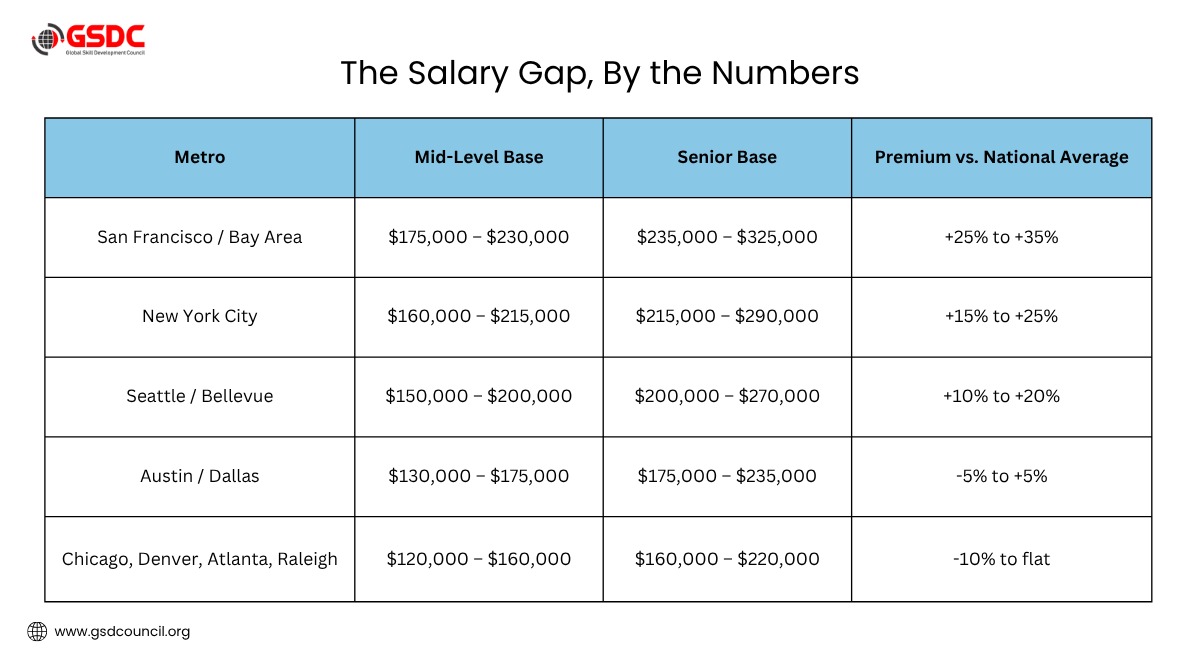
Compare that against the machine learning engineer salary benchmark in a non-hub metro, and the gap is striking. Based on the same metro-level compensation breakdown, a senior ML engineer working remotely or in a second-tier city often lands closer to the national mid-level prompt engineering range - meaning a prompt engineer in a major hub can out-earn an equally experienced ML engineer working from a lower-cost metro, despite the ML role traditionally being viewed as the more "technical" of the two.
At a small number of frontier AI labs, the picture gets even more dramatic - though it's worth being clear this top-of-market tier represents a thin slice of the overall job market, not a typical outcome. Industry compensation data shows packages at these labs clearing half a million dollars once equity and signing bonuses are factored in, with base salaries for senior prompt and evaluation engineers running from roughly $280,000 to $425,000. That's not a typo, but it also isn't the number most people researching ai prompt engineer salary should anchor their expectations to. It's what happens when a handful of companies compete for a genuinely scarce skill set in one geographic cluster - not the going rate for the role broadly.
Why Tech Hubs Specifically?
Three forces are stacking on top of each other in cities like San Francisco, New York, and Seattle, and none of them apply with the same intensity in lower-cost metros.
The labs are physically there.
Anthropic, OpenAI, and a cluster of well-funded foundation-model startups are headquartered in the Bay Area. These companies aren't just hiring prompt engineers - they're hiring people to design the evaluation harnesses and reinforcement learning workflows that get baked directly into how their models behave. That work happens close to where the models are trained, and proximity to decision-makers and infrastructure still matters even in a remote-friendly industry.
Equity changes the math.
Outside the Bay Area, compensation is overwhelmingly cash-based. Inside it, a meaningful chunk of total pay comes from equity grants tied to companies whose valuations have moved fast. That equity component is a major reason the senior and frontier-lab compensation bands pull so far ahead of the base-salary numbers alone.
The candidate pool is small and the bar is high.
Genuinely qualified prompt and evaluation engineers - people who can ship production LLM systems, not just write clever one-off prompts - remain in short supply relative to demand. When a tight labor pool is concentrated in one metro, local salaries get bid up faster than the national average can catch up.
Prompt Engineer vs. ML Engineer: Why the Title Confusion Costs You Money
A lot of the salary noise online comes from the fact that "prompt engineer" gets used to describe at least three very different jobs: a frontier-lab evaluation specialist, an applied AI engineer building RAG pipelines and agent workflows at a regular company, and a marketing or content specialist who's simply good at using AI tools. Those three roles can be separated by well over $150,000 in base pay, even though they share a job title.
This matters if you're researching how to become a prompt engineer, because the path you take determines which of those three paychecks you end up with. The content-and-marketing track requires comfort with consumer AI tools and prompt libraries. The applied AI engineering track - the one with the most volume and the strongest growth - requires hands-on experience with retrieval-augmented generation, vector databases, and agent orchestration frameworks. The frontier-lab track requires a graduate-level background in machine learning or NLP and a portfolio of shipped production systems.
The confusion gets worse once you throw related titles into the mix - LLM engineer, generative AI engineer, large language model engineer - which all overlap with prompt engineering but emphasize different parts of the stack. A quick side-by-side helps clarify the AI engineer vs prompt engineer question that comes up constantly in job-search forums:
Internla Image: Prompt Engineer vs. ML Engineer: Why the Title Confusion Costs You Money
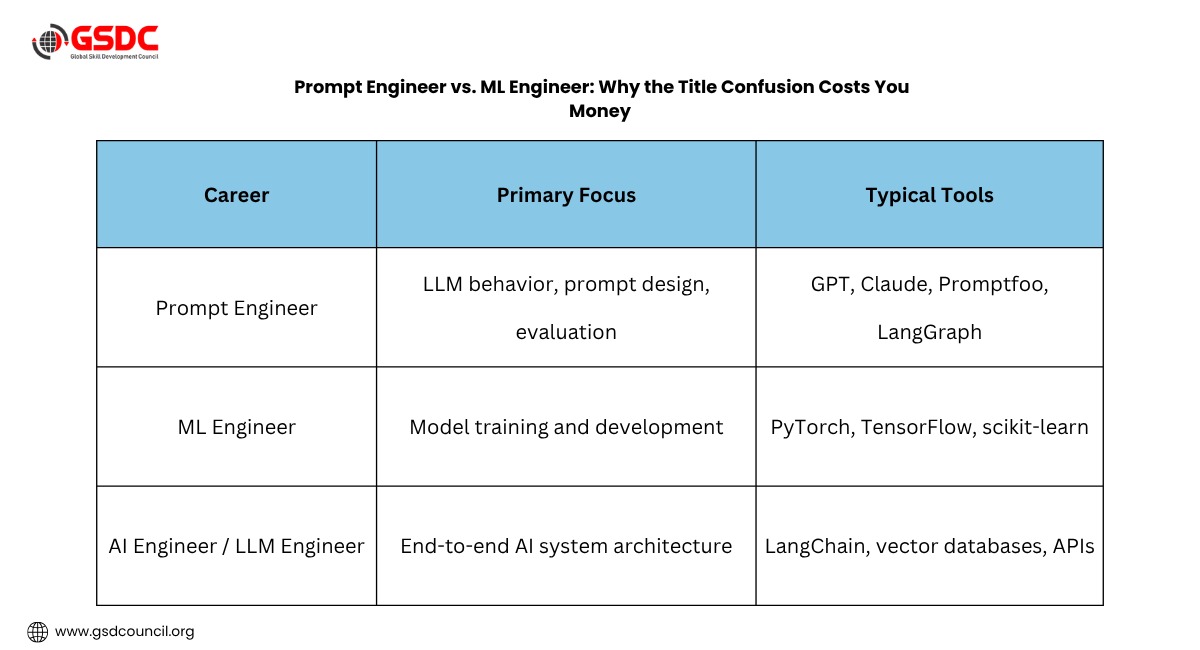
In practice, the lines blur constantly - most real job postings combine elements of all three - but understanding which bucket a role mostly falls into will help you read a job description (and a salary range) far more accurately.
Skills That Separate a $120K Prompt Engineer From a $300K Prompt Engineer
Title aside, pay inside this field varies enormously based on a specific set of capabilities. The further down this list someone can credibly go, the higher their ai prompt engineer salary tends to land:
- Prompt writing vs. evaluation design. - Anyone can write a decent prompt. Far fewer people can build a rigorous evaluation set that catches when a prompt silently degrades after a model update.
- RAG architecture. - Knowing when to use retrieval-augmented generation, how to chunk and index documents, and how to choose between vector databases like Pinecone, Weaviate, or pgvector.
- Agentic AI. - Designing multi-step agents that call tools, make decisions, and recover from errors - increasingly the default shape of production AI work in 2026.
- Python and APIs. - Enough programming fluency to wire prompts into real applications, not just test them in a chat window.
- Experiment design. - Running structured A/B tests on prompt variations instead of relying on gut feel.
- AI safety and guardrails. - Anticipating misuse, bias, and failure modes before they reach end users - especially critical in regulated industries like healthcare and legal.
- Production monitoring. - Tracking drift, hallucination rates, and latency once a system is live, not just when it ships.
The $120K range tends to belong to people strong in the first one or two skills. The $300K range belongs to people who can credibly do all seven, and that's the exact gap GSDC's training pathway is built to close.
How to Become an AI Prompt Engineer
If you're starting from scratch, the realistic path looks less like memorizing clever phrasing tricks and more like building genuine technical range. A few steps consistently show up in the backgrounds of people who land the better-paying roles:
Build a foundation in how language models actually work.
You don't need a PhD, but you need to understand tokens, context windows, and why models respond differently to structurally differentwhat does a prompt engineer do prompts.
Get hands-on with real tools.
Vector databases like Pinecone or pgvector, orchestration frameworks like LangGraph, and evaluation tools like Promptfoo are now standard parts of the job, not nice-to-haves.
Build something specific, end to end, and document it.
Instead of a vague portfolio piece, do something like this: build a customer-support chatbot using RAG, evaluate its hallucination rate with Promptfoo, deploy it somewhere real users can hit it, and write up what broke and how you fixed it. That kind of project - with a clear problem, a measurable failure mode, and an honest account of trade-offs - is what hiring managers increasingly pay attention to, far more than a list of tutorials completed.
Use formal training to fill specific gaps, not as a substitute for projects.
Employers usually care more about demonstrable skills than certificates alone. That said, a structured Engineers Certified prompt engineering certification or prompt engineering course can shorten the learning curve meaningfully, especially for professionals moving into AI-focused roles from software development, QA, business analysis, or technical writing backgrounds. Think of it as scaffolding for faster learning, not a credential that replaces shipped work.
Is the Premium Sustainable?
It's a fair question, and the honest answer is: partly. The narrow task of hand-writing individual prompts is already being automated by tools that optimize prompts algorithmically against labeled datasets. But the broader discipline - designing, testing, and maintaining the systems that make AI products reliable - is expanding, not shrinking, as more companies put LLMs into production. The skill is shifting from "write a good prompt" toward "build and evaluate the system that writes good prompts," and that shift tends to pay more, not less.
For now, the geography premium holds because the underlying scarcity hasn't gone away. Until more companies outside the major hubs start building serious in-house AI evaluation teams, the city you work in will keep being one of the biggest single factors in your paycheck - sometimes bigger than your job title itself.

Closing the Gap: Where Structured Learning Fits In
The skills that separate a $120K prompt engineer from a $300K one - evaluation design, RAG architecture, agentic workflows, production monitoring - aren't picked up by accident. They're built faster with the right structure, especially for professionals moving in from software development, QA, business analysis, or technical writing.
That's the gap the Global Skill Development Council (GSDC)'s Certified Prompt Engineering Certification is built to close. It covers prompt design and evaluation, RAG fundamentals, and working with production LLM systems - the same skill clusters that show up in real hiring decisions. Paired with a solid portfolio project, it gives hiring managers a clear, recognized signal that your skills were built against an industry-aligned framework, not picked up piecemeal.
The Bottom Line
If you're comparing prompt engineering jobs against a traditional ML career path, or weighing an ai engineer salary against what a prompt specialist can earn, location and specialization both matter more than the job title on its own. A prompt or applied AI engineer in a major tech hub can realistically out-earn an ML engineer in most other U.S. cities, not because the work is fundamentally harder, but because the market for that specific blend of skills, concentrated in a handful of metros, is still catching up to demand.
Five years ago, prompt engineering wasn't even a recognized profession. Today, in the right market, it can command compensation that rivals or exceeds traditional machine learning roles. Whether that premium lasts forever is uncertain, but one thing is already clear: organizations aren't simply paying for better prompts - they're paying for people who can make AI systems dependable at scale. For anyone building a prompt engineering career as part of the broader wave of AI jobs in 2026, that's where the long-term opportunity lies.

Related Certifications
Frequently Asked Questions
A prompt engineer is someone who designs, tests, and refines the instructions that get fed into AI models so the output is accurate, useful, and consistent. It's less about typing clever one-liners and more about understanding how a model "thinks," then building structure around that - prompts, evaluation checks, and sometimes the retrieval systems feeding the model context in the first place.
Most days look like a mix of writing and testing prompts, reviewing where outputs went wrong, building small evaluation sets to catch regressions, and working with engineers on how the AI fits into a larger product. It's far more iterative than people expect - a lot of the job is figuring out why something that worked yesterday stopped working today.
Start by getting comfortable with how large language models process instructions, then move quickly into hands-on practice - building something real, even small, beats reading about the theory. From there, tools like RAG pipelines and evaluation frameworks come into play, and a structured course can help organize the learning instead of jumping between scattered YouTube tutorials.
The honest answer is there's a lot of overlap, and the title itself is getting blurrier every year. What separates the "prompt engineer" lane is depth in prompt design and evaluation specifically - knowing why one phrasing produces a more reliable output than another, and being able to prove it with data rather than instinct.
Honestly, both matter, just for different reasons. Projects prove you can ship something real. A prompt engineering certification gives you a structured path so you're not guessing what to learn next, which matters a lot if you're switching careers from something like QA or technical writing. Neither one replaces the other.
It depends heavily on where you sit in the market. National figures land somewhere between $95K and $206K base, but that range hides a lot - junior roles, applied engineering roles at regular companies, and frontier-lab roles are really three different jobs wearing the same title, with very different paychecks attached.
ML engineering still pays well, often slightly ahead of prompt engineering at the junior-to-mid level, since it traditionally requires deeper math and model-building skills. But once you factor in location and specialization, a senior prompt or applied AI engineer in a major hub can actually out-earn an ML engineer working remotely or in a lower-cost city.
Yes, though the job titles are shifting. A lot of what used to be posted as "prompt engineer" is now folded into "AI engineer" or "applied AI engineer" listings. The underlying work - designing and evaluating how AI systems behave - isn't going away. If anything, it's spreading into more industries as companies put LLMs into production.
If you already have a technical background, you can probably learn a lot of this on the job. If you're coming from a non-technical field, a prompt engineering course gives you the vocabulary and frameworks to not feel lost in interviews, which honestly makes a bigger difference early on than people expect.
The narrow task of hand-writing individual prompts is already getting automated by tools that test and optimize prompts algorithmically. But the broader work - designing reliable AI systems, catching failure modes, keeping things accurate at scale - is growing, not shrinking. The job is shifting upward in scope, not disappearing.
Stay up-to-date with the latest news, trends, and resources in GSDC
If you like this read then make sure to check out our previous blogs: Cracking Onboarding Challenges: Fresher Success Unveiled
Not sure which certification to pursue? Our advisors will help you decide!