Prompt Engineering Career Path: From Beginner to AI Workflow Lead
Written by Matthew Hale
- What Is Prompt Engineering?
- Career Opportunity 1: Prompt Engineer
- Career Opportunity 2: AI Content Strategist
- Career Opportunity 3: AI-Powered Business Analyst
- Career Opportunity 4: AI Workflow Automation Specialist
- Career Opportunity 5: Learning & Development AI Specialist
- Career Opportunity 6: AI-Enhanced HR Professional
- Career Opportunity 7: AI Consultant
- Career Opportunity 8: AI Workflow Lead
- How to Move Into These Roles
The Skill That Is Quietly Creating New Careers
Five years ago, if you wanted to work faster, you needed a bigger team.
Today, one person with strong prompt engineering skills can do the work that used to need a researcher, a writer, an analyst, and a coordinator, all at once. That's not because AI is replacing people. It's because people who know how to work with AI are becoming far more productive than people who don't.
The question companies are asking has changed. It used to be, "Can you use AI?" Almost everyone can answer yes to that now. The real question is, "Can you direct AI to actually solve a business problem?"
That's exactly where prompt engineering comes in. And it's exactly why it's turning into one of the most flexible career paths in the AI era, not a single job title, but a skill that opens doors across content, business, HR, operations, and leadership.
What Is Prompt Engineering?
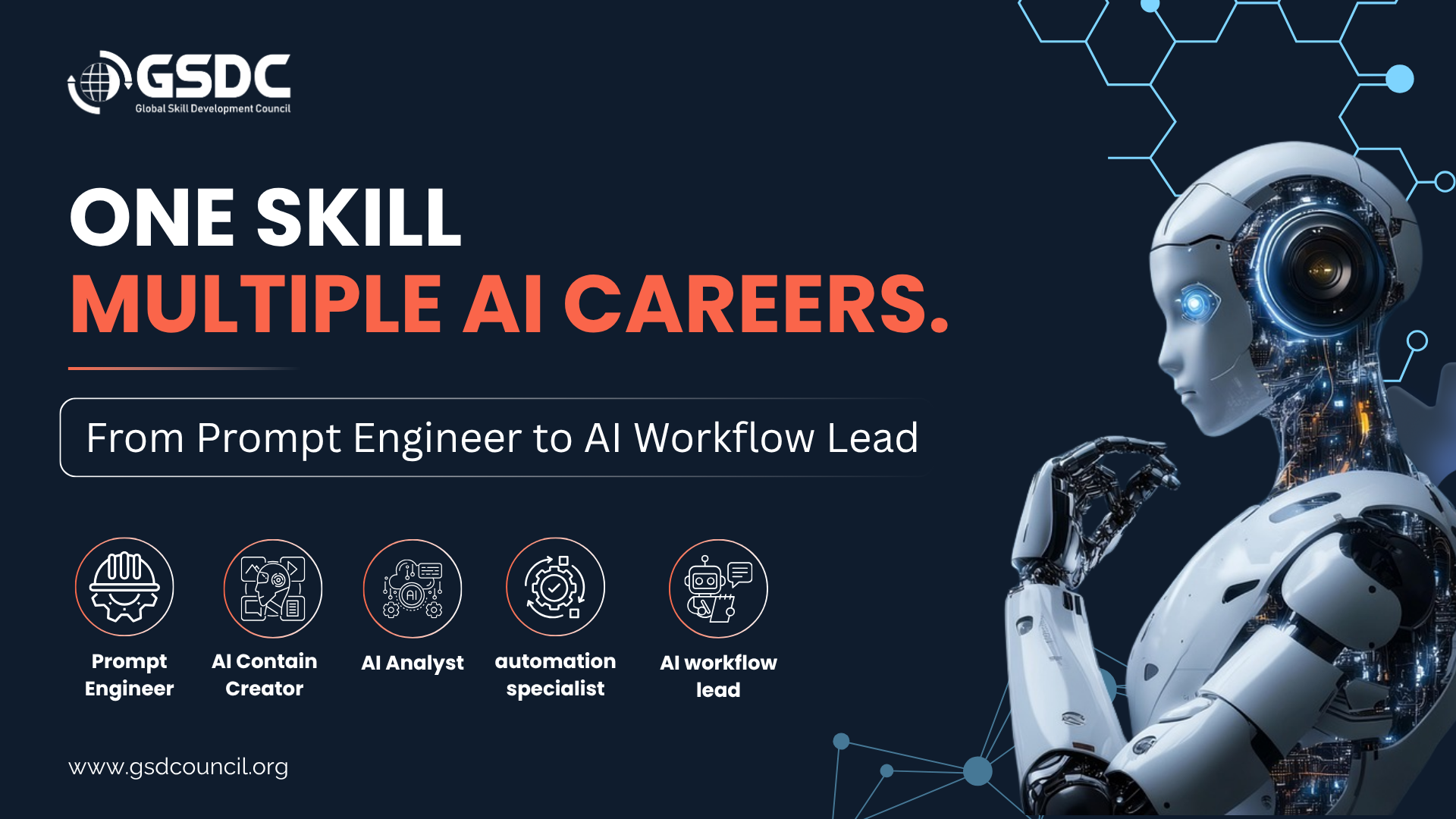
Prompt engineering is the skill of writing clear instructions so an AI tool gives you the answer or output you actually want. If you've ever typed something into ChatGPT, gotten a vague or wrong answer, and then rewritten your question to get a much better one, you've already done a basic version of prompt engineering.
So what is prompt engineering in AI, more specifically? It's the practice of designing inputs (prompts) for large language models like ChatGPT, Claude, and Gemini, so the output is accurate, useful, and consistent. It sits at the meeting point between how humans think and how AI systems respond.
What does a prompt engineer do, day to day?
- Writes and tests prompts until they get reliable results
- Builds reusable prompt templates for common tasks
- Checks AI output for accuracy and fixes it when it's wrong
- Helps other people on their team get better results from AI tools
Once you're good at this, it becomes the foundation for a whole range of careers
Career Opportunity 1: Prompt Engineer
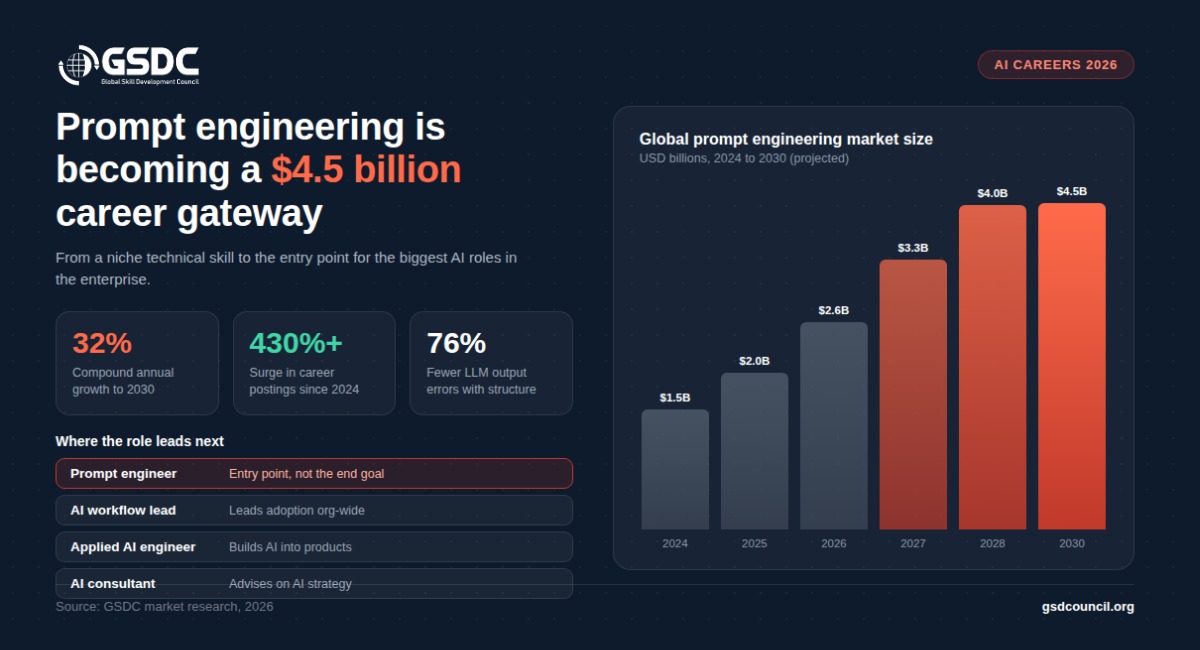
Prompt engineering jobs are among the fastest-growing roles in the AI industry right now. Companies across every sector, from tech startups to large enterprises, are actively hiring for this position because they have AI tools but lack people who know how to make those tools actually work. This role is the entry point to a wide range of AI-related careers, and it’s one of the few technical positions that doesn’t require a programming background. Strong writers, researchers, and analytical thinkers are finding their way into this role, and the demand consistently outpaces the available talent. As AI adoption accelerates, prompt engineering jobs are only expected to multiply.
Responsibilities
- Write and test prompts until they produce reliable, repeatable results
- Build and maintain a documented prompt library the whole team can reuse
- Catch and fix AI output that's inaccurate, biased, or off-tone
- Train teammates on how to write better prompts themselves
- Keep prompts updated as AI tools and models change
| Before prompt engineering | After prompt engineering |
|
|
Where you can apply
- Product teams
- Customer support operations
- Marketing departments
- AI-native startups
Scope in future
This role rarely stays the same for long. It's often the first AI job someone holds, not the last. Over time, it opens the door to bigger, more specialized AI roles. As more companies start using AI every day, the demand for this skill keeps growing. And the experience gained here carries forward, helping people move into senior AI positions later in their career. So, learning prompt engineering and getting certified is your first step towards a bright future in the upcoming AI world.
Career Opportunity 2: AI Content Strategist
Content is one of the highest-volume, most time-intensive business functions there is, and prompt engineering jobs in content strategy are exploding because AI fundamentally changes how fast content can be created without sacrificing quality. Businesses that publish at scale, agencies managing multiple clients, e-commerce brands needing product descriptions, and media companies all need someone who can combine editorial judgment with AI capability. The AI Content Strategist is that person, and it’s a role with genuine seniority potential because the skill of directing AI well is increasingly rare and valuable in creative fields.
Responsibilities
- Plan content calendars and decide what's actually worth creating
- Use AI to generate multiple angles or drafts for a topic quickly
- Edit AI drafts for accuracy, tone, and brand voice
- Build reusable prompt templates that match the brand's style
- Make the final call on what gets published
Before prompt engineering | After prompt engineering |
| Content teams used to research manually, write every first draft from scratch, and spend hours just brainstorming ideas before any real writing began. A single blog post could easily eat a full day. | The same teams can now generate multiple content ideas instantly, produce strong first drafts in minutes, and spend more of their time on strategy and creative judgment instead of blank-page syndrome. Output volume goes up without quality going down, as long as a human is still steering. |
Where you can apply
- Marketing teams
- Content agencies
- SEO and growth teams
- Companies that publish regularly and need to scale output
Scope in future
As AI writing tools keep improving, this role won't disappear, it will shift. The repetitive parts of content creation will keep getting automated, but someone will still need to decide what's actually good, accurate, and on-brand. That judgment becomes more valuable over time, not less, because it's the one part AI can't take over.
Looking ahead, companies will need to publish more content without growing their teams at the same pace. That means AI content strategists will be expected to manage larger volumes of content, often across more channels and formats than today. Many will also grow into broader roles, leading how their entire team uses AI, rather than just producing content themselves.
In short, the future of this role isn't about writing less. It's about deciding more, while AI handles more of the actual writing.
Career Opportunity 3: AI-Powered Business Analyst
Business analysis has always been about turning raw data into decisions. Prompt engineering dramatically expands how much ground an analyst can cover in a day, making this one of the most valuable intersections between traditional business skills and AI. Prompt engineering jobs in analytics are showing up across finance, operations, retail, and consulting, because any organization that runs on data needs people who can extract insight from it faster. For analysts looking to future-proof their careers, this combination of domain knowledge and AI skill is increasingly what separates candidates at the senior level.
Responsibilities
- Feed structured data into AI tools with clear, well-built prompts
- Generate fast summaries of long reports and large datasets
- Spot trends, risks, or anomalies that need a closer look
- Verify AI-generated insights against the actual source data
- Turn findings into clear recommendations for decision-makers
Before prompt engineering | After prompt engineering |
| Manual spreadsheet work, hours spent just formatting and preparing reports, and slow decision-making because insights took too long to surface. By the time a report was ready, the data behind it was often already a week old. | Faster analysis, automatic summaries of long reports, and quicker identification of trends or risks that used to take a full day to find. Reports that took a week now take an afternoon, freeing up time for the analysis that actually requires human judgment. |
Where you can apply
- Finance teams
- Operations teams
- Sales analytics
- Any department with regular reporting cycles (weekly sales numbers, monthly reviews, quarterly business reviews)
Scope in future
This role keeps growing in value as AI tools improve. AI can help pull numbers and build reports faster. But knowing which numbers actually matter, and catching when an AI summary is quietly wrong, is something only a skilled analyst can do. That skill becomes more important over time.
As businesses get more data, they need analysts who can use AI to think faster, not replace their thinking with it. This opens the door to bigger roles too, where the analyst isn't just running reports, but helping decide what the business should do next.
In short, this role grows by helping people trust the right numbers, while AI takes care of the heavy lifting.
Career Opportunity 4: AI Workflow Automation Specialist
This is one of the most immediately impactful prompt engineering jobs available today, because it has a direct, visible effect on a business’s bottom line. Any organization dealing with high volumes of repetitive, predictable work is a potential employer. Operations teams, customer support departments, logistics companies, and back-office functions across virtually every industry are actively looking for people who can design AI-powered workflows that reduce manual effort. As automation becomes a priority rather than an experiment, this role is moving from niche to essential, and professionals who can build these systems without needing a software engineering background are in particularly high demand.
Responsibilities
- Map out existing manual processes to find where time is being lost
- Design AI-powered workflows that connect prompts with other tools
- Decide which steps AI can fully handle and which still need a human
- Set up systems for AI to draft reports, emails, or routine communication
- Test and monitor workflows to make sure they keep working correctly
Before prompt engineering | After prompt engineering |
| Employees manually created reports, sent routine updates, categorized information, and managed the same repetitive tasks week after week. Every new request started from zero, even when it was nearly identical to one from last week. | AI can now draft those reports, generate routine emails, organize incoming data, and support faster decision-making, all with a human checking the final result. The same task that used to take 30 minutes might now take three. |
Where you can apply
- Operations teams
- Customer support leadership
- Companies trying to do more with the same headcount
- Industries with high volumes of repetitive, predictable work
Scope in future
This role keeps growing in value as more companies look to save time and cut costs. The specialist's real strength is process thinking, spotting where "if this happens, then this should happen" can replace manual, repetitive work. As no-code and low-code tools get easier to use, this skill becomes even more powerful, since it lets people build smart automations without needing to write complex code.
As businesses keep looking for ways to do more without growing their teams, this role becomes one of the clearest paths to real savings. It also opens the door to bigger roles, where the specialist isn't just automating single tasks, but redesigning entire workflows across a team or department.
Career Opportunity 5: Learning & Development AI Specialist
The corporate learning and development market is one of the sectors most actively being reshaped by AI, and prompt engineering jobs within L&D are growing rapidly as a result. Organizations need to upskill their workforces faster than ever, and traditional course development timelines can’t keep pace. L&D professionals who understand prompt engineering can close that gap, making them highly valuable inside companies going through transformation, inside EdTech businesses building AI-native products, and inside certification bodies that need to publish large volumes of learning content efficiently. This role also has a clear pathway upward into learning technology leadership.
Responsibilities
- Turn learning objectives into a first-pass course or module structure using AI
- Generate and refine assessment and quiz questions at scale
- Personalize content for different learner levels using targeted prompts
- Review AI-generated material for accuracy and instructional quality
- Keep a library of reusable prompts for common course formats
Before prompt engineering | After prompt engineering |
| Building a single training course could take weeks. Writing quiz questions was repetitive and slow. Every learner got the same generic content regardless of their level, because personalizing at scale simply wasn't practical. | Course development moves much faster, quiz and assessment creation can be automated, and learning content can be personalized based on what each learner actually needs. What used to be a multi-week project can often be drafted in days. |
Where you can apply
- Corporate L&D teams
- Training and certification bodies
- EdTech companies
- HR departments handling onboarding and upskilling
Scope in future
Organizations are adopting AI-enabled learning programs quickly, because faster training means faster-skilled teams. This trend keeps growing, and it's creating more demand for L&D professionals who also understand prompt engineering. AI can help build content and assessments faster, but knowing how people actually learn, what makes a good question, and how to structure a module well are things only a skilled L&D professional can do.
As more organizations move toward AI-enabled learning, this combination of instructional design and prompting skill becomes one of the most valuable skill sets in the space. It also opens the door to bigger roles, where the specialist isn't just building training content but shaping how their entire organization learns and upskills using AI.
Career Opportunity 6: AI-Enhanced HR Professional
Human resources is one of the most document-heavy, communication-intensive functions in any organization, which makes it one of the most natural fits for prompt engineering. The scope of this career is broad: recruitment, onboarding, employee engagement, performance management, and workforce planning all have components that AI can assist with when properly directed. Prompt engineering jobs in HR are appearing both as standalone roles inside larger HR teams and as an added competency that makes existing HR professionals significantly more effective. For those already in HR, adding prompt engineering to their toolkit is one of the fastest ways to increase their value and influence.
Responsibilities
- Draft job descriptions and interview questions using AI, then refine them
- Use AI to do a first-pass screening of resumes against role requirements
- Generate onboarding communication and routine employee messages
- Review all AI-assisted hiring decisions for fairness and accuracy
- Keep prompt templates updated as roles and hiring needs change
Before prompt engineering | After prompt engineering |
| HR teams manually screened every resume, wrote each job description from scratch, and built interview questions one role at a time. A single hiring round could take days just on the administrative side, before any actual interviewing started. | AI now assists with candidate screening, drafting job descriptions, preparing interview questions, and even handling routine employee communication. The administrative load drops, and HR professionals can spend more time on the human side of hiring and retention. |
Where you can apply
- Recruitment teams
- HR business partners
- People operations
- Talent acquisition departments across companies of every size
Scope in future
A lot of companies use AI to speed up hiring and HR processes, and this trend keeps growing. AI can help screen candidates faster, but catching bias, verifying accuracy, and making careful decisions about people is something only a skilled HR professional can do. That judgment becomes even more important as AI takes on more of the repetitive screening work.
As companies look for faster hiring cycles and a smoother employee experience, they'll need HR professionals who can use AI responsibly without losing the human judgment these decisions still need. This combination of fairness and AI skill is becoming one of the most valued qualities in HR. It also opens the door to bigger roles, where the professional isn't just managing individual hires but shaping how their whole organization uses AI fairly across HR.
Career Opportunity 7: AI Consultant
AI consulting is one of the most open-ended and lucrative paths for someone with prompt engineering skills. The scope here goes well beyond a single industry or company type: almost every business that is trying to adopt AI needs outside guidance because they lack the internal expertise to do it well on their own. That gap is what creates the opportunity. Prompt engineering jobs in consulting can take the form of a dedicated firm role, a freelance practice, or an internal “AI champion” position inside a larger company. At the senior end, this role shades into strategic advisory work, where the consultant isn’t just showing a team how to use a tool but helping an entire organization decide where AI fits into its future.
Responsibilities
- Assess how a client currently works to find slow or repetitive processes
- Design AI workflows and prompt systems specific to that business
- Train client teams on how to use AI tools and prompts effectively
- Set up simple ways to track whether the new workflow is actually working
- Advise on broader AI strategy and where to focus adoption next
Before prompt engineering | After prompt engineering |
Consultants mostly focused on process optimization and getting new technology installed and running. Their value was largely about systems and processes, less about teaching people how to actually work with a new kind of tool day to day. | Consultants now help businesses build entire AI workflows, train employees on how to use AI tools properly, develop AI strategy, and measure productivity gains. The job has shifted from "implement the software" to "make sure people can actually get value out of it." |
Where you can apply
- Consulting firms
- Freelance and independent AI advisory work
- In-house "AI champion" roles inside larger companies rolling out AI adoption
Scope in future
A lot of organizations want to use AI but don't have anyone in-house who actually knows how, and this gap keeps growing. AI consultants can help close that gap, but explaining things simply to non-technical teams matters as much as the technical skill itself. That ability to teach and communicate becomes even more valuable as more companies try to roll out AI across their teams.
As demand for AI adoption grows, consultants who understand both business and prompt engineering will be the ones organizations turn to first. This combination of communication skill and technical knowledge is becoming one of the most valuable things a consultant can offer. It also opens the door to bigger roles, where the consultant isn't just advising on tools, but shaping how an entire organization adopts and uses AI.
Career Opportunity 8: AI Workflow Lead
The AI Workflow Lead represents the senior end of the prompt engineering career path, where individual skill becomes organizational strategy. The scope of this role is company-wide: setting AI priorities, managing adoption across departments, overseeing governance, and ensuring AI delivers real business results rather than just activity. Prompt engineering jobs at this level typically come with titles like Head of AI Operations, Director of AI Enablement, or AI Transformation Manager, and they show up most often in mid-size to large organizations that have moved past experimentation and are scaling AI use seriously. For professionals with both technical fluency and leadership ability, this is one of the most significant new roles the AI era has created.
Responsibilities
- Set AI strategy and priorities across multiple teams
- Decide where AI should be adopted next, and why
- Lead and mentor people who are newer to working with AI tools
- Oversee AI governance, accuracy, and responsible use organization-wide
- Track and report on productivity and ROI from AI adoption
Before prompt engineering | After prompt engineering |
Leaders mostly focused on managing people and processes. Technology decisions were usually handled separately by IT or a specialized technical team. | Leaders now manage people, processes, and AI systems, all at the same time, which is a genuinely new kind of leadership skill. The AI Workflow Lead has to understand both the human side of change management and the practical side of how these tools actually work. |
Where you can apply
- Mid-size to large organizations scaling AI across multiple teams
- Roles like Head of AI Operations, Director of AI Enablement, or AI Transformation Manager
- Organizations that have moved past pilot projects into full AI adoption
Scope in future
Mid-size to large organizations are moving past pilot projects and scaling AI use across multiple teams at once, and this trend keeps growing. At this stage, leadership and strategic thinking matter more than deep prompting skill. The ability to see across an entire organization, decide where AI adds real value, and bring people along with the change becomes the most important skill of all.
As more companies reach this stage of AI adoption, they'll need leaders who can guide that change, not just technical experts who write prompts. This is where prompt engineering stops being just a technical skill and becomes a leadership capability. The AI Workflow Lead isn't writing every prompt anymore. They're making sure the whole organization is using AI in a way that actually works.
How to Move Into These Roles
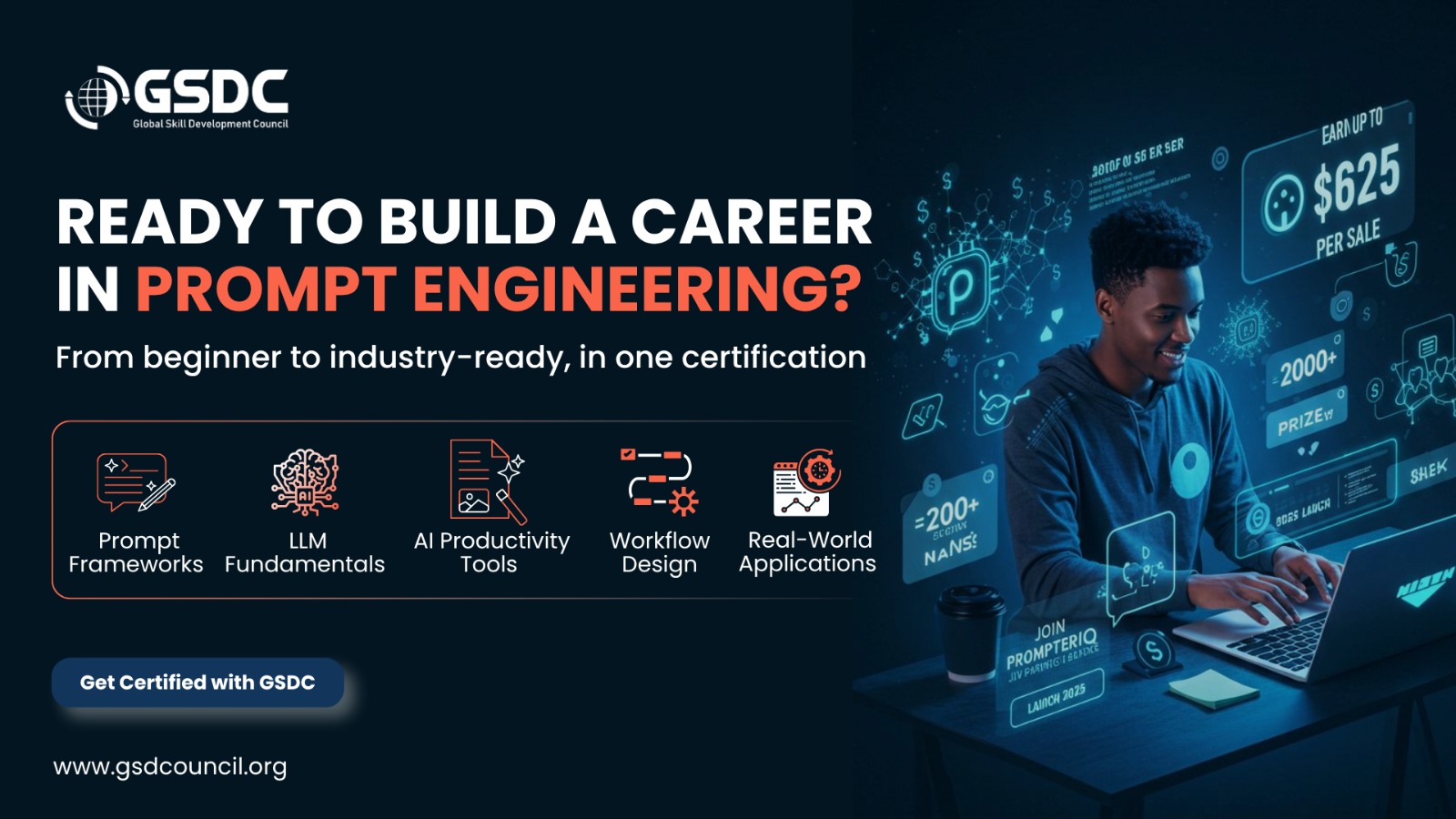
If any of the eight roles above sound interesting, the path into them tends to follow a similar pattern. The skills worth focusing on first are:
- Prompt engineering fundamentals: the core skill everything else builds on
- Basic LLM concepts: understanding what AI can and can't reliably do
- AI productivity tools: getting hands-on with the platforms teams actually use
- Workflow design thinking: learning to see a process end-to-end, not just one task
- Business communication: translating AI output into something a team or client actually finds useful
- Automation thinking: spotting which repetitive tasks are worth handing to AI in the first place
A lot of people try to learn this by jumping between random YouTube videos and free guides. It works eventually, but it's slow, and it's easy to spend weeks on the wrong things before figuring out what actually matters on the job.
This is exactly the gap GSDC's Prompt Engineering Certification is built to close. Instead of piecing together six different skills from six different sources, the certification brings them into one structured path, covering prompt fundamentals, real frameworks and techniques, and the AI productivity tools teams are actually using right now. It's designed for beginners and non-programmers as much as for people already working in tech, so you're not starting from a disadvantage just because your background isn't technical.
A few things make it worth a serious look if you're aiming for any of the eight roles above:
- It's built around practical skills, not just theory, so you finish with something you've actually practiced, not just watched.
- It maps directly to real job roles, so you can see which certification track lines up with the career direction you actually want.
- It gives you a recognized credential to show employers or clients when you're switching into this space without a technical resume.
It shortens the learning curve, since the skills are sequenced for you instead of left for you to figure out in the right order.

Related Certifications
Frequently Asked Questions
A prompt engineer writes and tests prompts until they get reliable results, builds reusable prompt templates, checks AI output for accuracy, and helps teammates get better results from AI tools.
No. Prompt engineering is one of the few technical roles that doesn't require programming knowledge. Strong writers, researchers, and analytical thinkers regularly move into this field. GSDC's Prompt Engineering Certification is designed specifically for beginners and non-programmers, so a technical background isn't required to get started.
Prompt engineering skills open doors to roles like AI Content Strategist, AI-Powered Business Analyst, AI Workflow Automation Specialist, Learning & Development AI Specialist, AI-Enhanced HR Professional, AI Consultant, and AI Workflow Lead.
Yes. Prompt engineering jobs are among the fastest-growing roles in the AI industry, since most companies have AI tools but lack people who know how to use them effectively, and demand consistently outpaces available talent.
Prompt engineering skills are in demand across marketing, customer support, finance, operations, HR, consulting, EdTech, and any department that handles repetitive reporting or high-volume content work.
You can get certified through a structured program like GSDC's Prompt Engineering Certification, which covers prompt fundamentals, real frameworks, and the AI productivity tools teams currently use and gives you a recognized credential to show employers when moving into this space.
GSDC's Prompt Engineering Certification is built for beginners, non-programmers, and professionals already working in content, marketing, HR, business analysis, or consulting who want to add AI skills to their existing role. It's equally useful for someone starting fresh and for someone looking to move into a more senior AI-focused position.
There's no fixed timeline, but a structured certification program can get you job-ready faster than learning informally, since the skills are sequenced for you instead of being pieced together from scattered videos and guides.
Pay varies by industry, experience, and region, but prompt engineering is consistently listed among the higher-paying AI-adjacent roles because demand for the skill outpaces the number of trained professionals available.
It's a long-term career foundation. While the specific tools and techniques will keep evolving, the underlying skill of directing AI clearly and effectively is becoming a core requirement across most business functions, not a niche specialty that disappears.
Stay up-to-date with the latest news, trends, and resources in GSDC
If you like this read then make sure to check out our previous blogs: Cracking Onboarding Challenges: Fresher Success Unveiled
Not sure which certification to pursue? Our advisors will help you decide!