Generative AI in Fraud Detection: How AI Is Transforming Financial Security
Written by Matthew Hale
- What Is Generative AI and How Does It Work?
- How Generative AI Differs from Traditional AI
- The Role of Generative AI in Financial Services
- Why Is Generative AI Important for Financial Security?
- Risks of Artificial Intelligence in Financial Services
- Advancing Your Career in AI-Driven Financial Security
- Final Thoughts
In early 2025, several of the leading banks reported a sharp rise in real-time payment fraud, whereby the criminals used AI-generated identities and deepfake verification videos to bypass traditional security checks. One incident that made wide discussion recently was when a European digital bank blocked over 200 coordinated account-takeover attempts within hours, not through manual review but by deploying advanced behavioural models powered by generative AI.
Fraud remains one of the biggest threats across banking, payments, insurance, and digital commerce. As criminals adopt more advanced digital tactics, traditional rule-based systems struggle to keep pace. This is where generative AI in fraud detection is redefining how organisations protect customers and financial assets.
At the moment, working with generative AI in finance is no longer about conducting research and experiments - it’s becoming one of the essential elements of modern financial security approaches.
What Is Generative AI and How Does It Work?
What is generative AI?
At its core, generative AI refers to advanced deep-learning systems that learn from massive volumes of data to recognise behaviour patterns and generate new insights for smarter decision-making.
Here’s how generative AI works in fraud detection:
- It learns from real financial data: The models study millions of real transactions – legitimate as well as fraudulent – to learn about what constitutes normal behaviour in terms of customers, devices, and channels.
- Enhances Behavioural Intelligence: Unlike traditional systems, where rules are constant, in Generative AI, patterns of spending, login, and usage are constantly adapted to.
- They Detect Anomalies in Real Time: By looking for minute anomalies, such systems help discover fraud patterns that regular systems cannot find.
- Produces synthetic data for training: Artificial intelligence can produce genuine examples of fraud when real ones are not available.
This explains what is AI in finance and how can AI be used in finance - by converting raw transaction data into intelligent, real-time risk decisions that protect both customers and financial institutions.
How Generative AI Differs from Traditional AI
To fully grasp what constitutes a difference between legacy systems and current AI-based defences, see below for a comparison between the current use of generative models and how fraud detection is currently achieved by traditional AI models.
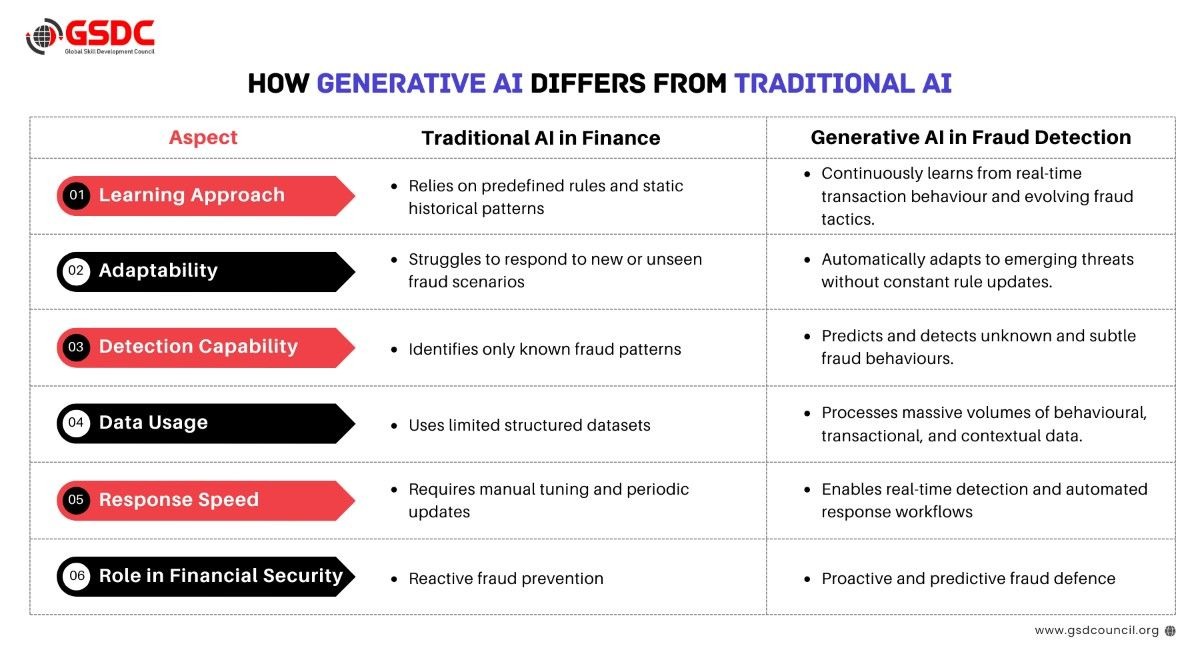
From this comparison, it becomes clear why there has been a growing shift from static tools to generative AI models in financial security by organisations.
The Role of Generative AI in Financial Services
Implementations of generative AI in the financial sector have been gaining momentum in banks, insurers, fintech, and payment service providers. Firms are adding layers of security using AI along the consumer journey, without compromising consumer experience.
Generative AI in Payments and Digital Platforms
The role of generative AI in payments is expanding rapidly as transaction volumes and fraud complexity increase across digital channels.
- Transaction Behavior Analysis: The Generative AI examines transaction behaviour and velocity and uses devices to detect anomalous spending patterns during a live transaction.
- Real-Time Fraud Block: Models use algorithms to detect anomalies in milliseconds; thereby, payment systems can counteract fraud to prevent losses due to fraud.
- Reduced Customer Friction: AI aids in ensuring minimal unwanted declines and, therefore, a smooth user experience.
- Scale Across Platforms: Generative AI technology is usable in general wallets, card networks, and cross-border payment systems that can enhance security in the payment environment.
Key Applications in Financial Services
- Real-Time Transaction Analysis: AI algorithms process several million transactions every second, identifying potential malicious activities instantly - a key requirement for doing fraud work on a generative AI model in a banking context.
- Behaviour-Based Pattern Recognition: By learning spending habits, device behaviour, and login routines, generative AI identifies subtle anomalies that often signal fraud in its earliest stages.
- Data Generation: The GenAI tool produces realistic data that helps train detection systems to protect against new means of attacks in uncommon fraud patterns.
- Intelligent Alerting and Automation: The automated prioritisation capability helps ensure that fraud examiners target only the most critical notifications.
Together, these applications reflect how AI will be used increasingly in banking and finance, fraud prevention is going to be predictive and adaptive. Organisations are showing ever-more interest in the GSDC for pactical competencies in generative AI and financial security.
Why Is Generative AI Important for Financial Security?
Why is generative AI important?
The schemes are changing at a pace that’s harder for traditional systems based on specific rules to keep up with. Here lies the fusion of generative AI and security to offer learning and detection capabilities.
Key benefits include:
- Stronger Fraud Detection Generative AI analyses behavioural patterns across devices, transactions, and user journeys, helping organisations identify suspicious activity that static controls often miss.
- Reduces false positives: By understanding transaction context instead of relying on rigid rules, AI blocks fewer legitimate transactions, preserving a seamless customer experience.
- Accelerates investigations: Automated alert prioritisation enables fraud teams to focus on high-risk cases rather than spending time reviewing low-value or irrelevant alerts.
- Supports adaptive learning: Models keep being updated to incorporate new patterns of fraud, thus maintaining adaptability in combating fraud detection.
- Lessens financial impact: Financial institutions that adopt AI report significant reductions in losses due to fraud and operational costs, further fortifying revenue protection and customer trust.
Professionals seeking to develop expertise in this area often pursue the Certification in Generative AI in Finance and Banking to gain practical, industry-aligned skills in secure AI deployment.
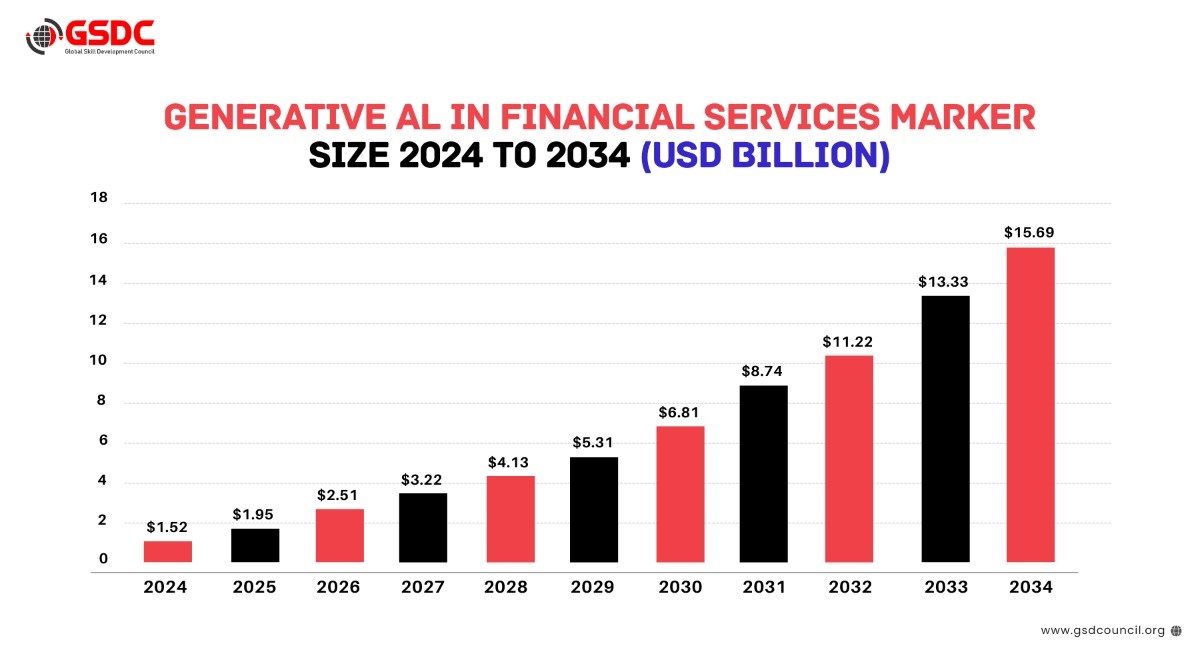
The rapid adoption of generative AI across banking and finance is reflected in the projected market growth shown below.
Risks of Artificial Intelligence in Financial Services
As adoption grows, organisations must actively manage the risks of artificial intelligence in financial services to avoid introducing new vulnerabilities.
- Weak Governance and Oversight: Without clear accountability frameworks, AI systems can operate in ways that are difficult to audit, increasing exposure to regulatory and operational risk.
- Biased or Poor Quality Training Data: In case models get trained with incomplete or biased datasets, they might unfairly flag a legitimate customer or be unable to detect new fraud patterns.
- Infrastructure and Integration Gaps: A lack of adequate system design or an inefficient integration of banking systems might cause blind spots for fraud detection.
- AI-Powered Fraud Tactics: By leveraging AI for the development of synthetic identities and deepfake verification media, fraud perpetrators are increasing the complexity of threats that must be protected against.
- Lack of Continuous Monitoring: Without continuous model validation and monitoring, the effectiveness of AI models will gradually diminish with the evolving methods of fraud.
To tackle these risks, there is a need for robust governance frameworks, compliance controls, and continuous performance monitoring to responsibly deploy AI.
Advancing Your Career in AI-Driven Financial Security
The use of AI by financial institutions is increasing at a rapid pace. As a result, many professionals are looking to get the generative AI in finance and banking certification to gain knowledge of fraud protection and governance of artificial intelligence.
The Global Skill Development Council (GSDC) provides an industry-specific programme through which it assists professionals in acquiring practical skills for the application of generative AI to banking scenarios such as fraud prevention, compliance management, and secure AI implementation.

Final Thoughts
Fraud Prevention with Generative AI is no longer a nice-to-have but a requirement. It is quickly becoming a cornerstone of Finance Security. The truth is that through the overcoming of rule-based systems, it is possible to empower Behavioural Intelligence.
From generative AI fraud detection in banking to real-time monitoring in digital wallets and payment systems around the world, AI technology has turned the corner in transforming how the financial industry combats fraud. With increased transaction activity and evolving fraudulent patterns, this strategic need to learn, predict, and react has become an imperative.
Organisations that want to stay ahead of evolving threats must treat generative AI as a core security capability and not as an experiment.

Related Certifications
Stay up-to-date with the latest news, trends, and resources in GSDC
If you like this read then make sure to check out our previous blogs: Cracking Onboarding Challenges: Fresher Success Unveiled
Not sure which certification to pursue? Our advisors will help you decide!