How to Write GEO-Friendly Content?
Written by Nazir Uddin Himel
- The Shift from SEO to GEO
- Why GEO Matters Now?
- How Generative Engines Actually Work
- E-E-A-T Is More Important Than Ever
- GEO Is About Topics, Not Keywords
- What Makes Content AI-Citable?
- Writing Techniques That Improve GEO Visibility
- Reframing Content to Avoid Redundancy
- NLP Optimization: Writing the Way AI Understands
- The Importance of Future-Focused Content
- Smart Interlinking Builds GEO Authority
- GEO vs. Conversion Optimization
- The Future of Content Is Context-Driven
- How Does GEO Certification Support in This Era?
- Conclusion
- FAQs
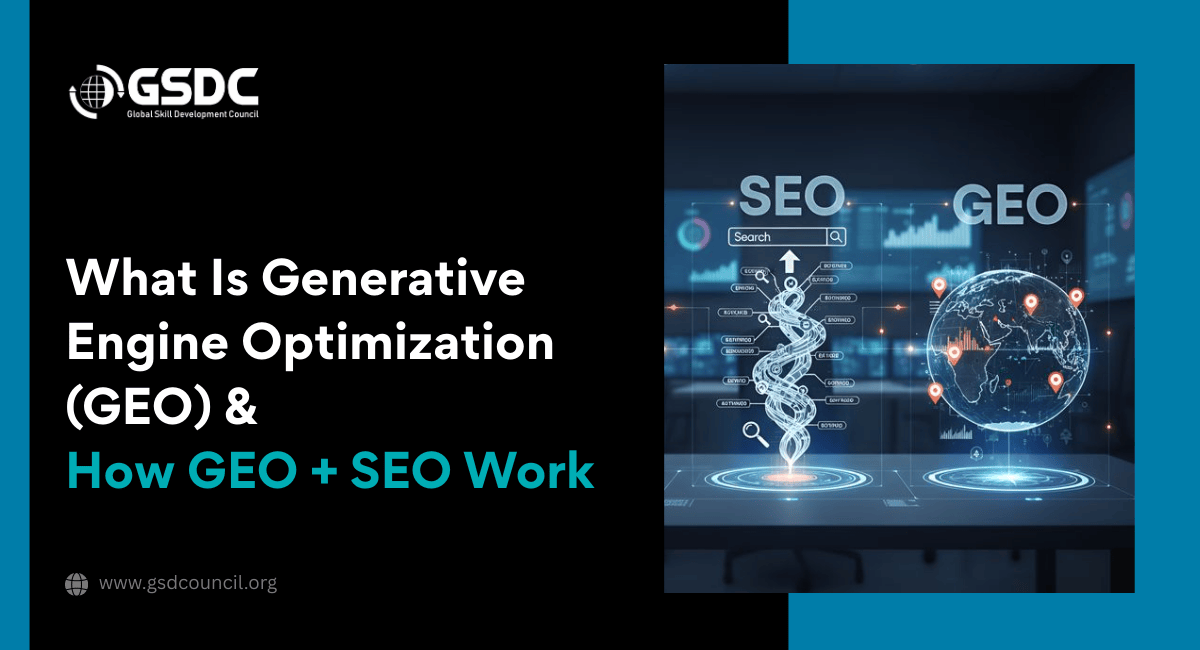
The way people search for information has changed dramatically since the rise of generative AI in 2022. SEO practitioners used traditional SEO methods to achieve web page ranking through keyword searches while teaching brands how to write content for SEO that would generate website traffic. Organizations can use Generative Engine Optimization (GEO) to obtain content that people will use to cite their work, summarize it, and recommend it through AI-powered platforms.
Content has evolved to compete for AI trust during its fight to gain online visibility. The new approach demands that businesses develop an intelligent AI content strategy that needs AI content automation to produce relevant, structured content with contextual details. Organizations can use generative engine optimization tools to make their expertise accessible through AI-powered search systems and traditional search results.
The blog presents practical methods, insights, and frameworks that marketers, writers, and businesses can use to adapt to AI-driven discovery.
The Shift from SEO to GEO
For years, SEO revolved around optimizing for keywords, backlinks, and rankings. But with the rise of generative search, these engines don’t behave like traditional search platforms. Instead of listing links, they provide direct answers synthesized from multiple sources, often using AI generated content to deliver fast, contextual responses.
That means:
- Users may never click on a website.
- The AI system determines which sources to accept as trustworthy and which sources to use as references.
- The ability to see content depends on three factors, which are authority, clarity, and context, and not only on the existing rankings.
This shift explains why many websites have seen declining informational traffic while still maintaining commercial or branded traffic. AI now answers many informational queries instantly, signaling a major transformation in how people discover knowledge and highlighting the future of generative AI in reshaping digital visibility.
Key Insight:
GEO exists as an evolution of SEO, which it uses as its foundational base. SEO still serves as the main foundation for traditional practices, but content creation now requires designers to develop AI-friendly structures.Why GEO Matters Now?
Recent industries elaborate that AI-driven traffic has surged significantly in just a few years, and experts predict AI interactions could surpass traditional search behavior by the end of the decade.
Generative engines prioritize informational intent more than navigational or transactional intent. That means educational, in-depth, and contextual content is far more likely to be surfaced by AI systems.
Businesses that fail to optimize for this shift risk losing visibility at the discovery stage even if their products remain strong.
How Generative Engines Actually Work
AI models do not create knowledge from scratch. They reformulate information from:
- Existing web content
- Trusted data sources
- Real-world examples
- Structured explanations
This means your goal is not to “write for AI,” but to publish content worth learning from.
AI evaluates:
- Credibility of sources
- Depth of topic coverage
- Clarity of explanation
- Demonstrated expertise
- Unique perspectives
If your article simply repeats what already exists, it is unlikely to be cited.
E-E-A-T Is More Important Than Ever
The familiar e-e-a-t in seo concept of Experience, Expertise, Authority, and Trust (E-E-A-T) is now central to GEO success.
AI engines prioritize:
- User-Generated Signals: Real experiences shared in forums, case studies, and reviews.
- Demonstrated Expertise: Content written from actual knowledge, not generic summaries.
The e-e-a-t in seo explains why AI frequently cites platforms like Reddit, Quora, and niche blogs, which offer authentic human insights.
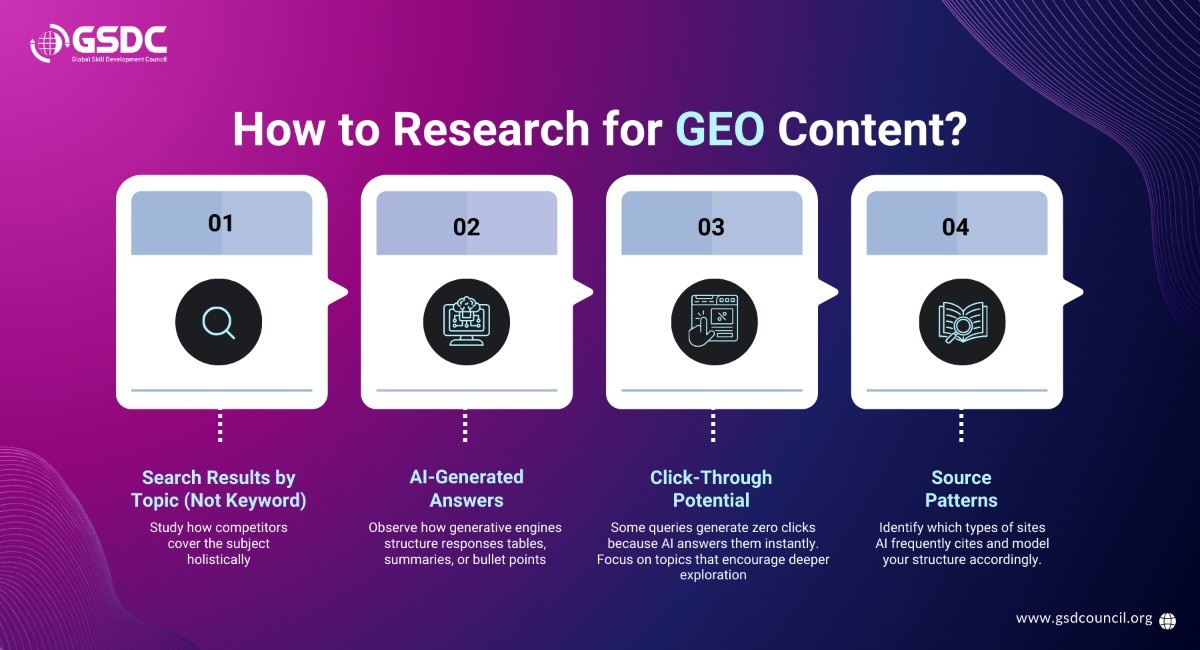
GEO Is About Topics, Not Keywords
Traditional SEO asked:
“Which keyword should we rank for?”
GEO asks:
“Have we fully explained this topic from every angle?”
Instead of targeting isolated keywords, GEO requires topical completeness.
Example:
Rather than writing one blog on “Email Marketing Tools,” GEO requires content that covers:
- What email marketing is
- Who needs it
- Use cases
- Integration options
- Challenges
- Comparisons
- Future trends
AI favors content ecosystems, not isolated posts.
What Makes Content AI-Citable?
The webinar highlighted four elements consistently favored by generative engines:
1. Data from Trusted Sources
Use credible studies, statistics, and validated references. Unsupported claims reduce trust signals.
2. Real-World Case Studies
AI prioritizes examples grounded in experience rather than theory.
3. Demonstrated Industry Knowledge
Write within domains where you have expertise or validated insights.
4. Distinct Perspectives
AI avoids repeating identical viewpoints. Unique analysis improves citation probability.
Writing Techniques That Improve GEO Visibility
Write for Scanners
AI prefers structured, easily extractable information:
- Clear headings
- Short paragraphs
- Bullet points
- Defined sections
Focus on One Idea per Section
Natural Language Processing (NLP) systems interpret clarity better than dense, multi-idea paragraphs.
Use Conversational Language
Human-sounding writing differentiates your content from generic AI-generated material.
Include Unexpected Insights
Fresh angles help break repetition patterns and maintain relevance.
Reframing Content to Avoid Redundancy
To stand out:
- Conduct small surveys or gather user feedback.
- Share internal insights or usage data.
- Address limitations or challenges honestly.
- Build a narrative rather than listing facts.
NLP Optimization: Writing the Way AI Understands
NLP optimization involves identifying related concepts and naturally integrating them into your content.
Instead of repeating a keyword, cover associated ideas:
- Definitions
- Use cases
- Tools
- Benefits
- Comparisons
- Future outlook
This semantic richness signals topical authority.
The Importance of Future-Focused Content
Many writers ignore forward-looking questions, yet users frequently ask:
- “Will prices drop?”
- “What’s next for this technology?”
- “How will this evolve?”
Including future perspectives increases relevance and citation opportunities.
Smart Interlinking Builds GEO Authority
Internal linking should now support topic clusters, not random connections.
A strong GEO structure includes:
- A pillar (“mother”) article covering the main topic
- Supporting articles addressing subtopics
- Contextual links reinforcing relationships
This creates a connected knowledge network that AI can easily interpret.
GEO vs. Conversion Optimization
Product pages should prioritize conversion first, then GEO support.
Instead of overloading product pages with SEO content:
- Build educational content around the problem your product solves.
- Use those articles to reinforce authority.
- Let the product page focus on credibility, proof, and outcomes.
The Future of Content Is Context-Driven
Generative engines reward context, clarity, and credibility over volume and keyword density.
Winning brands will be those that:
- Teach, not just promote
- Demonstrate expertise, not just summarize
- Build ecosystems, not isolated posts
How Does GEO Certification Support in This Era?
As businesses accelerate digital transformation, they must balance innovation with strong governance, risk control, and ethical accountability.
GSDC provides organizations with their Certified Generative Engine Optimization Professional, which enables professionals to manage technological ecosystems through compliance and responsible AI implementation and sustainable growth practices.
Organizations can innovate securely because the organizations created a framework that maintains transparency and trust while preparing for global regulatory requirements.
Benefits of GEO Certification:
- Strengthens Governance Expertise: Learn to design and implement effective governance frameworks.
- Enhances Career Credibility: Gain globally recognized validation of your professional capabilities.
- Responsible technology adoption: It needs organizations to implement ethical practices that govern AI, data, and digital transformation processes.
- Improves Risk & Compliance Management: Organizations will benefit from improved risk and compliance management through the development of skills that help identify and manage organizational risks.
- Supports Sustainable Business Growth: Sustainable business growth will occur when organizations implement their ESG objectives together with their long-term strategic value target.

Conclusion
GEO demonstrates how content strategies have developed in an era where artificial intelligence controls content creation. The new standard for success requires organizations to demonstrate their expertise and provide valuable insights instead of relying on keywords. Organizations can achieve their content goals through their AI content strategy, which combines ethical content management and their ability to scale automated content production.
Businesses can optimize content through the creation of topical authority, which includes structured writing and actual expertise, and contextual relevance.
FAQs
1. What is GEO (Generative Engine Optimization)?
GEO is the process of optimizing content so that AI platforms like ChatGPT, Gemini, and Perplexity recognize, cite, and recommend it in generated responses rather than just ranking it in search results.
2. How is GEO different from traditional SEO?
SEO focuses on ranking web pages for keywords, while GEO focuses on making content understandable, credible, and valuable enough for AI systems to reference in their answers.
3. Does AI prefer long content?
Not necessarily. AI prefers clear, well-structured, and complete content. A concise article that fully answers a topic can outperform a lengthy but unfocused one.
4. What type of content performs best in GEO?
Informational, experience-driven, and insight-rich content, such as guides, case studies, expert opinions, and educational resources, performs best because AI prioritizes knowledge over promotion.
5. Is keyword research still relevant in GEO?
Yes, but keywords are now secondary. Start with topic research and user intent, then incorporate keywords naturally within a broader, semantically rich discussion.

Related Certifications
Stay up-to-date with the latest news, trends, and resources in GSDC
If you like this read then make sure to check out our previous blogs: Cracking Onboarding Challenges: Fresher Success Unveiled
Not sure which certification to pursue? Our advisors will help you decide!