From AI Hype to Real Business Value: How to Measure ROI and Drive P&L Impact
Written by Matthew Hale
- Why Most AI Initiatives Fail to Deliver Business Value
- Why Traditional ROI Models Fail in the Age of AI
- Measuring What Matters: Financial ROI vs Strategic Impact
- The Four Pillars of AI-Driven Business Value
- The Two Levels of AI Value Creation
- Choosing the Right AI Path: Build, Buy, or Partner
- Understanding the Total Cost of Ownership (TCO) in AI
- Achieving Measurable Business Impact with AI
- Building ROI-Focused AI Expertise through GSDC
- Conclusion
Most enterprises today can explain what is AI and how artificial intelligence works. Yet very few can confidently explain its return on investment or connect it directly to profit and loss outcomes - the real P&L impact.
The challenge is not a shortage of AI business tools or technical talent. It is the absence of a structured framework for converting AI for business activity into measurable business value.
To support professionals in closing this gap, the GSDC Certified Learning Holiday AI Bootcamp: Winning Clients, Delivering Smarter, Deciding Faster has been designed to build practical, business-ready AI capability.
This intensive program empowers leaders to apply generative AI tools, leverage real-world case studies, and make faster, data-driven decisions - enabling them to enhance client experience, optimise service delivery, and integrate AI into business strategy with measurable impact.
Why Most AI Initiatives Fail to Deliver Business Value
Numerous organisations invest in AI business ideas with the expectation that business value will naturally arise. As a matter of fact, merely acquiring technology seldom leads to a significant change.
Consequently, 66% of companies do not find it easy to put in place ROI metrics for AI projects. They also struggle with what is ROI in business when it comes to AI business use cases.
The main reasons why AI projects cannot be scaled are those gaps that follow:
- Unclear Business Use Case: Teams adopt AI business tools without aligning them to a measurable AI business plan, making it impossible to show P&L in financial terms.
- Inadequate Workforce Enablement: Access to AI tools is provided to employees, but they are not trained on how to use the tools in their daily work routines. Consequently, the rate of utilisation is low, and productivity gains are inconsistent.
- Unavailability of Performance Metrics: If an organisation neglects to identify KPIs such as shortening of the cycle time, reduction of error rate or increase of revenues, the top management will lose the ability to quantify ROI.
- Leadership Sponsorship is Not Strong: AI cannot go beyond small-scale trials and be deployed throughout the company unless there is an executive sponsor who owns the idea and governs the process.
- Weak Leadership Sponsorship: Without executive ownership and governance, AI remains confined to pilot programs instead of becoming an enterprise capability.
Together, these challenges explain why many organisations possess AI tools - but lack AI-driven business outcomes.
Why Traditional ROI Models Fail in the Age of AI
Most ROI frameworks were designed long before today’s rapid AI growth rate. Hence, executives cannot clearly articulate what is P&L impact of intelligence-driven systems because traditional methods fail to measure how artificial intelligence reshapes value creation.
A modern AI ROI model has to figure out how intelligence alters the business rather than merely the expenditure.
It achieves this through four outcome-driven dimensions:
- Cost Avoidance: AI's real savings are typically the things that you will not have to do anymore, such as delaying headcount growth, cutting rework, and preventing operational bottlenecks before they happen.
- Revenue Generation: AI paves the way for new products, service tier elevation, predictive offerings, and rapid go, to, market cycles thereby resulting in new income streams.
- Risk Mitigation: The most valuable AI systems identify anomalies, compliance gaps, and failure patterns. Thus, they save the enterprise from loss of revenues, legal exposure, and reputational damage.
- Total Cost of Ownership (TCO): There cannot be a supply of sustainable ROI unless one gives attention to the total cost of the full lifecycle of AI, including the infrastructure, the compute, retraining, data governance, and regular optimisation.
These four dimensions form the modern AI ROI equation:
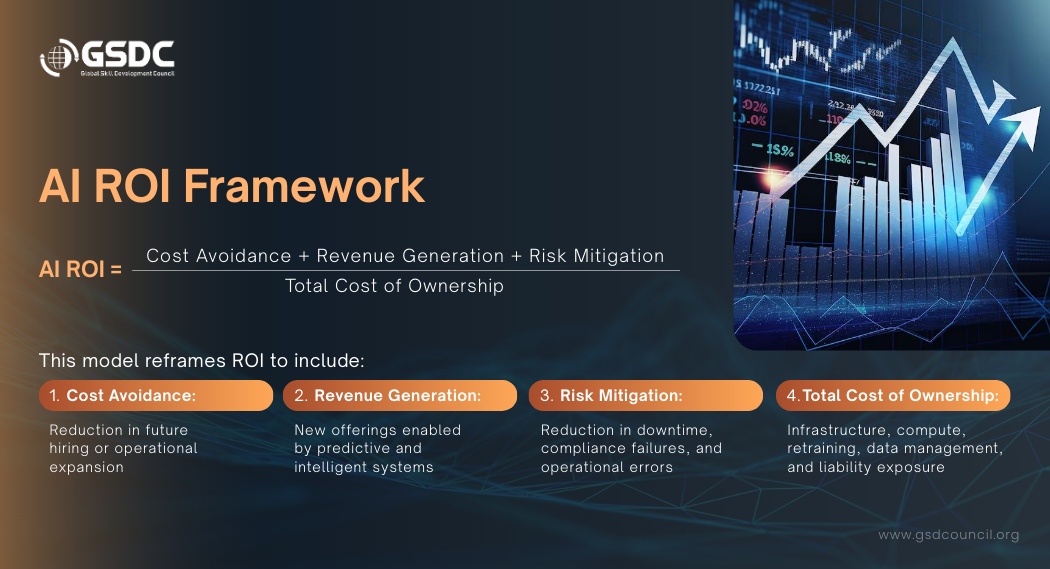
This framework reframes AI investment as a strategic growth decision, not a technology expense.
Organisations that measure AI ROI only through cost reduction are undervaluing more than half of AI’s real business impact. True ROI emerges when cost avoidance, revenue generation, and risk mitigation are measured together against total cost of ownership.
Measuring What Matters: Financial ROI vs Strategic Impact
AI investments must be evaluated across two complementary dimensions: hard savings and strategic value. Focusing on only one of these creates a distorted view of performance.
|
Hard Savings - Financial Validation |
Strategic Value - Competitive Survival |
|
Reduced operational expenditure |
Increased innovation capacity |
|
Lower dependency on headcount growth |
Higher workforce engagement |
|
Faster cycle time and throughput |
Improved customer experience |
|
Clear short-term ROI visibility |
Sustainable competitive advantage |
Organisations increasingly ask:
- what tools can measure the ROI of AI initiatives?
- how do you measure the ROI of AI in operations?
These questions go beyond technology - they define how AI business performance should be reflected in financial models.
Hard savings answer the CFO’s question: What is ROI in business?
Strategic value answers the CEO’s question: How does AI influence long-term P&L imports?
The Four Pillars of AI-Driven Business Value
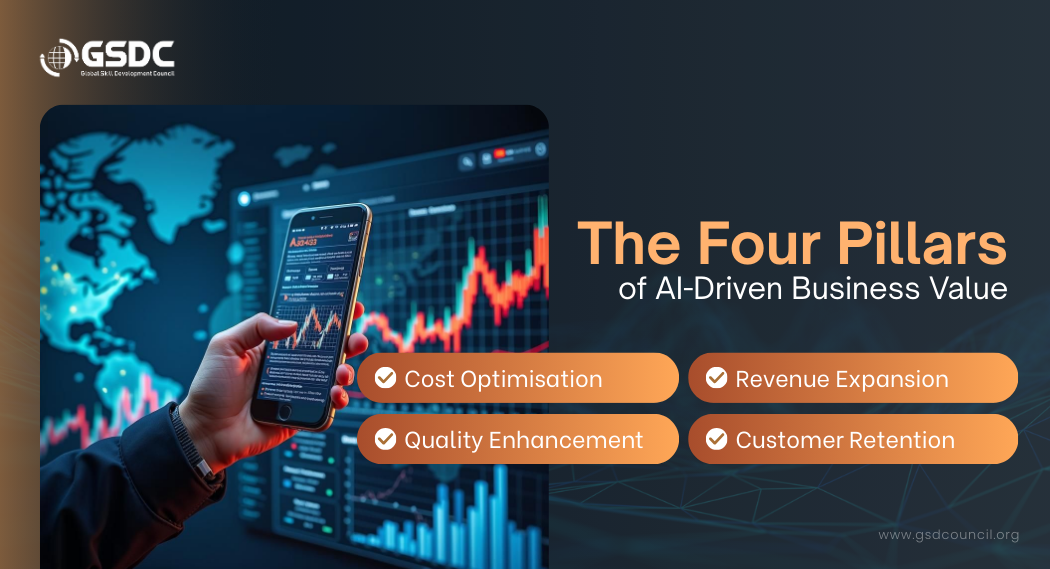
AI reshapes enterprise performance only when it is embedded into real operational contexts. Each pillar below explains the strategic role of AI, followed by a real-world style example to illustrate its impact.
Each pillar below reflects critical AI business use cases:
- Cost Optimisation – using AI for business automation to reduce operational spend.
AI automates repetitive, high-volume tasks, shortens cycle times, and reduces dependency on manual intervention, enabling organisations to scale without proportional increases in cost.
Example: An IT service desk deploys AI to auto-diagnose and resolve routine incidents, cutting resolution time from 45 minutes to under a minute.
- Revenue Expansion – applying AI business ideas to unlock new revenue streams.
By analysing customer behaviour and market signals, AI uncovers new opportunities for premium services, cross-selling, and predictive offerings.
Example: A SaaS company uses AI to identify at-risk customers and proactively offers tailored service packages, increasing renewals and upsell revenue.
- Quality Enhancement – embedding artificial intelligence into compliance workflows.
AI stays at a high level of efficiency throughout the processes, it also lessens the number of mistakes and makes the overall compliance more robust.
Example: A software engineering team implements AI-driven code review as an ongoing process, which results in very few defects found after the release of the product.
- Customer Retention - raising loyalty with the help of personalised AI business tools.
If the company deeply integrates AI in its processes, it is very difficult for the customer to switch to another company and at the same time, the level of client dependence is increased.
Example: A consulting firm embeds AI into its knowledge platform, making historical insights instantly accessible and dramatically improving client loyalty.The Two Levels of AI Value Creation
Organisations often mistake tactical productivity gains for long-term transformation. While short-term improvements deliver immediate efficiency, they rarely create competitive advantage.
The two levels of AI impact include:
|
Tactical Improvements (Short-Term Gains) |
Strategic Investments (Long-Term Advantage) |
|
Task automation |
Proprietary data intelligence |
|
Reporting efficiency |
Risk forecasting capabilities |
|
Productivity tools |
End-to-end process intelligence |
Tactical improvements deliver short-term ROI, but strategic investment in a long-term AI business plan is what delivers sustainable P&L impact.
Choosing the Right AI Path: Build, Buy, or Partner
The decision to adopt AI business tools through buying, building, or partnering directly affects how fast organisations can realise returns from AI for business. Industry research over the last year indicates that 71% of enterprises cannot scale AI beyond pilot stages because they have an unclear strategy and lack internal expertise. Hence, making this decision is more important than ever.
- Buy: Off-the-shelf AI tools enable rapid deployment and early productivity gains. However, organisations relying only on generic tools are far more likely to remain stuck at the pilot stage, contributing to the 71% failure-to-scale statistic across enterprises.
- Partner: Companies that use AI platforms integrated with their own data and business workflows have a 2. 3 times higher chance of achieving measurable performance improvement. This model provides a balance between speed and differentiation and, therefore, is the most effective approach for the majority of enterprises.
- Build: If an organisation decides to create AI solutions internally, it means that the organisation should have a very advanced level of data maturity, it should recruit highly skilled talents, and it should be willing to invest in the long-term.
Such a method is feasible only in organisations where AI is the main product, a limited number of companies that are able to be a step ahead of the market in AI, and set the trend for innovation.
Embedding these industry benchmarks into the sourcing strategy helps leaders avoid common pitfalls and accelerate the journey from AI experimentation to enterprise-wide impact.
Understanding the Total Cost of Ownership (TCO) in AI
One of the most common reasons AI initiatives fail to meet ROI expectations is the underestimation of total ownership cost, which is why organisations fail to justify the ROI in business for AI programs.
True ROI only appears when enterprises align infrastructure, governance, and adoption to measurable P&L explained outcomes.
Key components of AI total cost of ownership include:
- Infrastructure and Compute: AI systems continuously consume processing power for inference, retraining, and scaling. This transforms AI from a capital expense into an ongoing operational cost model similar to utilities.
- Model Maintenance and Retraining: Data patterns change, customer behaviour evolves, and market conditions shift. Without periodic retraining, AI models degrade in accuracy - requiring sustained engineering effort and compute resources.
- Data Governance and Quality Management: AI performance is constrained by data quality. Organisations must invest in data cleansing, version control, monitoring, and validation pipelines to avoid hallucinations and biased outputs.
- Security, Compliance, and Legal Liability: AI outputs carry regulatory and reputational risk. Enterprises must implement governance frameworks, access controls, audit trails, and compliance reviews to manage exposure.
- Workforce Enablement and Change Management: Sustained ROI depends on how effectively employees adopt AI. Training, enablement, and workflow redesign represent long-term investments that are often omitted from cost planning.
A realistic TCO model is the foundation of credible AI ROI. Without it, organisations are measuring aspiration - not performance.
Achieving Measurable Business Impact with AI
When AI business use cases are embedded into operations, organisations move from reactive problem-solving to proactive value creation - directly improving P&L impact.
This is how artificial intelligence becomes a core driver of business performance.
The most significant impacts include:
- Reduced Downtime: AI systems monitor for deviations and thus are able to identify situations before service disruptions; in this way, they prevent loss of revenue and help maintain operational continuity.
- Improved Employee Experience: By eliminating repeated troubleshooting and escalations at odd hours, AI lessens the cause of burnout, and hence, it is possible to redirect the team's focus to more valuable work.
- Increased Customer Trust: The clients are satisfied with the resolution times getting shorter and the communication being proactive, hence, their loyalty and relationship with the company strengthen.
Together, these results turn AI adoption into real profit and loss account improvement, besides just a few isolated efficiency gains.
Building ROI-Focused AI Expertise through GSDC
It is a common misconception that simply adopting AI tools is sufficient for generating business value. In reality, to successfully connect AI implementation with tangible business results, one needs not only the tools but also the appropriate skills and a strategic way of thinking.
At the Global Skill Development Council (GSDC), our Certified AI Tool Expert equips professionals with practical frameworks to measure AI ROI, apply augmentation-driven strategies, and deploy AI responsibly across business functions. The program enables organisations to move beyond experimentation and build AI capabilities that deliver sustained performance improvement.
Conclusion
Artificial intelligence (AI) should not be seen as a magic wand that just by itself automatically brings business value. A major effect is only visible when AI initiatives are in line with a company's strategic objectives, are deeply integrated into the operational workflows, and their implementation is tracked by quantifiable performance indicators.
Organisations treating AI only as a technology in which to invest are likely to experience a repeated cycle of pilot programs and standalone productivity tools with no significant progress. Whereas enterprises are leveraging AI to improve decision-making, service.

Related Certifications
Stay up-to-date with the latest news, trends, and resources in GSDC
If you like this read then make sure to check out our previous blogs: Cracking Onboarding Challenges: Fresher Success Unveiled
Not sure which certification to pursue? Our advisors will help you decide!