Is Generative AI Deep Learning? Understanding the Intersection and Differences
Written by Matt Johnson
AI is a vast field, encompassing deep learning and generative AI, as a few of its particularities.
These comprise but are not exclusive to maintaining their respective roles in the larger AI picture.
Whereas deep learning serves mostly as the underpinning of most modern AI applications, generative AI has been growing exponentially for its professional features- machine creativity, producing new text, images, music, and even video content.
What is the relationship between these two topics? Are they actually a type of deep learning, or do they merely intersect occasionally?
This article seeks to provide a comprehensive description of both Generative AI and Deep Learning-their intersections and differences clarify their roles and create some understanding of how they are contributing to the entire AI ecosystem.
What is Generative AI and Deep Learning?
 Before diving into the intersection and differences between generative AI and deep learning, it's crucial to define each concept.
Generative AI: A Creative Force in AI
Generative AI describes a series of AI techniques used to produce new data based on existing patterns.
New images, text, or even music may be generated that resemble their human counterparts.
Unlike traditional AI systems, which focus on predictions or classification, generative AI seeks to create completely original content, some of which may be virtually indistinguishable from real data. Some of the common generative AI models include Generative Adversarial Networks (GANs) and Variational Autoencoders (VAEs).
Generative AI is applied to many artistic works, including image generation, video game design, and text-to-speech synthesis.
In particular, Generative AI can produce realistic avatars and artwork, sometimes exceeding the capability of humans' creativity in design. Of note is the evolution of deepfake videos and synthetic media; the impact of misuse is a cause for concern.
Deep Learning: A Pillar of Machine Learning
Deep learning is an aspect of machine learning, which is an aspect of AI. Deep learning deals with learning through the use of neural networks from very large amounts of data and making predictions or classifications.
This is one of the most important processes in AI, like speech recognition, image recognition, or Natural Language Processing (NLP). A general deep learning model has layers of neurons that imitate the workings of a human brain; therefore, the term neural networks.
Deep learning algorithms generally help in tasks requiring the analysis of relatively exotic and complicated unstructured data, such as facial recognition or navigation of self-driving cars. They excel in harnessing voluminous data and are good at feature extraction without human intervention.
Boost Your Professional CredentialsDownload the checklist for the following benefits:
Practical Implementation Guidance
Comprehensive Skill Assessment
The Intersection Between Generative AI and Deep Learning
While generative AI and deep learning are distinct concepts, the two are intricately linked. Generative AI relies heavily on deep learning models, particularly those involving neural networks.
Deep Learning Models in Generative AI
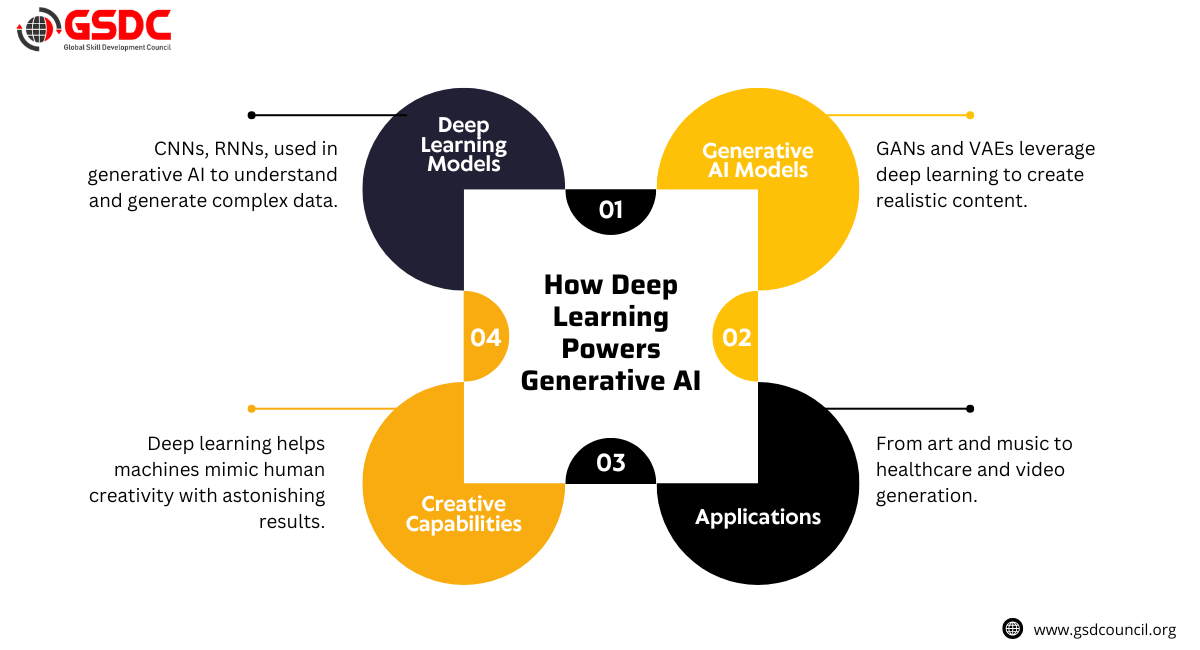
Deep learning models, such as GANs, VAEs, and other variants, are at the core of generative AI in that they are trained to produce new data.
The deep learning models learn the structure of some data-whether images, texts, or sounds-and generate new content that abides by that structure.
Generative Adversarial Networks (GANs) consist of two neural networks: the generator and the discriminator. The generator creates data that can either be real or fake, while the discriminator tries to tell the difference between real and fake data.
Hence, GANs can generate high-quality synthetic data, for example, images of faces, art, and even natural speech through this malice-competition process.
Variational Autoencoders (VAEs) are another type of model popular in generative AI but take a different approach with renewability.
VAEs encode data into an efficient, condensed format before decoding it for new sample generation. VAEs have been popularly employed for image generation and drug discovery.
Techniques: How Deep Learning Powers Generative AI
Generative AI techniques, in this case, GANs and VAEs, implement the use of convolutional neural networks and recurrent neural networks to model complex patterns.
CNNs are especially suitable for tasks such as image generation due to their property of auto-detecting hierarchical features in images.
The opposite is true for RNNs that find great application in text generation, allowing machines to comprehend and predict sequences of words based on the patterns contained in the corpus.
Such deep learning techniques are important for the functioning of generative AI models that require tons of data for effective training.
Hence it is deep learning that qualifies generative AI to forge the outputs into the realms of human creativity, across domains such as entertainment, marketing, education, and healthcare.
GSDC’s Generative AI Professional Certificationcan play a key role here, ensuring your team is well-equipped to handle AI technologies and generate creative solutions that align with business objectives
Differences Between Generative AI and Deep Learning
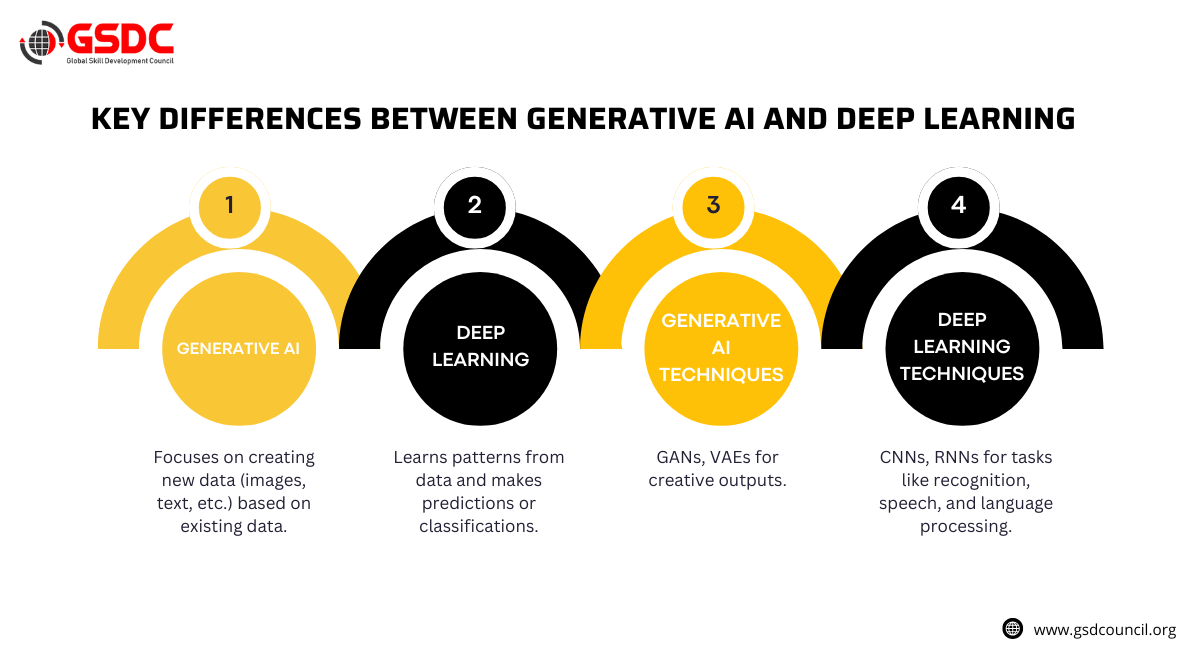 Despite their close relationship, there are distinct differences between generative AI and deep learning that set them apart in the AI ecosystem.
Focus and Purpose
- Generative AI is specifically designed to create new data, mimicking patterns in existing datasets. Its primary purpose is content generation, whether it's producing realistic images, text, or other forms of media.
- Deep learning, on the other hand, is a more general-purpose technology used for learning patterns from data and making predictions or classifications. It can be applied to a wide range of tasks, including image and speech recognition, language translation, and more.
Techniques and Models
- Generative AI typically uses specific models like GANs and VAEs to generate data. These models are specialized in learning data representations and generating new data based on those representations.
- Deep learning is broader and encompasses a variety of techniques, such as CNNs, RNNs, and deep belief networks (DBNs). While deep learning can be used for generative tasks (as seen with GANs), it also applies to non-generative tasks, such as supervised learning for classification or regression.
Applications
- Generative AI is applied in fields that involve creating new content, such as art, music, gaming, and advertising. It is also being used in advanced fields like drug discovery and molecular biology.
- Deep learning is applied to more traditional AI tasks like speech recognition, image classification, and natural language processing. These applications are essential in industries such as healthcare, finance, and autonomous driving.
Is Generative AI Deep Learning?
This article posits that although generative AI is not exactly deep learning, it somehow wields much reliance on the latter's techniques.
Generative AI instead stands out as a subfield of AI actually attached to the strong application of deep learning architecture such as GANs, VAEs in other platforms for generating new content. Deep learning then really becomes a significant enabler of generative AI.
More so, its base under this subject will reflect most of the techniques employed in content generation.
Thus, generative and deep learning are not synonymous, wherein the former is identified as a specific framework for generative tasks while the latter is a broader subset of machine Learning that accommodates a wide range of applications including Generative applications.
In other words, generative artificial intelligence focuses only on generating new data but does so with the support of deep learning models.
AI vs Deep Learning: What’s the Difference?
It’s also important to clarify the distinction between AI and deep learning, as this often leads to confusion.
- AI (Artificial Intelligence) refers to the entire field of building machines that can perform tasks typically requiring human intelligence. AI includes everything from machine learning, deep learning, and natural language processing to robotics and expert systems.
- Deep learning is a subset of machine learning, which itself is a subset of AI. Deep learning specifically deals with neural networks that simulate the human brain's structure and function to recognize patterns and make decisions.
Deep learning forms an integral part of the AI revolution but is only an aspect in the broad field of AI.
Other approaches, like rule-based systems or symbolic AI, belong to the AI domain but do not involve any of the deep learning techniques.
The Future of Generative AI and Deep Learning
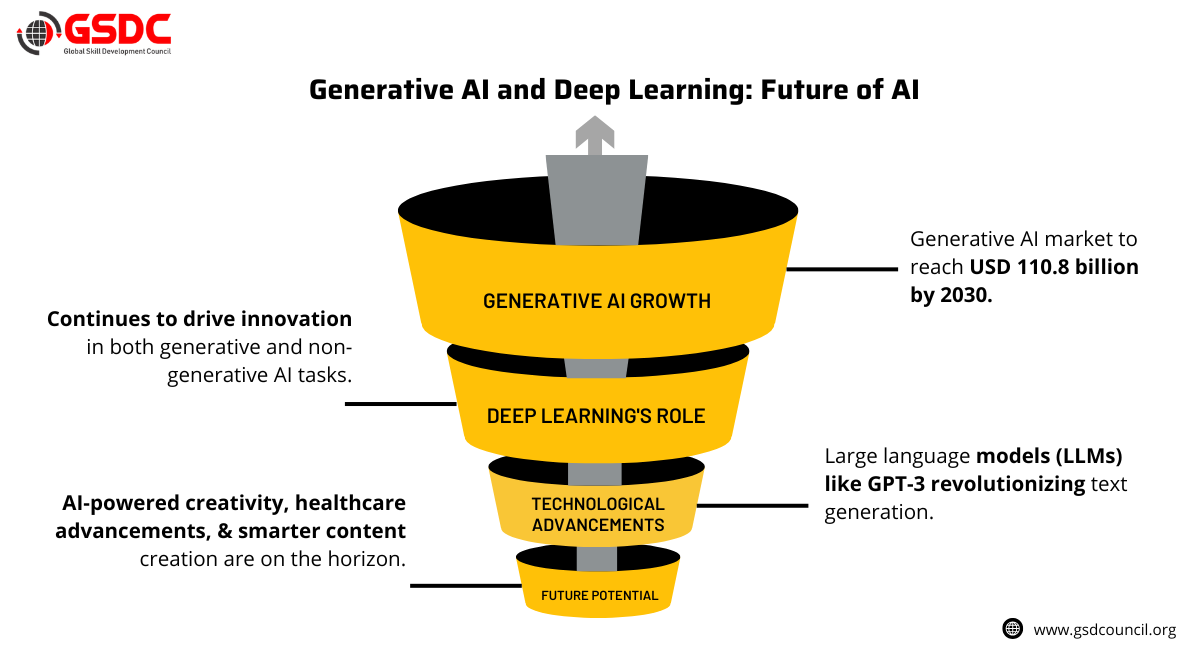 The future of generative AI and deep learning are closely intertwined, with both technologies expected to evolve and complement each other.
- Generative AI is poised to make significant advancements in the next few years, with the rise of large language models (LLMs) such as GPT-3 enabling even more sophisticated text generation and creative applications. These advancements will continue to leverage deep learning, pushing the boundaries of what AI can create.
- Deep learning itself will continue to evolve, with new architectures and techniques improving its ability to handle more complex tasks. The combination of deep learning and generative AI will enable more realistic, creative, and intelligent applications across various industries.
Challenges and Ethical Considerations
Despite the immense potential, generative AI and deep learning face several challenges.
- Generative AI models can suffer from issues like mode collapse, where the generator produces limited types of outputs, and interpretability problems, where it’s hard to understand how the model makes its decisions. Additionally, there are ethical concerns around the misuse of generative AI, such as the creation of deepfakes or misleading content.
- Deep learning models also require vast computational resources, making them expensive and environmentally challenging. Additionally, deep learning models can sometimes be black boxes, making it difficult to understand the decision-making process

Conclusion
In fact, generative AI and deep learning are very closely interlinked but still exist in somewhat different ecosystems within AI.
Generative AI is more focused on producing novel data using deep learning algorithms such as GANor VAE.
Whereas deep learning extends itself to a wide range of tasks in many applications including neural networks into the myriad of AI.
GSDC offers valuable resources and expert guidance to help businesses implement AI-driven tools effectively across their teams.
As AI uses advancement over time, the integration of generative AI and deep learning would open avenues for many more power-packed and creative applications.
The relationship between the two almost certainly needs to be understood, as well as other differences, to have a full inside track on using them.

Related Certifications
Stay up-to-date with the latest news, trends, and resources in GSDC
If you like this read then make sure to check out our previous blogs: Cracking Onboarding Challenges: Fresher Success Unveiled
Not sure which certification to pursue? Our advisors will help you decide!