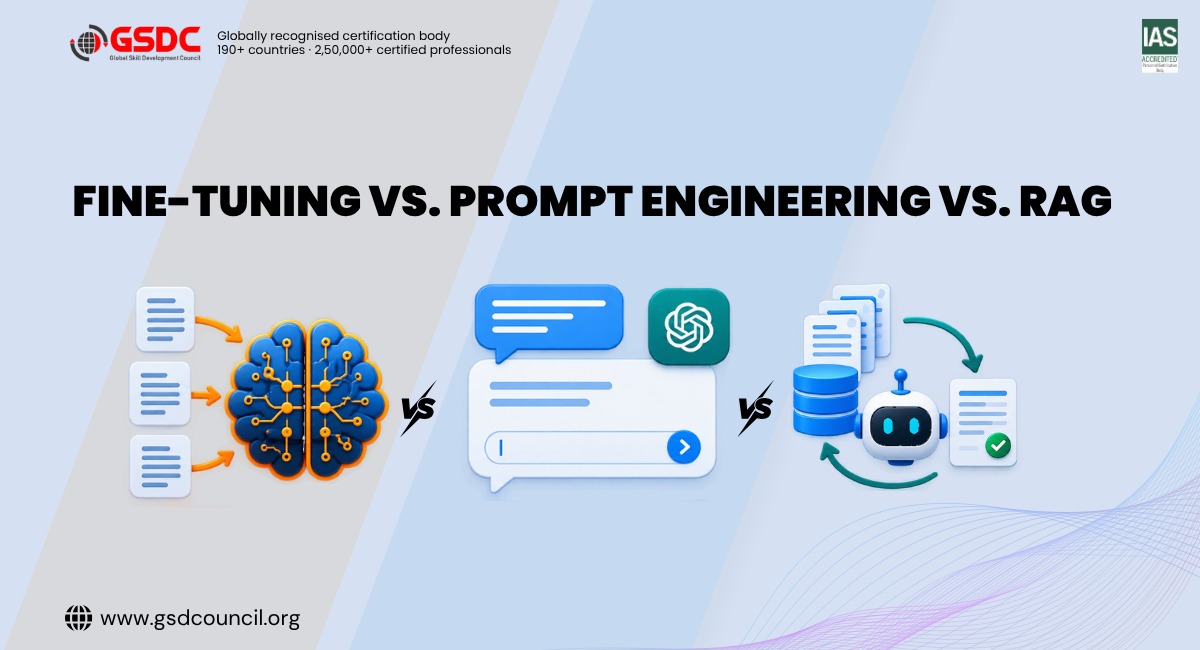
Fine-Tuning vs. Prompt Engineering vs. RAG
Written by Mugoh Edna
- Understanding the Four Levels of AI Improvement
- Prompt Engineering: Improving How the Model Responds
- RAG: Giving the Model Access to Reliable Information
- When Graph RAG Can Help
- Fine-Tuning: Teaching a Model a Specialized Skill
- How to Decide Between Prompting, RAG, and Fine-Tuning
- Building AI Systems That Can Adapt
- Build Skills for Enterprise AI Deployment
- Conclusion
As organizations adopt large language models (LLMs) for customer support, healthcare, finance, legal services, and other business applications, one question comes up repeatedly: Should you use prompt engineering, Retrieval-Augmented Generation (RAG), or fine-tuning?
These approaches can all improve how an AI system performs, but they solve different problems. Choosing the wrong approach can increase development time, cost, and maintenance effort without delivering the expected results.
The webinar “Fine-Tuning vs. Prompt Engineering vs. RAG” explored how organizations can identify the right intervention based on the problem they are trying to solve. The discussion focused on four important areas: direction, truth, skill, and exactness.
Understanding the Four Levels of AI Improvement
Before choosing between prompting, RAG, or fine-tuning, it helps to understand what kind of problem the AI system is facing.
- Direction: This is about helping the model understand what it needs to do. Prompt engineering is useful here, using clear instructions, structured outputs, examples, and constraints to guide the model toward the desired response.
- Truth: This involves giving the model access to information it may not already know. RAG can retrieve relevant policies, documents, or private business information from an external knowledge source instead of relying only on the model's existing knowledge.
- Skill: This refers to repeated behavior or specialized tasks. If a model continues to struggle with a narrow task despite effective prompting and retrieval, fine-tuning can help it learn the required behavior.
- Exactness: Calculations, business rules, validation, and other deterministic tasks may be better handled using traditional software, tools, validators, or function calling rather than relying entirely on an LLM.
This distinction is important because not every AI problem needs a larger model or additional training.
Prompt Engineering: Improving How the Model Responds
Prompt engineering is often the first approach organizations should consider because it can be relatively quick to implement and modify.
A prompt acts as an interface or contract between the application and the language model. It can define the task, provide examples, specify a tone, establish constraints, and request a particular output format.
For example, imagine a customer asking:
“I want a refund for the bundles I purchased yesterday.”
A prompt can instruct the model to identify the customer's intent, respond in a specific tone, and return the result in a structured format.
Structured outputs can also help applications validate whether the response follows the required syntax. However, structured output does not automatically guarantee that the information itself is correct.
This is one of the major limitations of prompting. A model can follow the requested format while still producing an incorrect answer.
For example, if a company's refund policy says that refunds are available within five days, a prompt alone cannot guarantee that the model will always use the latest policy. If the policy changes, the prompt must also be updated or connected to another source of information.
Prompt engineering also requires testing. Small changes to wording can sometimes affect model behavior, so organizations should maintain regression tests and evaluate important prompt changes before deploying them.
RAG: Giving the Model Access to Reliable Information
Retrieval-Augmented Generation, or RAG, addresses a different problem: access to relevant and current information.
Instead of putting all knowledge directly into the model, RAG connects the model to external information sources. These may include company policies, PDFs, databases, websites, internal documents, tables, or other knowledge repositories.
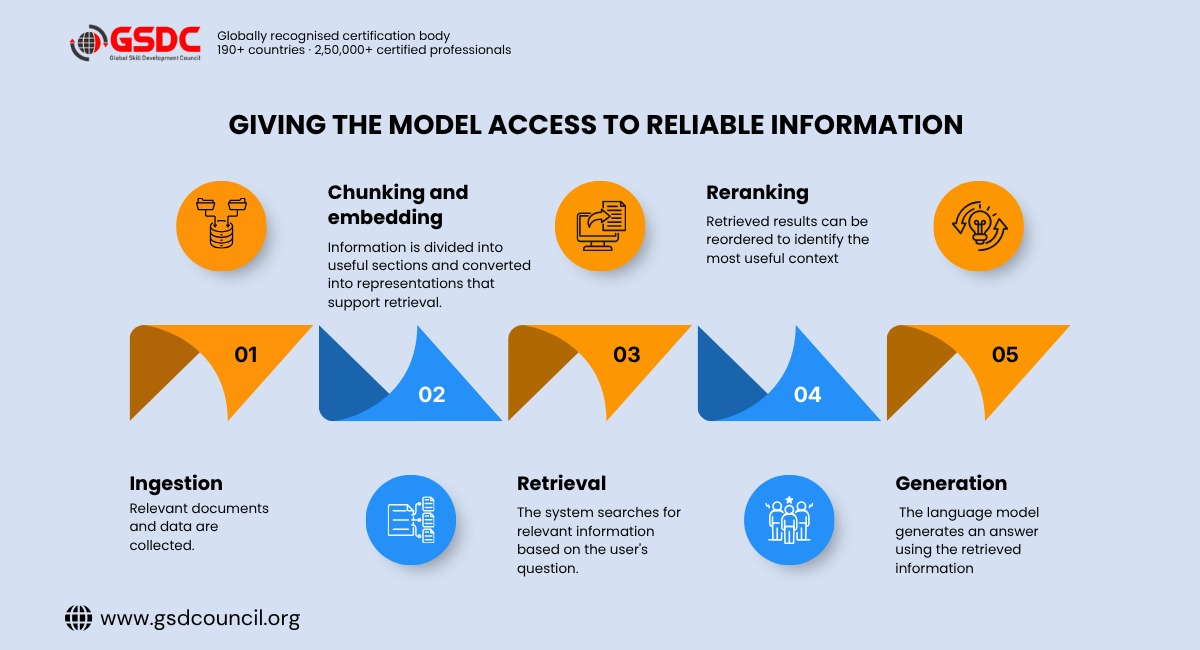
Consider an organization with an internal refund policy. Rather than fine-tuning a model every time the policy changes, the updated policy can be added to the organization's retrieval system. The model can then retrieve the latest version when answering a question.
However, RAG is not automatically accurate. If the wrong document is retrieved, the final answer may also be wrong. Retrieval quality depends on ingestion, chunking, embeddings, search methods, reranking, metadata, and the quality of the underlying documents.
In other words, a wrong answer after good retrieval is a generational problem, while a wrong answer caused by retrieving the wrong information is a retrieval problem.
When Graph RAG Can Help
Traditional RAG works well for many document-based questions, but some questions require connections across a large amount of information.
Graph RAG can help in these situations by extracting entities and relationships from documents and organizing them into a graph structure. The system can then use these relationships to answer questions that span multiple documents or topics.
For example, a legal organization may have thousands of documents containing policies, regulations, cases, and related concepts. A simple retrieval system may find individual passages, while a graph-based approach can help connect information across different parts of the knowledge base.
Graph RAG is therefore more relevant when questions require broader relationships across large and interconnected datasets. For simpler document retrieval, conventional or hybrid RAG may be sufficient.
Fine-Tuning: Teaching a Model a Specialized Skill
Fine-tuning is different from RAG because its main purpose is to change model behavior, rather than simply provide access to new information.
Fine-tuning can be useful when an organization has a narrow, repeated, and measurable task, but the model continues to perform inconsistently despite effective prompting and retrieval.
For example, an organization may receive 50,000 support tickets across multiple intent classes. A general-purpose model may handle common categories well but struggle with rare cases. With a clean, labeled dataset, fine-tuning can help the model recognize these specialized patterns more consistently.
Several fine-tuning approaches can be used depending on the use case:
- Supervised Fine-Tuning (SFT): Uses input-output examples to teach the model the desired behavior. It works well when organizations have a clean dataset with clearly matched inputs and expected outputs.
- Low-Rank Adaptation (LoRA): Keeps the base model frozen while training smaller adapter layers for a specific task. These adapters can be switched based on the task, language, or application.
- Preference Tuning (DPO): Helps the model learn which responses are preferred over others. It can be useful for controlling tone, response style, ranking, or specific behaviors.
- Knowledge Distillation: Trains a smaller model using outputs from a stronger model, helping create a more efficient model for a specific application.
LoRA can be particularly useful for organizations managing multiple specialized applications because different adapters can be used without maintaining a completely separate model for every task.
How to Decide Between Prompting, RAG, and Fine-Tuning
The decision should begin with the problem rather than the technology.
If the problem is mainly how the model should respond, start with prompt engineering.
If the problem is access to changing, private, or external information, consider RAG.
If the problem is repeated specialized behavior or classification, fine-tuning may be appropriate.
If the problem requires exact calculations, deterministic rules, or validation, use tools or traditional code rather than expecting the language model to perform everything.
Cost and development time should also be considered. Prompt changes can generally be implemented quickly. RAG requires work around ingestion, indexing, retrieval, evaluation, and monitoring. Fine-tuning can require considerably more effort because teams need suitable datasets, labeling, training infrastructure, evaluation, and ongoing maintenance.
The cost should therefore be measured not only by infrastructure but also by the cost of building, changing, evaluating, and maintaining the system.
Building AI Systems That Can Adapt
The webinar also highlighted the importance of ongoing evaluation and monitoring. AI systems using prompt engineering, retrieval augmented generation (RAG), or fine tuning LLM should not be treated as “build once and forget” applications.
Organizations should monitor model versions, retrieval quality, latency, cost, evaluation results, and failure cases. When a new model or policy is introduced, teams should test it against a reliable evaluation set before fully replacing an existing version. This is especially important for AI model fine tuning, where changes to training data can affect model performance.
Security is another important consideration. Retrieved documents and user inputs should be treated carefully because prompt injection can attempt to manipulate how an AI system behaves. Sensitive personal information should also be protected throughout the training and retrieval augmented generation pipeline.
A strong AI system is therefore not defined by whether it uses prompt engineering, RAG, or fine tuning LLM. It is defined by how well these components work together to solve a specific problem, including different retrieval augmented generation use cases.
Build Skills for Enterprise AI Deployment
The GSDC Forward Deployed Engineering Certification helps professionals build practical skills for deploying AI solutions in real-world enterprise environments. It covers AI implementation, system integration, troubleshooting, and working closely with business teams. The certification is designed for professionals who want to bridge the gap between AI development and successful enterprise deployment.

Benefits of GSDC Forward Deployed Engineering Certification
- Learn Practical AI Deployment – Build skills for implementing AI solutions in real-world enterprise environments.
- Bridge AI and Business Needs – Understand how to translate business requirements into practical AI solutions.
- Develop Integration Skills – Learn how AI systems can work with existing enterprise tools and workflows.
- Improve Problem-Solving Skills – Gain experience handling deployment challenges, troubleshooting, and system issues.
- Work With Enterprise AI Systems – Understand the practical challenges of deploying AI at scale.
- Strengthen Cross-Functional Collaboration – Learn to work effectively with developers, business teams, and stakeholders.
Conclusion
Prompt engineering, retrieval augmented generation (RAG), and fine tuning LLM address different layers of AI application development. Prompt engineering helps guide model behavior, retrieval augmented generation provides access to relevant external knowledge, and AI model fine tuning can improve performance on specialized and repeated tasks.
The right approach depends on whether the challenge involves direction, knowledge, skill, or exactness. RAG use cases are especially useful when AI systems need access to changing, private, or organization-specific information.
In many real-world applications, the answer may not be one technology. A reliable AI application could combine prompting, retrieval augmented generation, fine tuning LLM, tools, validation, and human oversight. The key is to diagnose the actual problem first and then choose the simplest approach that can solve it effectively.

Related Certifications
Frequently Asked Questions
Prompt engineering changes model instructions, while fine tuning LLM uses training data to adapt the model for specialized and repeated tasks.
Use retrieval augmented generation when the model needs access to changing, private, or organization-specific information without retraining the model.
Yes. AI model fine tuning improves specialized behavior, while RAG provides access to current or business-specific information.
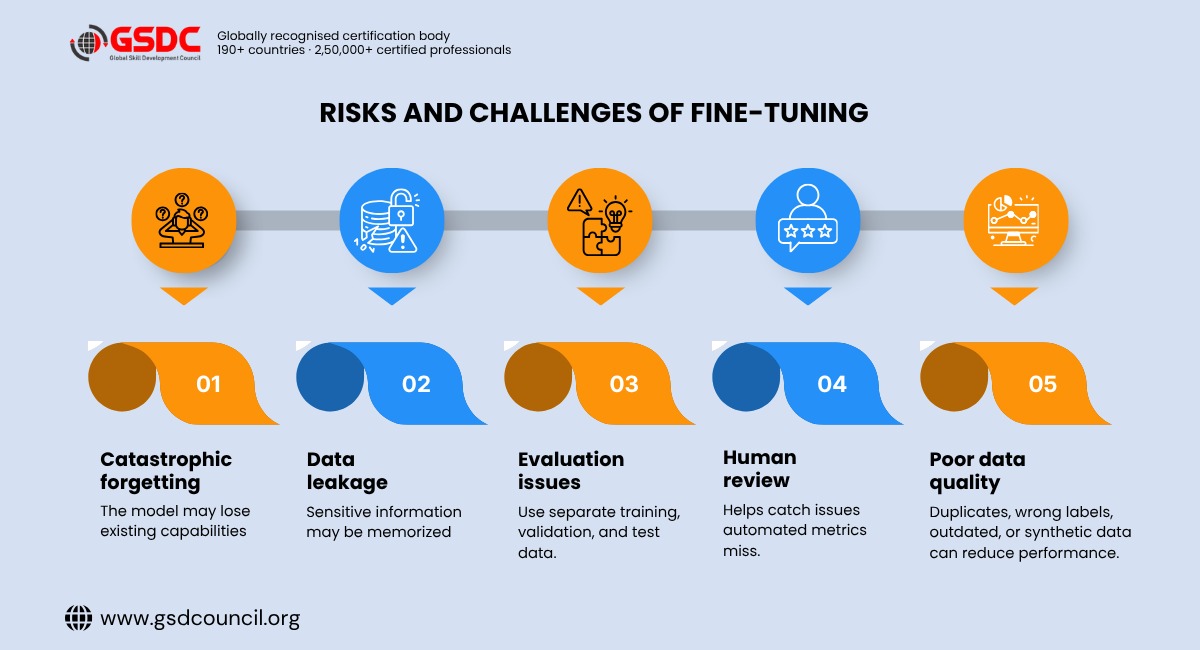
Key risks include poor data quality, overfitting, catastrophic forgetting, sensitive-data memorization, and evaluation issues.
Prompt engineering is enough when the model has the required knowledge and mainly needs clearer instructions, examples, or output formatting.
Stay up-to-date with the latest news, trends, and resources in GSDC
If you like this read then make sure to check out our previous blogs: Cracking Onboarding Challenges: Fresher Success Unveiled
Not sure which certification to pursue? Our advisors will help you decide!