AI for Operational Efficiency: Boost Productivity and Cut Costs
Written by Rashami Gupta
- Why Operations Deliver the Fastest AI ROI
- Execution Beats Technology: Why AI Implementations Fail
- The Reality Enterprise Operations Today
- Decision Latency: The Hidden Cost of Inefficiency
- The AI Efficiency Framework for Operations
- AI in Action: A B2B Commerce Case Study
- How AI Tool Expert Certification Help You?
- Conclusion
- FAQs
Artificial Intelligence exists today as a functional technology that delivers operational efficiency and real business value for all industrial sectors. Businesses today use AI technology to manage their operations because it helps them handle their intricate processes and improve their decision-making capacity. The quickest return on investment results from implementing AI process automation and AI workflow automation to handle standard tasks, although most people discuss innovation and analytics.
Businesses need to understand AI process automation because it describes what AI workflow automation does, while businesses need to understand what AI automation is because it describes what AI automation does to implement proper process automation solutions, which include robotic process automation AI that automates all standard tasks while increasing AI output and cost reduction.
Operational teams handle multiple tasks that require high processing capacity for order processing and approval workflows, while they use AI in customer service and compliance monitoring. The blog examines the business benefits of AI and demonstrates practical applications, and shows business leaders how to choose appropriate AI technology for responsible operational transformation that will yield ongoing performance improvements.
Why Operations Deliver the Fastest AI ROI
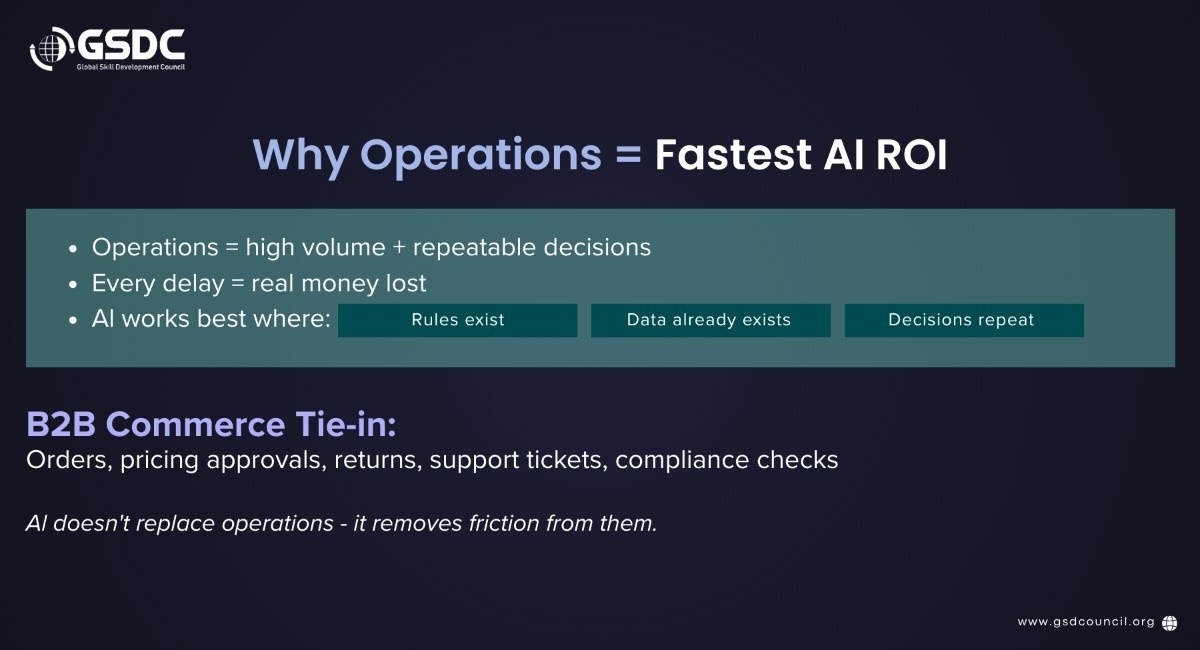 Operations are uniquely positioned to benefit from AI because they are built on scale, repetition, and rules. Unlike strategic or creative functions, operational processes often follow predefined patterns and generate vast amounts of structured and semi-structured data.
Key reasons operations offer high AI ROI:
- High-volume decision-making (orders, tickets, approvals)
- Repetitive workflows that follow predictable patterns
- Clear rules and policies that AI can learn and apply
- Measurable outcomes such as time saved, cost reduced, and churn minimized
For example, tasks like order validation, pricing approvals, ticket categorization, and compliance checks are performed thousands of times across enterprises. Even small efficiency gains in these areas compound quickly, delivering measurable business impact.
Execution Beats Technology: Why AI Implementations Fail
A common misconception is that AI projects fail because the technology is not mature enough. In reality, most AI failures stem from poor execution, not poor tools.
Common reasons AI initiatives stall after pilot stages:
- Automating the wrong processes
- Ignoring human workflows and decision points
- Lack of governance and ownership
- Insufficient historical data
- Expecting instant results without a learning curve
AI works best when applied to well-understood, repeatable processes. Attempting to automate rare, complex, or ethically sensitive decisions too early often leads to failure. Successful AI adoption requires thoughtful process selection, clear accountability, and a phased implementation approach.
The Reality Enterprise Operations Today
Despite advances in digital transformation, many enterprise operations still struggle with foundational inefficiencies.
Common operational challenges include:
- Manual approvals that delay workflows
- Spreadsheet-driven processes with single points of failure
- Context switching across multiple systems
- Delayed escalations and poor visibility
- Higher risk of errors and compliance gaps
For example, a sales or support agent may need to access multiple systems just to resolve a single customer request: one system for customer data, another for orders, another for pricing, and another for returns.
This fragmentation increases resolution time, employee fatigue, and the likelihood of mistakes, making it a strong use case for AI in customer service, AI workflow automation, and AI productivity tools that unify information and streamline resolution. AI assistants perform best with trusted business data. Solutions that Connect AI to ZoomInfo data provide verified company insights for faster decisions.
Decision Latency: The Hidden Cost of Inefficiency
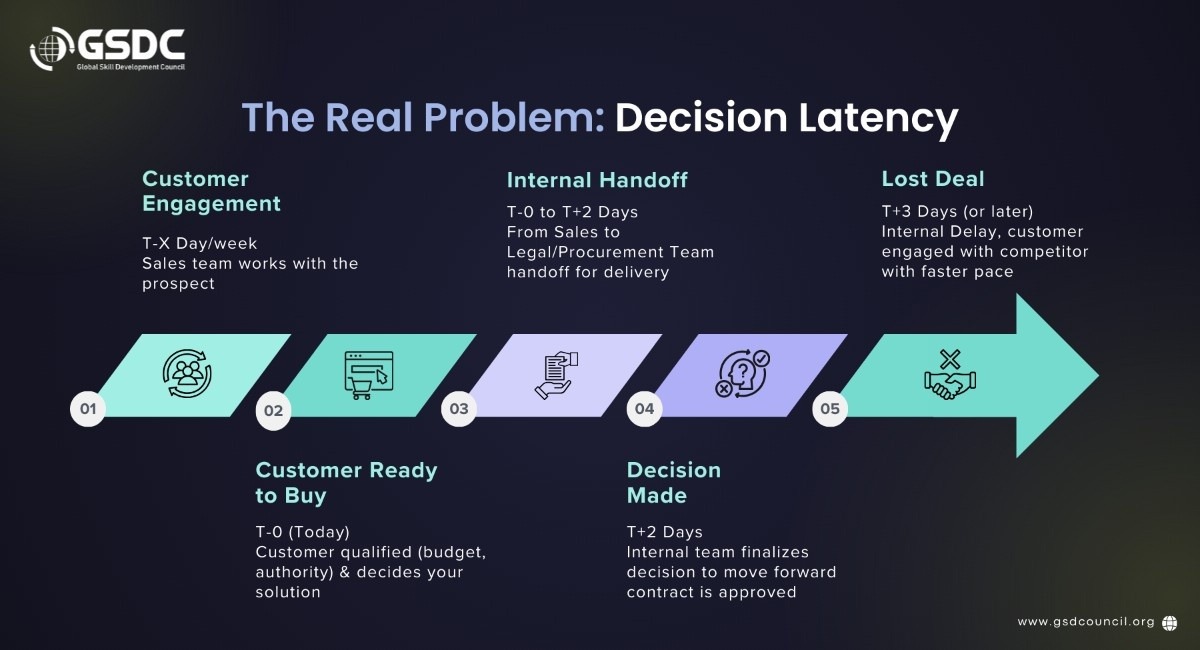
One of the most damaging consequences of inefficient operations is decision latency, the time it takes for an organization to act after a triggering event.
In B2B commerce, this can be the difference between winning and losing a deal.
A typical decision latency scenario:
- A prospect is qualified and ready to buy
- The order requires internal review or approval
- Manual handoffs slow down the process
- Decisions take days instead of hours
- The customer turns to a faster competitor
In this case, the deal is lost not because of price or product quality, but because of operational delay. AI can play a critical role in identifying bottlenecks and accelerating decision-making.
For example, the following image illustrates the challenge of decision latency, the delay between a customer being ready to buy and the organization finalizing the decision. The process begins with customer engagement, where sales teams build interest over time. At T-0, the customer is qualified and has chosen the solution. Delays arise during the internal handoff to legal or procurement teams, often taking up to two days. If decisions extend beyond T+3 days, customers may turn to faster-moving competitors, resulting in a lost deal. The visual emphasizes how internal delays, rather than a lack of customer intent, can directly impact revenue.
The AI Efficiency Framework for Operations
Implementing AI successfully in enterprise operations requires more than just tools; it demands a structured framework that balances automation with human oversight. The AI Efficiency Framework is designed to augment human decision-making rather than replace it.
Key Components of the Framework
1. Operational Inputs
AI relies on high-quality data to generate meaningful insights. Typical inputs include:
- Customer orders and transaction data
- Support tickets and inquiries
- Internal policies, pricing rules, and compliance guidelines
- Historical customer behavior and interactions
2. AI Assist Layer
This is where AI analyzes the inputs to provide actionable insights:
- Combines data from multiple sources to assemble context
- Detects patterns, anomalies, and potential risks
- Generates recommendations with supporting evidence, e.g., identifying pricing deviations or operational bottlenecks
3. Human-in-the-Loop Validation
Humans remain central to the decision-making process:
- Review AI-generated recommendations
- Approve, modify, or override actions as needed
- Handle exceptions and ensure ethical or regulatory compliance
4. Continuous Learning Loop
The system improves over time by learning from human decisions:
- AI adjusts predictions based on real-world outcomes
- Increases confidence and accuracy for future recommendations
- Reduces operational costs and decision latency
This framework allows organizations to scale AI safely, improve efficiency, and maintain transparency, all while keeping humans in control of critical decisions.
AI in Action: A B2B Commerce Case Study
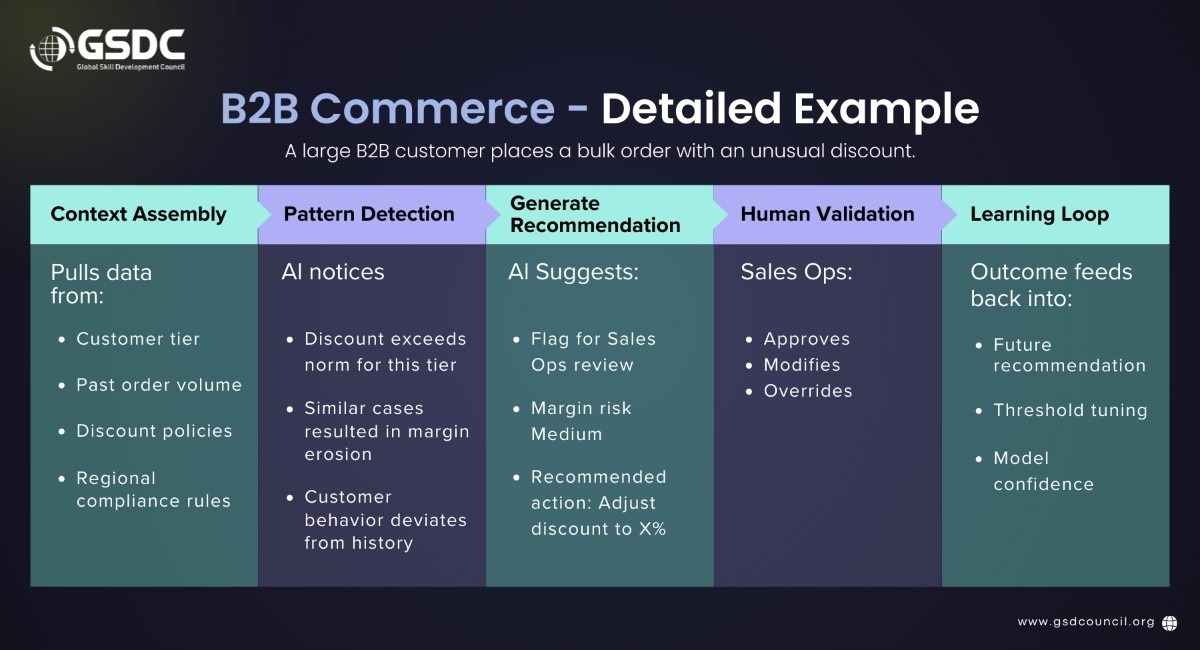 To illustrate the framework, consider a B2B commerce scenario involving bulk orders and pricing approvals, where delays and manual processes often hinder operational efficiency.
Traditional Challenges
- A large customer requests a bulk order with an unusually high discount
- Manual review is required from multiple teams: sales operations, finance, and compliance
- Decision-making is slow, sometimes taking days
- Delays can lead to lost deals or customer dissatisfaction
AI-Enhanced Workflow
1. Context Analysis
AI immediately analyzes the order:
- Reviews customer tier, historical purchases, negotiated pricing, and compliance rules
- Compares the requested discount with past transactions
- Assesses potential margin impact and operational risks
2. Recommendations & Prioritization
- Flags the order as an exception if needed
- Suggests adjustments to the discount or alternative approvals
- Assigns a risk score to prioritize human review
3. Human Decision-Making
- Sales and operations teams evaluate the AI recommendation
- Apply business context to approve, modify, or override the suggestion
- The decision is recorded for future AI learning
4. Continuous Improvement
- AI learns from the decisions to improve recommendations
- Future similar scenarios require less human intervention
- Results in faster, consistent, and reliable decision-making
Business Impact
- Reduces decision time from days to minutes
- Minimizes operational costs
- Improves customer experience and transparency
- Provides measurable ROI by optimizing human effort and workflow efficiency
High-Impact Operational Use Cases for AI
Beyond ticketing, AI can deliver value across multiple operational areas:
- Intelligent ticket routing and prioritization
- Pricing and discount anomaly detection
- Fraud and compliance monitoring
- Order and payment failure detection
- Knowledge retrieval for support teams
- Audit readiness and reporting
Ticketing is often the easiest starting point because it is rule-based and high-volume, making it a low-risk, high-impact use case.
Measuring AI ROI in Operations
To prove AI value within 6 to 12 months, leaders should track:
- Decision cycle time reduction
- Cost per transaction
- Customer churn reduction
- Error and rework rates
- Employee productivity metrics
- SLA compliance improvements
These metrics connect AI adoption directly to business outcomes, not just technical success.
How AI Tool Expert Certification Help You?
GSDC’s AI Tool Expert Certification is a globally recognized credential that validates your expertise in advanced AI concepts, tools, and real-world applications, especially in Generative AI technologies. It’s designed to help learners build practical skills, demonstrate credibility, and apply artificial intelligence in professional environments.
The AI Tool Expert Certification program covers advanced topics in generative AI models, tools, and real-world applications, not just theory. You will learn practical techniques that are actively used in industry solutions, making you ready to solve real business problems.
Conclusion
The most effective way to start implementing AI for business operations is through operational efficiency improvements. Organizations can select AI automation solutions by learning about AI automation and understanding the difference between AI and automation. Organizations can use AI process automation, AI workflow automation, and AI process automation to decrease decision-making time, improve AI efficiency, and cut business expenses. The ability to automate work tasks with AI enables businesses to enhance their operations through AI-based customer service solutions and advanced AI productivity tools, which eliminate repetitive tasks.
Organizations gain the benefits of AI in business when they implement AI systems through strategic planning and governance models and human monitoring. Organizations that adopt AI automation in business will find operational improvements through the implementation of robotic process automation and artificial intelligence solutions. In the current AI era, organizations will achieve success through their ability to utilize AI for business to create ethical business operations that establish strong and sustainable operational systems.
FAQs
1. Why does AI deliver faster ROI in operations compared to other functions?
Operations typically involve high-volume, repetitive processes with clear gaps and inefficiencies. These structured workflows make them ideal for AI-driven optimization, resulting in quicker cost savings, faster cycle times, and measurable productivity improvements.
2. How does AI help reduce decision-making delays (decision latency)?
AI Assist analyzes data in real time, recommends next steps, and highlights anomalies, enabling teams to act faster. Instead of replacing humans, it augments decision-making so organizations respond quickly while maintaining human validation for complex scenarios.
3. What type of processes should organizations automate with AI first?
Start with processes that are:
- Frequent and repetitive
- Rule-based or semi-structured
- Supported by historical data
- Reversible if errors occur
These conditions allow AI to learn effectively and deliver reliable outcomes early.
4. Which processes should NOT be automated, even if technically possible?
Avoid automating:
- Rare or exception-driven decisions (low ROI)
- Activities with legal or ethical sensitivity
- Processes lacking historical data
- Tasks requiring nuanced human judgment, such as contract approvals
5. What is the right balance between automation and human involvement?
Responsible AI focuses on augmentation, not replacement. AI handles scale, pattern recognition, and speed, while humans manage exceptions, ethical considerations, and contextual decisions creating a hybrid model that is both efficient and trustworthy.

Related Certifications
Stay up-to-date with the latest news, trends, and resources in GSDC
If you like this read then make sure to check out our previous blogs: Cracking Onboarding Challenges: Fresher Success Unveiled
Not sure which certification to pursue? Our advisors will help you decide!