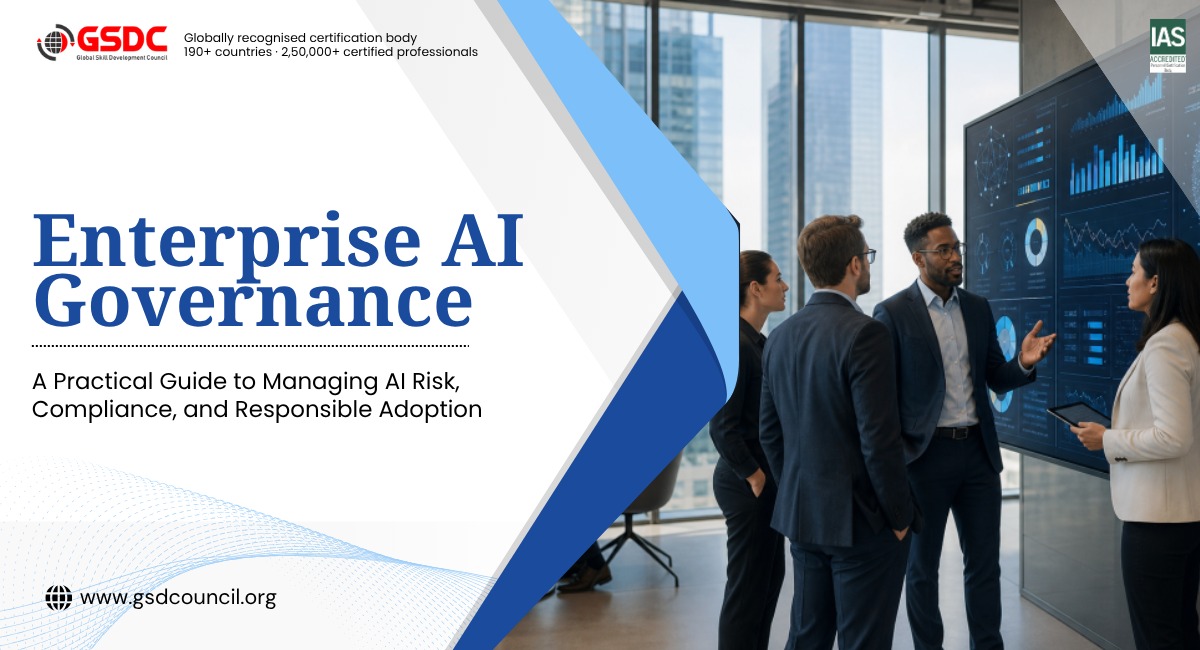
Enterprise AI Governance
Written by Pravena K
- Why Enterprise AI Governance Matters
- Four Pillars of Enterprise AI Governance
- Use a Risk-Based Governance Model
- Build an AI Inventory and Risk Register
- Responsible AI and Human Oversight
- Govern AI Across Its Entire Lifecycle
- Auditability: Can You Explain What Happened?
- Build Enterprise AI Implementation Skills with GSDC
- Conclusion
Artificial intelligence is quickly moving from experimentation into everyday business operations. Organizations now use AI for content creation, customer service, recruitment, forecasting, data analysis, decision support, and automated workflows. As adoption grows, one question becomes increasingly important: who is responsible when an AI-supported decision creates a problem?
This is where enterprise AI governance becomes essential. AI governance provides a structure for managing AI risks, meeting relevant obligations, protecting data and people, and maintaining accountability. It is not simply an IT or legal responsibility. It requires collaboration between leadership, business, technology, risk, compliance, security, and people functions.
The webinar “Enterprise AI Governance” explained how organizations can move from simply adopting AI tools toward using them responsibly and at scale.
Why Enterprise AI Governance Matters
AI adoption is moving faster than traditional organizational governance. What is AI governance is becoming increasingly important as employees can discover an AI platform, subscribe to it, upload information, and begin using it within hours. Procurement, legal reviews, security checks, and risk assessments can take weeks or months.
This creates a governance gap. Another challenge is shadow AI. Employees may use tools such as ChatGPT, Gemini, Copilot, or other AI platforms before formal approval. AI features can also appear inside software that an organization already uses, making it difficult to identify every AI-enabled workflow.
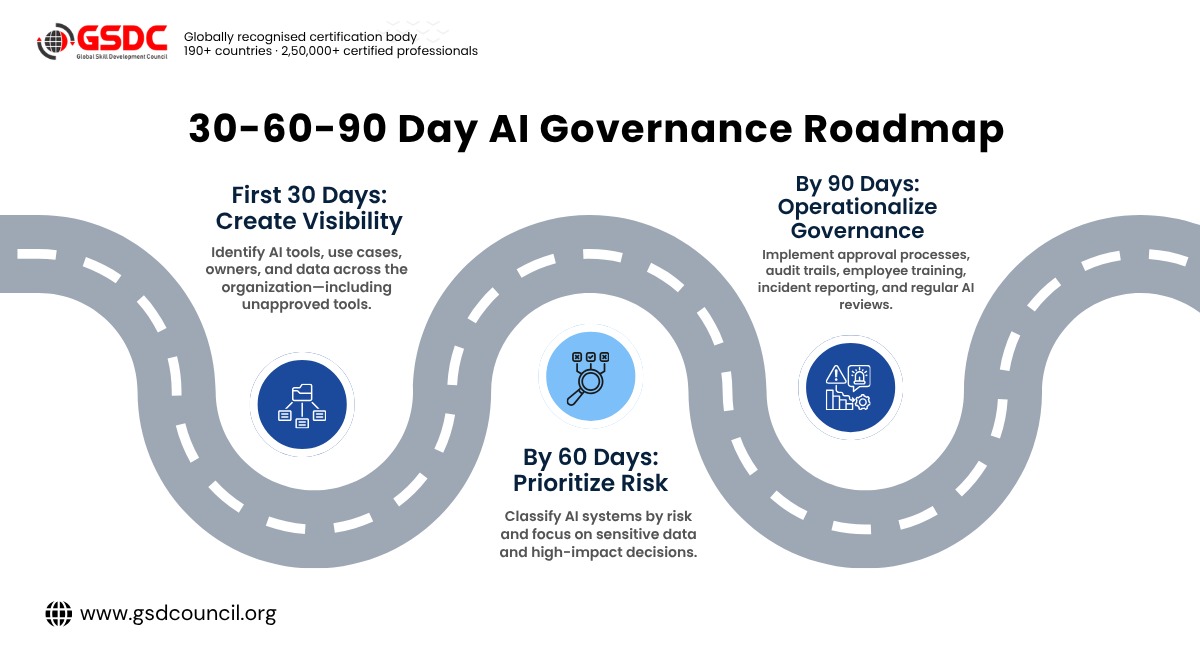
Therefore, enterprise AI governance starts with visibility. Organizations need to know what AI systems are being used, who uses them, what information they process, what decisions they influence, and who owns them. This is essential for AI governance for enterprise, enterprise AI risk management, AI risk management, and AI compliance.
Organizations need to understand what is enterprise AI? and what is enterprise AI governance? to manage AI use across business processes and systems. Strong AI risk and compliance practices also support responsible AI governance.
Four Pillars of Enterprise AI Governance
A practical AI governance program can be organized around four connected pillars: risk, compliance, responsible AI, and auditability.
AI Risk Management
AI risk is not only a technical or model issue. It can become a business risk affecting legal obligations, reputation, operations, finances, safety, and customer trust.
For example, an AI recruitment system may unintentionally disadvantage certain candidates. A customer service chatbot may provide incorrect information. An AI forecasting system may become less accurate over time and affect inventory or procurement decisions.
Organizations should consider four broad areas of risk: data, models, usage, and third parties.
Data risk can involve sensitive information, poor-quality data, or existing bias. Model risk can include hallucinations and performance changes. Usage risk occurs when employees rely too heavily on AI or use an unsuitable tool. Third-party risk appears when organizations depend on vendors, APIs, cloud platforms, or embedded AI features.
The important question is not only “Can the AI system fail?” but also “What happens to the business if it fails?”
Use a Risk-Based Governance Model
Not every AI application requires the same level of governance. An AI tool that helps rewrite an internal email does not carry the same consequences as a system influencing recruitment, credit, healthcare, or safety decisions.
A risk-based approach allows organizations to apply stronger controls where the potential consequences are greater. High-risk systems may require detailed testing, documentation, human oversight, monitoring, and formal approval. Lower-risk applications may need simpler controls.
This approach helps organizations avoid two extremes: governing too little or creating controls so complicated that employees bypass them.
Build an AI Inventory and Risk Register
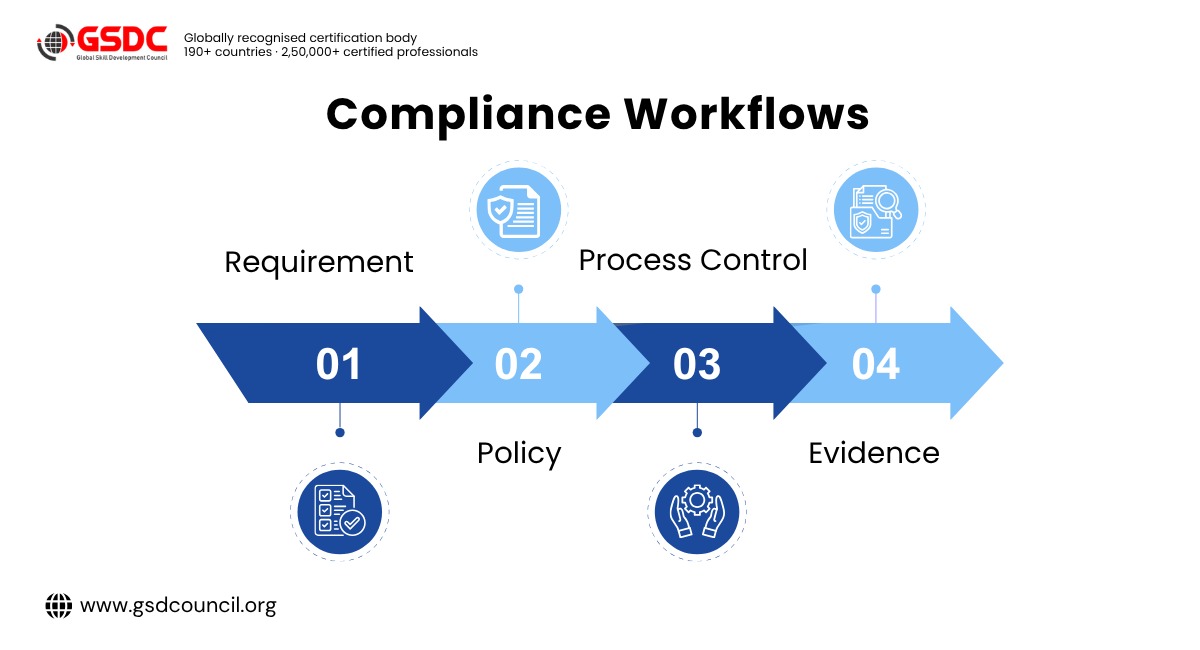
An AI inventory and risk register is one of the most practical starting points for an organization. It provides a central view of the AI systems being used across departments and supports AI risk management and enterprise AI governance.
The register can capture the system owner, use case, data processed, risk level, existing controls, human oversight requirements, review dates, and current status. This helps organizations strengthen AI risk and compliance and support responsible AI governance.
Consider an AI resume-screening system. Because it can influence employment outcomes, it may be classified as high risk. The organization could require human review, recurring bias assessments, and documented approval before decisions are finalized.
The purpose of the register is not to create unnecessary paperwork. It is to establish visibility and ownership. If leadership asks which AI systems influence employees or customers, the organization should be able to answer quickly..
Responsible AI and Human Oversight
Responsible AI focuses on how AI systems behave and how their impact is managed. Key principles include fairness, transparency, accountability, privacy, safety, and human oversight.
Human oversight is particularly important when AI affects high-impact decisions involving employment, credit, healthcare, legal matters, or safety. It can also be necessary when an AI system produces uncertain results or encounters unusual situations.
However, “human in the loop” should not remain a general statement in an AI policy. Organizations should define where human judgment is required, who performs the review, and what happens when the reviewer disagrees with an AI recommendation.
This creates a clear accountability structure instead of treating AI as the final decision-maker.
Govern AI Across Its Entire Lifecycle
AI governance should continue throughout the entire AI lifecycle rather than ending when a system receives approval.
- Design: Define purpose, users, acceptable use, and limitations.
- Development: Test performance, bias, security, and key risks.
- Deployment: Establish transparency requirements and human checkpoints.
- Monitoring: Track model performance, data, business conditions, and user behavior.
- Retirement: Retain records, manage access, and preserve key decision history.
This means responsible AI is not simply a launch checklist. It is an ongoing management process.
Auditability: Can You Explain What Happened?
Auditability allows an organization to reconstruct what happened when an AI-supported decision is questioned.
This requires information such as data lineage, model versions, decision logs, risk assessments, approval records, and change history.
For example, if an AI recommendation is challenged six months later, the organization should ideally know which system version was used, what data was involved, who reviewed the result, and what final decision was made.
Without proper records, investigations become difficult because AI models, prompts, data, and system capabilities may have changed since the original decision.
Good auditability therefore supports accountability and helps organizations demonstrate that governance controls were actually followed.
Build Enterprise AI Implementation Skills with GSDC
GSDC’s Forward Deployed Engineer Certification helps professionals build skills for connecting AI solutions with real-world enterprise requirements. The certification focuses on areas such as AI implementation, solution architecture, enterprise integration, problem-solving, and stakeholder communication.
These capabilities are relevant for professionals working at the intersection of technology, business, risk, and responsible AI adoption. By understanding how AI systems fit into existing workflows, data environments, and organizational requirements, professionals can better support the journey from AI experimentation to practical enterprise deployment.

Forward Deployed Engineer Certification can also help strengthen the technical and business skills needed to contribute to scalable and responsible AI initiatives.
Conclusion
Enterprise AI governance is not about stopping innovation. It creates the structure organizations need to use AI with greater confidence.
The webinar highlighted four important priorities: understand where AI is being used, manage risk according to impact, build responsible AI practices throughout the lifecycle, and maintain evidence that decisions and controls can be reconstructed.
AI governance cannot sit entirely with IT or legal teams. It requires collaboration between leadership, business owners, technology, risk, compliance, security, and people functions.
As organizations move beyond asking “Can we use AI?”, the more useful question is: “How can we use AI responsibly, safely, and at scale?”

Related Certifications
Frequently Asked Questions
Enterprise AI governance is the framework of policies, processes, responsibilities, controls, and oversight used to manage AI across an organization. It covers AI risk management, AI compliance, responsible AI, human oversight, and auditability.
An AI inventory helps organizations understand which AI systems are being used, who owns them, what data they process, and what risks they may create. It provides visibility for enterprise AI risk management before stronger governance controls are introduced.
Shadow AI refers to AI tools used for work without formal organizational approval or visibility. It can create risks involving sensitive data, security, AI compliance, and accountability.
Human oversight is particularly important when AI influences high-impact decisions involving employment, credit, healthcare, legal matters, or safety. It can also be useful when AI produces uncertain or unusual outputs as part of responsible AI governance.
A practical starting point is to create an AI inventory and risk register. Organizations can then classify risks, assign ownership, introduce relevant controls, train employees, and establish regular monitoring and review as part of AI governance for enterprise.
Stay up-to-date with the latest news, trends, and resources in GSDC
If you like this read then make sure to check out our previous blogs: Cracking Onboarding Challenges: Fresher Success Unveiled
Not sure which certification to pursue? Our advisors will help you decide!