Why Upskilling with Generative AI Is a Smart Career Move in 2025
Written by Matthew Hale
- Market Overview: Generative AI’s Meteoric Rise
- Key Players Driving Generative AI Growth
- Upcoming Generative AI Trends in 2026
- Impact on Jobs, Skills, and the Future of Work
- Preparing for the Future: Learning and Upskilling
- Conclusion: Generative AI Ahead - Shaping Industries, Workforces, and Innovation
Generative AI is redefining what machines can achieve, transforming industries by creating original content-from text and visuals to code and audio. But what is generative AI? It’s a class of advanced machine learning models that learn from massive datasets to generate human-like outputs.
Key generative ai examples include:
- ChatGPT: Drafts text for business, education, and customer solutions.
- DALL·E: Generates images from textual descriptions.
- Google Gemini: A multimodal AI integrating language and vision.
These tools extend human creativity rather than simply automating tasks. Earning a certificate in generative AI empowers professionals to apply these tools confidently across industries.
The market reflects this momentum: valued at USD 16.87 billion in 2024, the generative AI sector is projected to reach USD 22.20 billion in 2025, growing at a CAGR of 37.6% through 2030. Private funding reached USD 33.9 billion in 2024, signaling strong investor confidence. For professionals, mastering generative AI is becoming essential for enhancing creativity, streamlining processes, and driving innovation.
Market Overview: Generative AI’s Meteoric Rise
Generative AI is no longer futuristic-it’s reshaping industries and redefining business potential.
A Market on Fire
The global generative AI market reached USD 16.87 billion in 2024, expected to surge to USD 22.20 billion by the end of 2025. This growth outpaces many cloud computing and enterprise software segments, emphasizing the urgency for businesses to adopt AI strategically.
Cross-Industry Disruption
Applications now touch nearly every sector:
- Finance: Automates reporting, simulates market risks, improves forecasting.
- Healthcare: Supports diagnostics, research, and patient communication.
- Marketing & Advertising: Generates personalized campaigns and visual content.
- Entertainment & Media: Produces music, scripts, visual art, and immersive game content.
Tools like ChatGPT and DALL·E illustrate how generative AI is changing creative work, enabling rapid ideation and scalable content creation.
Investment Explosion
Investor confidence underscores AI’s potential. Private funding hit USD 33.9 billion in 2024, up 18.7% from 2023. Venture capital and corporate investments are fueling innovation and AI-driven startups.
Key Players Driving Generative AI Growth
The generative AI market has experienced explosive growth, surpassing $25.6 billion in 2024, fueled by widespread adoption across industries and significant investments in AI infrastructure. Both established tech giants and agile startups are shaping this fast-evolving landscape, driving innovation and building the AI frameworks of tomorrow.
1. Data Center GPUs: Powering Generative AI Computation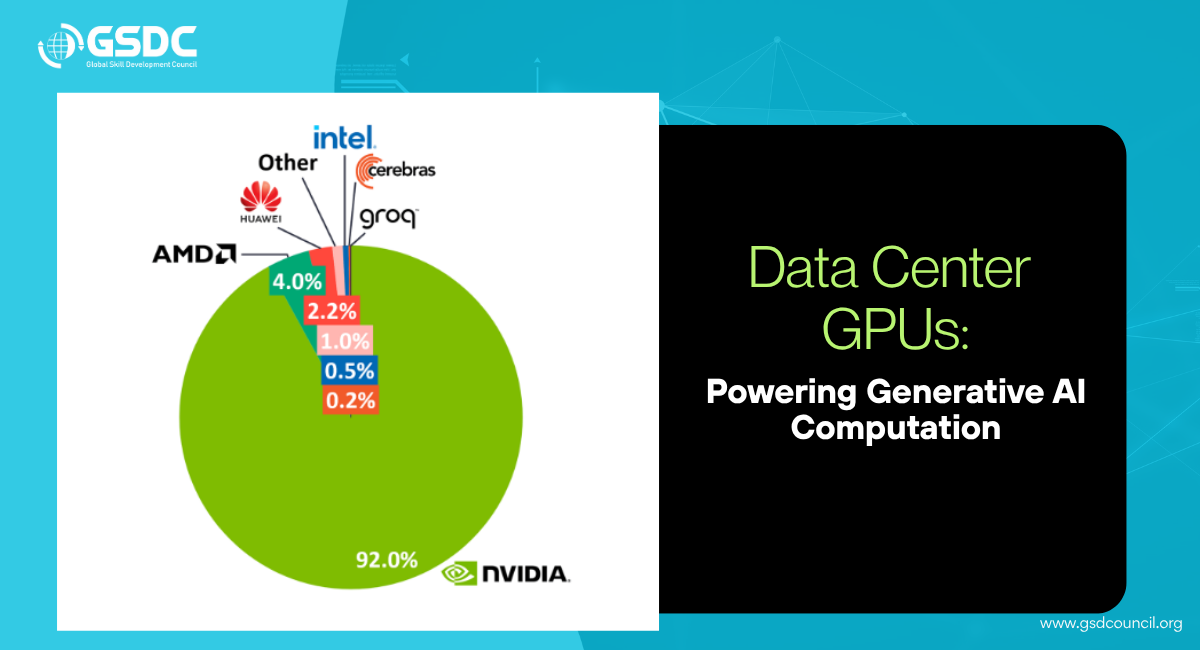
Data center GPUs are the backbone of generative AI, handling massive computational loads. In 2024, the market reached $125 billion, with NVIDIA dominating 92% of the market.
- NVIDIA: Continues to lead with its H100 and Blackwell architecture GPUs and the CUDA ecosystem, powering enterprise AI applications globally.
- AMD: Growing its presence with MI300X GPUs, offering a cost-effective alternative to NVIDIA for hyperscalers like Microsoft and Meta.
- Emerging players: Huawei, Cerebras, and Groq are pushing innovation with proprietary AI chips and scalable architectures.
2. Foundation Models and Platforms: The AI Software Backbone
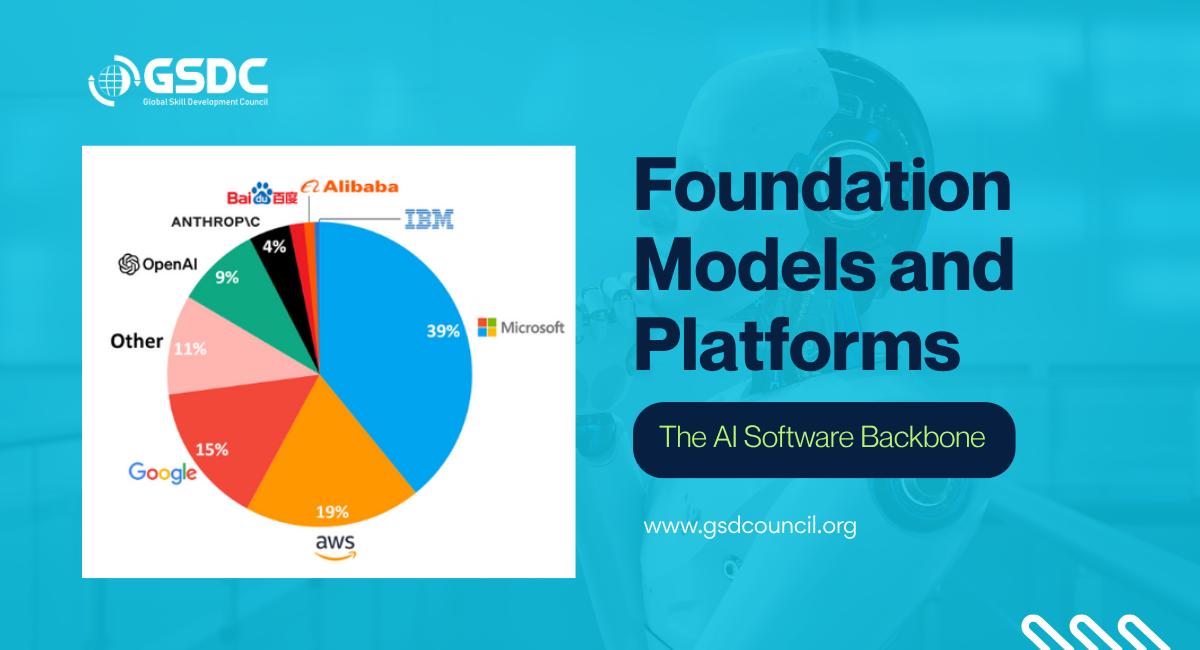
Foundation models and model management platforms reached $11 billion in 2024, with hyperscalers capturing significant market share.
- Microsoft: Leads with 39% market share, integrating OpenAI models into Azure AI and building agentic enterprise ecosystems.
- AWS: Holds 19% share, leveraging Bedrock, SageMaker, and its collaboration with Anthropic.
- Google: Controls 15%, focusing on Vertex AI and developer-centric innovation.
- OpenAI: Around 9% market share, advancing AGI initiatives and enterprise-focused solutions.
- Emerging players: Hugging Face, Mistral AI, and DeepSeek are reshaping the open-source and cost-efficient AI model landscape.
3. Generative AI Services: Consulting and Integration Experts
Professional services companies are enabling enterprises to adopt AI at scale.
- Accenture: Leads with 7% market share, backed by a $3 billion AI investment and partnerships with top AI providers.
- Deloitte: Holds 3%, driving over 700 generative AI projects and investing $4 billion in AI services.
- IBM: At 2%, focuses on enterprise AI through Watsonx, automation, and hybrid cloud integration.
- Others: McKinsey, BCG, Cognizant, and Capgemini are expanding industry-specific AI solutions.
These companies are continuously building a generative AI framework that blends innovation with efficiency, enabling enterprises to leverage AI across operations, decision-making, and customer experiences.
Upcoming Generative AI Trends in 2026
Generative AI is embedded in workflows across organizations and daily life. What began with ChatGPT in 2023 now influences research, content creation, education, and companionship. While challenges like copyright disputes, bias, and potential job displacement remain, the benefits of generative AI-from enhancing productivity to accelerating learning-are too significant to ignore.
These Top Generative AI innovations are redefining creative and operational processes globally.
- Generative Video Comes of Age: Powers TV shows and Hollywood productions, cutting costs and production time.
- Authenticity Becomes a Premium: Human-driven content stands out amid AI-generated material.
- Copyright and Intellectual Property Challenges: Lawsuits and regulatory debates over AI training using copyrighted material will intensify.
- Agentic Chatbots Evolve: Chatbots act proactively, executing multi-step workflows across apps.
- Privacy-Focused Generative AI: On-device processing and privacy-first AI models gain prominence.
- Generative AI in Gaming: Adaptive storylines and intelligent characters enhance immersion and reduce development costs.
- Synthetic Data for Analytics & Simulation: Generates data for training models and conducting experiments safely.
- Monetizing Generative Search: AI-driven search platforms integrate generative results with paid ads.
- Breakthroughs in Scientific Research: Accelerates discoveries in healthcare, energy, and food security.
- New Generative AI Jobs Prove Their Value: Roles like prompt engineers, model trainers, output auditors, and ethicists are in high demand.
The GSDC continues to support professionals worldwide in gaining practical expertise and staying aligned with the fast-evolving generative AI landscape.
Download the checklist for the following benefits:
📥 Download your free roadmap & career guide
💼 Build the skills employers are looking for!
Impact on Jobs, Skills, and the Future of Work
Generative AI is transforming the workforce, creating new opportunities even as it automates routine tasks. Automation could displace 92 million jobs by 2030, but at the same time, it is expected to create 170 million new roles in AI development, management, and application.
Emerging Generative AI Roles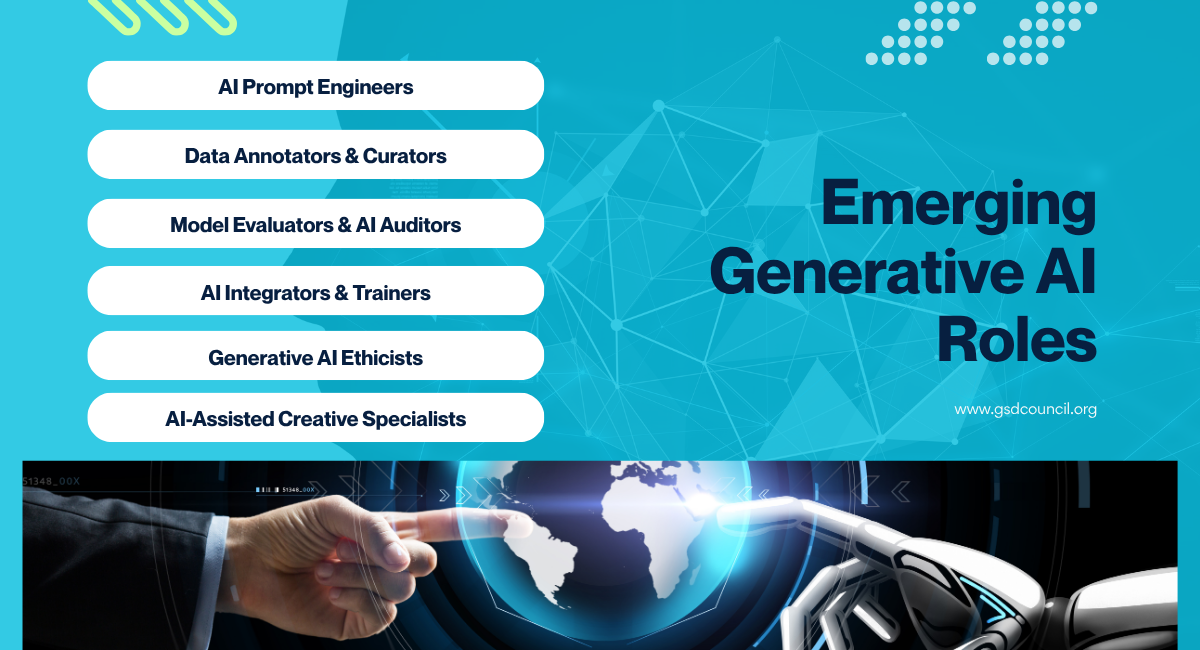
- AI Prompt Engineers – Design and optimize prompts; demand rose 320% in 2024–2025.
- Data Annotators & Curators – Maintain high-quality training datasets; 60% of companies now have dedicated teams.
- Model Evaluators & AI Auditors – Monitor AI outputs for bias, accuracy, and compliance; 75% of AI companies have formal auditing processes.
- AI Integrators & Trainers – Embed AI into workflows; global AI implementation services projected at USD 35 billion in 2025.
- Generative AI Ethicists – Address ethical and legal implications.
- AI-Assisted Creative Specialists – Focus on ideation while AI handles repetitive tasks; Adobe reports 80% of teams using AI improve turnaround times.
Shifting Skill Requirements
High-value skills such as creativity, critical thinking, AI literacy, and cross-functional collaboration are increasingly prioritized over repetitive tasks.
Career Outlook
Is artificial intelligence a good career? Evidence supports that generative AI careers are booming, offering opportunities to work alongside AI, guide outputs responsibly, and create strategic value.
Preparing for the Future: Learning and Upskilling
Proactive learning is essential to staying competitive. Roles requiring AI literacy grew 58% in the past two years, emphasizing the urgent need for upskilling.
Why Upskilling Matters
- Enhanced Employability: Hands-on experience with AI tools and processes makes candidates more competitive in a crowded job market.
- Career Advancement: AI-certified professionals are more likely to secure managerial and strategic roles, bridging technical expertise with business insight.
- Future-Proof Skills: As companies increasingly adopt AI, employees with generative AI knowledge are positioned to influence workflows, innovation, and decision-making.
Certification & Learning Opportunities
Many professionals are now turning to generative AI certification programs focusing on foundational skills, practical applications, and ethical practices. The Generative AI Foundation Certification by GSDC equips learners to apply AI concepts effectively, preparing them for real-world challenges and emerging career opportunities.
Enrolling in a generative AI course or generative AI certification program enables professionals to explore how Generative AI is Changing Creative workflows and business innovation. Certified learners gain expertise to leverage AI responsibly and strategically.
Conclusion: Generative AI Ahead - Shaping Industries, Workforces, and Innovation
The generative AI future promises unprecedented transformation across industries. It is redefining business operations, creative workflows, and workforce interactions. High-value roles are emerging while repetitive tasks are automated, emphasizing continuous learning and skill development.
Understanding what generative AI is is no longer optional-it’s essential for professionals and organizations to remain competitive. By adopting ethical practices, investing in skills, and embracing AI responsibly, companies can harness its full potential, creating meaningful value, empowering employees, and driving sustainable growth.
The future belongs to those who adapt, learn, and innovate with AI as a partner, not just a tool.

Related Certifications
Stay up-to-date with the latest news, trends, and resources in GSDC
If you like this read then make sure to check out our previous blogs: Cracking Onboarding Challenges: Fresher Success Unveiled
Not sure which certification to pursue? Our advisors will help you decide!