Advanced Prompt Engineering: Key Interview Questions & Expert Insights
Written by Matt Johnson
“Generate a market analysis for AI adoption in healthcare-make it concise, data-backed, and formatted for a boardroom presentation.”
When an AI model misses the nuance of such a request, that’s where the real work begins. Prompt engineering is the art of refining language until the Large Language Model (LLM) delivers exactly what’s needed - accurate, contextual, and actionable insights.
As industries accelerate their adoption of generative AI, the ability to design effective prompts is becoming one of the most valuable skills in tech. In fact, experts estimate the prompt engineering market will surpass USD 2 billion by 2030, underscoring the growing demand for professionals who can blend creativity with technical precision.
This guide explores 20 essential prompt engineering interview questions to help you strengthen your expertise, enhance your strategic thinking, and position yourself at the forefront of the AI revolution.
Mastering the Dynamics of Advanced Prompt Engineering
At an expert level, prompt engineering is about controlling model interpretability and predictability. It demands proficiency in tuning model parameters, diagnosing behavioral drift, and designing scalable frameworks that balance creativity, compliance, and computational cost.
Recent studies indicate that over 65% of enterprises face challenges with prompt reliability and model interpretability in generative AI adoption. Additionally, nearly half of large organizations are expected to establish dedicated prompt engineering functions within the next two years to enhance model governance and ensure consistent output accuracy.
A high-performing prompt engineer must be able to:
- Interpret and fine-tune model parameters (temperature, top-k, top-p) for precision versus creativity trade-offs.
- Implement instruction tuning and prompt chaining to embed ethical and organizational context.
- Design modular prompts for reasoning, ensuring coherence across multi-step or cross-domain tasks.
- Apply mitigation strategies to minimize hallucinations and bias propagation in generative outputs.
For professionals seeking to validate this depth of capability, GSDC provides a globally recognized framework that equips experts to architect governed, auditable, and high-accuracy AI systems.
It emphasizes the transition from experimentation to precision-helping organizations build AI models that are scalable, ethical, and enterprise-ready.20 Key Prompt Engineering Interview Questions
Professionals entering AI roles today are expected not only to craft effective prompts but also to understand how models behave under different configurations. This section lists 20 critical prompt engineering interview questions, categorized to assess your technical, analytical, and problem-solving abilities in LLM prompt engineering and generative AI prompts.
A. Advanced Technical Questions (1–5)
1. How do you approach prompt optimization for large language models?
Prompt optimization begins with iterative experimentation-refining, testing, and scoring outputs for relevance, coherence, and factual accuracy. By applying LLM prompt engineering and AI model optimization techniques, engineers can systematically adjust prompt phrasing and structure to guide model behavior toward more consistent, high-quality results. The process often includes leveraging prompt versioning, automated evaluations, and A/B testing frameworks.
2. Explain how temperature and top-k/top-p settings affect AI outputs.
These parameters directly influence creativity and determinism in AI responses. A higher temperature (e.g., 0.8–1.0) produces more varied and creative text, while lower values (e.g., 0.2–0.4) generate precise and deterministic outputs. Meanwhile, top-k and top-p (nucleus sampling) restrict the pool of token choices, allowing engineers to fine-tune the balance between diversity and accuracy-vital in applications like summarization or factual generation.
3. Describe a situation where prompt iteration led to a better result.
For instance, in a customer-support chatbot, early prompts produced overly generic answers. Through structured prompt iteration-reframing instructions, adding examples, and using contextual anchors-the responses became more relevant and empathetic. Iterative prompt refinement remains a cornerstone of prompt engineering best practices, ensuring adaptive alignment between model outputs and user intent.
4. How do you debug a prompt that produces unexpected outputs?
Prompt debugging involves dissecting both the instruction clarity and contextual depth of the input. Engineers analyze token weighting, remove ambiguity, and reframe constraints to eliminate misinterpretation. Common strategies include example-based prompting, using system messages for control, or breaking complex instructions into smaller sub-prompts to isolate the error source and restore predictability.
5. Discuss the trade-offs between prompt length and model accuracy.
Long prompts improve contextual understanding but may overload memory and dilute focus, especially in smaller LLMs. Concise prompts maintain precision and faster inference but risk missing nuanced details. Effective AI prompt engineering finds the balance through context compression, reference chaining, and modular prompt design to maintain both accuracy and computational efficiency.
B. Application & Use Case Questions (6–10)
6. How would you design prompts for AI-assisted content generation?
Effective content-generation prompts must include tone, structure, and purpose. By specifying the desired outcome (“Create an informative yet engaging article on...”), defining target audience, and setting stylistic parameters, prompt engineers ensure outputs are both creative and brand-aligned. This approach also enables scalable automation across multiple domains like marketing, training, or technical writing.
7. Explain prompt design for AI summarization tasks.
Summarization prompts should clarify structure (“Summarize in 3 bullet points”), context (“Highlight key insights from the report”), and tone (“Use formal business language”). Including constraints like word limits or target sections improves coherence and precision. This structured prompting ensures reliable and repeatable summarization results-especially in enterprise applications like financial reports or policy briefs.
8. How do you handle multi-turn conversational prompts?
Handling multi-turn conversations requires maintaining context continuity through variable tracking or conversation state management. Prompt engineers use memory buffers or context-chaining methods to ensure consistent tone and logic across interactions. These techniques are central to LLM prompt engineering for building realistic chatbots, voice assistants, and customer service automation.
9. Describe your approach for integrating prompts into business workflows.
Integrating prompts at scale involves standardizing prompt templates, integrating them with API pipelines, and implementing automated evaluation checkpoints. This workflow-driven approach allows teams to reuse optimized prompts for similar tasks while maintaining consistent quality, compliance, and efficiency-an essential capability for organizations deploying generative AI solutions.
10. How do you ensure prompt outputs align with company guidelines?
Governance mechanisms like instruction tuning, ethical review, and human-in-the-loop validation help align model outputs with corporate policies. Engineers also use prompt compliance frameworks that embed tone, style, and sensitivity filters directly within the prompt. This ensures every generated response maintains ethical, brand-consistent, and regulation-compliant standards.
C. Analytical & Critical Thinking Questions (11–15)
11. How do you measure the performance of a prompt quantitatively?
Prompt performance can be measured using metrics such as output accuracy, user satisfaction scores, and iteration efficiency (prompt-to-result ratio). Quantitative evaluation also includes semantic similarity scoring, BLEU or ROUGE for text overlap, and custom benchmarks tied to business KPIs. Tracking these over time supports continuous prompt optimization.
12. Explain how context and phrasing affect AI responses.
Even slight changes in wording can dramatically alter model interpretation due to probabilistic token prediction. For example, “Explain the benefits of renewable energy” may yield broader results than “List three key economic benefits of renewable energy.” Mastering phrasing is thus a critical prompt engineering technique that defines clarity and precision in AI interactions.
13. How would you adapt prompts for multilingual AI tasks?
When localizing prompts, clarity and cultural neutrality are paramount. Avoid idioms or region-specific phrases that could mislead translation models. Engineers often rely on language-agnostic templates and instruction tuning to ensure that generative AI prompts deliver consistent quality across languages and demographics.
14. How do you prevent bias in AI-generated outputs?
Bias prevention begins at the prompt level through neutral phrasing, diverse input examples, and fairness prompts (“Respond without assuming gender or ethnicity”). Regular bias audits, ethical prompting, and post-processing filters further ensure that AI outputs maintain integrity, fairness, and inclusivity-key requirements in modern AI governance frameworks.
15. Explain a situation where prompt design failed and how you resolved it.
A common failure occurs when prompts are too vague (“Write about AI”) or overloaded (“Explain AI, compare models, and write a conclusion in 100 words”). The fix involves decomposition-breaking tasks into modular, focused prompts-and advanced prompting methods such as role-based instructions (“You are a technical analyst...”) to guide consistent reasoning.
D. Scenario & Problem-Solving Questions (16–20)
16. How would you design a prompt for legal document generation?
Such prompts demand strict factual grounding and domain precision. Engineers create templates with explicit constraints (“Cite legal sources verbatim”) and rule-based validation to ensure compliance. Incorporating context locking and retrieval-augmented generation (RAG) further reduces hallucinations in sensitive applications like contracts or compliance reports.
17. Discuss prompt strategies for generating creative content while minimizing hallucinations.
The balance between creativity and accuracy comes from combining temperature control, evidence-grounded prompting, and chain-of-thought reasoning. By encouraging structured creativity (“Invent a futuristic scenario based on current tech trends, cite at least two facts”), prompts achieve originality without compromising reliability.
18. How do you structure prompts for multi-step reasoning?
Prompts for complex reasoning follow an explicit stepwise logic: “First analyze the data, then summarize insights, and finally recommend solutions.” This aligns with the chain-of-thought prompting technique, which improves model interpretability and reasoning accuracy across analytical and problem-solving tasks.
19. Describe a method to test prompts under different model versions.
Prompt engineers develop prompt performance benchmarks to compare outputs across LLM updates. They use tools for drift detection, quality scoring, and reproducibility checks. This helps ensure that model upgrades don’t degrade prompt reliability-a growing concern as AI systems evolve rapidly.
20. How do you prioritize prompts in a resource-constrained AI project?
In limited-resource scenarios, prioritize prompts based on business impact, task frequency, and optimization difficulty. High-frequency prompts like automated responses or data queries should be optimized first. This structured prioritization reflects effective prompt design strategies in enterprise-scale AI deployment.
Access 30+ additional Q&As, reusable templates, and evaluation checklists in the downloadable Prompt Engineering Interview Toolkit to sharpen your skills and master generative AI prompt design.
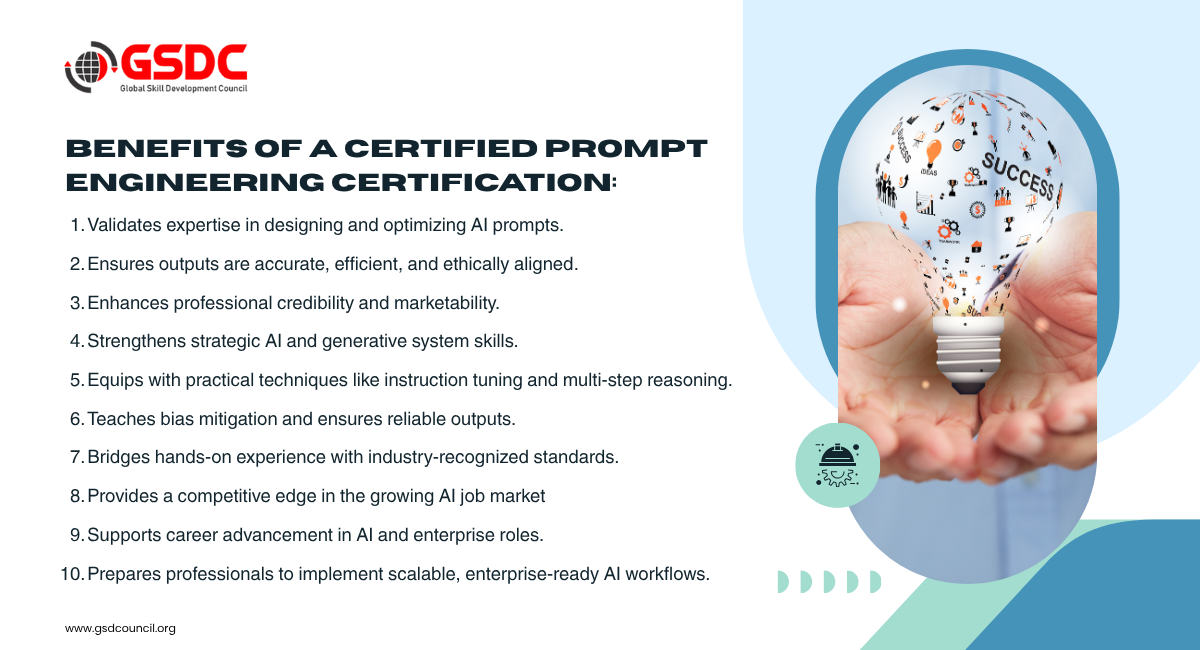
As the complexity of AI systems deepens, success in prompt engineering depends not only on mastering technical methods but also on continuous learning and real-world application. Pursuing a Prompt Engineering Certification from GSDC further strengthens professional credibility-validating your expertise and advancing your career in the evolving AI landscape.Download the checklist for the following benefits:
Tips to Get Ready for Interviews on Prompt Engineering
- Practice by using actual AI models:
Take the same tool like ChatGPT, Claude, or Gemini and figure out how changes in prompt structure affect the response. In this way, you understand the context-response dynamics from the real-time world and AI model optimization.
- Read the model documentation and APIs:
Understand how a change in temperature, top-k, or top-p parameter might make the output creative or accurate. These are the main factors leading to prompt engineering best practices.
- Participate in peer reviews and testing groups:
Work with AI colleagues to create, review, and compare prompts. Peer testing gets you more learning through feedback and shared insights.
- Take part in hackathons and AI challenges:
Participate in generative AI competitions to improve your prompt engineering skills in a constrained environment.
- Create a professional portfolio:
Encompass projects in different areas like content generation, summarization, and reasoning to show your technical and creative skills.
- Start with foundational certification:
Consider starting with a Generative AI Foundation Certification to solidify your understanding of AI models and generative techniques. Then, enhance your expertise through hands-on practice and advanced prompt engineering courses.
Want More Expert-Level Interview Questions?
Access our Prompt Engineering Interview Toolkit, featuring 30+ real-world Q&As, optimization templates, and structured prompt design frameworks.
Perfect for mastering advanced techniques and preparing confidently for your Certified Prompt Engineering Certification interview.GSDC: Advancing Careers Through Prompt Engineering Certification
The Global Skill Development Council (GSDC) is a globally recognized certification body dedicated to empowering professionals through structured programs in AI, governance, and emerging technologies.
Its Certified Prompt Engineering Course focuses on practical mastery over theoretical understanding, emphasizing instruction tuning, prompt design strategies, and AI model optimization. The certification equips professionals to design efficient, ethical, and scalable AI workflows for LLM-based systems and generative AI applications.
Achieving a prompt engineering certification from GSDC enhances your global credibility and validates your ability to implement best prompt engineering practices in real-world scenarios. It serves as both a professional milestone and a career accelerator-ensuring your expertise stands out in the competitive AI ecosystem.

Conclusion
Mastering prompt engineering goes far beyond technical expertise - it demands strategic thinking, continuous experimentation, and structured learning. In today’s fast-evolving AI landscape, professionals who merge creativity with disciplined methodology are driving innovation and setting new standards in AI prompt engineering.
To stay competitive, keep enhancing your prompt engineering techniques, deepen your understanding of AI model optimization, and validate your skills through a recognized prompt engineering certification. This balance of hands-on experience and structured learning ensures lasting success in the world of generative AI.

Related Certifications
Stay up-to-date with the latest news, trends, and resources in GSDC
If you like this read then make sure to check out our previous blogs: Cracking Onboarding Challenges: Fresher Success Unveiled
Not sure which certification to pursue? Our advisors will help you decide!