Agentic AI Jobs in 2026: Careers, In-Demand Skills & Salary Benchmarks

Written by Matthew Hale
- What Is Agentic AI, and How Does It Work?
- Why Agentic AI Careers Are Gaining Momentum
- Top Agentic AI Job Roles You Should Know
- Skills Needed for Agentic AI Careers
- Real Salary Benchmarks: What the Data Actually Shows
- Which Industries Are Hiring for Agentic AI Roles?
- Agentic AI Career Path: How to Get Started
- Should You Get an Agentic AI Certification?
- The Bottom Line
Job platforms have started listing roles like "Agentic AI Engineer," "AI Agent Developer," and "AI Workflow Specialist" alongside more familiar titles like "ML Engineer." That's not scientific proof of a trend by itself, but it lines up with what recruiters and hiring platforms are reporting: agentic AI careers are one of the newer, faster-moving categories in tech hiring right now.
This blog breaks down what these roles actually involve, the skills employers are screening for, what the data says about pay, and how to get started, even if you're switching from a non-technical background.
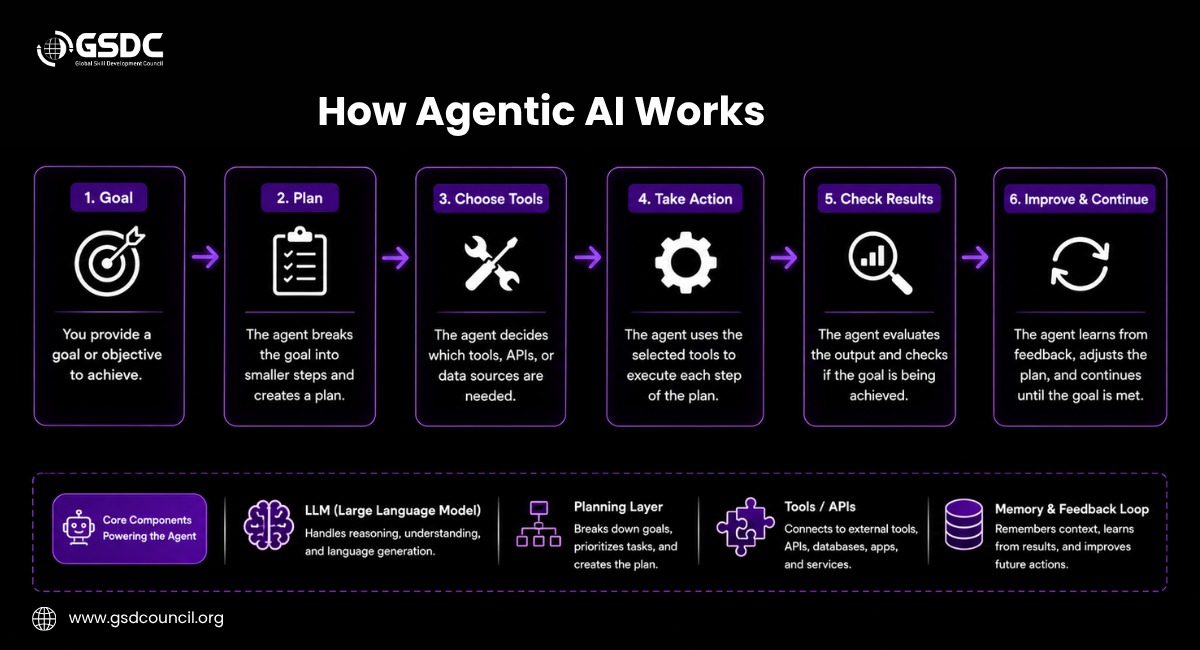
What Is Agentic AI, and How Does It Work?
Before we get into jobs, it helps to understand how agentic AI works in plain terms.
A regular AI tool, like a chatbot, answers one question at a time. It waits for you to ask, then responds. An AI agent works differently. You give it a goal - say, "research three competitor pricing pages and summarize the differences" and it breaks that goal into smaller steps, decides which tools or APIs it needs, executes them one by one, checks its own output, and adjusts if something goes wrong.
So how do AI agents work under the hood? Most agentic systems rely on four moving parts:
- A large language model (LLM) that handles reasoning and language understanding
- A planning layer that breaks a goal into smaller tasks
- Tool or API connections that let the agent take real actions - searching the web, updating a spreadsheet, sending an email
- A memory or feedback loop that lets the agent remember context and improve mid-task
Frameworks like LangGraph, AutoGen, and CrewAI are commonly used to build these systems, stitching reasoning, tools, and memory into one working pipeline. This is exactly what's driving demand for people who understand not just AI models, but how to orchestrate them into working systems.
Why Agentic AI Careers Are Gaining Momentum
Manual, multi-step work that used to need a few people and half a day can now be handled by a supervised AI agent in minutes, and hiring data backs this up. Stanford's 2026 AI Index found that US job postings mentioning "agentic systems" jumped from 151 in 2024 to over 16,500 in 2025, the sharpest skill-demand shift the report tracked.
It's not a US-only trend. The same report shows AI skills claiming a growing share of postings worldwide, led by Singapore (4.7%), with the US at 2.6%. Within India specifically, analysis notes demand is concentrated in hubs like Bengaluru, Noida, and Pune, spreading beyond engineering into product and strategy roles.
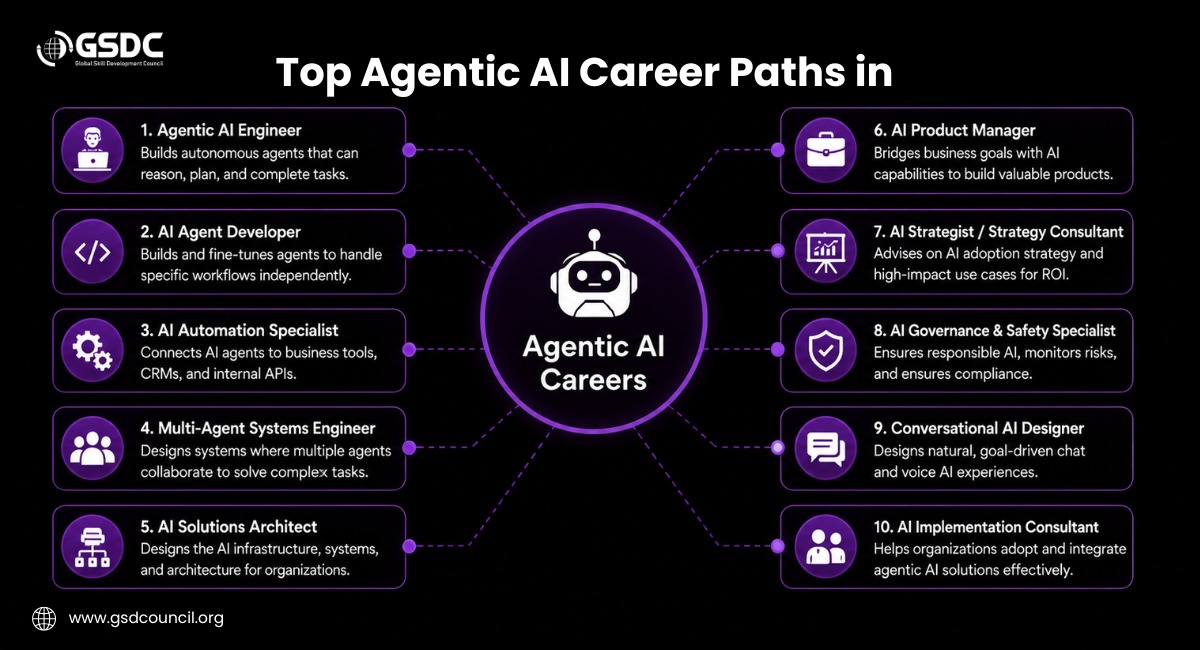
Top Agentic AI Job Roles You Should Know
The list of agentic AI job roles has expanded quickly. Here are the ones showing up most often in job postings today:
Role | What They Actually Do |
Agentic AI Engineer | Builds autonomous agents that can reason, plan, and complete multi-step tasks |
AI Agent Developer | Trains and fine-tunes agents to handle specific workflows independently |
AI Automation Specialist | Connects AI agents to business tools, CRMs, and internal APIs |
Multi-Agent Systems Engineer | Designs setups where several agents collaborate to finish complex jobs |
AI Solutions Architect | Designs the overall AI infrastructure for large organizations |
AI Product Manager | Bridges business goals with what the AI system can realistically deliver |
AI Strategist / Strategy Consultant | Advises leadership on where and how to deploy agentic systems for ROI |
AI Governance & Safety Specialist | Monitors agent behavior and reduces bias, errors, and compliance risk |
Conversational AI Designer | Builds natural, goal-driven chat and voice agents |
AI Implementation Consultant | Helps companies adopt and integrate agentic tools into daily operations |
Roles like AI strategist and AI implementation consultant lean more on process thinking than deep coding, worth keeping in mind if you're weighing an engineering path against a more business-facing one.
One thing that keeps coming up when people ask how to break into these roles: hiring managers can't always tell from a resume whether someone actually understands how agents plan, reason, and execute tasks, or whether they've just used a few AI tools casually. That's where something like the Agentic AI Professional Certification tends to help. It gives you a way to show, on paper, that you've actually worked through the concepts rather than picked them up secondhand, which matters more than usual in a field this new.
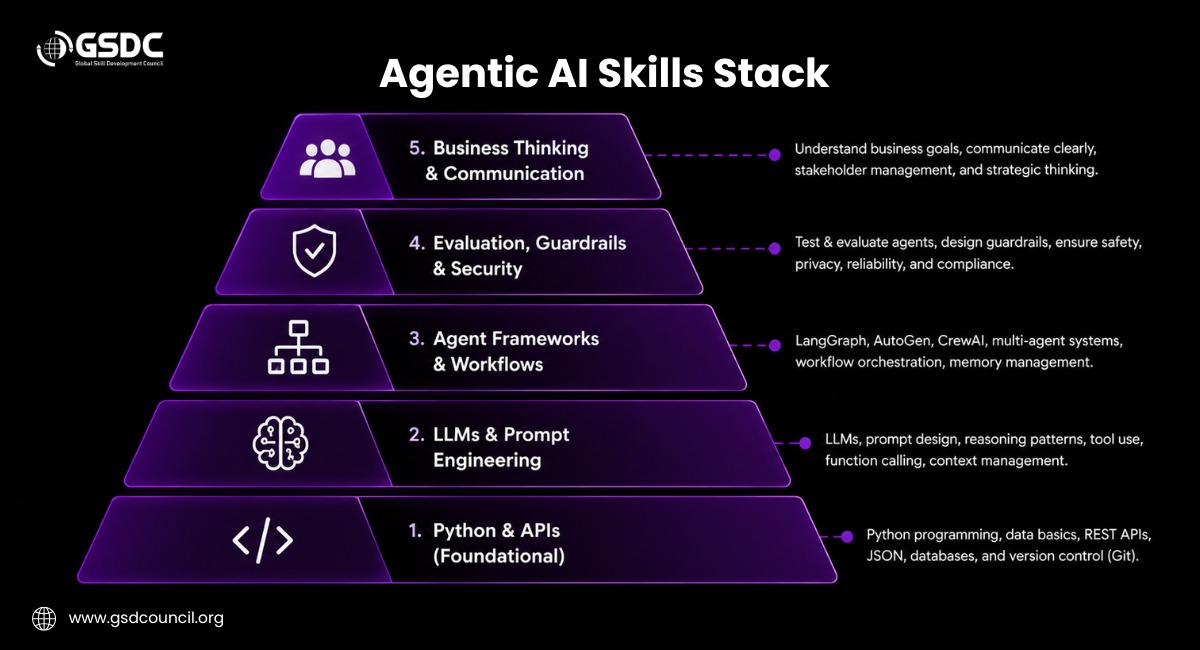
Skills Needed for Agentic AI Careers
Recruiters aren't just scanning résumés for "Python" anymore. The skills needed for an AI engineer role today combine technical depth with the ability to reason about workflows and risk. Here's what actually matters:
1. Programming and framework fluency
Solid Python is still the baseline. Beyond that, familiarity with agent frameworks (LangGraph, AutoGen, CrewAI) and API integration is what separates a candidate who can build a working prototype from one who can only describe the theory.
2. Core AI agent skills 0
This includes prompt engineering, understanding LLM reasoning patterns, and knowing how to design "guardrails" - rules that stop an agent from taking an unsafe or incorrect action mid-task.
3. Workflow and systems thinking
Being able to map a messy, real-world business process into clear steps an agent can follow is one of the most valuable - and least taught - skills in this field right now.
4. Data and system fundamentals
Agents are only as good as the data feeding them. Basic data engineering and system design knowledge help candidates build agents that don't break the moment they hit messy, real-world data.
5. Judgment and risk-awareness
Since agents act with some independence, employers value people who can anticipate failure points - an agent looping endlessly, misreading a task, or acting on outdated information - and design around them.
6. Communication
A large share of agentic AI work involves explaining trade-offs to non-technical stakeholders. If you can't explain why an agent made a decision, you can't be trusted to supervise it.
Not all of this requires a computer science degree. Product managers, business analysts, and operations professionals are increasingly moving into AI strategist or implementation roles by pairing their domain knowledge with a working understanding of these tools. This is also why structured learning paths are gaining ground over pure self-study: something like the Global Skill Development Council's certification programs exist precisely to bridge that gap, giving non-engineers a way to build credible, verifiable skills in this area without needing to go back for a full technical degree.
Real Salary Benchmarks: What the Data Actually Shows
Salary data for a job title this new is still thin, so instead of one headline number, here's a tiered look - from the most reliable government baseline to the newest agentic-specific figures.
Tier 1: Government Baseline
The US Bureau of Labor Statistics puts the median wage for the broader "software developers" occupation at $133,080/year (May 2024, the latest official data), with typical pay running roughly $103,000–$169,000. This doesn't isolate AI or agentic roles - it's the floor the rest of this data sits above.
Tier 2: Employer-Verified Specialist Data
Robert Half's 2026 Salary Guide, built from actual placements plus third-party job posting data, puts the national AI/ML Engineer range at $134,000 (starting) to $193,250 (senior), with a $170,750 midpoint - and projects a 4.4% pay increase for the role in 2026, among the fastest of any tech specialty it tracks. Notably, Robert Half's own guide separately names "Agentic AI engineer/developer" as a newly emerging role to watch, though it hasn't published a distinct salary band for it yet.
Tier 3: Job-Platform Listings for "Agentic AI Engineer"
This is the newest and least stable data. Reported averages range from $134,613 to $192,826, with Glassdoor itself flagging its figure as based on a small self-reported sample.
Source | Reported Average | Range |
$192,826/yr | $152,427–$247,443 | |
$136,810/yr | $94,500–$208,000 | |
$134,613/yr | Limited postings |
Put together, a realistic US band for a specialized AI/ML or agentic engineering role is roughly $134K–$193K, matching Robert Half's employer-verified range - with the higher platform figures likely reflecting senior, equity-inclusive, or big-tech-skewed postings rather than a typical offer.
India
Glassdoor 2026 report gives the following averages:
Job Role | Average Annual Salary (India) | Converted to USD* |
AI Product Manager | ₹28.35L | ~$29,700 |
AI Solutions Architect | ₹25.9L | ~$27,200 |
Machine Learning Engineer | ₹14L | ~$14,700 |
AI Automation Engineer | ₹11.5L | ~$12,100 |
Agentic AI Engineer | ₹6L | ~$6,300 |
Worth flagging: this table compares different job titles at what are likely different seniority levels, not a like-for-like career ladder. It's not safe to conclude "architecture roles pay more than engineering roles" from this alone. Treat it as a snapshot of what different titles are currently paying in India, not a definitive statement about which specialization is more lucrative.
Which Industries Are Hiring for Agentic AI Roles?
Based on IIT Kharagpur's industry analysis, six sectors are leading the hiring wave:
- Technology & SaaS - building and refining AI-native products
- Finance - fraud detection, automated reporting, risk forecasting
- Healthcare - documentation automation and diagnostic support
- E-commerce - customer service agents and personalized recommendations
- Manufacturing - predictive maintenance and quality-check automation
- Enterprise IT - internal process automation and knowledge management
If your current industry falls into one of these, you may not need to switch fields at all - you can often move into an agentic AI role within the company you already work for.
Agentic AI Career Path: How to Get Started
Here's a realistic path, adapted from how the field is currently evolving:
Step 1 - Learn the fundamentals.
Get comfortable with Python, basic machine learning concepts, and how LLMs generate responses.
Step 2 - Build one small, real project.
Not a tutorial clone - something that solves an actual problem, even a tiny one, using an agent framework.
Step 3 - Get hands-on with agent frameworks and APIs.
LangGraph, AutoGen, and CrewAI are good starting points, since most job listings mention at least one of them.
Step 4 - Document everything.
A portfolio that shows your reasoning, error-handling, and results carries more weight than a stack of certificates with no projects behind them.
Step 5 - Keep learning as the tooling shifts.
This space is changing fast enough that staying current matters more here than in most other tech careers.
Should You Get an Agentic AI Certification?
There's no single right answer — it depends on how you learn best.
Self-teaching is free or low-cost, flexible, and works if you're disciplined enough to build and document real projects on your own. A structured program trades that flexibility for a project-based curriculum and a faster, verifiable signal to recruiters — especially useful if you're switching careers and don't have prior AI job titles to point to, or aiming for roles like AI Solutions Architect that also expect some grounding in governance and system design.
Which fits depends on your timeline and how much self-study you can realistically sustain. If you want to see what a structured path looks like, GSDC's Agentic AI Professional Certification track covers the same core skills in this blog.
The Bottom Line
Agentic AI careers are still early enough that there's real room to get in without a decade of AI research experience behind you, but the field is moving fast enough that the entry bar will likely rise. Whether you're an engineer, a product person, or someone in operations looking for your next move, the practical next step is the same: start building something small, rather than waiting for a perfect roadmap.


Related Certifications
Frequently Asked Questions
They design, test, and refine autonomous agents - writing the logic that lets an agent plan tasks, call tools or APIs, and self-correct when something goes wrong, while also building in safety checks.
Early indicators - hiring activity, the spread of new job titles, and reported salary bands - suggest strong momentum, particularly in India's major tech hubs and among US listings. It's still a new enough category that long-term data is limited, so treat it as a promising direction rather than a guaranteed outcome.
Workflow mapping, prompt engineering, basic data literacy, and the ability to evaluate AI output critically. Many AI strategist and implementation consultant roles prioritize business judgment over deep coding skill.
A chatbot responds to one prompt at a time. An AI agent pursues a goal across multiple steps, decides which actions to take, and adjusts its own plan without needing a new prompt for every step.
No. Finance, healthcare, e-commerce, and manufacturing companies are all actively hiring for these roles, often with less competition than at large tech firms.
Stay up-to-date with the latest news, trends, and resources in GSDC
If you like this read then make sure to check out our previous blogs: Cracking Onboarding Challenges: Fresher Success Unveiled
Not sure which certification to pursue? Our advisors will help you decide!