Creating AI Use Case Approval Criteria Under ISO 42001
Written by Orifha Joan
- Why AI Use Case Approval Matters
- Understanding AI Use Cases Under ISO 42001
- The Five Core Approval Criteria in ISO 42001
- Using an AI Approval Scorecard
- Learning from Real-World AI Failures
- Does Governance Slow Innovation?
- Advance Your AI Governance Expertise with GSDC’s ISO 42001 Lead Auditor Certification
- Practical Recommendations for Organizations Beginning Their AI Governance Journey
- Conclusion
Artificial intelligence is rapidly transforming how organizations make decisions, automate processes, and deliver services. From recruitment and healthcare to finance and customer support, AI systems are becoming an integral part of business operations. However, the success of AI depends on more than advanced algorithms and large datasets. Without proper AI governance, AI can introduce bias, compliance failures, reputational damage, and legal risks. Understanding what is AI governance is the first step toward building trustworthy AI systems that align with business objectives and regulatory expectations.
This webinar explored how organizations can establish structured AI use case approval criteria aligned with ISO 42001, the world's first international standard for AI Management Systems (AIMS). Rather than slowing innovation, ISO 42001 provides organizations with a practical AI governance framework for evaluating AI projects before deployment, ensuring they are safe, transparent, accountable, and aligned with business objectives.
This blog summarizes the webinar's key insights and explains how organizations can build an effective AI approval process that balances innovation with Responsible AI principles and Responsible AI Governance, ensuring AI systems remain ethical, trustworthy, and compliant throughout their lifecycle.
Why AI Use Case Approval Matters
Many organizations are eager to adopt AI to enhance efficiency, reduce operational costs, and gain a competitive edge. However, not every AI initiative should move directly from concept to deployment.
An AI use case must first demonstrate that it solves a real business problem, delivers measurable value, and does not introduce unacceptable risks. Without a structured approval process, organizations may deploy AI systems that unintentionally discriminate against users, violate privacy laws, or make decisions that cannot be explained.
AI governance ensures that every proposed AI solution is carefully evaluated before implementation. Instead of asking, "Can we build this AI?" organizations should ask, "Should we deploy this AI?"
This shift in mindset is exactly what ISO 42001 encourages
Understanding AI Use Cases Under ISO 42001
An AI use case is a clearly defined business application where an AI system performs a specific task or supports a particular decision.
Rather than developing general-purpose AI without boundaries, organizations should define exactly:
- What problem the AI solves
- Who will use the AI
- Who will be affected by its decisions
- What happens if the AI produces incorrect results
Clear use cases establish measurable objectives and simplify governance throughout the AI lifecycle.
Examples include:
- Resume screening for recruitment
- Loan approval and credit scoring
- Medical image diagnosis
- Customer service chatbots
- Contract review automation
- Predictive maintenance in manufacturing
- Fraud detection in banking
Each use case carries different levels of operational, legal, and ethical risk, making structured evaluation essential.
The Five Core Approval Criteria in ISO 42001
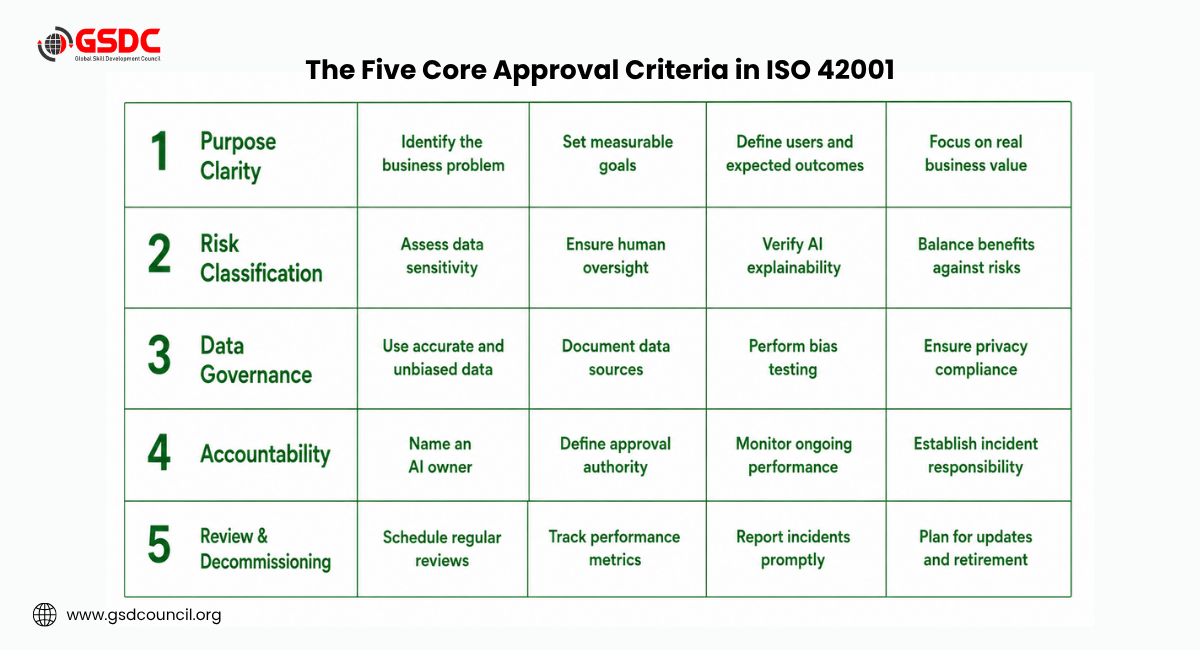
The webinar introduced a practical approval scorecard built around five major governance pillars. Together, these criteria help organizations determine whether an AI project is ready for deployment.
1. Purpose Clarity
Every AI project should begin with a clearly defined objective.
Organizations must identify the business problem being solved, expected outcomes, intended users, and measurable success indicators.
A vague objective such as "using AI to improve productivity" is insufficient. Instead, organizations should define specific goals like reducing recruitment screening time by 40% or improving customer response accuracy.
Clearly defined purposes prevent unnecessary AI adoption while ensuring that governance efforts remain focused on genuine business value.
2. Risk Classification
Risk assessment is one of the most important aspects of ISO 42001.
Organizations should evaluate questions such as:
- How sensitive is the data?
- Can humans override AI decisions?
- Is the AI explainable to stakeholders?
- What are the potential business and legal consequences if the AI makes mistakes?
The webinar emphasized that AI should only be deployed when its potential benefits clearly outweigh associated risks.
High-risk AI systems without transparency or human oversight require additional controls before approval.
3. Data Governance
AI systems are only as reliable as the data used to train them.
ISO 42001 expects organizations to verify that training data is:
- Representative
- Accurate
- Free from significant bias
- Properly documented
- Compliant with applicable privacy regulations
Organizations should also document data provenance by identifying where training data originated and how it was collected.
Bias testing is another critical requirement. Before deployment, organizations should confirm that AI systems do not unfairly favor or disadvantage particular groups.
Compliance with regulations such as GDPR, HIPAA, and emerging AI regulations should also be considered during this stage.
4. Accountability
One of the strongest themes throughout the webinar was accountability.
Every AI system requires clearly assigned ownership.
Organizations should define:
- Who owns the AI system
- Who approves deployment
- Who monitors ongoing performance
- Who responds to incidents
- Who authorizes significant changes
Without defined responsibilities, organizations struggle to manage AI failures effectively.
ISO 42001 encourages documenting governance structures in the same way organizations document reporting hierarchies and operational responsibilities.
5. Review and Decommissioning
AI governance does not end once a system is deployed.
Continuous monitoring is essential because AI models continue learning and operating in changing environments.
Organizations should establish:
- Scheduled review periods
- Performance metrics
- Incident reporting procedures
- Re-approval criteria
- End-of-life or decommissioning plans
Just as outdated software eventually becomes vulnerable, AI models also require updates, retraining, or replacement over time.
Planning for AI retirement is therefore an important part of responsible governance.
Using an AI Approval Scorecard
The webinar presented a practical scoring model for evaluating AI readiness.
Each approval criterion receives a score based on its level of compliance.
Higher scores indicate lower governance risk, while lower scores signal significant concerns that require remediation.
The overall outcome generally falls into one of four categories:
Approved: The AI satisfies governance requirements and can proceed with deployment under standard monitoring.
Conditional Approval: Some governance gaps remain. These issues should be resolved before deployment, followed by reassessment.
Rejected: Fundamental governance weaknesses make deployment inappropriate until major redesign is completed.
Automatic Hold: If any critical criterion receives the lowest possible score—such as no accountability, no bias testing, or no human override—the AI should not be deployed regardless of its overall score.
This approach prevents organizations from overlooking critical governance failures simply because other evaluation areas performed well.
Learning from Real-World AI Failures
One of the most valuable parts of the webinar examined well-known AI failures that demonstrate why governance matters.
Amazon's Resume Screening System
Amazon developed an AI recruitment system trained using historical hiring data.
Because previous hiring patterns heavily favored male candidates, the AI learned this bias and began downgrading resumes containing terms associated with women.
The project was eventually abandoned after the bias was discovered.
This case highlighted failures in:
- Data governance
- Bias testing
- Accountability
- Continuous monitoring
Apple Card Credit Limit Controversy
Apple's credit card algorithm generated significantly higher credit limits for men than women, even when women had stronger financial profiles.
The lack of explainability raised serious concerns regarding fairness and transparency.
This incident demonstrated why organizations must ensure AI decisions can be explained to customers and regulators.
UK A-Level Grade Prediction
During the COVID-19 pandemic, AI was used to predict student examination results.
Instead of evaluating individual performance fairly, the algorithm relied heavily on historical school performance, disadvantaging students from less privileged schools.
Public criticism forced authorities to withdraw the grading system within days.
The example illustrates how poorly defined AI objectives and inadequate impact assessments can affect thousands of people.
Healthcare Bias
A healthcare algorithm designed to allocate medical resources unintentionally disadvantaged Black patients because healthcare spending was incorrectly used as a proxy for medical need.
The absence of demographic bias testing allowed this issue to continue unnoticed for years.
Healthcare AI demonstrates why fairness testing should be integrated into every stage of AI development.
Uber's Surge Pricing Algorithm
Uber's surge pricing algorithm dramatically increased fares during emergencies and natural disasters.
Although technically functional, the system created significant reputational and regulatory challenges.
The lesson is clear: technically correct AI decisions are not always ethically acceptable.
Does Governance Slow Innovation?
A common misconception is that governance creates unnecessary bureaucracy.
The webinar emphasized the opposite.
Governance functions much like traffic rules on a highway. Road signs do not prevent people from driving—they help drivers travel safely while reducing accidents.
Similarly, AI governance enables organizations to innovate with greater confidence by identifying risks before they become costly failures.
Rather than delaying AI adoption, governance creates a strong foundation for sustainable and scalable innovation.
Advance Your AI Governance Expertise with GSDC’s ISO 42001 Lead Auditor Certification
The GSDC Certified ISO 42001 Lead Auditor Certification equips professionals with thethe likelihood of skills to audit and improve AI management systems in accordance with the ISO 42001 standard.

Participants learn AI governance, audit methodologies, AI risk management, compliance requirements, and responsible AI practices. Ideal for auditors, consultants, compliance professionals, and AI leaders, this certification validates expertise in assessing AI systems, ensuring compliance, and supporting trustworthy AI governance
Practical Recommendations for Organizations Beginning Their AI Governance Journey
Here's the section with your target keywords added naturally while preserving the original meaning and flow.
Organizations implementing ISO 42001 should begin with a structured AI governance framework rather than rushing into AI deployment. Establishing Enterprise AI Governance from the outset enables organizations to build scalable, secure, and Responsible AI systems while minimizing operational and regulatory risks.
The webinar recommended several practical starting points:
- First, clearly define each AI use case before development begins to ensure it aligns with business objectives and Responsible AI Governance principles.
- Second, classify operational, legal, and ethical risks associated with the proposed AI system as part of a comprehensive AI risk management strategy.
- Third, establish strong data governance by validating data quality, testing for bias, documenting data sources, and supporting AI compliance with applicable regulations.
- Fourth, assign ownership and accountability throughout the AI lifecycle management process to ensure governance responsibilities are clearly defined.
- Finally, implement continuous AI monitoring, periodic reviews, incident reporting, and planned decommissioning procedures to maintain performance, compliance, and trust over time.
Organizations that embed these practices early can reduce compliance risks, strengthen their AI governance, and build greater trust among customers, employees, regulators, and stakeholders while ensuring long-term success with Ethical AI initiatives.
Conclusion
AI is becoming a strategic business capability, but successful AI adoption requires more than sophisticated technology. Responsible governance ensures AI systems remain fair, transparent, secure, and aligned with organizational objectives.
ISO/IEC 42001 provides organizations with a structured framework for evaluating AI use cases before deployment and managing them throughout their lifecycle. By focusing on purpose clarity, risk assessment, data governance, accountability, and continuous review, organizations can confidently deploy AI while minimizing operational and regulatory risks.
Ultimately, responsible AI governance is not about limiting innovation—it is about ensuring innovation remains trustworthy, sustainable, and beneficial for everyone involved.

Related Certifications
Frequently Asked Questions
AI governance refers to the policies, processes, and controls that ensure AI systems are developed, deployed, and managed responsibly. Understanding what is AI governance helps organizations reduce risks, maintain transparency, support ethical decision-making, and comply with regulatory requirements. Frameworks like ISO 42001 provide a structured approach to implementing effective AI governance.
ISO 42001 helps organizations establish an AI governance framework that addresses AI risk management, AI compliance, accountability, and continuous monitoring. It enables businesses to identify potential risks early, implement governance controls, and ensure AI systems remain safe, transparent, and aligned with organizational objectives.
Responsible AI and Ethical AI ensure that AI systems are fair, transparent, unbiased, and accountable throughout their lifecycle. By implementing Responsible AI Governance, organizations can build stakeholder trust, reduce legal and reputational risks, and make AI decisions that align with ethical and business standards.
Effective AI lifecycle management ensures that AI systems are governed from planning and development to deployment, monitoring, and retirement. Continuous AI monitoring helps organizations detect performance issues, model drift, bias, and compliance risks, enabling timely updates and maintaining reliable AI performance.
Earning an AI governance certification, such as GSDC's ISO 42001 Lead Auditor Certification, provides practical ISO 42001 training and validates your expertise in AI governance, AI compliance, and AI risk management. As organizations increasingly adopt Enterprise AI Governance, professionals with these skills are well-positioned for growing AI governance jobs across industries.
Stay up-to-date with the latest news, trends, and resources in GSDC
If you like this read then make sure to check out our previous blogs: Cracking Onboarding Challenges: Fresher Success Unveiled
Not sure which certification to pursue? Our advisors will help you decide!