Aligning AI Strategy with Business Goals Using ISO 42001
Written by Carlos Durigan
Artificial Intelligence (AI) is transforming industries by enabling organizations to automate tasks, analyze data more efficiently, and enhance decision-making. From improving operational efficiency to revolutionizing AI in learning and development, organizations are increasingly leveraging AI technologies to create smarter, more agile workplaces. However, simply adopting AI tools and systems does not automatically create value for a business. Many organizations invest heavily in AI solutions, including AI-powered learning management systems, but fail to achieve meaningful outcomes because their AI initiatives are not aligned with business objectives.
As AI employees and intelligent automation become more prevalent, businesses must ensure that AI in the workplace supports strategic goals, workforce development, and organizational growth. This is where ISO 42001, the international standard for Artificial Intelligence Management Systems (AIMS), plays an important role. It provides a structured framework to help organizations manage AI responsibly, align AI initiatives with strategic goals, and ensure governance, risk management, and accountability.
The webinar “Aligning AI Strategy with Business Goals Using ISO 42001” highlighted how organizations can move beyond experimental AI adoption and build a well-governed, value-driven AI strategy that supports AI and learning initiatives, enhances employee performance, optimizes learning management system effectiveness, and drives long-term business success.
Understanding Artificial Intelligence and AI Strategy
Artificial Intelligence refers to the capability of computer systems to perform tasks that typically require human intelligence. These tasks include learning from data, recognizing patterns, making decisions, understanding language, and solving complex problems.
AI systems are powered by algorithms, data models, and machine learning techniques that allow them to analyze large amounts of information and produce insights or predictions.
However, AI technology alone does not drive business value. Organizations must develop a clear AI strategy that defines how AI will support business objectives.
An AI strategy is essentially an organizational plan that determines:
- How AI technologies will be used
- What business problems will AI solve
- How AI initiatives will deliver measurable value
- How risks, governance, and compliance will be managed
In a well-structured organization, there is a hierarchy of strategic alignment:
- Corporate Strategy – Defines the organization's mission, vision, and long-term objectives.
- Business Strategy – Defines how the organization will achieve its competitive and operational goals.
- AI Strategy – Specifies how AI will support business objectives.
- AI Technology – The algorithms, models, and systems used to implement the strategy.
This hierarchy ensures that AI initiatives are not isolated experiments but rather strategic enablers of business success.
What is ISO 42001?
ISO 42001 is the first international standard designed specifically for Artificial Intelligence Management Systems (AIMS).
It functions similarly to other well-known ISO standards:
- ISO 27001 for Information Security
- ISO 9001 for Quality Management
- ISO 37301 for Compliance Management
Just as these standards provide structured frameworks for their respective domains, ISO 42001 ensures that AI systems are implemented responsibly, governed effectively, and aligned with business strategy.
The standard emphasizes several key principles:
- Responsible AI usage
- Governance and accountability
- Risk management
- Transparency and ethics
- Continuous monitoring and improvement
Through these principles, ISO 42001 transforms AI from an experimental technology into a controlled strategic capability within organizations.
Artificial Intelligence Management Systems (AIMS)
At the core of ISO 42001 is the concept of an Artificial Intelligence Management System (AIMS).
AIMS provides a structured framework to manage AI initiatives across the organization. It ensures that AI systems are:
- Strategically aligned with business objectives
- Governed through clear policies and procedures
- Monitored for performance and risks
- Continuously improved over time
The AIMS framework typically includes:
- Governance structures
- AI policies and standards
- Risk management processes
- Monitoring and reporting mechanisms
- Continuous improvement cycles
Organizations following AIMS adopt a Plan–Do–Check–Act (PDCA) cycle, ensuring that AI systems are constantly evaluated and improved.
Governance: The Foundation of AI Alignment
Governance plays a crucial role in ensuring AI initiatives support business goals.
ISO 42001 recommends establishing a clear governance structure that defines roles, responsibilities, and decision-making processes related to AI systems.
A typical AI governance structure may include:
- Board and Executive Leadership – Responsible for strategic oversight.
- AI Governance Committee – Ensures AI initiatives align with corporate strategy.
- Risk Management Teams – Monitor AI-related risks.
- Technical Teams – Develop and maintain AI systems.
Governance ensures transparency, accountability, and effective decision-making when implementing AI technologies.
Risk-Based Approach to AI
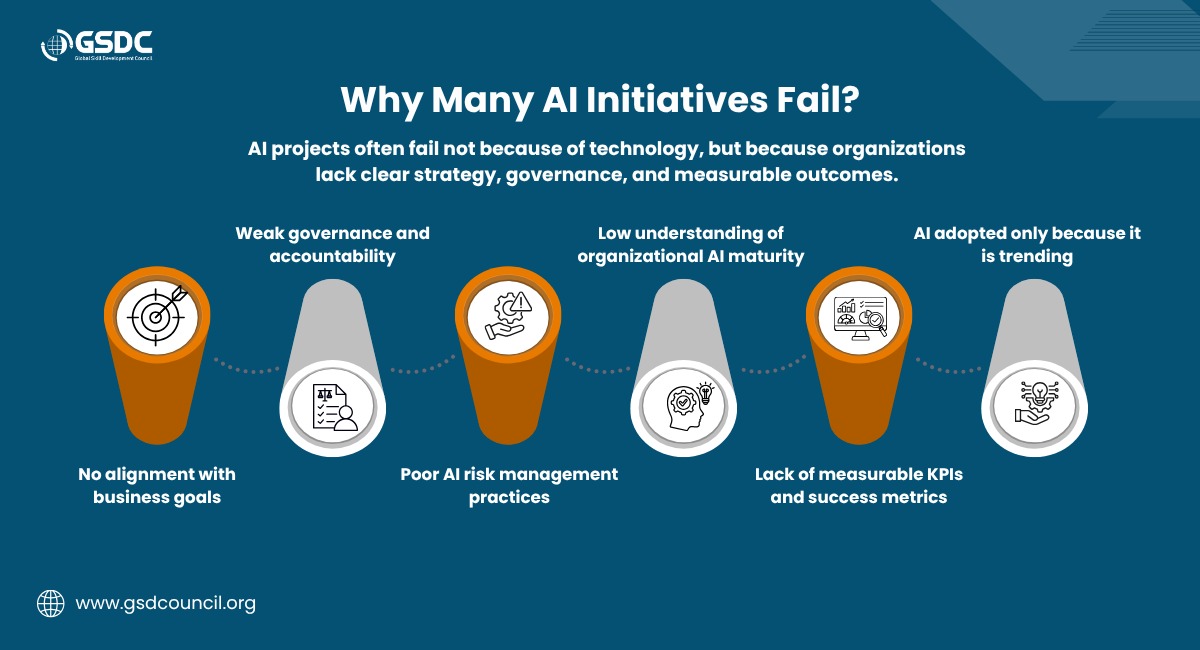
Every new technology introduces risks, and AI is no exception. ISO 42001 encourages organizations to adopt a risk-based approach to AI management.
Risk management ensures that potential negative impacts of AI are identified and addressed early.
Some common AI-related risks include:
- Operational risks
- Ethical risks
- Bias and fairness issues
- Compliance risks
- Reputational risks
- Model failures
Organizations must define risk management frameworks that identify, assess, monitor, and mitigate these risks.
Importantly, risk is not always negative. In many cases, risks also highlight new opportunities and innovation potential.
Measuring Business Value from AI
One of the key principles highlighted in the webinar is that AI must deliver measurable business value.
Organizations must define Key Performance Indicators (KPIs) to measure the success of AI initiatives.
Examples of AI performance indicators include:
- Revenue growth
- Cost reduction
- Automation rate
- Risk reduction
- Improved decision accuracy
- Customer satisfaction
By monitoring these metrics, organizations can evaluate whether AI initiatives are truly contributing to business success.
Example: AI in Fraud Detection
A practical example of AI-business alignment can be seen in the financial industry.
Consider a bank implementing AI for fraud detection.
Business Goal: Reduce fraud losses.
AI Objective: Detect fraudulent transactions faster and more accurately.
Using AI algorithms, the bank can analyze transaction patterns in real time and identify suspicious activities.
ISO 42001 ensures that:
- The AI system operates under proper governance.
- Risks and ethical concerns are managed.
- Performance is continuously monitored.
The result is reduced fraud losses, increased customer trust, and improved financial stability for the organization.
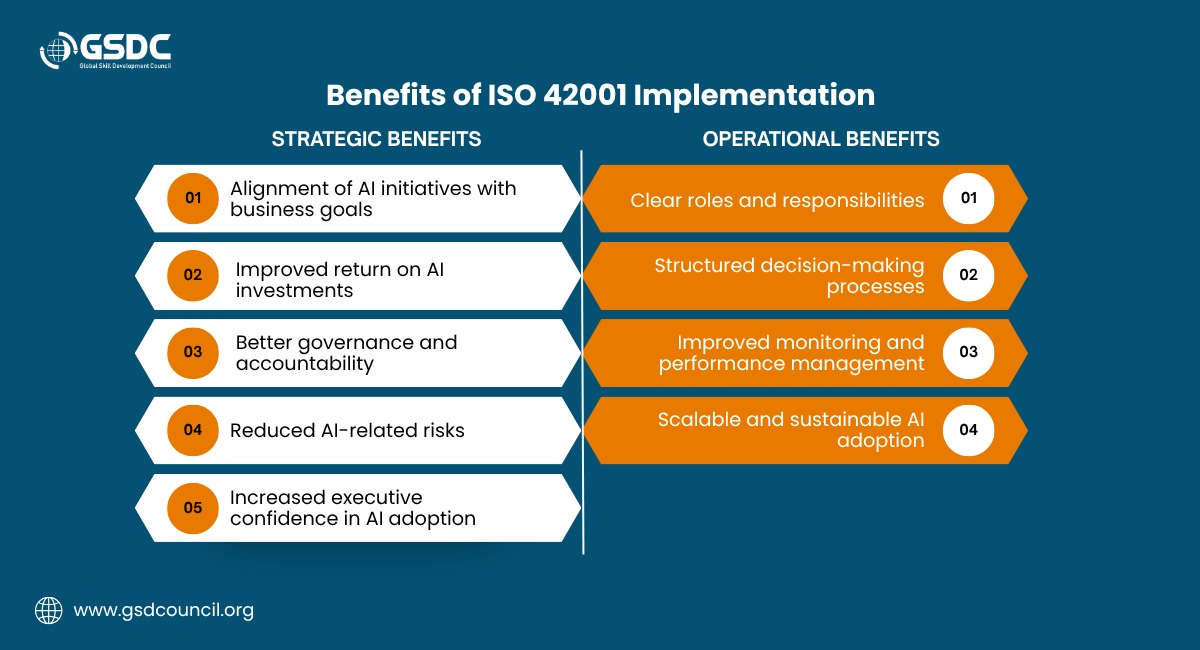
Roadmap for Implementing ISO 42001
Organizations planning to adopt ISO 42001 can follow a structured implementation roadmap.
- Assess AI Maturity – Evaluate existing AI systems, capabilities, and the organization's readiness to leverage AI in training, learning initiatives, and business operations.
- Define Governance Structure – Establish leadership, accountability roles, and oversight mechanisms to ensure responsible AI adoption across functions, including AI in training and development programs.
- Identify Business Alignment Objectives – Determine where AI can create value, enhance productivity, and support strategic initiatives such as AI in corporate training and workforce development.
- Implement Risk Management Framework – Identify, assess, and manage AI-related risks while maintaining compliance, transparency, and trust.
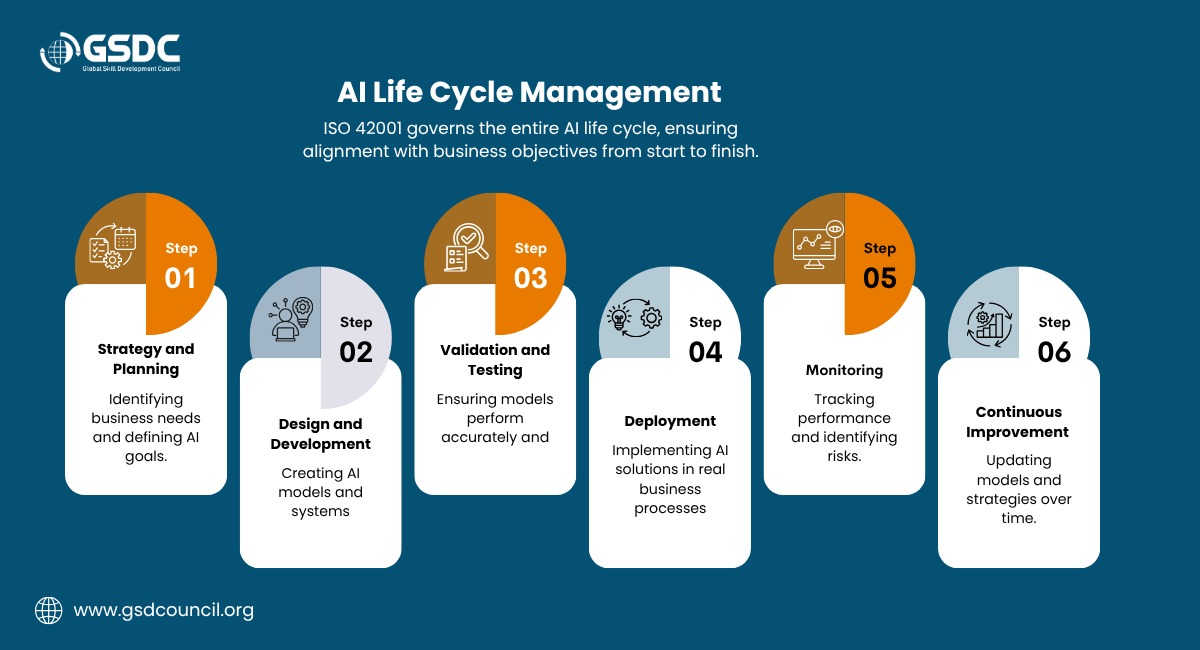
- Establish Life Cycle Controls – Manage AI systems throughout their lifecycle to ensure consistent performance, reliability, and alignment with business goals.
- Monitor and Improve – Continuously evaluate AI performance, optimize outcomes, and support ongoing transformation training efforts that enable employees to adapt to evolving technologies and business needs.
This roadmap ensures that AI adoption remains strategic, controlled, and value-driven.
Advance Your AI Governance Expertise with GSDC’s ISO 42001 Lead Auditor Certification
GSDC’s ISO 42001 Lead Auditor Certification equips professionals with the knowledge and skills required to assess, audit, and improve Artificial Intelligence Management Systems (AIMS) in accordance with ISO 42001 standards.
The ISO 42001 Lead Auditor Certification provides comprehensive training on AI governance, risk management, compliance requirements, ethical AI practices, and audit methodologies. Participants learn how to evaluate AI systems, identify potential risks, ensure regulatory alignment, and promote responsible AI adoption within organizations.
Designed for auditors, compliance professionals, AI leaders, and governance specialists, this certification helps organizations build trust, accountability, and transparency while maximizing the strategic value of AI initiatives.
Key Takeaway
The most important message from the webinar is clear: AI creates value only when aligned with business strategy. Organizations should not adopt AI simply because it is a popular technology. Instead, AI should be implemented with a clear purpose, strong governance, and measurable business outcomes.
This principle is particularly important as organizations increasingly invest in AI training programs, AI in employee training initiatives, and AI personalized learning solutions to enhance workforce capabilities and drive continuous learning. Without proper alignment to business objectives, even the most advanced AI-powered learning initiatives may fail to deliver meaningful results.
ISO 42001 provides the framework to achieve this alignment by ensuring responsible AI adoption, effective risk management, and sustainable value creation. By following this standard, organizations can transform AI from an experimental tool into a strategic capability that supports long-term business success, strengthens employee development, and maximizes the impact of AI-driven learning and training programs.
Subscribe to Our Newsletter
Stay up-to-date with the latest news, trends, and resources in GSDC

Related Certifications
Frequently Asked Questions
Stay up-to-date with the latest news, trends, and resources in GSDC
If you like this read then make sure to check out our previous blogs: Cracking Onboarding Challenges: Fresher Success Unveiled
Not sure which certification to pursue? Our advisors will help you decide!