Reduce Software Costs with Smart Asset Management Strategies

Written by Matthew Hale
- What Is Software Asset Management?
- Why it matters now
- SAM vs. ITAM vs. License Management
- Building a Software Asset Management Program
- What Is a Software Asset Management Tool?
- Software Asset Management Examples in Practice
- What Is the Best Asset Management Software?
- Software Asset Management Metrics That Matter
- Software Asset Management Risks to Address
- Software Asset Management Certification Options and Salary
- Certified Software Asset Manager Salary
- Software Asset Management Requirements for Success
- Using Software Asset Management to Reduce Costs
- Conclusion
Software budgets are climbing. Vendor contracts are multiplying. And for most organizations, a significant portion of what they pay for sits entirely unused.
In fact, studies show that software asset management to reduce costs is becoming critical, as nearly 30–45% of enterprise software spend is wasted due to unused licenses and overlapping tools.
If your company is struggling to answer basic questions - who owns this tool, how many licenses do we actually use, when does this contract renew - you're not alone. This guide breaks down what is software asset management, how it works, and what it takes to build a software asset management program that genuinely moves the needle.
What Is Software Asset Management?
What is software asset management (SAM)? It is a structured approach to managing and optimizing an organization’s software across its entire lifecycle, from procurement and usage to renewal and retirement.
It covers both on-premises and cloud-based tools, helping organizations track usage, control costs, and ensure value from their software investments. A strong software asset management program answers three key questions: what software do we own, how is it used, and are we maximizing its value?
Why it matters now
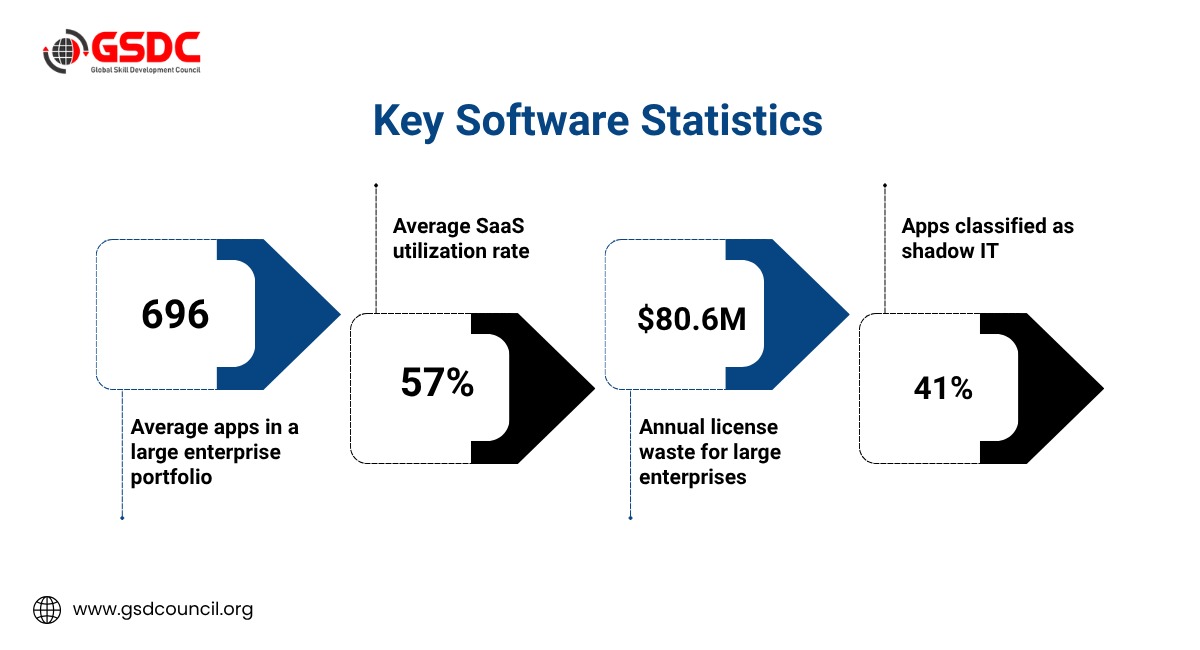
According to the 2026 SaaS Management Index, average enterprise SaaS spending has reached $55M annually, up 8% year over year, while average utilization sits at just 57%. That gap represents enormous, recoverable waste.
SAM vs. ITAM vs. License Management
Aspect | SAM | ITAM | SLM |
Focus | Software lifecycle | All IT assets | Software licenses |
Scope | Usage, cost, compliance | Hardware + software + data | License tracking |
Goal | Optimize software value | Manage all IT assets | Ensure compliance |
Building a Software Asset Management Program
The development of a software asset management program is an ever-evolving process and not an audit that is conducted once. The success of a strategy depends on having a well-defined owner, a workflow and, most importantly, the appropriate technology for managing the changing IT environment. This often involves hiring a certified software asset manager (CSAM).
Core Steps:
Assess your software environment
Find out the total list of software that you use, whether on-site or in SaaS, and look for duplicate applications as well.
Standardize procurement
Establish a procedure that defines how the software is acquired and ensure there is no unauthorized IT system acquisition.
Audit licenses and subscriptions
Check your subscriptions and licenses and identify any unused software licenses.
Centralize the software inventory
Keep a centralized database of your software inventory to prevent duplication.
Continuous software monitoring
Collect actual data on software use to reduce licensing and eliminate unproductive software.
Integration of your SAM toolsets
Leverage other systems, including HR and finance systems to track your software automatically.
Track and optimize regularly
Continuously monitor assets and adjust usage to align with business needs.
What Is a Software Asset Management Tool?
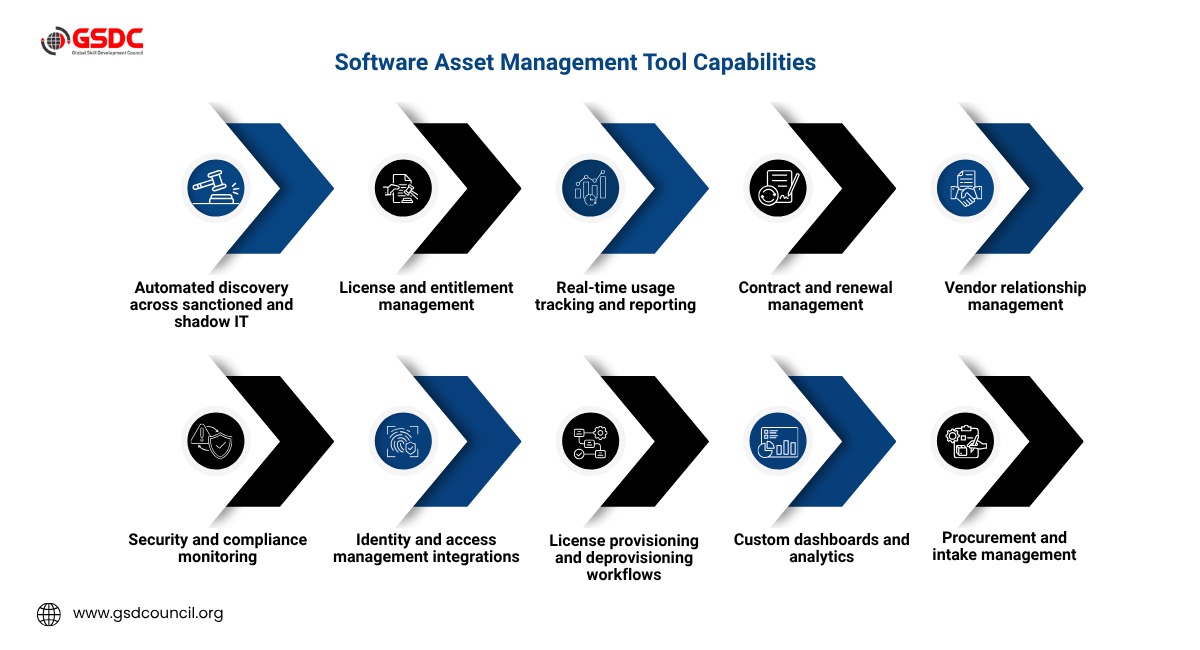
What is a software asset management tool? A software asset management tool is one that automates the process of discovering and managing software assets.
Modern software asset management tools not only help with licensing but do much more to give you total visibility.
Key features that must be included in every software asset management tool include:
Software Asset Management Examples in Practice
Here are a few real-world software asset management examples that show how SAM delivers value:
- A company identifies unused licenses and reclaims them before renewal, saving high costs.
- Multiple teams using similar tools are consolidated into one platform, improving efficiency and negotiation power.
- Security teams detect unmanaged applications, reducing risk and strengthening governance.
As these software asset management examples show, visibility is the foundation of control - because you can’t manage what you don’t see.
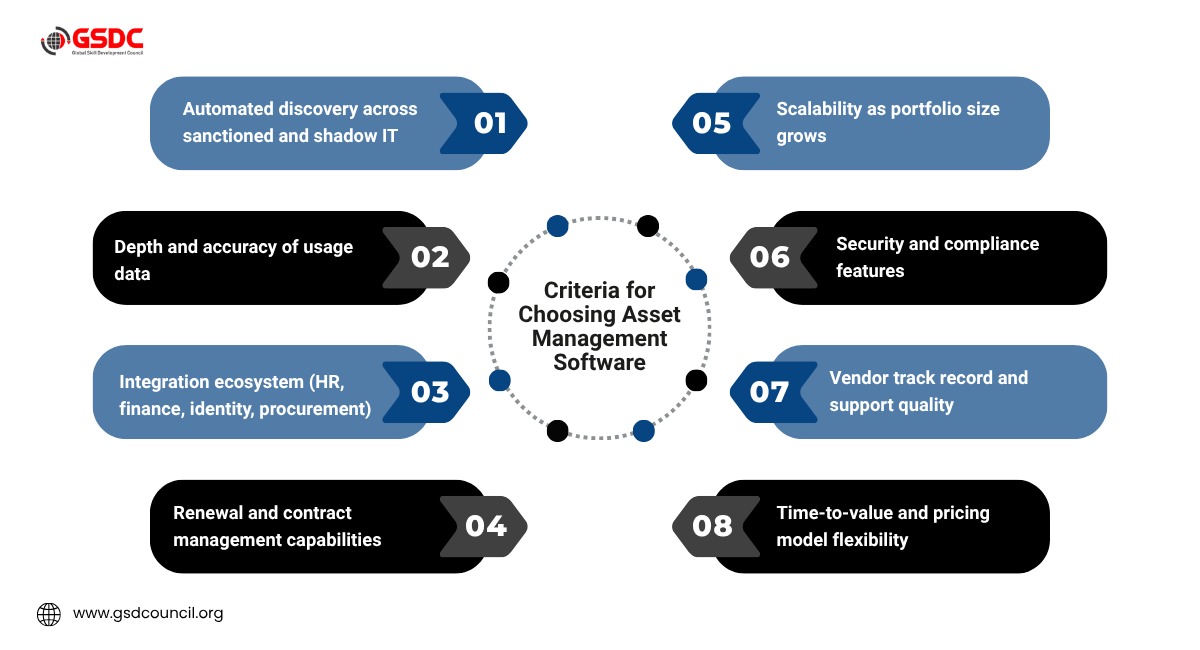
What Is the Best Asset Management Software?
What is the best asset management software? It depends on your organization’s needs.
Traditional SAM tools are ideal for managing complex on-premises licenses, while SaaS management platforms provide better visibility and control for cloud-based tools.
For most organizations, the best approach is a combination using one solution for license compliance and another for SaaS optimization.
Key criteria to evaluate when selecting any platform:
Software Asset Management Metrics That Matter
A SAM program is only as strong as the software asset management metrics it tracks. Without measurement, optimization is guesswork. The most meaningful software asset management metrics span financial performance, compliance health, and operational efficiency. Professionals trained through organizations like the Global Skill Development Council (GSDC) are often equipped to define, track, and optimize these metrics effectively.
License utilization rate
Percentage of purchased licenses actively used. Industry average sits at 57% any score below 70% signals a significant optimization opportunity.
Compliance position
Ratio of licenses owned vs. licenses deployed. Both over-licensing (wasted spend) and under-licensing (audit risk) represent measurable problems.
Renewal preparation lead time
How far in advance are renewals analyzed and acted upon? Best-in-class programs begin review 90–180 days before expiry.
Shadow IT discovery rate
Volume of applications discovered outside official procurement channels. A high rate signals governance gaps that need to be addressed.
Cost avoidance achieved
Dollar value of spend prevented through reclamation, rightsizing, or consolidation. This is the headline ROI metric for most SAM programs.
Security compliance rate
Percentage of applications meeting defined security standards (e.g., SOC 2, SSO coverage). Tracks governance health beyond pure cost metrics.
Software Asset Management Risks to Address
Every organization implementing or scaling a SAM function will encounter predictable software asset management risks. Understanding them in advance is the difference between a program that stalls and one that delivers sustained value. The most common software asset management risks include:
Shadow IT and decentralized purchasing
Business units now drive more than 50% of software purchases at many large enterprises, with IT owning just 15% of total spend. Tools acquired outside official channels bypass security review, create compliance gaps, and generate invisible waste.
SaaS sprawl
Large organizations routinely add 21 or more new applications per month. Without automated discovery, this growth quickly outpaces any team's ability to govern it manually.
Zombie accounts and unused licenses
Former employees, project-specific tools, and abandoned experiments leave dormant licenses accumulating costs. Across large enterprises, this contributes to tens of millions in annual waste.
Duplicate subscriptions
Different teams independently purchasing tools with overlapping functionality is one of the most common and most correctable forms of SaaS waste.
Noncompliance with licensing agreements
Licensing terms vary enormously across vendors, and the complexity is growing. A single unanticipated audit finding can generate penalties that dwarf years of SAM investment.
AI-driven cost unpredictability
Consumption-based pricing for AI tools and copilots is a fast-growing source of unexpected spend. Nearly 78% of IT leaders reported surprise costs tied to AI and usage-based SaaS in 2026 - a new category of risk that legacy SAM processes weren't built to handle.
Software Asset Management Certification Options and Salary
Professionals looking to formalize their expertise have several paths to software asset management certification. The most widely recognized credentials in the field include:
Credential | Issuing Body | Focus Area | Notes |
Certified Software Asset Manager (CSAM) | Industry certification body | Software lifecycle, compliance, governance | Most widely recognized SAM-specific certification |
CITAM (Certified IT Asset Manager) | Industry certification body | Broader ITAM, including hardware | Good complement to CSAM for the full ITAM scope |
ISO/IEC 19770-1 Practitioner | Accredited providers | International SAM standards | Relevant for global organizations |
SAM Fundamentals | Industry alliance | Vendor compliance focus | Useful entry-level credential |
Certified Software Asset Manager Salary
The certified software asset manager salary reflects the growing strategic importance of the role. In the United States, a mid-level software asset management specialist typically earns between $85,000 and $120,000 annually, depending on experience, industry, and geography.
Senior SAM roles and program leads at large enterprises often exceed $130,000–$150,000, and professionals with a certified software asset manager designation and proven cost optimization impact tend to earn at the higher end of this range.
In Europe and the Asia-Pacific region, the certified software asset manager salary varies by country and market conditions, but the certification remains a strong differentiator for career growth.
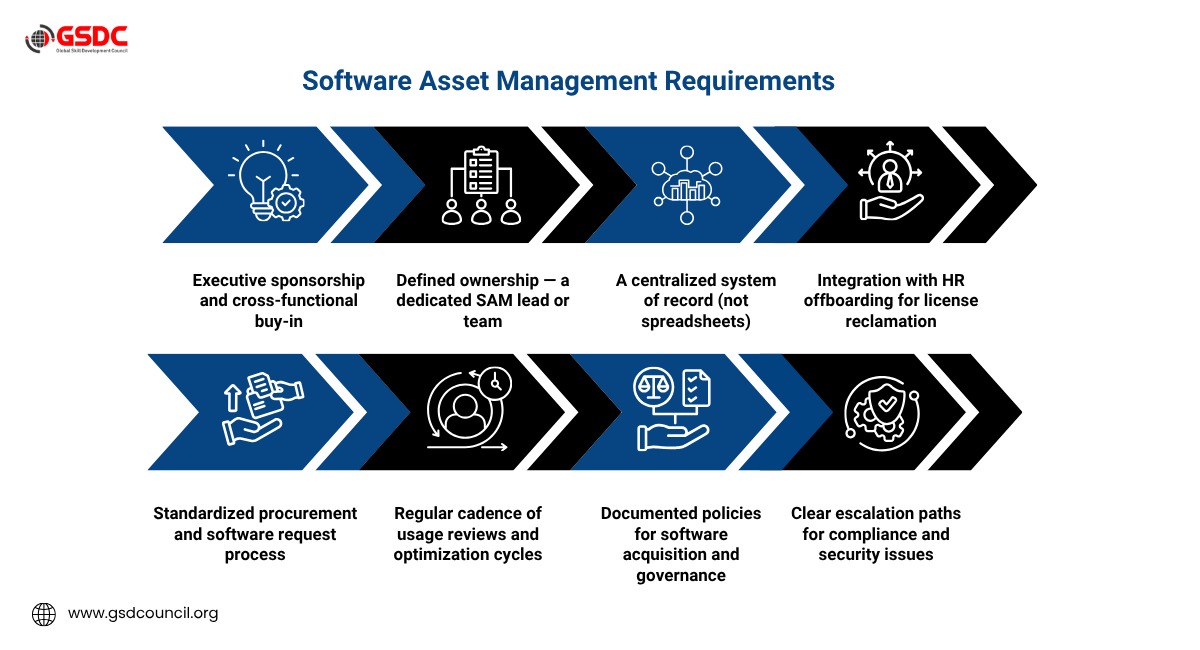
Software Asset Management Requirements for Success
Knowledge of the software asset management requirements before embarking on such a program is important in avoiding failure. Among the requirements that ensure success are the following:
Using Software Asset Management to Reduce Costs
The biggest benefit of SAM is financial. Software asset management to reduce costs is not a one-time effort; it requires continuous optimization.
Organizations achieve this by eliminating unused licenses, consolidating duplicate tools, rightsizing contracts using real usage data, and avoiding audit penalties through proactive compliance.
Real-World Impact
For instance, automatic license reclaiming processes have saved $913,576 and increased utilization to 75.3%. This indicates the practical application of continuous SAM improvement.
SAM professionals who have been trained in the best practices of SAM, like those enrolled in CSAM certification courses by the Global Skill Development Council, can capitalize on such opportunities to achieve consistent savings.
Conclusion
SAM is more than a mere function; it is becoming a strategic tool. With the development of AI, automation, and the complexity of SaaS, organizations that depend on manual methods will lag..
The future of SAM is going to be with those who consider SAM as a process that is constantly driven by technology. The first thing for such organizations will be to invest in software and have people certified in SAM.
By integrating SAM into daily business operations, organizations will save money, improve control and compliance, and get more value from their software assets.

Related Certifications
Frequently Asked Questions
Stay up-to-date with the latest news, trends, and resources in GSDC
If you like this read then make sure to check out our previous blogs: Cracking Onboarding Challenges: Fresher Success Unveiled
Not sure which certification to pursue? Our advisors will help you decide!