10 Common ISO 31000 Risk Register Mistakes to Avoid
Written by Matthew Hale
A risk register is one of the most obvious outcomes of any ISO 31000 risk management process implementation. When created and used properly, such a tool will facilitate consistent risk management, enable effective use of information, and support good governance. A risk register is especially important when using ISO 31000 risk management guidelines and principles.
However, some companies face problems due to the fact that their risk registers are flawed with several mistakes that result in an ineffective ISO 31000 risk management framework. They negatively affect risk identification and assessment processes and lead to poor-quality risks.
The following blog will not only help you learn what ISO 31000 risk management is, but will also show how to avoid making the most ISO 31000 common risk mistakes in implementing the ISO 31000 framework.
What is ISO 31000?
ISO 31000 is an international standard that provides ISO 31000 risk management guidelines for identifying, analyzing, evaluating, and treating risks.
ISO 31000 can be applied to any organization and helps integrate risk management into business processes and decision-making.
The standard is based on three key elements, known as ISO 31000 components:
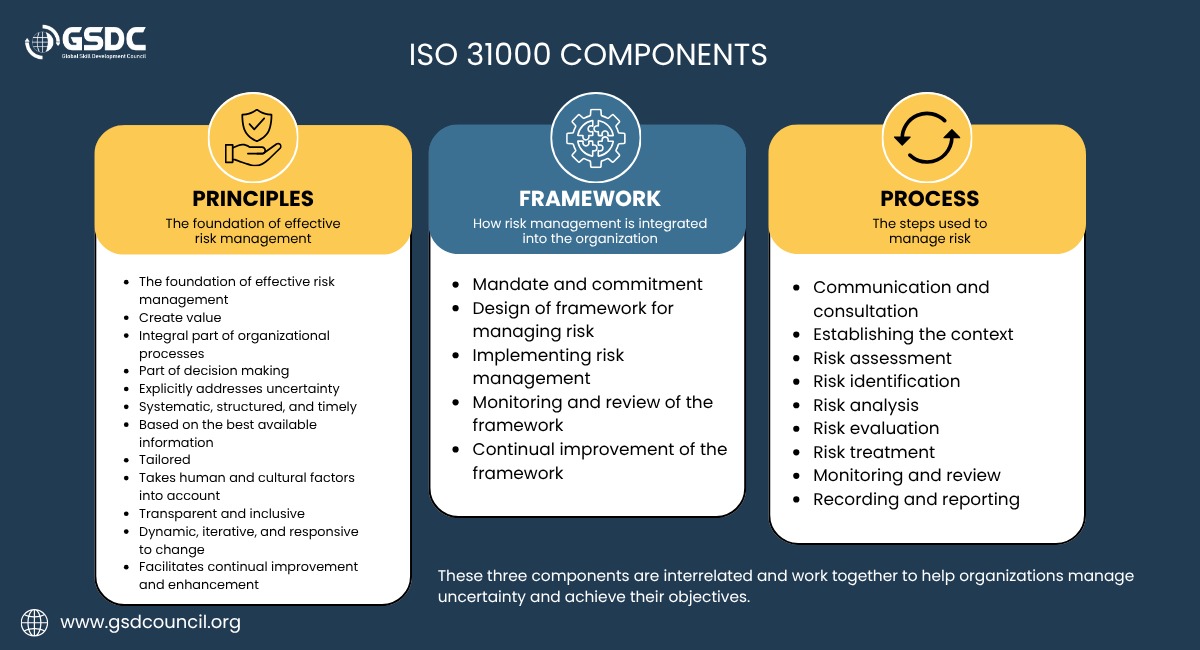
These elements form the ISO 31000 framework:
- ISO 31000 principles provide the foundation
- The ISO 31000 framework ensures integration
- The risk management process defines how risks are managed
Together, they create the ISO 31000 risk management framework and support effective use of the ISO 31000 risk management guidelines.
Professional Development in ISO 31000
Developing a clear understanding of ISO 31000 explained in practice requires both knowledge and application.
Certifications such as the Certified ISO 31000:2018 Risk Manager support professionals in implementing the ISO 31000 risk management framework, applying the ISO 31000 risk management guidelines, and defining appropriate ISO 31000 risk criteria.
Why a Risk Register is Important
A risk register is a structured report used by companies to list all the risks in the company. It is one of the key components of the ISO 31000 standard and is vital for the entire ISO 31000 risk management framework.
Compliant with the ISO 31000 risk management guideline, it enables companies to:
- Maintain risk visibility
- Adhere to ISO 31000 risk management criteria
- Distribute accountability
- Monitor mitigation measures
- Make well-informed decisions
However, mistakes and ineffective risk register management may impair the efficiency of the ISO 31000 risk management framework.
10 Common Risk Register Mistakes in ISO 31000
The risk register is one of the most crucial tools in the ISO 31000 risk management framework. In conjunction with ISO 31000 risk management standards, the use of risk registers helps businesses effectively manage their risks.
Nevertheless, some common mistakes make them ineffective and render the entire ISO 31000 model ineffective.
Common Risk Register Mistakes
1. Treating the Risk Register as a One-Time Document
A common ISO 31000 common risk issue is failing to update the risk register regularly, resulting in outdated risk information.
This reduces the accuracy of risk assessments and weakens ongoing monitoring under the ISO 31000 risk management guidelines.
2. Mixing Up Risk with Issues
Companies tend to record past events rather than look ahead at possible risks.
It makes it difficult for the company to predict uncertainties, which is one of the essential requirements of the ISO 31000 risk management standard.
3. Failing to Define ISO 31000 Risk Criteria
The lack of a clear definition of ISO 31000 risk criteria creates inconsistencies in the risk assessment process.
Various groups may evaluate the risk in different ways, which makes comparison using ISO 31000 standards difficult.
4. Complicating the Risk Register
Adding too many details decreases the usefulness and applicability of the risk register among various groups.
A complicated risk register may be more challenging to maintain when using ISO 31000 standards.
5. Lack of Consistency with the Objectives of the Organization
If the risk register is inconsistent with organizational goals, its usefulness will be minimized.
This inconsistency renders the whole risk management ineffective.
6. Lack of Risk Ownership
The absence of clearly defined ownership leads to a lack of accountability and postpones the process of managing risks.
Risks cannot be managed effectively if there is no ownership, according to ISO 31000 risk management guidelines.
7. Failure to Recognize Interrelated Risks
Risks may be evaluated separately without regard to their collective impact on ISO 31000 risk management principles.
This can lead to an underestimation of overall risk exposure.
8. Lack of Risk Response Strategy
A risk register without any mitigation measures will not be able to aid risk response.
Thus, its use in implementing the ISO 31000 framework is restricted.
9. No Usage in Making Decisions
In some companies, a risk register is kept mainly for documentation and record-keeping purposes only. It does not become a useful tool when making decisions.
10. Overemphasis on ISO 31000 Certification
Overemphasis on obtaining ISO 31000 certification can be a hindrance to the practical use of ISO 31000 risk management standards.
Aspects like ISO 31000 certification cost may be taken into consideration; however, implementation efficiency is key.
Organizations that intend to enhance their ISO 31000 risk management implementation process concentrate on process improvements as well as skill development. Learning programs provided by the Global Skill Development Council (GSDC) will help professionals implement ISO 31000 risk management principles in practice.
Best Practices for Implementing Effective Risk Registers
The above-mentioned problems can be solved through implementing the following practices in light of the ISO 31000 risk management standard and ISO 31000 risk management guidelines:
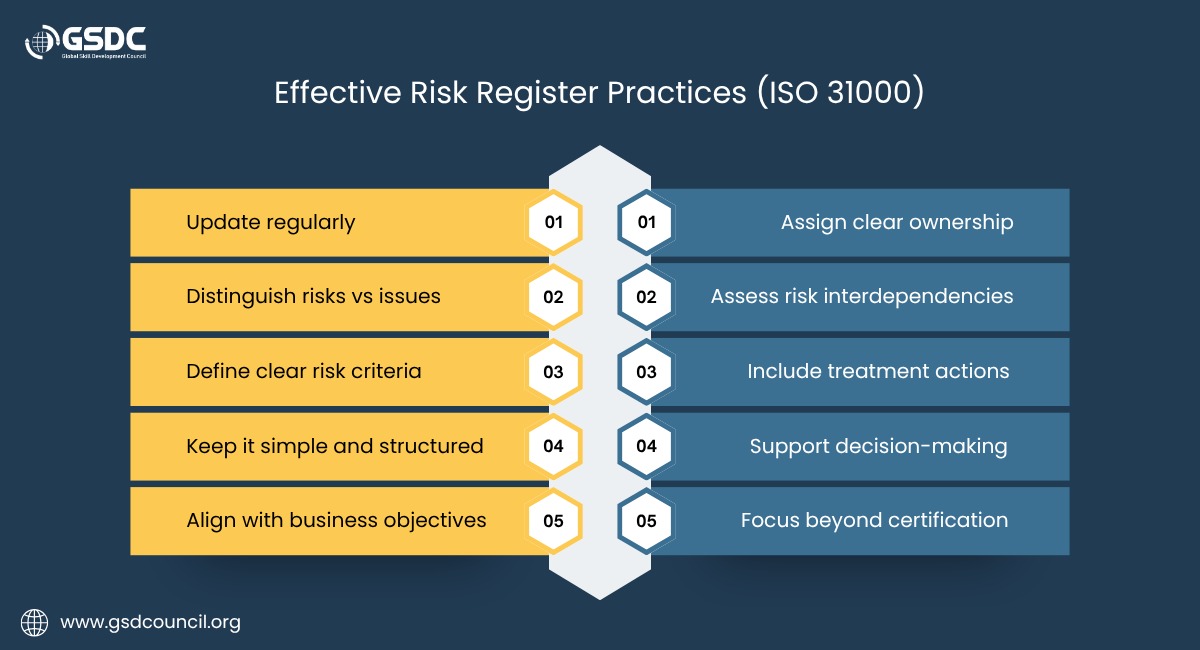
- Keep the risk register updated in light of changing risks
- Clearly distinguish between risks and issues, focusing on future uncertainty
- Establish clear ISO 31000 risk criteria
- Ensure a simple structure of the risk register in accordance with ISO 31000 standards
- Link risks with the organization's goals under ISO 31000 requirements
- Assign clear ownership and accountability for each risk
- Identify and evaluate risk interdependencies
- Include defined risk treatment actions, timelines, and responsibilities
- Use the risk register to support strategic and operational decision-making
- Focus on effective implementation beyond ISO 31000 certification, while considering factors such as ISO 31000 certification cost
A proper risk register plays an important part in the ISO 31000 risk management framework. Through tackling those ISO 31000 common risk problems and using ISO 31000 risk management guidelines, companies can have greater visibility on risks, increase accountability, and facilitate better decision-making.
Through effective use of the ISO 31000 model and with ISO 31000 alignment, risk management can create lasting value rather than mere compliance.
Understanding ISO 31000 Framework and Principles
The ISO 31000 framework helps ensure that risk management is incorporated in organizational processes.
The ISO 31000 principles involve a systematic, tailor-made, and continuous improvement process for risk management. In this regard, the principles, when followed appropriately, improve the quality of risk registers and assist in implementing the ISO 31000 risk management standards.
Enhancing ISO 31000 Risk Management Capabilities
An efficient risk register is dependent on the practical use of the ISO 31000 risk management model and ISO 31000 risk management best practices.
Organizations can enhance their implementation through systematic learning facilitated by entities such as the Global Skill Development Council (GSDC).
ISO 31000:2018 Risk Manager certification can assist individuals in implementing ISO 31000 principles, establishing ISO 31000 risk criteria, and utilizing the ISO 31000 framework effectively.

Conclusion
The risk register is not only a tool but an important part of the ISO 31000 risk management framework. With proper design and maintenance, the risk register will ensure a consistent risk identification and assessment process.
Organizations can minimize the following SO 31000 common risk mistakes to make risk management more effective.
Applying the ISO 31000 risk management guidelines consistently ensures that risk management remains a continuous and value-driven process.
Subscribe to Our Newsletter
Stay up-to-date with the latest news, trends, and resources in GSDC

Related Certifications
Frequently Asked Questions
Stay up-to-date with the latest news, trends, and resources in GSDC
If you like this read then make sure to check out our previous blogs: Cracking Onboarding Challenges: Fresher Success Unveiled
Not sure which certification to pursue? Our advisors will help you decide!