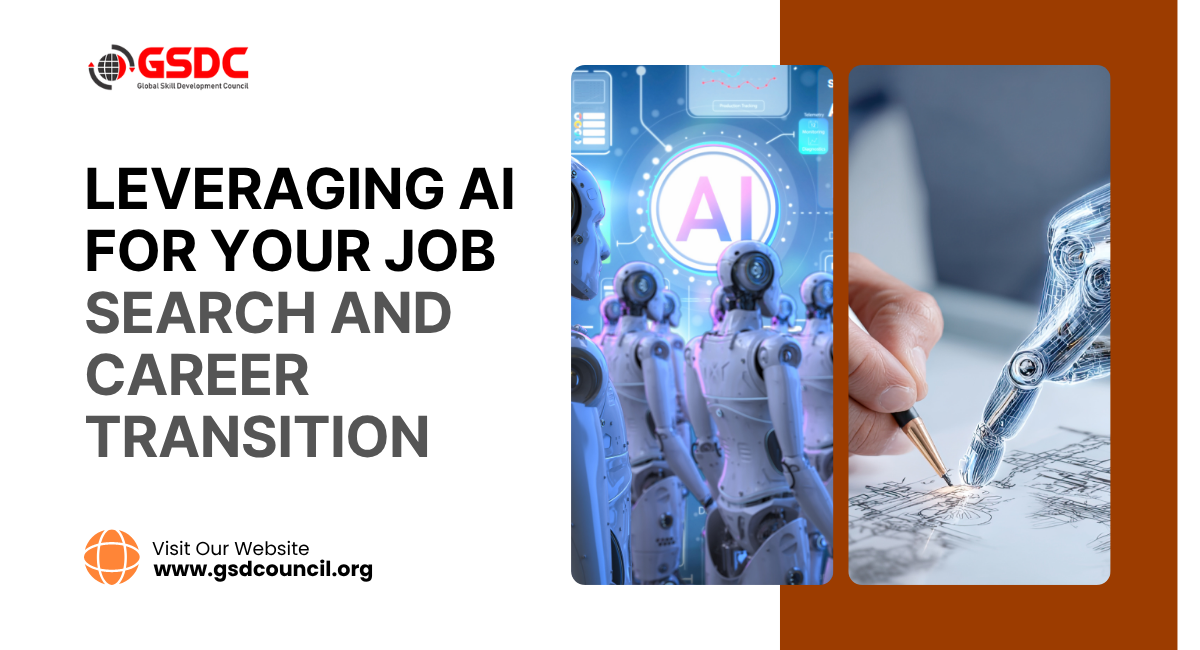
Leveraging AI for your job search and career transition
Written by Matthew Hale
- Why AI matters for job seekers and career changers
- Start with the fundamentals: resume, LinkedIn, and skills mapping
- Use AI job search tools to target better opportunities
- AI interview practice: prepare like the session recommends
- Selecting the best AI tools for job seekers
- Cost and ROI: How much does AI cost for a job search?
- Career transition and how to get a job in AI?
- Final checklist to run a week-long pilot
- Closing thoughts
The article is based on the transcript of one of our current GSDC AI Tool Challenge 2025 sessions.
The speaker took a walk through the real-life examples of how AI is transforming the way people seek employment, switch jobs, and get ready before an interview.
The session was dedicated to the tools and workflows that can be adopted by job seekers and career changers in the near term: resume and LinkedIn optimization, interview preparations, job search platforms, and skills-gap analysis.
The guidelines below are a mapping of those recommendations into action, and a one-week pilot to start.
Why AI matters for job seekers and career changers
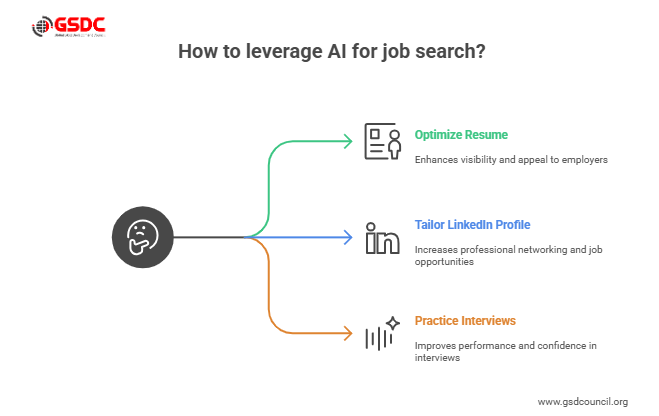
AI in human resources and artificial intelligence in recruitment are reshaping hiring from both sides.
Employers use automation to screen and route candidates, while job seekers can use job search AI to optimize visibility, tailor applications, and practice interviews.
The difference between a scattershot campaign and a focused, measurable job search often comes down to adopting the right AI job search tools and job search platforms.
- Employers increasingly rely on artificial intelligence in recruitment to shortlist candidates and prioritize outreach.
- Candidates who adopt AI job search tools get faster, more polished outputs of resumes, cover letters, and tailored LinkedIn profiles.
- The session recommended beginning with one measurable change: a single optimized resume, plus one tailored LinkedIn summary, used across job search AI flows.
Start with the fundamentals: resume, LinkedIn, and skills mapping
Optimizing core assets is the fastest way to improve outcomes from AI tools for job seekers.
Action checklist
- Run an AI resume review to score clarity, keywords, and role fit so the resume aligns with what applicant-tracking systems and hiring teams see.
- Generate a role-specific LinkedIn headline and a concise summary with an AI draft, then personalize tone and specifics.
- Perform a skills-gap analysis to map current experience to target roles and for those targeting AI governance, following a structured ai compliance roadmap ensures the 2–3 high-impact skills you acquire are precisely those employers screen for in AI compliance officer job descriptions.
When documents and profiles match job descriptions, job search platforms and AI job search tools surface higher-quality matches and produce better results.
Use AI job search tools to target better opportunities
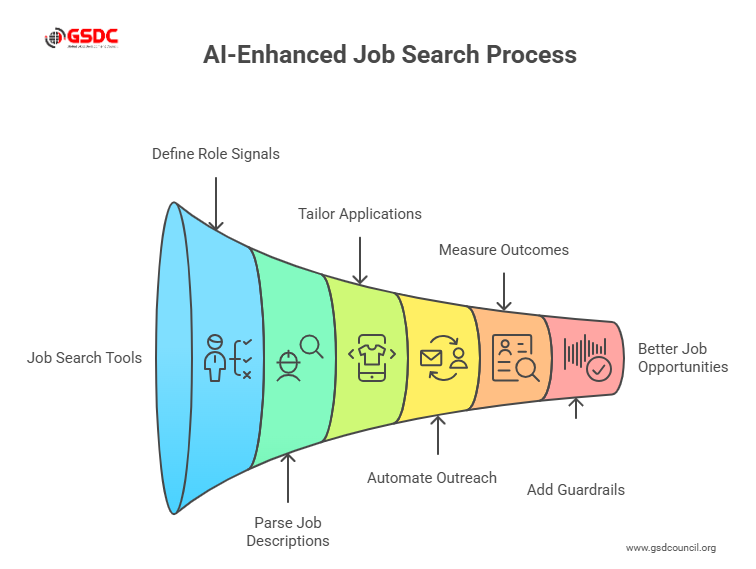
Treat job search platforms and job search AI as intelligent filters and prioritizers, not just alert systems. The session emphasized configuring tools carefully and measuring outcomes.
- Set precise role signals. Define titles, seniority, locations (or remote), required keywords, and company size. Clean inputs yield better match rankings from AI job search tools.
- Parse and score job descriptions. Use AI job search tools to extract must-have versus nice-to-have skills and to score postings against the profile. This helps separate high-fit roles from noise.
- Auto-tailor application artifacts. Link a tailored resume and brief profiles so AI can produce role-specific cover letters and LinkedIn snippets. That saves time while keeping each application relevant.
- Automate outreach responsibly. Use templates for initial messages, but maintain one human-reviewed template for priority roles. A/B test subject lines and openings.
- Leverage platform integrations. Choose job search platforms that centralize feeds, integrate with calendars, and connect to document storage to reduce manual work.
- Measure fit and outcomes. Track metrics such as jobs surfaced, applications submitted, responses received, interviews scheduled, and time spent per application. These KPIs turn anecdote into data.
- Add guardrails. Always review AI-generated content for accuracy and tone. For sensitive roles, add a final human review before submitting.
Used this way, AI job search tools and job search platforms create fewer, better applications and deliver more interviews.
AI interview practice: prepare like the session recommends
Interview readiness was a priority. The speaker recommended mixing automated practice with human feedback to refine delivery and substance.
Practical routine for AI interview practice
- Use AI interview tools to run mock interviews that simulate common, technical, and role-specific questions. Record responses and score them against a rubric.
- Have job search AI generate targeted answers for behavioral and technical prompts; then adapt those answers to personal stories.
- Pair AI feedback with one or two human rehearsals, mentor or peer, to polish delivery, tone, and presence.
- Iterate on weak areas highlighted by the tools and re-run mock sessions until answers are concise, structured, and evidence-based.
AI interview practice fast-tracks readiness by surfacing common pitfalls and creating repeatable, improvable responses.
Selecting the best AI tools for job seekers
Not every tool fits every search. Choose tools that integrate, produce measurable outputs, and save time.
Selection criteria
- Integration with job search platforms and ATS.
- Ability to produce role-specific outputs: resume, cover letter, LinkedIn snippets.
- Analytics that measure time saved, interview rate, and application quality.
- Affordability and easy onboarding for rapid piloting.
Focus on three tool types: AI job search tools that rank opportunities, AI interview tools for mock interviews, and document-generation tools that create tailored materials. Together, they form the core of the best AI tools for job seekers.
Cost and ROI: How much does AI cost for a job search?
Cost is best viewed as a trade-off between subscription/usage fees and hours saved. The session suggested a pilot-based ROI calculation.
Quick budgeting approach
- Trial a single tool for 2–4 weeks and measure hours saved on resume editing and application tailoring.
- Compare subscription cost to the hourly value of time saved and to the value of one interview.
- If the tool materially increases interview frequency, the investment typically pays off quickly.
Answering “how much does AI cost” becomes a practical ROI question: hours saved and interviews gained versus direct tool cost.
Career transition and how to get a job in AI?
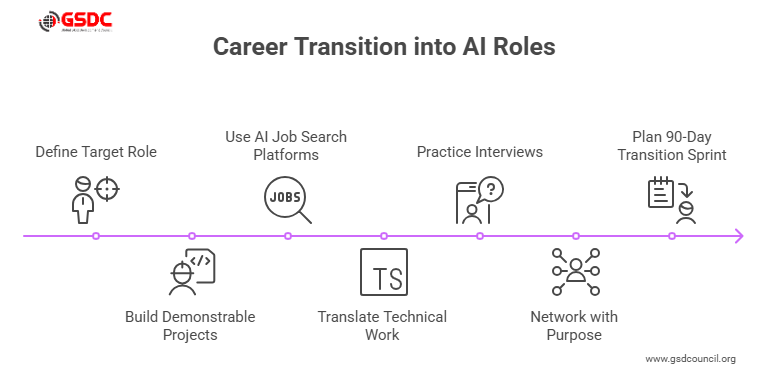
For people pivoting into AI roles, the session outlined a practical, project-driven pathway that combines portfolio work with smart job search AI.
- Define the target role and map transferable skills. Break the role into technical, analytical, product, and domain skills. Use a skills-gap analysis to list 3–5 upskilling priorities.
- Build demonstrable projects. Develop two to three projects that show applied ability, automation workflows, mini models, data pipelines, or a product case study, and host them on GitHub or a portfolio site. Recruiters value impact over AI tool Expert Certification.
- Use AI job search platforms to find pathways. Search for adjacent roles, such as product analyst or automation specialist, that lead to hands-on AI positions. Job search AI can surface stepping-stone positions and required skills.
- Translate technical work into business impact. Use AI to rewrite technical project descriptions into concise, business-focused impact statements for resumes and LinkedIn.
- Practice interviews with AI interview tools. Run mock technical, case, and behavioral interviews, then iterate on answers. Pair AI feedback with human review.
- Network with purpose. Use mentor matchups and informational interviews. AI can draft outreach, but messages must be personalized to convert into conversations.
- Plan a 90-day transition sprint. Learn, build, and apply in focused sprints. Use job search AI to automate sourcing and free time for projects.
This approach answers “How to get a job in AI” with a clear, repeatable formula: targeted projects, strategic applications via AI job search tools, and disciplined interview preparation.
Small business note: best AI tools for small business
Small teams should favor lightweight, integrated tools that improve hiring without heavy overhead.
Practical choices
- Pick affordable AI interview tools for structured mock interviews.
- Use job search platforms that offer applicant screening templates and mentor matchups.
- Choose document-generation tools that produce job descriptions, outreach templates, and onboarding checklists.
These best AI tools for small businesses that help streamline hiring while improving candidate fit.
Final checklist to run a week-long pilot
A focused one-week pilot proves concepts fast. Run this checklist precisely and measure outcomes.
Preparation (Day 0)
- Pick one target role and one job search platform. Prepare one base resume, one LinkedIn summary, and a list of 10 target roles.
Day 1: Optimize assets
- Run an AI resume review and implement 3–5 high-impact edits.
- Use AI to draft a role-specific LinkedIn headline and a two-line summary. Save versions for A/B testing.
Day 2: Configure job search AI
- Feed preferences, resume, and filters into an AI job search tool. Enable parsing for role-fit scoring and set alerts for high-fit roles.
- Create a standard cover letter template and a higher-touch template for top targets.
Day 3: Apply and automate
- Apply to 5–8 high-fit roles using tailored AI-generated materials. Log time per application and manual edits required.
- Queue a second set of roles for automation.
Day 4: Interview prep and outreach
- For any responses, run AI interview practice sessions and refine answers using AI interview tools. Send follow-ups where appropriate.
Day 5: Measure and refine
- Collect metrics: applications sent, responses, interviews scheduled, and time per application. Tweak prompts or filters based on results.
Day 6: Expand or narrow
- If signals are positive, scale to more roles. If not, refine titles, tighten filters, or switch platforms.
Day 7: Decide next steps
- Calculate ROI and create a 30–60–90 day plan: scale, pivot, or refine.
Sample prompts
- “Rewrite this resume bullet to highlight impact for [ROLE], focusing on [SKILL]. Keep it one line.”
- “Extract required skills from this job description and rank them by importance.”
- “Give five behavioral questions for [ROLE] and a STAR-structured answer outline.”

Closing thoughts
The human resources AI and artificial intelligence in the recruitment industry are transforming the way jobs are sought and filled.
AI job search tools, job search AI, and AI interview tools are effective levers of career transitions with specific objectives, measurement, and human oversight.
With the integration of streamlined resources, specialized search engines, and practice in interviewing, candidates can pass through the application process to offer quickly and with increased confidence than before.
In case it is necessary to transform a certain use case resume template along with immediate formulae or a script to practice an interview, mark the very one, and a corresponding implementation will be made.

Related Certifications
Stay up-to-date with the latest news, trends, and resources in GSDC
If you like this read then make sure to check out our previous blogs: Cracking Onboarding Challenges: Fresher Success Unveiled
Not sure which certification to pursue? Our advisors will help you decide!