AI Consultant Salary: Average Pay, Roles, and Career Growth

Written by Emily Hilton
- What Is an AI Consultant?
- AI Consultant Salary: Average Pay in India
- What Factors Affect AI Consultant Average Pay?
- AI Implementation Consultant Salary
- AI Engineer Consultant Salary
- How to Become an AI Consultant?
- AI Consultant Career Growth
- Build Your Skills With an AI Consultant Certification
- Conclusion
Artificial intelligence is moving from experimental projects to everyday business operations. Companies are using AI to automate processes, improve customer experiences, analyze data, build intelligent products, and make faster decisions. But adopting AI successfully is not simply about buying an AI tool or hiring an AI engineer.
Organizations also need professionals who can understand business problems, identify useful AI opportunities, select the right solutions, and guide implementation. That is where an AI Consultant comes in.
As demand for AI-driven transformation grows, many professionals are asking about AI consultant salary, career opportunities, responsibilities, and the skills needed to enter the field.
So, what can you expect from an AI consulting career? Let's explore the role, salary potential, career growth, and how to become an AI consultant.
What Is an AI Consultant?
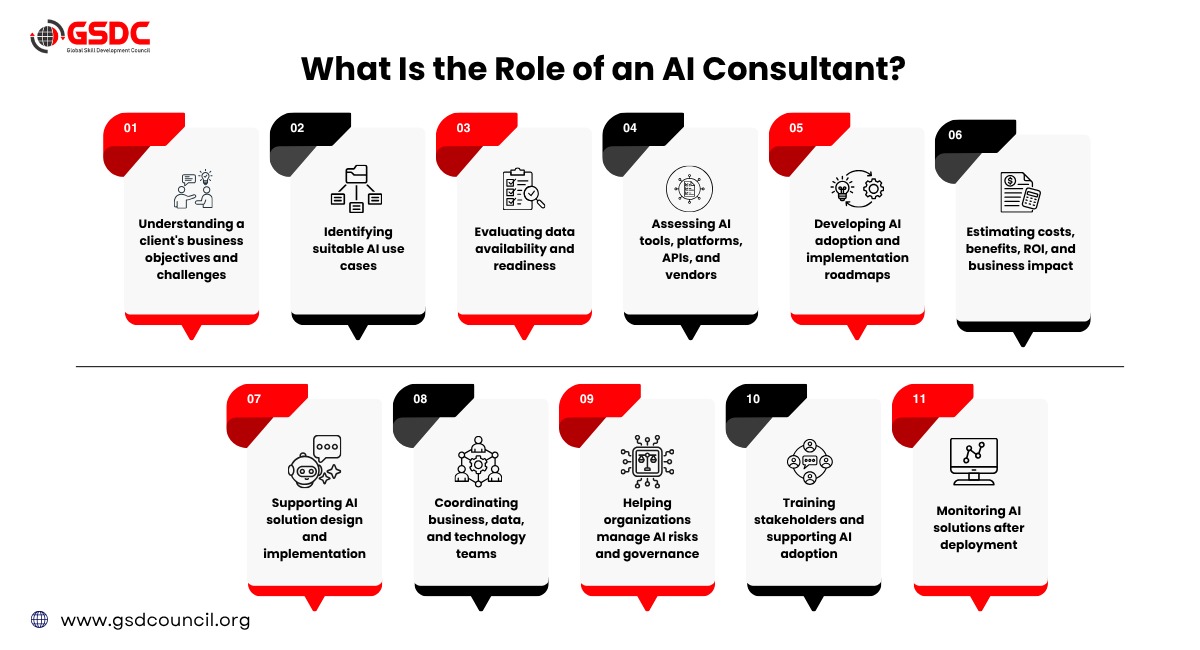
An AI consultant helps organizations understand where and how artificial intelligence can create measurable business value.
Instead of focusing only on developing AI models, consultants connect business requirements with AI capabilities. They may analyze existing processes, identify automation opportunities, evaluate AI tools, recommend solutions, develop implementation roadmaps, and work with technical teams during deployment.
For example, a consultant working with a customer-service company might identify opportunities for AI-powered chatbots, knowledge assistants, automated ticket classification, or customer sentiment analysis.
The role can therefore sit between business strategy, technology, and implementation.
The World Economic Forum's Future of Jobs Report 2025 lists AI and machine learning specialists among the fastest-growing roles through 2030, while AI and big data are identified as the fastest-growing skills.
AI Consultant Salary: Average Pay in India
One of the biggest attractions of this career is its earning potential.
According to Glassdoor's India salary data, AI consultants have an average base pay of around ₹14 lakh per year, with additional pay averaging around ₹4 lakh. Another Glassdoor salary dataset reports an average of about ₹17 lakh per year, showing how much salary estimates can vary by sample, experience, location, and methodology.
AmbitionBox's 2025 data for Artificial Intelligence Consultants shows a broader annual salary range of approximately ₹4.4 lakh to ₹50 lakh, based on reported salaries across experience levels.
So, if you're wondering what is an AI consultant salary, there isn't one fixed number. A practical way to look at compensation is:
Experience level | Indicative annual salary in India |
Entry-level / early career | ₹4–10 lakh |
Mid-level | ₹10–20 lakh |
Senior consultant | ₹18–30+ lakh |
Specialized / leadership roles | ₹30 lakh+ |
These figures are indicative rather than guaranteed salary bands. Actual compensation can vary significantly based on company, location, domain expertise, technical depth, consulting experience, and the complexity of projects handled.
What Factors Affect AI Consultant Average Pay?
Your AI consultant average pay can be influenced by several factors.
1. Experience
Experience is one of the strongest salary drivers. Professionals with experience in consulting, data science, software engineering, business analysis, product management, or digital transformation may have an advantage.
2. Technical Skills
Understanding machine learning, generative AI, large language models, APIs, cloud platforms, data pipelines, RAG, automation, and AI agents can increase your value particularly when you can translate these technologies into business outcomes.
3. Business and Industry Knowledge
An AI consultant who understands a specific industry can be particularly valuable. Finance, healthcare, manufacturing, retail, cybersecurity, logistics, and marketing all have different AI opportunities, risks, regulations, and workflows.
4. Location
Technology hubs and major consulting markets can offer higher compensation, although remote work has expanded opportunities beyond traditional locations.
5. Consulting and Communication Skills
AI consulting isn't only technical. Consultants need to present recommendations, communicate with executives, manage stakeholders, explain complex concepts, and negotiate priorities.
Interestingly, the World Economic Forum also identifies creative thinking, resilience, flexibility, leadership, and analytical thinking among skills rising in importance alongside AI and big data.
AI Implementation Consultant Salary
An AI implementation consultant salary can differ from a general AI consulting salary because implementation-focused professionals are usually more involved in taking an AI strategy from recommendation to production.
Their work may include:
- Selecting and configuring AI platforms
- Integrating AI APIs with existing systems
- Supporting data preparation
- Designing workflows and automation
- Testing AI solutions
- Coordinating deployment
- Monitoring performance
- Supporting user adoption
Because implementation requires a combination of consulting, technical, and project-management skills, professionals with hands-on implementation experience can progress into senior consulting, solution architecture, or AI transformation roles.
AI Engineer Consultant Salary
An AI engineer consultant salary can also be higher than some general consulting roles when the position requires strong engineering expertise.
AI engineer consultants may build or integrate machine learning systems, generative AI applications, AI agents, RAG systems, APIs, and production workflows.
For context, Glassdoor's 2026 India data puts AI Engineer compensation at roughly ₹11 lakh per year on average, with a typical reported range of approximately ₹6.8 lakh to ₹19 lakh. Specialized consulting positions can differ substantially depending on the employer and responsibilities.
This highlights an important distinction: an AI consultant doesn't necessarily need to be the person writing every line of code, but stronger technical knowledge can expand the types of projects and roles you can pursue.
How to Become an AI Consultant?
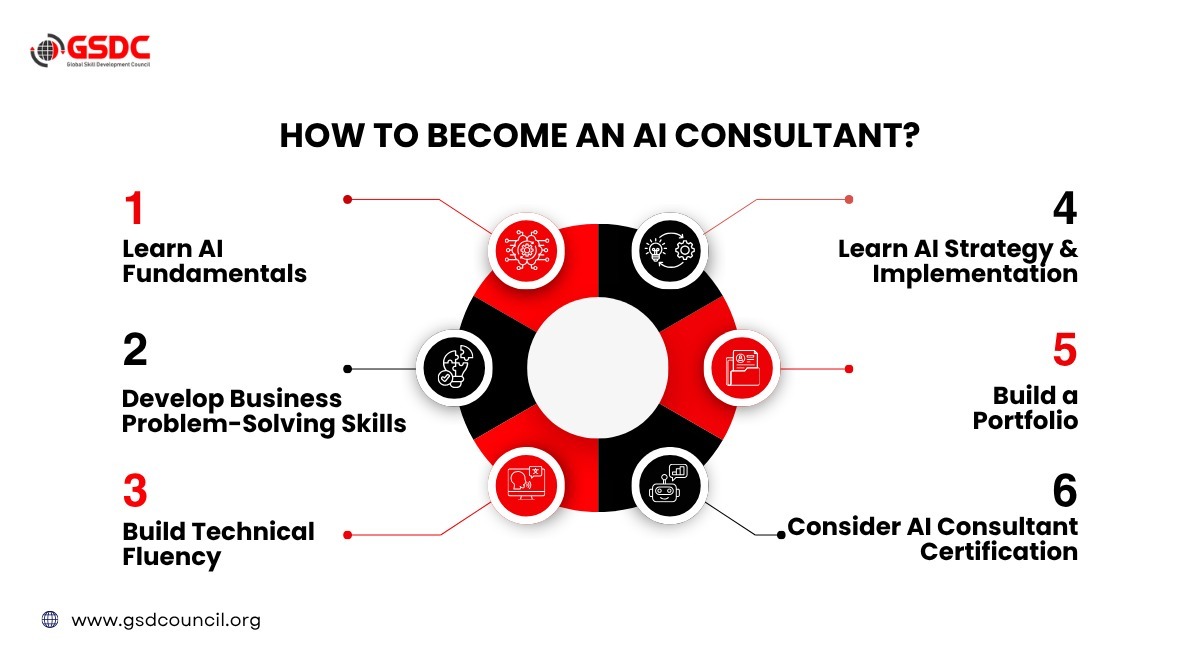
If you're wondering how to become an AI consultant, there isn't one mandatory career path. People enter the field from technology, consulting, analytics, business, project management, product management, and industry-specific backgrounds.
Here is a practical path.
Step 1: Learn AI Fundamentals
Start with core concepts such as machine learning, generative AI, NLP, computer vision, large language models, AI agents, automation, and responsible AI.
You don't necessarily need advanced mathematics to begin consulting, but you should understand what AI can and cannot realistically do.
Step 2: Develop Business Problem-Solving Skills
Learn to identify business problems before suggesting technology.
For example, instead of saying, "The company needs a chatbot," ask:
- What customer problem are we solving?
- What volume of queries exists?
- What data is available?
- What will implementation cost?
- How will success be measured?
This mindset separates AI consulting from simply knowing AI tools.
Step 3: Build Technical Fluency
Learn enough about technologies such as APIs, cloud AI services, databases, RAG, prompt engineering, AI agents, automation platforms, and model evaluation to have meaningful conversations with technical teams.
Step 4: Learn AI Strategy and Implementation
Understand AI use-case prioritization, ROI, data readiness, vendor evaluation, governance, risk management, change management, and implementation planning.
Step 5: Build a Portfolio
Create practical case studies instead of relying only on certificates.
For example, you could document how you would use AI to automate customer support, analyze documents, improve recruitment workflows, or build an internal knowledge assistant.
Step 6: Consider an AI Consultant Certification
An AI consultant certification can help structure your learning and demonstrate that you understand consulting concepts beyond individual AI tools.
Certification is particularly useful for professionals transitioning from another role into AI consulting because it can provide a structured foundation in AI strategy, use-case identification, implementation, business value, and governance.
AI Consultant Career Growth
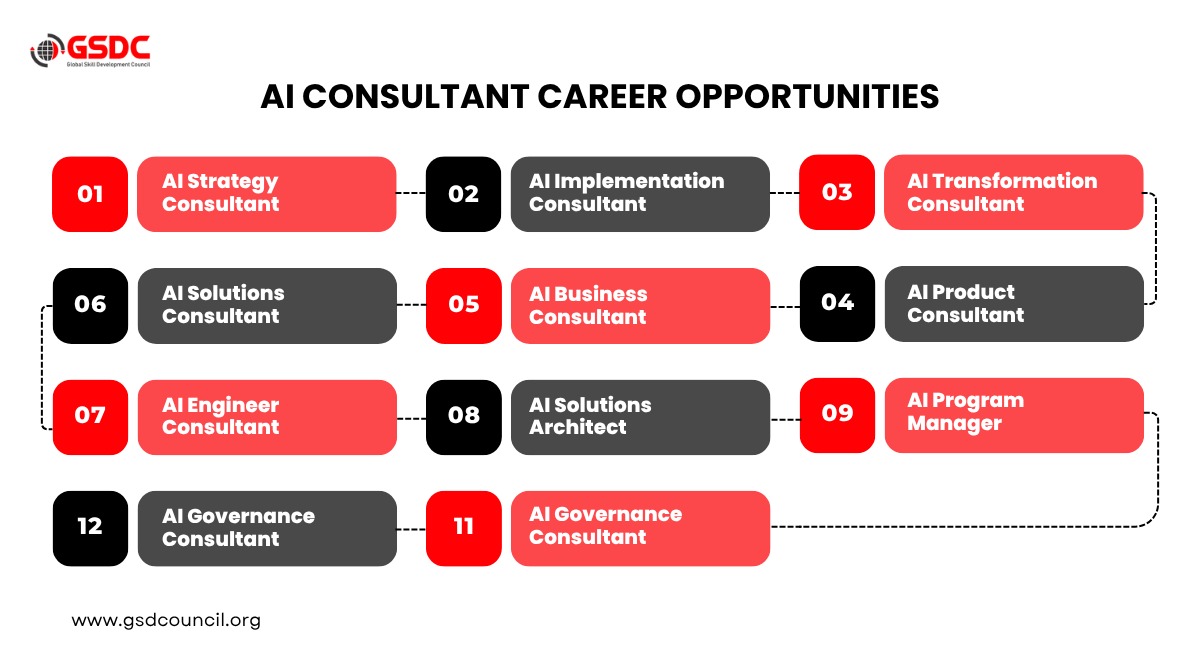
AI Consultant Career Growth can follow several paths.
An early-career professional may begin as an analyst, business analyst, technology consultant, or junior AI consultant. With experience, they can progress toward senior consultant, manager, principal consultant, or AI transformation leadership positions.
Another path is specialization.
For example, someone with a finance background could specialize in AI for financial services, while someone with cybersecurity experience could move toward AI security and governance.
The key is to develop a combination of AI expertise + business knowledge + consulting ability.
The World Economic Forum reports that nearly 40% of workers' core skills are expected to change by 2030, reinforcing the importance of continuous learning as AI adoption accelerates.
Build Your Skills With an AI Consultant Certification
If you're looking for a structured way to develop AI consulting capabilities, the GSDC Certified AI Consultant program covers areas directly relevant to this career path. The certification focuses on AI fundamentals, identifying and prioritizing use cases, assessing data readiness, AI solution design, ROI and business cases, implementation roadmaps, vendor evaluation, governance, risk, security, and responsible AI.
The GSDC’s program is designed for AI consultants, business and technology professionals, analysts, digital transformation professionals, managers, and others looking to move into AI strategy and advisory roles. It also includes self-paced learning, expert-led sessions, practice exams, a capstone project, and job-support resources.
Conclusion
An AI consulting career is about much more than understanding artificial intelligence. The most valuable consultants can connect AI capabilities with real business problems and help organizations move from experimentation to measurable outcomes.
The AI consultant salary can be attractive, but compensation should not be the only reason to enter the field. Long-term career growth will depend on how effectively you combine technical knowledge, business understanding, consulting skills, communication, and continuous learning.
If you're exploring how to become an AI consultant, start with AI fundamentals, develop business problem-solving skills, gain practical implementation knowledge, build a portfolio, and consider an AI consultant certification to structure your professional development. As organizations continue investing in AI transformation, professionals who can bridge the gap between technology and business are likely to remain increasingly valuable.

Related Certifications
Frequently Asked Questions
Current salary sources show significant variation. Glassdoor reports average AI consultant base pay around ₹14 lakh per year, while another Glassdoor dataset reports approximately ₹17 lakh annually. Experience, location, employer, specialization, and additional compensation can significantly affect actual pay.
Yes. AI consulting combines technology with business strategy and is positioned to benefit from increasing organizational adoption of AI. AI and machine learning roles are among the fastest-growing job categories identified by the World Economic Forum.
Not necessarily. Some AI consultants are highly technical, while others specialize in strategy, business analysis, implementation, or transformation. However, technical fluency helps you communicate effectively with engineers and evaluate AI solutions realistically.
An AI consultant certification is not universally mandatory. However, it can provide structured learning and demonstrate knowledge of AI consulting, strategy, implementation, business cases, governance, and responsible AI especially for professionals transitioning into the field.
Develop a combination of technical AI knowledge, consulting experience, industry specialization, communication skills, and implementation expertise. Building a portfolio of real-world AI projects and gaining experience with business cases, ROI, governance, and AI transformation can also strengthen your career profile.
Stay up-to-date with the latest news, trends, and resources in GSDC
If you like this read then make sure to check out our previous blogs: Cracking Onboarding Challenges: Fresher Success Unveiled
Not sure which certification to pursue? Our advisors will help you decide!