Effective Stakeholder Management: Winning Executive Buy-In for L&D

Written by Kassandra Jaramillo Calvo
- Why Ethical Decision-Making Matters More Than Ever
- The Trolley Problem: A Simple Scenario That Reveals Complex Thinking
- When the Same Principle No Longer Feels Right
- The Limits of Outcome-Based Thinking
- The Role of Fairness, Consent, and Shared Responsibility in Leadership Decisions
- Utilitarian Thinking: Maximizing Value for the Organization
- Balancing Results with Principles
- GSDC Certified Learning & Development Professional (CLDP) Certification
- Conclusion
Every day, individuals and organizations make decisions that shape lives, businesses, and society. Some choices are straightforward, while others involve difficult trade-offs where no option appears completely right or wrong. In such situations, business ethics becomes more than a philosophical concept it becomes a practical guide for ethical decision making and responsible decision-making.
A recent webinar explored how moral philosophy influences the way people evaluate complex situations. Through thought-provoking scenarios such as the famous Trolley Problem and real-world legal cases, the session demonstrated that what is ethical decision making is not simply about choosing between right and wrong. Instead, it involves balancing outcomes, responsibilities, personal values, and the rights of others.
The discussion also introduced two of the most influential ethical frameworks consequentialism and categorical moral reasoning and highlighted why these theories continue to influence law, business, leadership, and public policy today. Understanding these perspectives helps professionals develop stronger leadership skills and make better decisions when faced with uncertainty, competing priorities, and ethical dilemmas.
Why Ethical Decision-Making Matters More Than Ever
Modern society presents increasingly complex challenges. Business leaders, healthcare professionals, policymakers, and individuals frequently encounter situations where every available option carries consequences.
Ethical decision making is valuable because it helps people move beyond emotional reactions or personal preferences. Instead, it encourages structured thinking that considers both immediate outcomes and long-term implications.
Whether allocating limited resources, creating workplace policies, or responding to unexpected crises, ethical reasoning enables decision-makers to ask important questions:
- Who will be affected by this decision?
- What consequences will follow?
- Are individual rights being respected?
- Is the decision fair to everyone involved?
These principles also support effective stakeholder management, stakeholder collaboration, and stronger stakeholder management skills, particularly when organizations must balance competing interests.
For L&D professionals, ethical decision-making can also inform learning and development, employee learning and development, and an effective learning and development strategy or L&D strategy. As organizations adopt AI in learning and development, ethical considerations become increasingly important when designing responsible, fair, and people-focused solutions.
Rather than offering easy answers, ethics provides a framework for evaluating difficult choices objectively and developing a responsible stakeholder management strategy.
The Trolley Problem: A Simple Scenario That Reveals Complex Thinking
- The Trolley Problem: A runaway trolley is heading toward five workers, while another track has one worker.
- The Ethical Choice: Pulling the lever sacrifices one person but saves five, leading many people to prioritize the greater outcome.
- Beyond Numbers: The scenario explores how people weigh consequences, responsibility, fairness, and personal accountability.
- Different Perspectives: People may agree on the decision but disagree on the ethical reasoning behind it.
- Leadership & Ethics: The exercise shows why ethical decision making, business ethics, and strong leadership skills are essential when facing complex dilemmas.
When the Same Principle No Longer Feels Right
The webinar then introduced a second variation of the Trolley Problem that challenged participants' earlier reasoning.
Instead of controlling a switch, participants imagined standing on a bridge overlooking the tracks. A runaway trolley was again heading toward five workers, but this time the only way to stop it was by pushing a large individual from the bridge onto the tracks. The person's body would stop the trolley, sacrificing one life to save five others.
Logically, the outcome remained identical. One life would be lost, while five lives would be saved.
Yet this time, the overwhelming majority of participants refused to push the individual.
Why?
The discussion revealed an important insight about human morality. People often distinguish between allowing harm to occur and directly causing harm through their own actions. Even when the consequences are mathematically identical, the emotional and ethical weight of personally causing someone's death feels fundamentally different.
This example demonstrates that ethical decision making is influenced not only by outcomes but also by the nature of the action itself. It challenges the assumption that maximizing positive results is always enough to justify a decision and highlights the importance of business ethics and strong leadership skills when facing complex ethical dilemmas.
The Limits of Outcome-Based Thinking
- Focuses on Consequences: Consequentialism judges whether an action is ethical based primarily on its outcomes.
- Maximizes Overall Benefit: It encourages decisions that create the greatest benefit while minimizing harm.
- Supports Practical Decision-Making: Leaders can use it to evaluate the broader impact of choices on customers, employees, and stakeholders.
- Used in Real-World Decisions: Governments and organizations apply consequentialist reasoning when allocating resources, responding to emergencies, and prioritizing projects.
- Has Ethical Limitations: Focusing only on outcomes can create difficult questions about individual rights, fairness, and whether sacrificing one person can ever be justified.
Utilitarian Thinking: Maximizing Value for the Organization
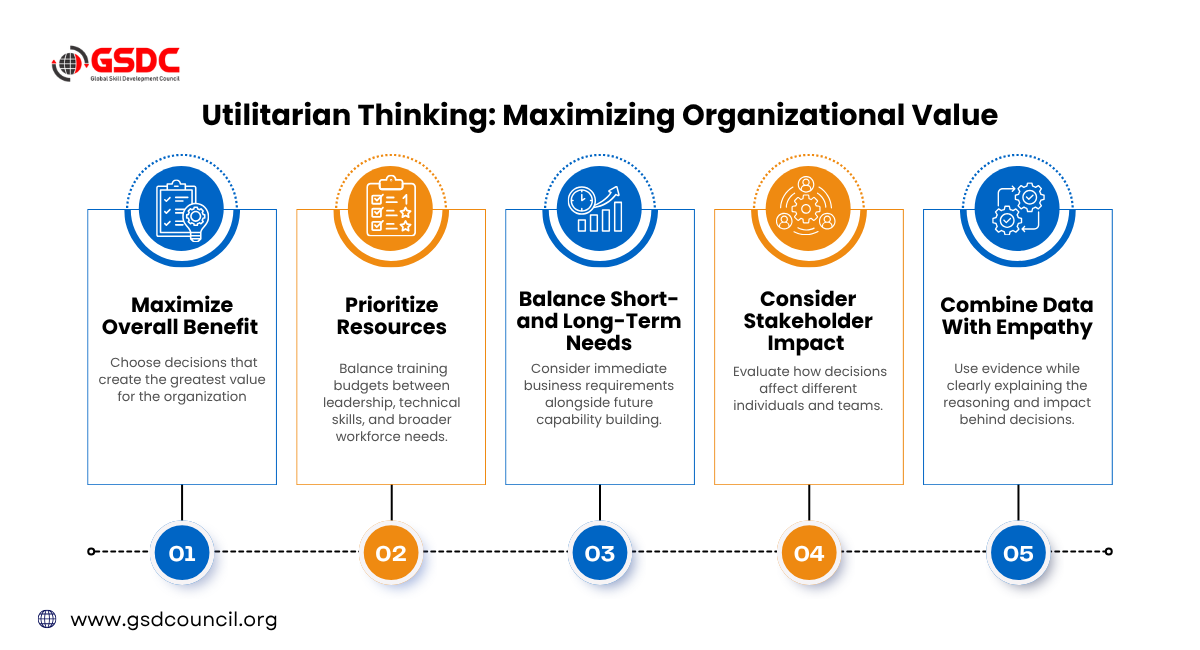
One of the central philosophical concepts discussed in the webinar is utilitarianism, introduced by Jeremy Bentham. Utilitarian thinking suggests that the best decision is the one that produces the greatest benefit for the greatest number of people.
Although originally developed as a moral philosophy, this principle is widely reflected in business decision-making today.
Organizations constantly evaluate investments based on their overall impact. For example:
- Should limited training budgets be spent on leadership development or technical upskilling?
- Should a company prioritize learning initiatives that benefit all employees or specialized programs for a few experts?
- Should resources be invested in long-term capability building or immediate business requirements?
These questions require leaders to balance competing priorities while maximizing organizational value.
However, the webinar also points out that focusing only on outcomes can be problematic. Decisions that improve overall performance may still negatively affect specific individuals or teams.
This is why effective stakeholder management combines data-driven analysis with empathy. Leaders must explain not only what decisions are being made but also why they are necessary and how they support broader organizational objectives.
Balancing Results with Principles
- Numbers Aren’t Everything: Metrics, ROI, and productivity matter, but they should not replace organizational values.
- Consider Employee Impact: Leaders should evaluate whether decisions are fair, transparent, and supportive of employees.
- Balance Results and Ethics: Combining business outcomes with ethical considerations builds long-term credibility.
- Build Employee Trust: Consistent fairness helps employees trust leaders, especially during difficult changes.
Strengthen L&D Buy-In: L&D professionals can gain executive support by balancing business performance with employee experience.
GSDC Certified Learning & Development Professional (CLDP) Certification
The GSDC Certified Learning & Development Professional (CLDP) Certification is designed to help professionals build practical expertise in modern Learning and Development.

The Certified Learning & Development Professional (CLDP) Certification covers learning needs analysis, L&D strategy, adult learning, instructional design, stakeholder management, learning technologies, AI in L&D, and measuring learning impact. It helps professionals align learning initiatives with business goals, strengthen employee development, and support organizational growth.
The certification includes self-paced learning, expert-led sessions, SME Connect opportunities, study resources, practice exams, and a capstone project. It is suitable for L&D professionals, HR professionals, trainers, instructional designers, talent development managers, and corporate learning specialists.
Conclusion
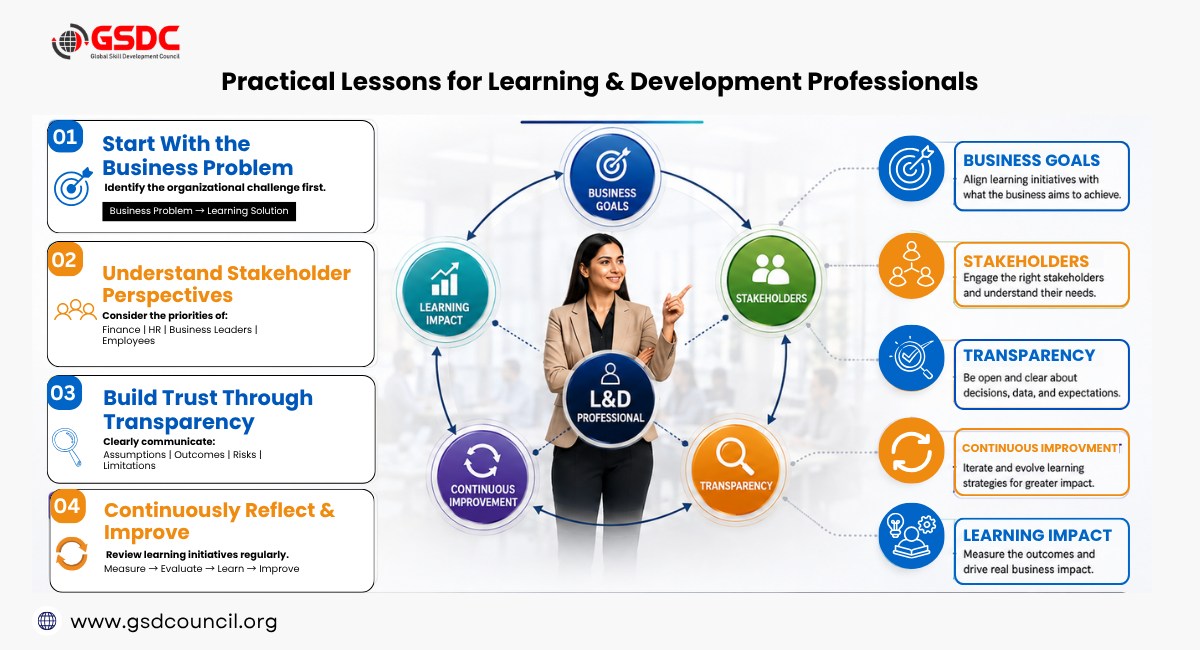
Effective leadership goes beyond making decisions; it requires thoughtful, transparent, and value-driven choices. Leaders must balance priorities, consider consequences, and recognize ethical responsibilities.
For L&D professionals, gaining executive buy-in requires trust, stakeholder involvement, clear communication, and alignment with business goals. Organizations that adopt balanced decision-making can navigate complexity, strengthen relationships, and create learning and development strategies that deliver lasting business value through effective stakeholder management and stakeholder collaboration.

Related Certifications
Frequently Asked Questions
Consequentialist reasoning evaluates decisions based on their outcomes, aiming to achieve the greatest overall benefit.
Ethical decision making ensures L&D strategy balances business objectives with employee well-being, fairness, and organizational values.
Engaging stakeholders early improves transparency, builds trust, and increases support for strategic initiatives through effective stakeholder management.
Utilitarianism suggests choosing actions that create the greatest good for the greatest number of people.
By aligning learning programs with business goals, presenting measurable outcomes, addressing stakeholder concerns, and communicating the strategic value of employee learning and development clearly.
Stay up-to-date with the latest news, trends, and resources in GSDC
If you like this read then make sure to check out our previous blogs: Cracking Onboarding Challenges: Fresher Success Unveiled
Not sure which certification to pursue? Our advisors will help you decide!