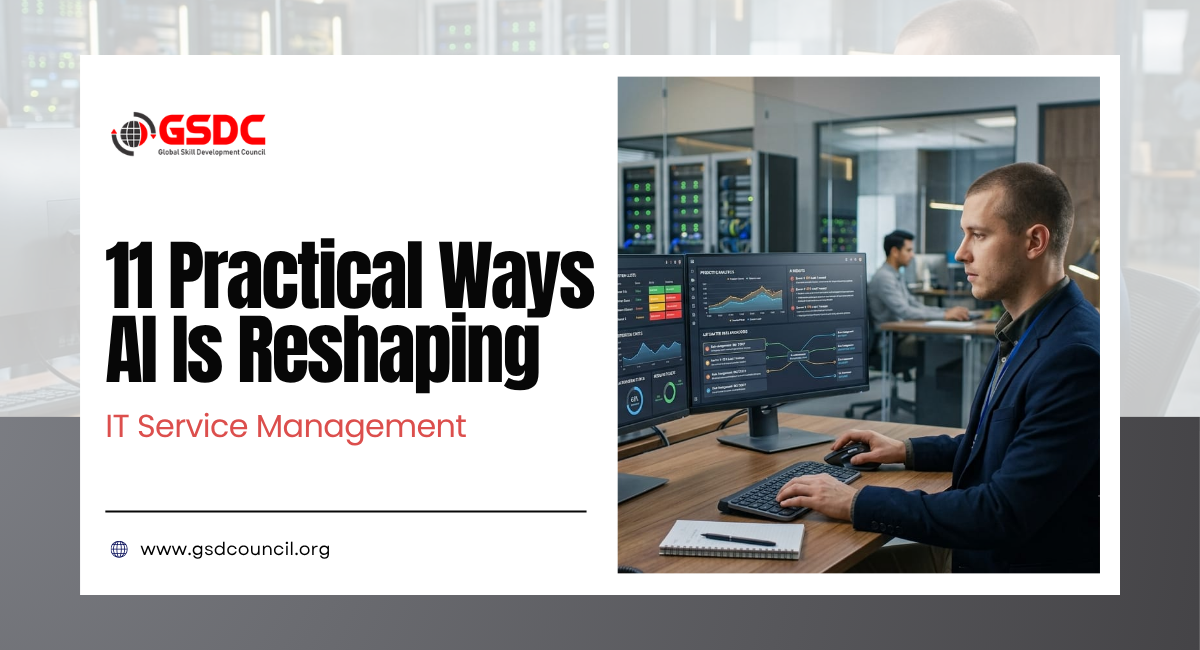
11 Practical Ways AI Is Reshaping IT Service Management
Written by Matthew Hale
ITSM has traditionally been reactive by design. Something breaks, an employee opens a ticket, a technician picks it up, and the clock starts on an SLA. AI is starting to rewrite that model, not by replacing the people who run ITSM, but by shifting the work earlier: predicting problems before they spread, resolving routine ones without a human touching them, and increasingly taking multi-step action before a ticket is ever raised.
A recent market study by TeamDynamix, which surveyed 392 IT professionals across 23 industries, found that 87% of organizations are already using or planning to use AI in ITSM within the next two years. The question most IT teams are asking isn't whether to adopt AI, but where to start and what actually works.
This blog covers what's genuinely changing in ITSM, how AI differs from the automation you already know, and 11 practical use cases, from simple to advanced, that show where organizations are getting results today.
AI in ITSM: What's Actually Changing?
AI in ITSM means using artificial intelligence, including machine learning, natural language processing, and increasingly "agentic" systems, to automate, predict, and improve how IT services are delivered. It sits on top of frameworks like ITIL, which govern how incidents, requests, changes, and assets are managed.
What's changing isn't the framework itself. It's how much of the process no longer needs a human in the loop. Reading a ticket, understanding it, deciding who should handle it, and even suggesting or executing a fix can now happen in seconds instead of sitting in a queue.
AI vs. Traditional ITSM Automation
"Automation" and "AI" get used interchangeably, but they're not the same thing.
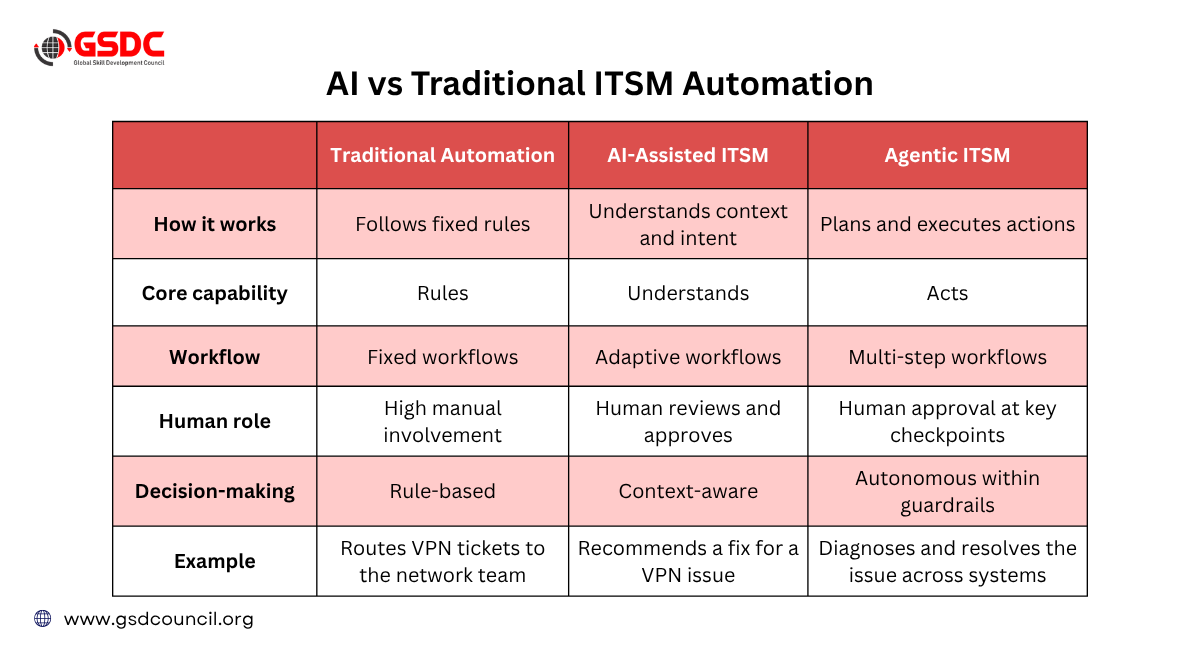
- Traditional ITSM automation runs on fixed rules: if a ticket contains "VPN," route it to networking. It's reliable for known scenarios but breaks the moment a request doesn't match exactly.
- AI-assisted ITSM understands intent rather than keywords. It reads a vaguely worded ticket, recommends a fix, drafts a knowledge article, or flags a risky change, but a human still reviews most of what happens next.
- Agentic ITSM goes further: it plans and executes multi-step actions across systems, such as provisioning accounts or updating records, with human approval built in only at key checkpoints.
Most organizations today sit somewhere between the first two categories, and this is exactly the middle ground. The Certified Generative AI in ITSM certification is designed to help professionals navigate: building the practical judgment to know which category a given workflow belongs in, and when it's ready to move to the next one. The use cases below show what that looks like in practice.
11 Practical AI in ITSM Use Cases
1. AI-Powered Virtual Agents and Chatbots
Instead of logging every request into a queue, employees type or speak a question to a virtual agent that understands natural language, checks the knowledge base, and either resolves the issue instantly or creates a properly categorized ticket. If an employee types "I can't connect to the VPN," the agent walks them through a known fix and escalates only if it doesn't work. This is usually the most visible starting point for AI in ITSM.
2. Intelligent Ticket Routing and Categorization
AI reads the content of a ticket, understands intent, and routes it to the right team and priority level automatically, cutting down the reassignments that quietly eat into resolution time. A vague ticket titled "system is slow" gets tagged as a network issue and sent straight to infrastructure instead of sitting in a general queue. This tends to be a genuine first step into AI ITSM, since it needs the least historical data to work well.
3. Predictive Incident Management
Rather than waiting for something to break, predictive AI analyzes historical patterns, system logs, and performance metrics to flag issues before they escalate. A model might notice a server's memory usage climbing in a pattern that has preceded past outages and alert the team to intervene early. This is one of the clearest signs of where the future of ITSM is heading: from reactive firefighting to proactive prevention.
4. AI-Driven Knowledge Management
Outdated or scattered knowledge bases are one of the highest hidden costs in ITSM. AI tools can scan resolved tickets, documentation, and chat logs to automatically generate and organize knowledge articles, closing gaps that stretched teams rarely have time to find manually. It's easy to underrate this use case because it's less visible than a chatbot, but among organizations with widespread AI deployment, knowledge article generation is the single most common application, reported by 88%, ahead of virtual agents, ticket routing, or anything else on this list.
5. Automated Root Cause Analysis
When an incident happens, figuring out why can take hours of manual log-digging. AI systems can correlate data across multiple systems in seconds, surfacing the likely root cause inside the technician's existing workflow. After a payment gateway outage, AI might cross-reference deployment logs and change records to point directly to a recent configuration change as the trigger, something that could otherwise take an engineer half a day to trace.
6. Self-Service Access and Password Management
One of the simplest, highest-volume use cases: AI-driven self-service portals let employees reset passwords, request software access, or unlock accounts without opening a ticket, using identity verification instead of a human agent. It removes a significant share of low-value tickets from a service desk's workload.
7. AI-Assisted Change Risk Assessment
A poorly assessed change can cause an outage. AI models can analyze the scope, history, and dependencies of a proposed change and assign a risk score, helping change advisory boards make faster, better-informed decisions. A database update might get flagged as "high risk" because AI detects that it touches a system with a history of failed changes.
8. Sentiment and Experience Analysis
AI can analyze the tone and language in tickets, chats, and post-resolution surveys to flag frustrated users before they escalate a complaint, giving managers a chance to step in early and protect the employee or customer experience.
9. Automated SLA Monitoring and Reporting
Instead of manually pulling reports to check whether service level agreements are being met, AI systems continuously track ticket data and flag SLA breaches, or the risk of one, in real time, along with the likely cause.
10. AI for IT Asset and Inventory Management
AI tools can track hardware and software assets across a business, predict when equipment is likely to fail, and flag unused software licenses that are quietly costing money. This ties ITSM directly to cost control, which matters more every year as IT budgets tighten.
11. Agentic AI for Multi-Step Workflow Automation
Agentic AI doesn't just answer questions or route tickets. It plans and carries out multi-step actions on its own, such as provisioning a new employee's accounts, software, and hardware end-to-end, only looping in a human at defined approval checkpoints.
Working across even a handful of these use cases well is less about picking the right tool and more about building the judgment to run them responsibly, which is the gap GSDC's certification programs are built to close for ITSM practitioners moving into AI-assisted roles.
The Shift From AI-Assisted to Agentic ITSM
Most of the use cases above still involve a human making the final call. Agentic ITSM is different in kind, not just degree: it's the difference between AI that suggests and AI that acts.
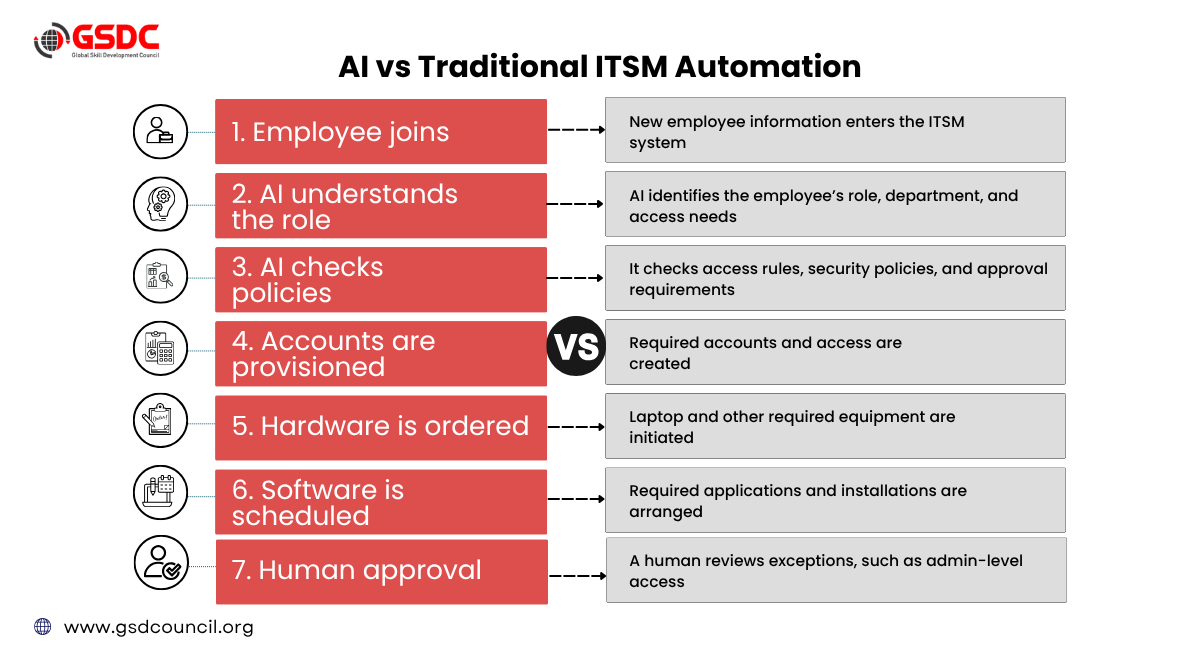
An onboarding workflow illustrates this well. Traditional automation might auto-create a single ticket for IT to provision a laptop. AI-assisted ITSM might read the new hire's role and suggest which software licenses and access groups they'll need. Agentic ITSM goes further: it provisions the accounts, orders the hardware, schedules the software installs, and only pings a human if something falls outside policy, like a request for admin-level access.
This is also where the wider software industry is moving. Gartner has predicted that task-specific AI agents will be integrated into roughly 40% of enterprise applications, up from under 5% a year earlier, and ITSM's clearly defined workflows make it one of the practice areas best positioned to adopt this quickly. Most organizations aren't there yet, though. The realistic starting point is still cleaning up routing and knowledge management first, since agentic workflows built on messy data tend to create more problems than they solve.
What Organizations Gain
The practical benefits organizations report from ITSM automation tend to cluster around a few outcomes:
- Faster resolution times, as routine issues get solved in seconds instead of sitting in a queue
- Lower ticket volumes for human agents, thanks to deflection and self-service
- Fewer repeat incidents, through predictive detection and root cause analysis
- Better knowledge retention, since AI captures and organizes fixes automatically
- More strategic use of human talent, as staff shift from repetitive triage toward problems that need real judgment
These aren't just aspirational, either. In the State of AI in IT report from ITSM.tools and Atomicwork, IT professionals surveyed were far more likely to describe their organization's AI ROI as positive than negative.
Where AI in ITSM Still Falls Short
- Data quality matters enormously. AI systems are only as reliable as the data, documentation, and context they can access. A messy knowledge base produces confidently wrong answers, not fewer tickets.
- Change management is still hard. Employees and IT staff both need trust and training before they'll rely on AI-driven workflows instead of working around them.
- Most organizations are still early-stage, piloting rather than running AI at scale.
- Governance becomes non-negotiable once agentic AI starts taking real actions instead of just suggesting them.
What This Means for ITSM Professionals
A natural question follows: Is ITSM still a good career when AI handles more of the routine work? The honest answer is yes, but the role itself is moving. A modern ITSM job description increasingly includes configuring AI-assisted workflows, reviewing what automation gets right and wrong, managing change-risk models, and interpreting service analytics, on top of traditional incident, problem, and change management duties.
For ITSM professionals, the valuable skill set is shifting: ITIL knowledge alone is no longer enough. What's increasingly in demand is that same foundation combined with AI literacy, automation fluency, and the governance judgment needed to know when an AI-assisted decision needs a second look, which is exactly why interest in ITSM certification has grown alongside AI adoption.
This is precisely the gap organizations like the Global Skill Development Council (GSDC) have moved to address. Its Certified Generative AI in ITSM program is built around this shift, pairing core ITSM practice with the AI and governance skills that employers are now screening for, rather than treating them as separate tracks. For professionals weighing what to add to their resume next, it's a fairly direct answer to where the field is headed.
Final Takeaway
The future IT service desk won't be defined by how many tickets it can close. It will be defined by how many problems it prevents, resolves, or automates before they ever become tickets in the first place. The 11 use cases above aren't a checklist to implement all at once. They're a rough map of that transition, from simple deflection and routing today toward AI that plans and acts with real autonomy tomorrow.

Related Certifications
Frequently Asked Questions
AI in ITSM is the use of artificial intelligence, including machine learning and natural language processing, to automate, predict, and improve how IT services are delivered. It builds on frameworks like ITIL rather than replacing them.
Common examples include virtual agents that resolve tickets automatically, intelligent ticket routing, predictive incident detection, AI-generated knowledge articles, and automated root cause analysis, all under the broader umbrella of ITSM automation.
Yes. AI is changing what the role involves rather than eliminating it. The most valuable ITSM professionals now combine framework knowledge with AI literacy and governance judgment, and demand for that combination is growing.
Ticket routing and knowledge management. They require the least historical data, generate quick wins, and build the clean data that more advanced use cases depend on later.
Yes, though its value has shifted. Certifications like ITIL still provide a shared vocabulary and career foundation, but pairing that with AI and automation skills is what increasingly sets candidates apart.
Stay up-to-date with the latest news, trends, and resources in GSDC
If you like this read then make sure to check out our previous blogs: Cracking Onboarding Challenges: Fresher Success Unveiled
Not sure which certification to pursue? Our advisors will help you decide!