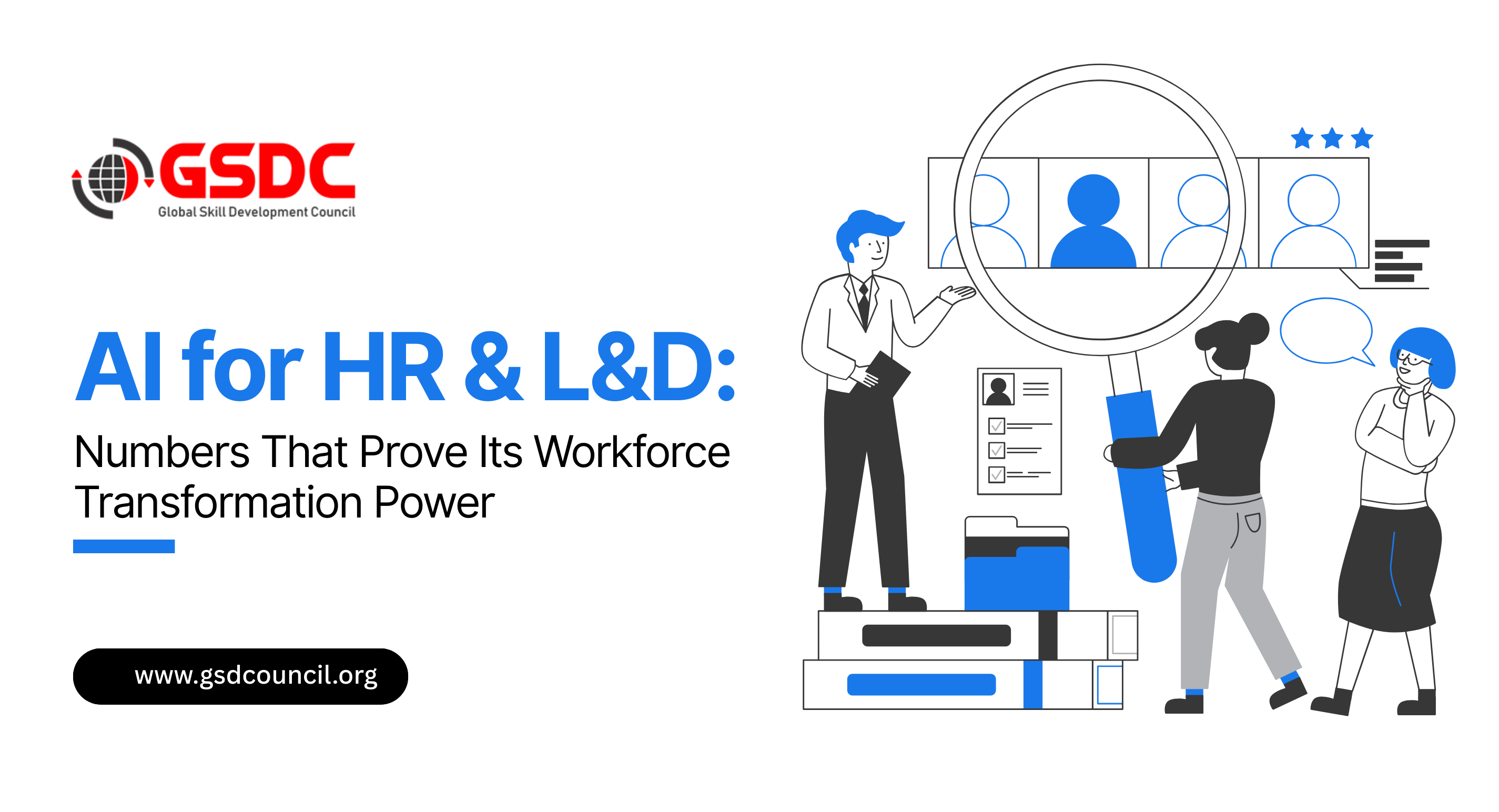
AI for HR & L&D: Numbers That Prove Its Workforce Transformation Power
Written by Emily Hilton
- What is L&D (Learning & Development) and Why AI Matters?
- Current Adoption & Market Statistics for AI in HR & L&D
- Real-World Use Cases of AI in HR & L&D
- Measurable Business Impact
- Skills, Careers & Certifications in AI for HR
- Challenges & Ethical Considerations
- Future Outlook for AI in HR & L&D
- Conclusion
What is L&D (Learning & Development) and Why AI Matters?
L&D is short for Learning and Development, the process through which the employees acquire new skills and knowledge. In every organization, the employees are the most important asset. Therefore, it is L&D that has to take care of those who are in the company or the potential future employees that are going to come. The concept of L&D has and is still being transformed by incorporating AI in various ways.
Some AI in human resources include facilitating the recruitment process, creating more engaging training and offering more personalized learning paths, and data-led decision-making. When AI is incorporated into L&D, it assists in developing learning patterns, measuring performance, and making adjustments to the learning process according to the employees' preferences. Thus, enabling the organization to develop the skills of their staff effectively and efficiently.
Considering the rapid advancement of technology and changing workforce necessities, the combination of AI in HR & L&D is the most scalable and efficient approach to upskill, reskill, and manage talent.
Current Adoption & Market Statistics for AI in HR & L&D
- Adoption of AI in HR
By the year 2025, the percentage of companies using AI for HR functions has increased to 43%, compared to only 26% in the previous year, 2024.
It was anticipated that the AI in HR market size would reach USD 3.25 billion globally in 2023, and it is likely to be USD 15.24 billion by 2030 with a CAGR of approximately 24.8%.
Among all the HR departments, almost three-quarters of the HR leaders stated that they have adopted AI for the purpose of automating the entire spectrum of repetitive administrative tasks covering candidate screening, onboarding, and answering employees' routine queries.
- AI in Learning & Development / Training & Development
According to a 2025 survey of HR and L&D leaders, 61% of organizations have adopted or are testing AI in their L&D strategies, but only 11% feel extremely confident about their future skills‑building readiness, highlighting both opportunity and a gap.
Regarding L&D applications, approximately 39% of the organizations that adopt AI report the latter as a contributor to their learning and development initiatives.
Additionally, it is reported that learning programs powered by AI can not only heighten engagement but also increase effectiveness, thus, making it easier for companies to train large groups of employees efficiently.
- Trend and Growth Forecasts
A large share of companies plan to increase AI investment: in one 2025 survey, 92% of companies indicated they will ramp up AI spending in HR / workforce‑related AI tools over the next three years.
With rising adoption and expanding use cases, AI for HR & L&D job roles such as HR‑tech specialists, AI‑enabled learning designers, and workforce analytics managers are becoming more prominent. Many HR professionals now view AI as essential for future workforce planning and talent management.
Real-World Use Cases of AI in HR & L&D
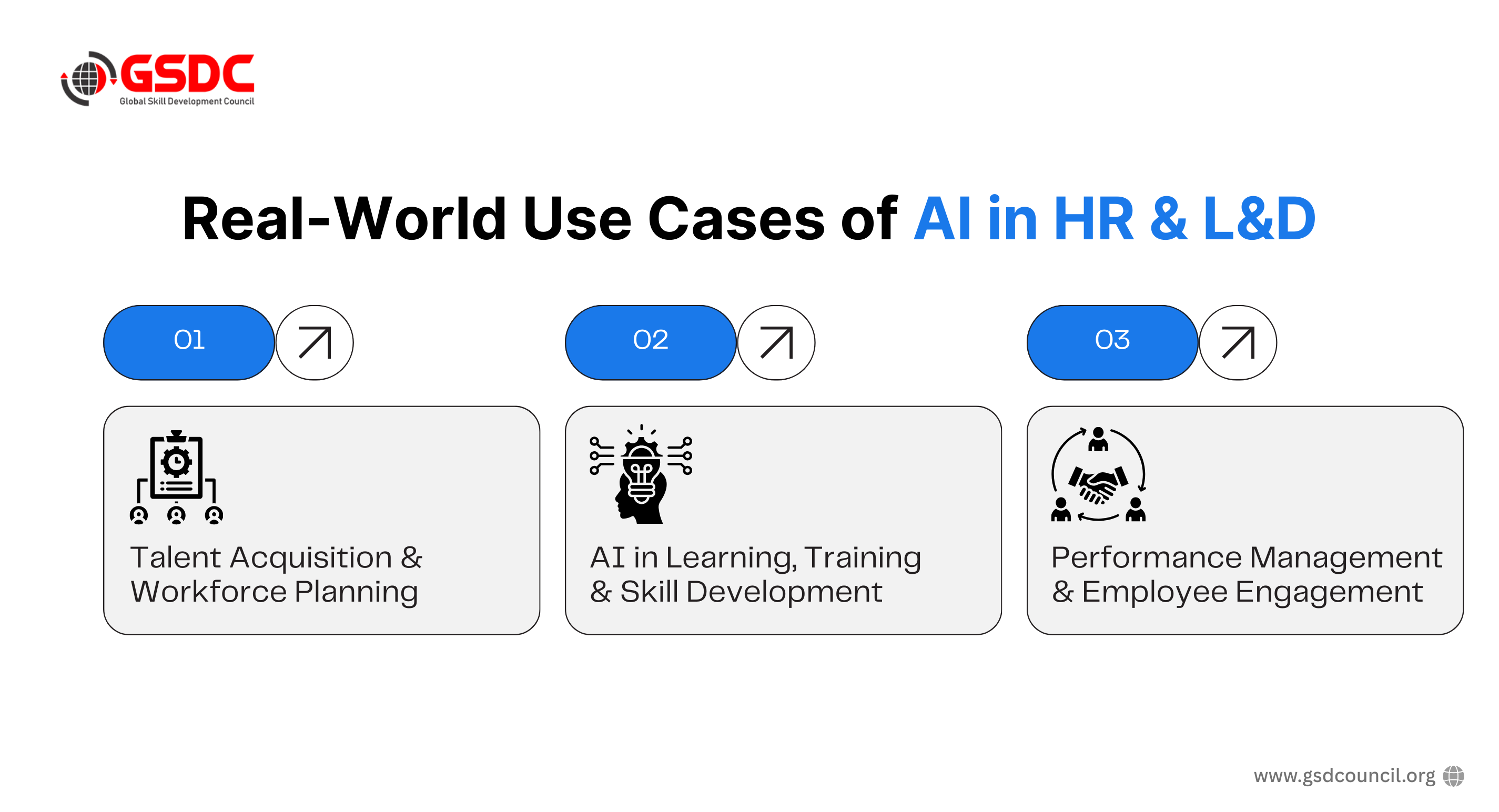
Talent Acquisition & Workforce Planning
One of the most mature applications of AI in human resources is recruitment. AI-powered tools analyze thousands of resumes in minutes, reducing time-to-hire by up to 40%. Predictive workforce analytics helps organizations identify future skill gaps, plan succession, and align hiring with long-term business goals.
Chatbots and virtual assistants now handle candidate communication, interview scheduling, and onboarding support, improving both efficiency and candidate experience.
AI in Learning, Training & Skill Development
In L&D, AI in training enables hyper-personalized learning at scale. AI-driven platforms assess employee skills, performance data, and learning behavior to recommend customized learning journeys. Content difficulty, format, and pacing adjust dynamically, resulting in better engagement and faster skill acquisition.
These advancements are also reshaping HR L&D jobs, creating demand for roles such as AI-enabled learning designers, workforce analytics specialists, and HR technology consultants.
Performance Management & Employee Engagement
AI tools interpret and dissect performance data, feedback, and sentiment to extract practical insights for managers. Real-time sentiment analysis from surveys and collaboration tools is facilitated by natural language processing, which enables HR teams to take proactive measures against burnout, disengagement, and attrition risks.
Such a changeover promotes continuous performance management instead of the conventional yearly review cycles.
Measurable Business Impact
When organizations filled with human resources and learning and development solutions report attending to AI, they talk about 20-30% operational cost savings as an outcome of automation.
The learning effectiveness is enhanced, as right from the very beginning employees get to work on skills that are relevant and specific to their roles, and this is in contrast to the case of common training. AI-enabled internal mobility programs delegating external hiring and simultaneously supporting retention through presenting clear career growth paths.
Skills, Careers & Certifications in AI for HR
As AI adoption accelerates, HR professionals are increasingly seeking AI courses for HR professionals to remain relevant. Upskilling in AI literacy, data interpretation, and ethical AI use is becoming essential for modern HR careers.
Demand is also growing for formal credentials such as a certification in generative AI in HR and L&D, which validates expertise in applying generative AI tools for talent development, learning personalization, and workforce transformation.
Challenges & Ethical Considerations
On the one hand, the positive aspects of artificial intelligence have been acknowledged, however, the obstacles such as data privacy, algorithmic bias, and lacking internal expertise will still need to be tackled. The HR leaders will have to set up robust governance frameworks, practice transparency in the AI-driven decisions, and find the right mix between automation and human judgment.
Future Outlook for AI in HR & L&D
In the future, AI-based content generation will take over more areas like coaching simulations, training for leaders, and competency mapping. AI-generated models for skills-based workforce will take over the job-based structures widely, thus allowing more flexibility in the organization.
Conclusion
The data clearly shows that AI in human resources and AI in learning and development are no longer optional; they are strategic imperatives. Organizations that invest in AI-powered HR and L&D capabilities, supported by the right skills and certifications, will be better positioned to build future-ready workforces, close skills gaps, and sustain long-term growth in an increasingly competitive business environment.

Related Certifications
Stay up-to-date with the latest news, trends, and resources in GSDC
If you like this read then make sure to check out our previous blogs: Cracking Onboarding Challenges: Fresher Success Unveiled
Not sure which certification to pursue? Our advisors will help you decide!