How to Foster Continuous Learning Across Your Organization?
Written by Dr Anand Wadadekar
- Understanding Workforce and Leadership Perspectives on Learning
- Evolution of Learning and Development: From Education to Skill-Building
- The Shrinking Half-Life of Skills
- Building a Culture of Continuous and Lifelong Learning
- Role of Leadership in Fostering a Learning Culture
- Integrating Learning into Daily Workflows
- Measuring Impact and Overcoming Resistance
- Empowering L&D Leaders to Create Safe, Future-Ready Learning Cultures with CLDP
- Conclusion
Have you ever noticed that, in many organizations, workplace learning often feels like a checkbox rather than a real growth opportunity? Employees skip training because it feels irrelevant, leaders worry about costs, and the connection between learning and business results seems blurry. Sound familiar?
The recent webinar, “Fostering a Continuous Learning Culture: How to Promote Lifelong Learning and Development Across Your Organization,” explored how a stronglearning and development strategy can cultivate continuous and lifelong growth across organizations. Through real-world examples, practical strategies, and actionable insights, the session demonstrated how companies can shift from one-time corporate training and development initiatives to an engaging, ongoing journey that benefits both employees and the business.
In this blog, let’s explore the key takeaways from the session and explore how organizations can create a culture where learning is continuous, relevant, and truly empowering, an environment where employee learning and development becomes a strategic enabler rather than a periodic activity.Understanding Workforce and Leadership Perspectives on Learning
A key reality for many professionals working in corporate learning and development is that both employees and organizational leaders often undervalue learning. Common workforce perceptions include:
- Training is unnecessary and time-consuming work because employees who believe they can acquire skills through Google and YouTube will not benefit from structured workplace learning programs.
- Employees who work at higher levels of the organization believe they should not learn new technologies because they consider themselves too senior for such talent development frameworks.
Leaders and stakeholders, on the other hand, often perceive learning as a luxury or a cost burden. Statements such as “We are too busy,” “Why invest in internal academies?” or “What if employees leave after training?” reflect a focus on short-term results over long-term capability development despite growing evidence about why lifelong learning is important for resilience and innovation.
These perspectives often stem from three root causes:
- The learning and development strategy is treated as training to be conducted at scheduled times, which should continue until the student achieves full knowledge.
- The staff members find it difficult to understand how their employee learning and development programs lead to actual business results, which makes them less interested in the company's training and development programs.
- The leaders of organizations see learning as an expense instead of viewing it as a strategic asset that produces value through continuous learning that leads to innovation and operational flexibility.
At its core, this challenge reflects a misunderstanding of what is lifelong learning not a one-time intervention, but an ongoing process of building skills, knowledge, and adaptability throughout an employee’s career.
Recognizing these perceptions is the first step toward redefining organizational learning and building a culture supported by modern tools such as AI-driven insights and a learning experience platform, enabling more relevant, personalized, and impactful development journeys.Evolution of Learning and Development: From Education to Skill-Building
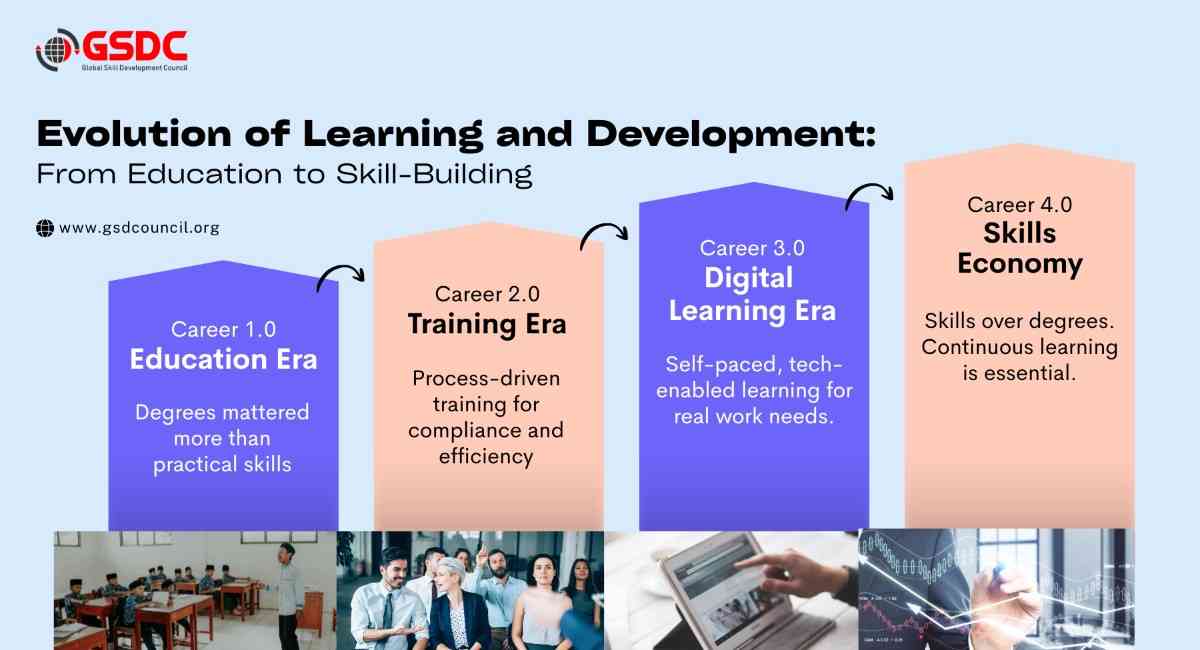
The historical evolution of L&D shows how workforce expectations and organizational strategies have transformed over decades:
- Career 1.0 – Education Dominant Era: Formal education and academic credentials were valued above practical skills. Organizations relied heavily on hiring graduates with prestigious degrees rather than assessing on-the-job capabilities.
- Career 2.0 – Training Era: Structured training programs focused on compliance, process efficiency, and operational readiness. Learning was procedural and often disconnected from strategic business outcomes.
- Career 3.0 – Digital Revolution: Digital learning platforms, Learning Management Systems (LMS), and blended learning models enabled self-directed, self-paced learning aligned with immediate work needs.
- Career 4.0 – Skill-Building Era: Today, organizations operate in a skills economy, hiring for capabilities and competencies rather than degrees. Lifelong learning and continuous skill-building are essential for success.
The Shrinking Half-Life of Skills
A central theme in the session was the rapid obsolescence of skills. The half-life of skills, the period before a skill becomes outdated, has dropped from over 10 years to just 2 years or less.
Implications for organizations:
- Skills must be context-specific, moving away from generic role-based training.
- Learning should be continuous and integrated into daily workflows, not confined to periodic sessions.
- Organizations must foster an adaptive workforce capable of unlearning, learning, and relearning as business needs evolve.
Building a Culture of Continuous and Lifelong Learning
Key strategies to establish a sustainable learning culture include:
1. Shift L&D from Training to Strategic Business Function
Organizations must reposition L&D as a strategic partner, not merely a support or administrative function. L&D should actively contribute to business outcomes, shaping workforce capabilities to meet organizational goals.
2. Build a Learning Ecosystem
Creating an ecosystem ensures knowledge sharing, skill development, and mentorship are embedded across all organizational levels. Essential elements include:
- Partnerships among CXOs, managers, and employees: All stakeholders must collaborate to prioritize learning.
- Accessible internal learning academies: Employees should have one-stop access to mentoring, career guidance, and skill-building resources.
- Recognition of milestones: Celebrating learning achievements reinforces motivation and engagement.
- Technology-enabled learning: Mobile apps, LMS, and digital platforms make learning convenient, flexible, and scalable.
- Peer-to-peer communities: Knowledge-sharing networks enhance learning through collaboration and real-world problem-solving.
3. Encourage Employee Ownership of Learning
Employees must take ownership of their learning journey. Effective approaches include:
- Communicate the purpose and relevance of learning programs.
- Highlight the business and personal impact of acquiring new skills.
- Explain the cost of inaction, what happens if learning stops or is ignored.
- Offer choice, convenience, and resources to engage learners actively.
- Recognize and reward learning efforts to reinforce commitment.
Role of Leadership in Fostering a Learning Culture
Leadership plays a pivotal role in embedding continuous learning:
- Strategic visibility: L&D leaders should have a place on the executive board, highlighting learning as a critical driver of business growth.
- Human-centric leadership: Managers and CXOs must act as coaches rather than command-and-control leaders, promoting curiosity and experimentation.
- Transparent communication: Leaders should share organizational goals, success metrics, and how learning contributes to achieving them.
- Guidance and mentorship: Managers and L&D heads must provide ongoing career support, ensuring employees feel valued and empowered to develop their skills.
When leadership actively participates, learning becomes integrated into organizational DNA, rather than being treated as an isolated initiative.
Integrating Learning into Daily Workflows
A major challenge is ensuring learning occurs within the flow of work, rather than as a separate activity. Effective approaches include:
- Learn-on-the-go mobile apps: Microlearning capsules delivered during commutes or downtime.
- Short, thought-provoking weekly learning sessions: Provide bite-sized knowledge while reinforcing relevance to daily tasks.
- Linking learning to business outcomes: Employees see how acquired skills directly impact their roles, driving motivation and engagement.
Measuring Impact and Overcoming Resistance
Organizations often struggle to assess the effectiveness of learning programs beyond participation metrics. Key strategies include:
- Continuous dialogue with employees: Understanding pain points and feedback ensures training is relevant and impactful.
- Tracking business impact: Aligning learning initiatives with measurable outcomes reinforces value to leadership.
- Addressing resistance: Educating employees on the purpose, payoff, and consequences of not learning helps reduce reluctance and fosters a growth mindset.
Empowering L&D Leaders to Create Safe, Future-Ready Learning Cultures with CLDP
GSDC’s Certified Learning & Development Professional (CLDP) enables L&D leaders to design impactful learning ecosystems that promote psychological safety, collaboration, and continuous improvement. It equips professionals to align L&D strategies with business objectives, enhance employee experience, and build inclusive workplace cultures where individuals confidently share ideas and grow.
Learning & Development Professional Certification provides practical frameworks for measurable learning interventions, strengthens leadership and stakeholder management capabilities, and supports culture transformation. By developing resilient, skilled teams and fostering a strong learning culture in the workplace, the certification helps organisations stay agile, innovative, and prepared for evolving business demands.

Conclusion
The webinar presented one fundamental principle, which states that continuous learning represents the sole unchanging element in existence. Organizations that fail to adapt their learning and development strategy experience employee disengagement, together with skill deficiencies, which will reduce their ability to compete. Organizations establish a workforce ready for future challenges through the development of continuous learning programs, which they pair with their effective learning and development platform. Employees achieve professional growth through structured learning programs, which include leadership commitment and modern educational tools such as AI-powered analytics and a learning experience platform.
The establishment of a lifelong learning culture within organizations requires more than independent corporate training programs. Organizations must develop learning environments that connect workplace learning with everyday tasks while using their talent development systems to reshape organizational learning practices. Companies that develop their learning and development programs through corporate learning investments will experience sustained success through increased employee engagement and retention, together with enhanced innovation capacity and consistent business growth.

Related Certifications
Stay up-to-date with the latest news, trends, and resources in GSDC
If you like this read then make sure to check out our previous blogs: Cracking Onboarding Challenges: Fresher Success Unveiled
Not sure which certification to pursue? Our advisors will help you decide!