The Future of Learning and Development: Data, Analytics, and AI in L&D
Written by Srijith Nair
- Why Learning and Development Must Become Data-Driven Now
- The Four Types of Learning Analytics Transforming Modern L&D
- How Data Analytics Is Helping Learning and Organizational Outcomes
- Challenges in Adopting Data-Driven L&D
- The New Skill Set Required for Modern L&D Professionals
- Why Learning and Development Certification is More Important Than Ever
- The Future of AI in Learning and Development
- Final Thought: Data Has Become the New Operating System for L&D
For years, organizations have invested heavily in learning and development (L&D) from leadership workshops and onboarding to skills academies and compliance training. Yet one question has always been hard to answer:
Is our learning actually creating measurable business impact?
Understanding what is L&D goes beyond delivering training. At its core, learning and development exists to improve employee capability, performance, and long-term organizational success. But in 2025, intuition-based learning strategies are no longer sufficient.
With rapid reskilling demands and the need to maximize ROI, organizations must rely on learning and development data to guide decisions. In fact, 88% of organizations say learning opportunities are now central to retention strategies, and learning leaders face intense pressure to prove value.
Why Learning and Development Must Become Data-Driven Now
Fundamentally, Learning and Development (L&D) is intended to facilitate employees to perform better, acquire new skills and be in line with the company goals. In the past, the success of L&D was gauged by the number of people attending, completing, and providing feedback to the training sessions.
However, currently, such metrics do not suffice any longer.
Three hard truths confront progressive organizations:
1. Skills Are Becoming Obsolete Faster Than Ever
Skills are no longer staying relevant for years. 70% of the skills used in jobs today, are expected to change by 2030, says LinkedIn. Such a fast pace of change makes learning continuously and reskilling to be a must, not an option.
2. Leaders Expect Measurable ROI
Top executives expect corporate learning programs to yield measurable returns, similarly to other types of investments. They are interested in finding out:
- Did training lead to better employee performance?
- Were the skill gaps effectively bridged?
- Did the learning initiatives contribute to business results?
These queries cannot be answered by mere completion rates and satisfaction scores.
3. Learning Is a Strategic Business Function
Learning is no longer a support activity. It directly influences productivity, innovation, employee retention, and long-term competitiveness.
In order to really figure out what learning and development is doing, companies need to look beyond the shallow metrics and concentrate on the proof of the effect. Traditional metrics do not demonstrate whether learning has led to a change in behavior, job performance, or value creation.
This is where data analytics in learning and development becomes critical.
- Studies across corporate L&D indicate that: Online learning may lead to the increase of employee performance by 15-25%.
- Firms having well-defined training plans witness a 218% higher revenue per employee as compared to those lacking formal training.
These numbers highlight one point very clearly: If learning decisions are based on data rather than on assumptions, L&D is not only a business driver that can be measured but also a cost center.
The Four Types of Learning Analytics Transforming Modern L&D
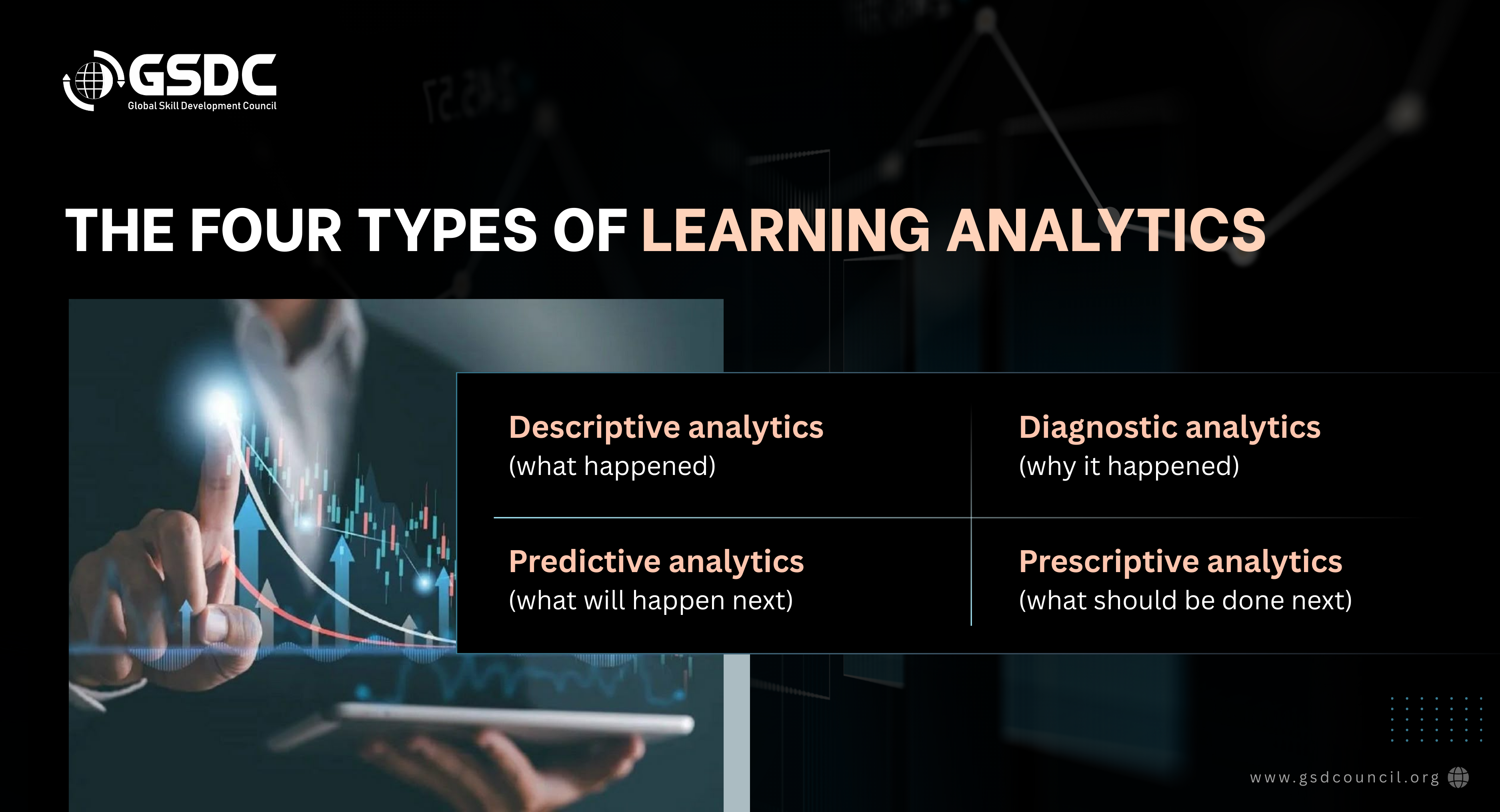
To move from training delivery to measurable impact, organizations are increasingly using learning analytics. The Consultancy-ME framework outlines four levels of analytics that help turn learning data into actionable insight.
1. Descriptive Analytics – “What happened?”
This is the simplest form of learning analytics. It is mainly concerned with providing information about the past, for example:
- Number of participants and students
- Percentage of completion and dropout rates for courses
- Grades
- Happiness of learners and their comments
Descriptive analytics reveal the learning activities but do not provide any explanation of whether training has enhanced performance or brought business value.
2. Diagnostic Analytics – "Why did it happen?"
This stage delves deeper into the analysis of patterns and the identification of root causes. It facilitates the understanding of questions like:
- What learners faced difficulties and why?
- At what point did the learners disengage or drop off?
- Which learning and development skills are lacking or weak?
Diagnostic analytics can be compared to a flashlight for L&D teams which reveals the causes of the performance gaps, just not the symptoms.
3. Predictive Analytics – “What will happen next?”
Predictive analytics rely on past learning data, trends, and AI models to forecast the outcomes. The technology can be employed to anticipate:
- Next skill shortages
- High-risk learners
- Possible performance declines
- Learning needs of the future by the role
At this point, L&D is essentially operating as a proactive, strategic partner of the business.
4. Prescriptive Analytics – “What should we do about it?”
The most advanced level of analytics is prescriptive analytics. It goes one step further by:
- Recommending personalized learning paths
- Suggesting targeted corrective training
- Optimizing content formats and delivery methods
This is where learning and development data analytics becomes true intelligence guiding decisions that directly improve performance and outcomes.
How Data Analytics Is Helping Learning and Organizational Outcomes
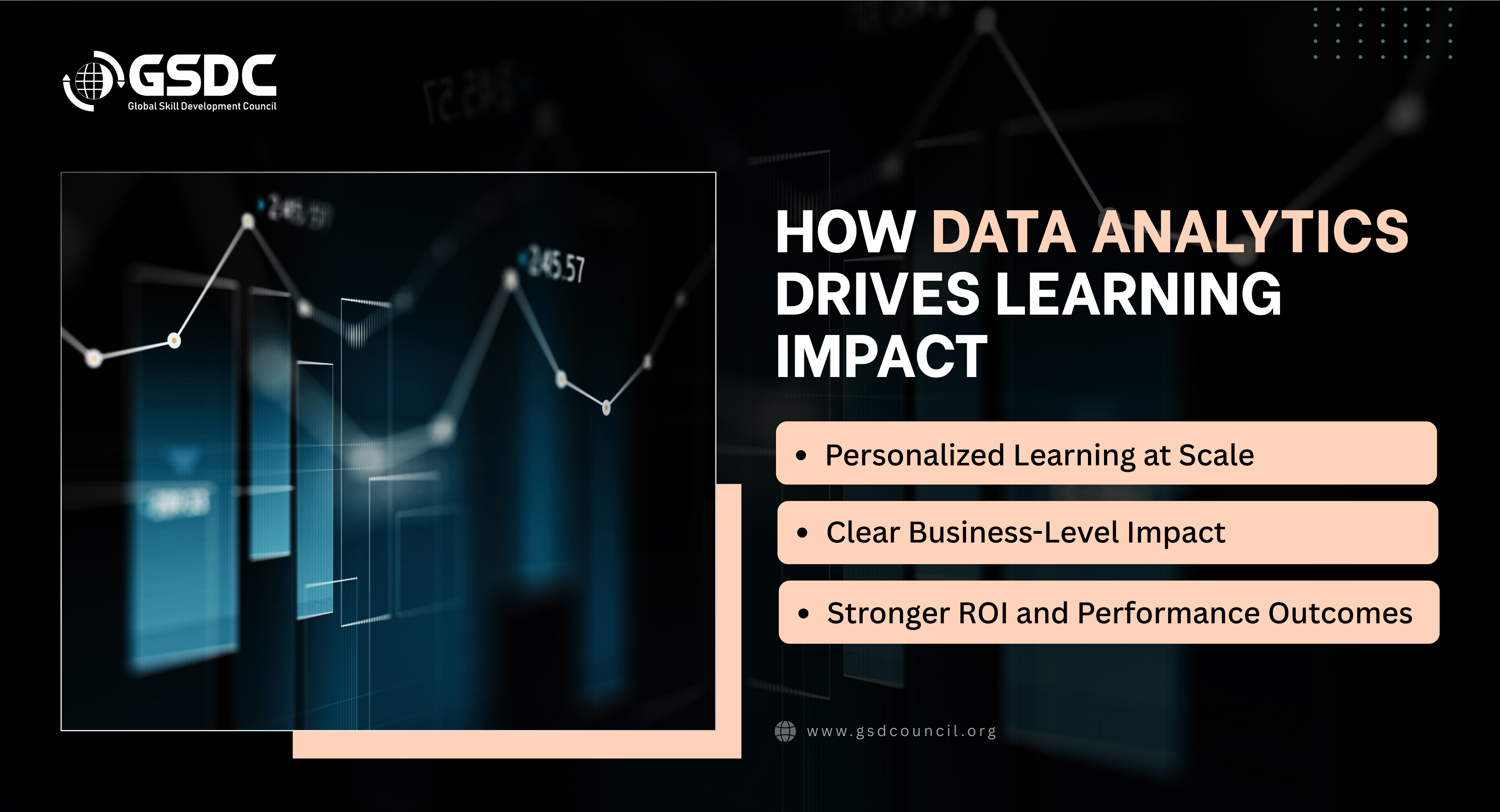
When learning decisions are guided by data, L&D moves beyond content delivery and starts driving measurable business results. This is how data analytics in learning and development creates real impact:
-
Personalized Learning at Scale
With the help of AI-based learning analytics, content can be customized by companies for the specific roles, skill levels, and performance requirements of individuals.
According to research, companies that implement analytics-driven personalization see a rise in learning efficiency by as much as 57%, thus making learning more suitable and productive for every employee.
-
Clear Business-Level Impact
Digital learning is no longer a supporting tool, but has become a strategic capability. Almost all big companies have made use of digital learning platforms, which is a clear indication that learning is a direct way of helping the business to become more productive, agile, and ready for the future workforce instead of just providing training content.
-
Stronger ROI and Performance Outcomes
By using data-driven methods for learning, companies have the ability to demonstrate how the training activities affect business metrics like productivity, quality, revenue growth, and retention.
Research in the various sectors of the industry keeps on revealing that well-planned and analytics-driven learning programs are the main contributors to the measurable business performance.
-
Higher Engagement and Retention
Once the learning becomes an aid to professional career and skill development, employees are bound to engage more deeply.
According to LinkedIn, 84% of employees claim that learning provides the main source of meaning to their work. As a result, there is a strong engagement and a higher retention rate.
📊 Turn your learning data into clear, actionable insights.Download the checklist for the following benefits:
🛠️ Explore practical tools and metrics made for real L&D challenges.
🚀 Download the L&D toolkit and start driving measurable impact today.
Challenges in Adopting Data-Driven L&D
Despite the clear advantages of data-driven learning, many organizations struggle to implement it effectively. Common challenges include:
- Learning data that is spread across various systems such as LMS, HRIS, and assessment platforms.
- Lack of sufficient analytics and data interpretation skills within L&D teams.
- The decision not to leave the traditional, activity-based training models in which the employees are resistant to change.
- Problems of Privacy, compliance, and data governance.
- Difficulty in establishing a direct link between learning data and job performance as well as business outcomes.
Due to these difficulties, a great number of L&D teams are struggling to find ways to transform data into actionable insight. An overwhelming majority of 87% of L&D leaders claim that they are not adequately equipped to accomplish their priorities, especially in such areas as analytics and digital learning capability.
Credentials such as the Certified L&D Analytics & Metrics Professional are designed to help L&D practitioners build practical analytics, metrics, and performance-measurement capabilities aligned with modern business needs.
The New Skill Set Required for Modern L&D Professionals
The role of L&D professionals is changing as learning becomes more data-driven. In order to have a measurable business impact, learning leaders of today need to acquire a wider and more analytical skill set.
To thrive in a data-driven environment, L&D professionals need to master:
- Acquiring knowledge about various measurement models like Kirkpatrick, ROI, and OKRs for evaluating the effectiveness of training.
- Developing skills in Learning and Development data analytics to be able to analyze learning data and recognize trends.
- Understanding the importance of aligning business KPIs to be able to link learning initiatives with company goals.
- Skill gap and capability analysis which will help in workforce planning and reskilling initiatives
- Creating dashboards and data storytelling to share the insights in a very clear manner with the leadership
- Using predictive and prescriptive analytics for understanding learning needs in advance and suggesting the next steps
- Connecting employee development directly to performance and productivity measurement
Professional bodies worldwide, for instance, the Global Skill Development Council (GSDC), acknowledge the widening gap in capability related to learning analytics.
As a result, they are leading a change to skill standards that are not only role-specific but also allow L&D professionals to transition from merely delivering training to making decisions that drive performance.
Why Learning and Development Certification is More Important Than Ever
With analytics taking a central role in L&D, a formally recognized learning and development certification is a must-have to show off one's professional credibility as well as capability and employability. It offers learners practical models, instruments for evaluating learning and development data, and the skill to make decisions supported by facts.
Such a program as GSDC Certified L&D Analytics & Metrics Professional offers a clear journey from the basics of analytics to the advanced measurement of the impact and thus, L&D professionals gain the confidence to establish the connection between learning and business results.

The Future of AI in Learning and Development
The integration of AI in learning and development is an ongoing process. In 2025:
- 42% of L&D leaders consider AI-powered learning as their main strategic priority
- 30% of the organizations have already invested in AI tools for learning and development
- The use of AI in L&D by organizations leads to better productivity and employee retention
- AI is opening the way for almost limitless deep personalization, predictive insights, and adaptive learning experiences.
- Learning analytics become indispensable rather than optional with the increased use of AI.
Together, these shifts show that AI is transforming how learning is designed, delivered, and measured, making data and analytics the foundation of modern L&D.
Final Thought: Data Has Become the New Operating System for L&D
Intuition and assumptions are not enough for learning and development anymore. Organizations that decide on learning based on evidence, actionable insights, integrated systems, and measurable business outcomes are the ones that will survive.
Data-driven L&D is not a temporary trend but rather the new way of working that is L&D's future. Such companies will be able to accelerate closing skill gaps, enhancing performance, and ensuring business success in the long run.

Related Certifications
Stay up-to-date with the latest news, trends, and resources in GSDC
If you like this read then make sure to check out our previous blogs: Cracking Onboarding Challenges: Fresher Success Unveiled
Not sure which certification to pursue? Our advisors will help you decide!