Becoming a Full-Stack Data Scientist: Bridging Analytics and Engineering
Written by Emily Hilton
- Why the Full Stack Data Scientist Role Matters Today?
- What Skills Do Data Scientists Need to Become Full Stack?
- Full Stack Data Scientist Roadmap: Step-by-Step Guide
- Is Full Stack Better Than Traditional Data Science?
- GSDC’s Full Stack Data Scientist Certification: A Smart Career Investment
- Career Scope & Salary Trends in 2025
- Conclusion: Your Path to Becoming a Full-Stack Data Scientist
As the tech world adoption and optimizes new technologies, organizations no longer rely on isolated roles for analytics, engineering, and machine learning. They increasingly seek professionals who can bridge the entire spectrum from data ingestion and preprocessing to modeling, deployment, and monitoring. This emerging role is known as the full-stack data scientist, a hybrid expert who blends analytical thinking with robust engineering capabilities.
But what is a full-stack data scientist in 2025? Simply put, it’s a professional who understands data end-to-end. They can extract raw data, build pipelines, develop statistical and machine learning models, deploy solutions to production, and manage them with engineering-grade discipline. As more companies shift toward scalable AI and automation, the demand for full-stack data scientist jobs is growing faster than ever.
If you want to take your career to the next level, build job-ready expertise, and meet industry expectations, understanding the full-stack data scientist roadmap becomes essential. This blog breaks down what you need to learn, how to begin, and how certifications like the GSDC Full Stack Data Scientist Certification can strengthen your profile.Why the Full Stack Data Scientist Role Matters Today?
Traditionally, the data ecosystem was divided into siloed roles: data engineers managed pipelines, data scientists built models, and ML engineers deployed systems. While specialization still matters, businesses today prefer professionals who understand the entire cycle.
A full-stack data scientist offers several advantages:
- They reduce dependency on multiple roles.
- They build solutions that are more cohesive and production-ready.
- They handle both analytics and engineering, making data products scalable.
- They bring agility to AI development by handling tasks independently.
This combination of versatility and technical depth directly impacts the full-stack data scientist salary, which often surpasses traditional data science compensation. With expertise across analytics, pipelines, and deployment, these professionals are among the highest paid in the tech ecosystem.
To understand cross-functional development roles, revisit What Is a Full Stack Developer to compare how full-stack approaches differ between software and data.
What Skills Do Data Scientists Need to Become Full Stack?
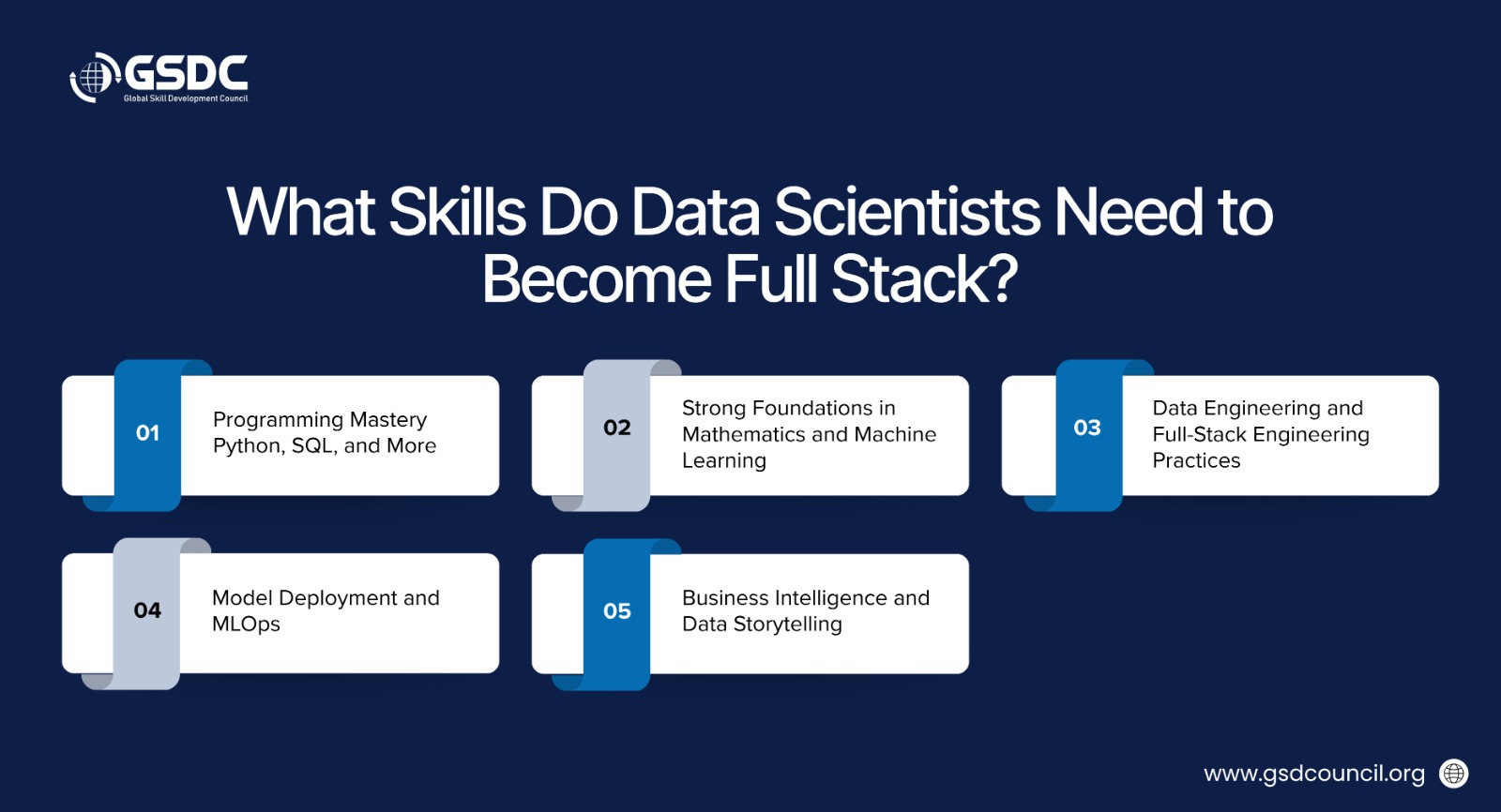
To excel in this hybrid role, you must master both analytical and engineering capabilities. When discussing what skills do data scientists need, the list becomes broader and more integrated for full-stack practitioners. Here are the core full-stack data scientist skills you must develop:
1. Programming Mastery Python, SQL, and More
Proficiency in Python is essential; it's the backbone of data science. But full-stack professionals must also know:
- SQL for data extraction
- PySpark or Scala for big data
- APIs and backend scripting for deployment
These are essential skills a data scientist needs when working in production environments.
2. Strong Foundations in Mathematics and Machine Learning
You must understand:
- Probability
- Statistics
- Linear algebra
- Supervised and unsupervised learning
- Deep learning fundamentals
These analytical capabilities help you design effective models rather than just running predefined algorithms.
3. Data Engineering and Full-Stack Engineering Practices
This is where full-stack talent differentiates itself.
Full-stack engineering elements include:
- ETL/ELT pipeline creation
- Working with cloud platforms
- Database management and optimization
- Building scalable, distributed systems
Understanding data plumbing makes you closer to a full-stack data engineer, a role often paired with advanced data science work. This knowledge also boosts your understanding of the full stack data engineer salary benchmarks and responsibilities.
4. Model Deployment and MLOps
Data science is incomplete without deployment. Full-stack professionals must know:
- Docker
- CI/CD pipelines
- Model versioning
- APIs for serving predictions
- Monitoring tools
These full stack data scientist skills make you capable of delivering real-world AI systems.
5. Business Intelligence and Data Storytelling
A full stack expert must communicate insights clearly. This requires:
- Data visualization
- Dashboarding
- Decision-making frameworks
- Domain knowledge
These capabilities overlap with full stack data analyst responsibilities, especially when translating data into actions.
Full Stack Data Scientist Roadmap: Step-by-Step Guide
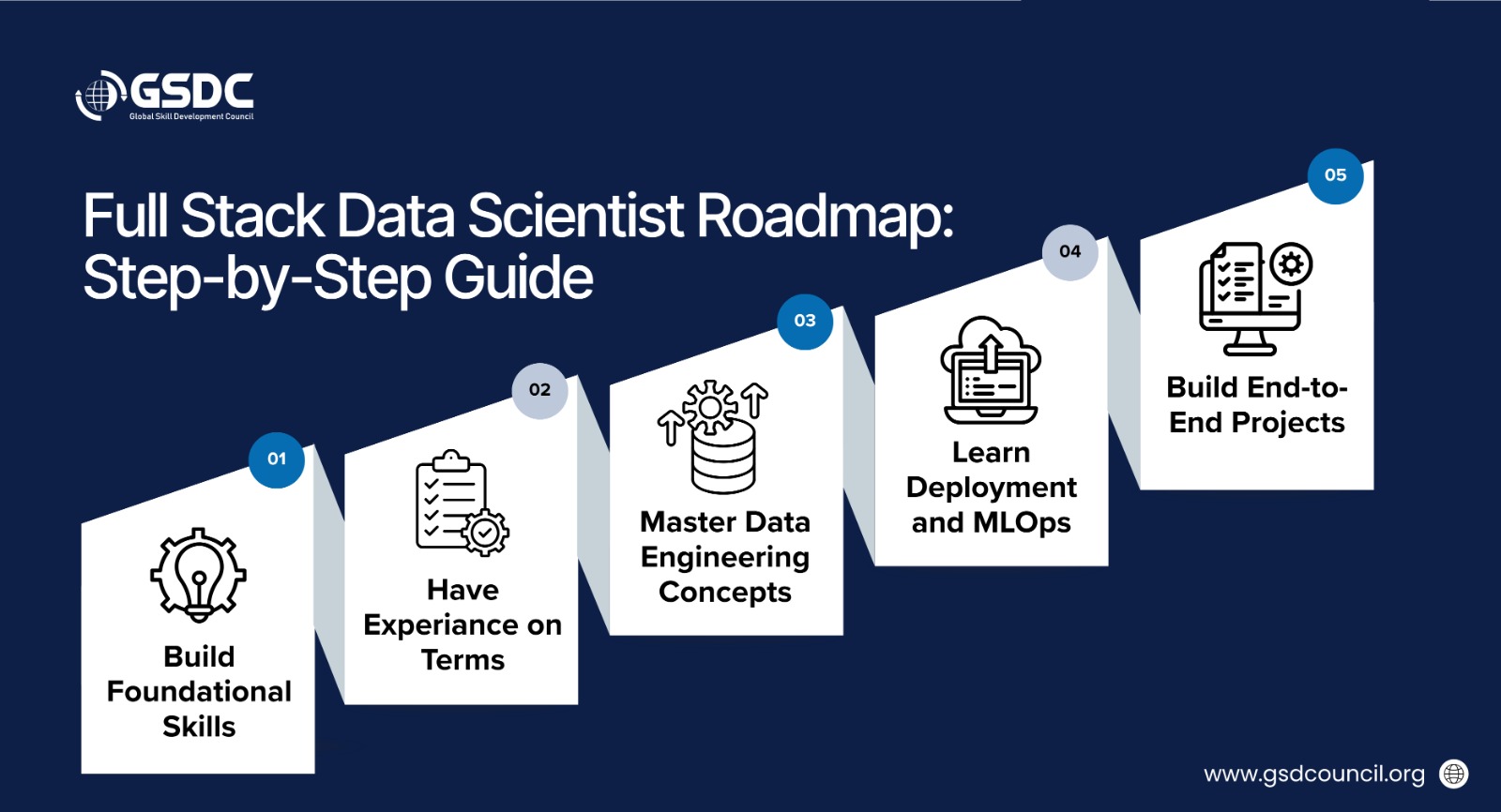
If you’re wondering how to become a full stack data scientist, here is a clear and structured Full Stack Developer Roadmap.
Step 1: Build Foundational Skills
Start with:
- Python
- SQL
- Statistics
- Excel fundamentals
You cannot jump into advanced techniques without solid groundwork.
Step 2: Have Experience on Terms
Gain hands-on experience with:
- Regression and classification
- Clustering
- Feature engineering
- Model evaluation
- Real-world ML case studies
This forms the backbone of any full-stack data science work.
Step 3: Master Data Engineering Concepts
Move on to:
- Data warehouses
- ETL processes
- Airflow or Prefect
- Cloud platforms like AWS or GCP
- Big data tools like Spark
These steps form the engineering foundation needed for full-stack understanding.
Step 4: Learn Deployment and MLOps
Your model is truly valuable only when deployed. Learn:
- Docker
- FastAPI or Flask
- CI/CD
- Monitoring frameworks
- Kubernetes (optional but powerful)
This transition transforms you from a traditional data scientist into a full-stack data scientist.
Step 5: Build End-to-End Projects
Create projects involving:
- Data ingestion
- Preprocessing
- Machine learning
- Deployment
- Reporting or dashboards
These portfolio items reflect the complete full stack data scientist roadmap.
Is Full Stack Better Than Traditional Data Science?
Understanding which is better full stack or data science depends on your career goals. Traditional roles focus on analytics and modeling, while full-stack roles combine engineering with machine learning.
If you prefer:
- Production-grade systems
- End-to-end AI delivery
- Higher pay and broader responsibilities
- Cross-functional leadership roles
Then full-stack data science is the better path.
🌟 Full-Stack Data Science Made Simple
Download the comprehensive roadmap to tools, techniques, and career tips.
Transform your knowledge into impactful data solutions!
GSDC’s Full Stack Data Scientist Certification: A Smart Career Investment
Aspiring professionals often need structured learning to become job-ready. The GSDC Full Stack Data Scientist Certification is designed for learners who want to master full-stack analytics and engineering competencies.
Why Choose GSDC Certification?
- Covers the complete lifecycle: data engineering, ML, and deployment
- Industry-recognized certification with global validity
- Hands-on assignments and capstone projects
- Supports learning for full-stack data scientist jobs
- Validates your capability as an end-to-end data expert
This GSDC’s certification strengthens your profile, improves your employability, and gives you a structured path to understand how to become a full-stack data scientist.
For professionals looking to upskill, it functions like a full-stack certification tailored specifically for AI and data.

Career Scope & Salary Trends in 2025
Full-stack roles command some of the highest salaries in the tech market. Companies seek professionals who save time, reduce dependencies, and deliver complete AI solutions. As per Glassdoor report, the average salary for a Full Stack Data Scientist in India is around ₹11.25 LPA.
Full-stack data scientist salary ranges vary by experience, but they consistently exceed traditional data roles due to the hybrid skill set.
Roles you can pursue include:
- Full Stack Data Scientist
- Full Stack Data Engineer
- ML Engineer
- AI Engineer
- Data Product Developer
- Full Stack Data Analyst
With the rise of real-time analytics and cloud-driven AI, the demand for these profiles is only increasing.
Conclusion: Your Path to Becoming a Full-Stack Data Scientist
The rise of the full-stack data scientist marks a new era in data careers. Businesses want experts who can build datasets, develop AI models, deploy them, and create impact across the entire lifecycle. As organizations accelerate the adoption of automation, machine learning, and cloud platforms, full-stack roles will continue to dominate the job market.
With the right skills, roadmap, and industry-backed certification like the GSDC’s Full Stack Data Scientist Certification, you can position yourself as a highly demanded professional capable of driving complete AI solutions.
Whether you're transitioning from analytics, engineering, or starting fresh, this is the best time to upskill and pursue full-stack mastery. The opportunities are vast, the salaries are competitive, and the future belongs to those who can understand and execute AI end-to-end.

Related Certifications
Stay up-to-date with the latest news, trends, and resources in GSDC
If you like this read then make sure to check out our previous blogs: Cracking Onboarding Challenges: Fresher Success Unveiled
Not sure which certification to pursue? Our advisors will help you decide!