The Role of AI in Strengthening Business Risk Assessment and Mitigation
Written by Akshad Modi
- Understanding Business Risk Assessment in the Digital Age
- The Role of AI in Transforming Risk Assessment
- Predictive Analytics: Anticipating Risk Before It Happens
- The Role of Artificial Intelligence in Risk Mitigation
- AI and the Modern Business Risk Management Framework
- Operational and Cyber Risk: AI in Action
- The Role of AI in Marketing and Risk Management
- What are the Benefits of AI for Risk Leaders?
- Challenges and Considerations in AI-Driven Risk Management
- Risk and AI Compliance Certifications
- Conclusion: AI as a Cornerstone of Future-Ready Risk Strategies
The modern risk landscape is being reshaped by digital disruption, geopolitical volatility, intensifying cyber threats, and evolving regulatory expectations. As risks become more interconnected and fast-moving, organizations face growing exposure to operational failures, financial uncertainty, data breaches, and reputational damage, making proactive and adaptive risk management a business necessity rather than a choice.
Traditional risk management approaches, which rely heavily on historical data and manual analysis, are increasingly inadequate. This is where artificial intelligence emerges as a transformative force. The role of AI in strengthening business risk assessment and mitigation lies in its ability to process massive datasets, identify hidden patterns, predict emerging threats, and enable faster, smarter decision-making.
This blog explores how AI enhances risk assessment, strengthens mitigation strategies, integrates into a modern business risk management framework, and delivers measurable value across industries, including insights into GSDC’s certification and what is the benefits of AI and the growing role of AI in marketing within enterprise risk strategies.
Understanding Business Risk Assessment in the Digital Age
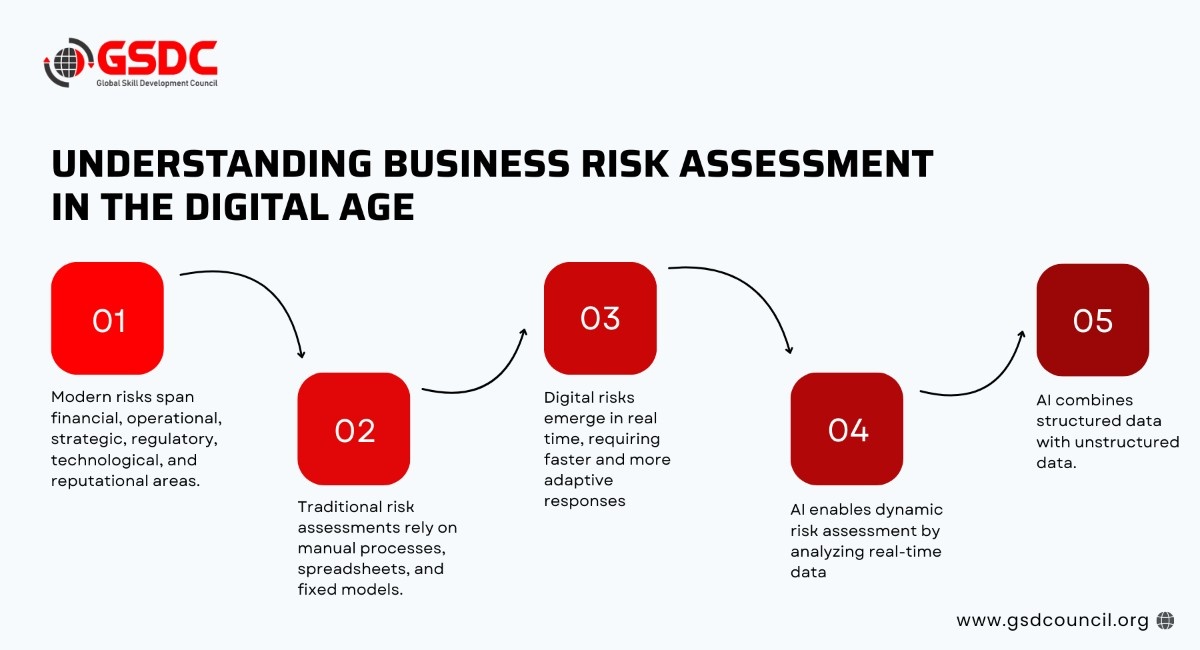
The current digital business environment requires organizations to create effective risk assessment methods that evaluate potential threats to their business objectives. Organizations face various threats, including financial dangers, operational hazards, strategic problems, regulatory issues, technological vulnerabilities, and risks to their public image.
Static, manual methods no longer keep up with real-time threats such as cyberattacks, supply-chain disruptions, and rapid shifts in customer sentiment. Organizations now need agile, technology-driven frameworks, where AI plays a critical role by enabling continuous, data-driven risk evaluation and timely decision-making.The Role of AI in Transforming Risk Assessment
The role ofAI in risk assessment is rooted in its ability to learn from data and adapt over time. Machine learning models continuously improve as they process new information, allowing organizations to detect emerging risks that traditional models might miss.
Key ways AI strengthens business risk assessment include:
- Pattern recognition at scale, identifying anomalies and correlations across vast datasets
- Predictive risk modeling, forecasting potential threats before they materialize
- Continuous monitoring, replacing periodic reviews with real-time visibility
- Reduced human bias, enabling more consistent and objective risk evaluation
These capabilities transform risk assessment from a retrospective exercise into a proactive, forward-looking discipline.
Predictive Analytics: Anticipating Risk Before It Happens
One of the most powerful applications of AI in risk management is predictive analytics. By analyzing historical trends alongside real-time data, AI models can forecast potential risk scenarios and estimate their likelihood and impact.
For example:
- AI technology helps financial institutions assess customer credit risk while predicting fluctuations in financial markets.
- Manufacturing companies use predictive maintenance models to forecast when their machines will stop working.
- Supply chain leaders use data on logistics and weather conditions and supplier performance to identify potential disruptions.
The predictive ability of this system allows businesses to assess their operational risks because it enables them to detect potential risks before they become actual incidents. The organizations that use AI technology to manage risks better demonstrate its value through their ability to create preventive controls and mitigation strategies that protect them from emerging threats.
The Role of Artificial Intelligence in Risk Mitigation
AI helps organizations identify risks, but its main function exists to strengthen risk mitigation efforts through its three main functions.
Artificial intelligence helps organizations reduce risks by using its three capabilities, which include automatic response systems, decision support tools, and ongoing control system improvements.
Key Ways AI Enhances Risk Mitigation
- Early Threat Detection: AI systems continuously analyze data streams to detect anomalies, enabling faster identification of security threats, compliance violations, or operational failures.
- Automated Risk Scoring and Prioritization: AI can assess multiple risk variables simultaneously and assign dynamic risk scores, helping organizations focus mitigation efforts where they matter most.
- Decision Support for Risk Response: By simulating scenarios and outcomes, AI provides actionable recommendations that support informed mitigation decisions.
- Incident Response Optimization: AI assists in coordinating incident response by automating routine tasks, categorizing alerts, and suggesting corrective actions, reducing response time and impact.
Through these capabilities, AI strengthens not only business risk assessment but also the execution of mitigation strategies, reinforcing enterprise resilience.
AI and the Modern Business Risk Management Framework
A business risk management framework provides the structured foundation for identifying, assessing, mitigating, and monitoring risks. Common frameworks such as ISO 31000 and COSO ERM emphasize governance, accountability, and continuous improvement.
AI enhances the business risk management framework by making it more dynamic, intelligent, and responsive:
- Risk identification becomes continuous, not periodic
- Risk evaluation adapts in real time, reflecting new data
- Controls evolve dynamically, based on changing conditions
- Reporting becomes more accurate and timely, improving governance
By embedding AI into the business risk management framework, organizations shift from static compliance-driven models to adaptive, insight-driven risk strategies.
Operational and Cyber Risk: AI in Action
AI has shown strong performance for these two areas because it addresses the most important threats that modern businesses face. The system performs its task by using AI technology to protect networks through its ability to monitor network traffic and detect when users access protected areas of the system.
Through its ability to predict equipment failures, quality problems, and operational inefficiencies, AI helps businesses reduce their operational downtime and financial damages.
The applications demonstrate how organizations can achieve various advantages through AI implementation, which includes better system resilience, speedier response times, decreased financial losses, and greater trust from stakeholders.
The Role of AI in Marketing and Risk Management
AI functions in marketing through three main components, which include personalized content delivery, customer segmentation, and predictive modeling. The technology helps businesses through its marketing applications while delivering similar advantages to their risk management functions.
The AI marketing analytics system enables organizations to:
- Detect reputational risks through sentiment analysis
- Identify abnormal customer behaviour linked to fraud
- Monitor advertising and data usage practices to ensure regulatory compliance
Organizations achieve a complete understanding of their growth prospects and associated dangers through marketing AI systems, which they incorporate into their corporate risk management procedures. The business world shows increased adoption of AI technology through its two distinct applications, which create new opportunities for organizations.
What are the Benefits of AI for Risk Leaders?
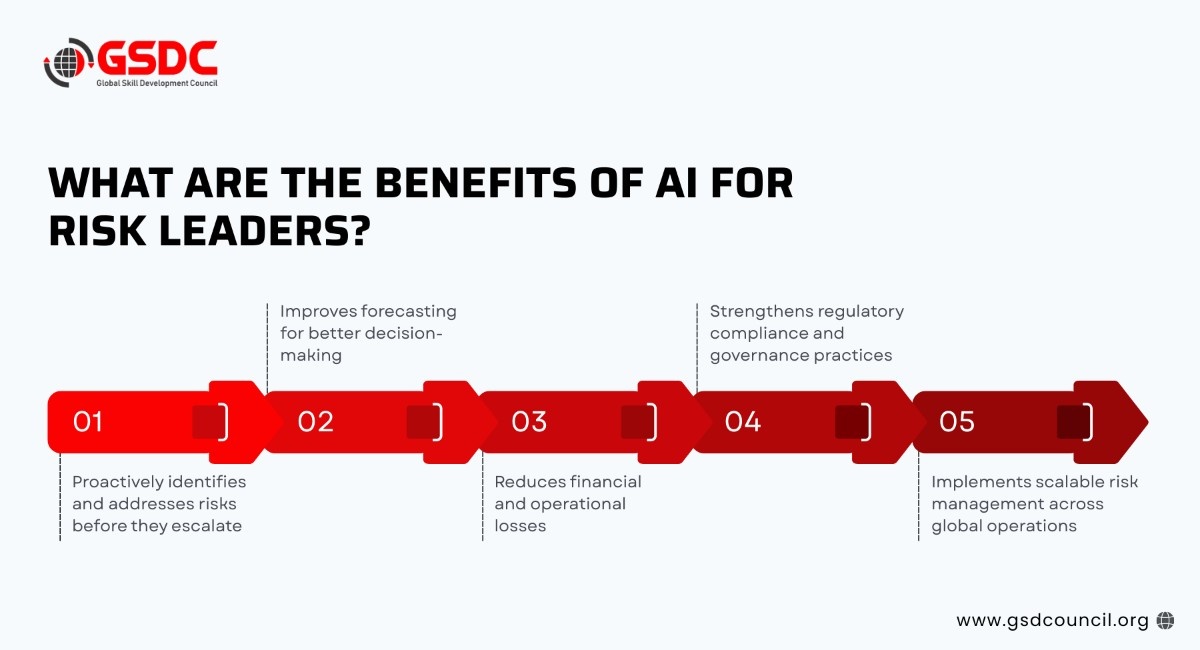
When evaluating what is the benefits of AI in risk assessment and mitigation, the value extends beyond efficiency gains:
- The organization practices active risk detection instead of waiting to respond to emergencies. The organization achieves better decision outcomes because of its ability to forecast upcoming events.
- The organization experiences decreased financial and operational losses.
- The organization establishes stronger regulatory compliance standards, thereby improving its governance practices.
- The organization implements risk management solutions that can expand to cover its entire international business operations.
AI enables risk management professionals to shift from risk protection to developing risk intelligence systems that help their businesses grow while maintaining their market position.
Challenges and Considerations in AI-Driven Risk Management
Despite its advantages, implementing AI in risk management is not without challenges. Organizations must address:
- Data quality and bias, which can affect model accuracy
- Ethical and regulatory concerns, including transparency and accountability
- Governance and skills gaps, requiring new competencies and oversight
A responsible approach to AI adoption ensures that these risks are addressed within the business risk management framework, reinforcing trust and sustainability.
Risk and AI Compliance Certifications
GSDC certifications offer structured learning paths to strengthen risk and compliance expertise. The curriculum spans risk management practices, compliance frameworks, and regulatory considerations for AI systems.
The Certified Generative AI in Risk & Compliance Program dives deeper into generative AI, focusing on ethical adoption, legal compliance, and governance models, equipping professionals with practical skills for managing AI-related risks.
Conclusion: AI as a Cornerstone of Future-Ready Risk Strategies
The role of AI in strengthening business risk assessment and mitigation is no longer theoretical; it is a practical necessity. From predictive analytics and real-time monitoring to intelligent mitigation and cross-functional insights, AI is redefining how organizations understand and manage risk.
By embedding AI into the business risk management framework, enterprises gain the agility, foresight, and resilience needed to thrive in an uncertain world. As the role of AI in marketing and other functions continues to expand, AI becomes not just a risk management tool but a strategic enabler of sustainable growth.
Ultimately, understanding what is the benefits of AI in risk management means recognizing its power to transform uncertainty into informed action and risk into opportunity.

Related Certifications
Stay up-to-date with the latest news, trends, and resources in GSDC
If you like this read then make sure to check out our previous blogs: Cracking Onboarding Challenges: Fresher Success Unveiled
Not sure which certification to pursue? Our advisors will help you decide!