Using ISO 31000 to Improve Risk-Informed Decision-Making
Written by Marcellina Eugenia
- Why Traditional Decision-Making Is No Longer Enough
- Understanding ISO 31000
- The Three Pillars of ISO 31000
- How ISO 31000 Reduces Analysis Paralysis
- Risk-Informed Decision-Making vs. Traditional Decision-Making
- Four Critical Success Factors for Implementing ISO 31000
- Building a Risk-Aware Organization
- Build Expertise with the Certified ISO 31000:2018 Risk Manager
- Conclusion
Every business decision involves uncertainty. Whether launching a new product, entering a new market, investing in technology, or responding to changing regulations, organizations constantly face risks that can influence their objectives. Traditionally, many organizations have viewed risk management as a compliance exercise focused on avoiding losses or satisfying regulatory requirements. However, today's fast-changing business environment demands a different approach.
Organizations now operate in a world characterized by economic uncertainty, technological disruption, geopolitical challenges, evolving customer expectations, and rapidly changing markets. In such conditions, delaying decisions until every piece of information is available can become a greater risk than acting with incomplete information.
This is where ISO 31000 plays a critical role. Based on the ISO 31000 principles, the framework helps organizations understand uncertainty, evaluate potential outcomes, and strengthen risk informed decision making. It transforms risk management from a defensive process into a strategic capability that supports growth, resilience, and innovation.
This webinar explored how ISO 31000 enables organizations to improve risk informed decision making, overcome common decision-making barriers, and embed risk awareness into everyday business operations.
Why Traditional Decision-Making Is No Longer Enough
Many organizations still rely on decision-making approaches that were designed for a far more predictable business environment. Unfortunately, today's markets are anything but predictable.
Rapid technological change, economic uncertainty, and global disruptions have exposed the limitations of traditional decision-making models. Organizations often respond to uncertainty by gathering more reports, requesting additional analysis, and involving more stakeholders in an attempt to eliminate risk before taking action.
While these efforts are well-intentioned, they frequently lead to slower decisions rather than better risk informed decision making.
Three common challenges often prevent organizations from making timely, risk-informed decision making.
The Illusion of Certainty
Many leaders believe that collecting more information automatically leads to better decisions.
As a result, organizations spend valuable time requesting additional reports, building complex spreadsheets, and extending approval processes in search of complete certainty.
However, complete certainty rarely exists in today's business environment.
Markets change rapidly, customer behavior evolves continuously, and new risks emerge almost daily. Waiting until every uncertainty disappears often means missing valuable opportunities or reacting too late to changing conditions.
Effective organizations recognize that decision-making should be based on sufficient, reliable information rather than perfect information.
The Consensus Trap
Another common obstacle is the desire to achieve complete agreement before moving forward.
Organizations often bring together multiple departments and stakeholders to develop solutions that satisfy everyone involved. Although collaboration is valuable, excessive consensus-building can dilute strong strategies and delay execution.
When every perspective receives equal weight, decisions may become overly cautious, making it difficult to respond quickly to changing business conditions.
Risk-informed organizations understand that effective decision-making requires clear accountability. Not every stakeholder needs to fully agree before action can be taken.
The Speed Fallacy
Many organizations assume that slower decisions are safer decisions.
In reality, delayed decisions often increase business risk.
Information has a very short lifespan in today's environment. Market conditions, regulations, customer expectations, and competitive landscapes can change within days or even hours.
A reasonably informed decision implemented today often creates greater value than a nearly perfect decision made weeks later.
Organizations that continuously monitor results and adjust their strategies are better positioned to respond to uncertainty than those waiting for complete confidence before acting.
Understanding ISO 31000
ISO 31000 is an internationally recognized risk management framework that helps organizations integrate risk into strategic and operational decision-making.
Unlike compliance-focused approaches, ISO 31000 defines risk as the effect of uncertainty on objectives. This definition fundamentally changes how organizations think about risk.
Rather than asking, "How do we avoid risk?" organizations begin asking, "How do we understand uncertainty well enough to make better decisions?"
The ISO 31000 principles encourage organizations to balance opportunities and threats instead of focusing solely on preventing negative outcomes. ISO 31000 therefore supports both value creation and value protection.
Instead of becoming a separate activity handled exclusively by compliance teams, risk management becomes embedded within planning, governance, strategy, investment decisions, and daily operations.
The Three Pillars of ISO 31000
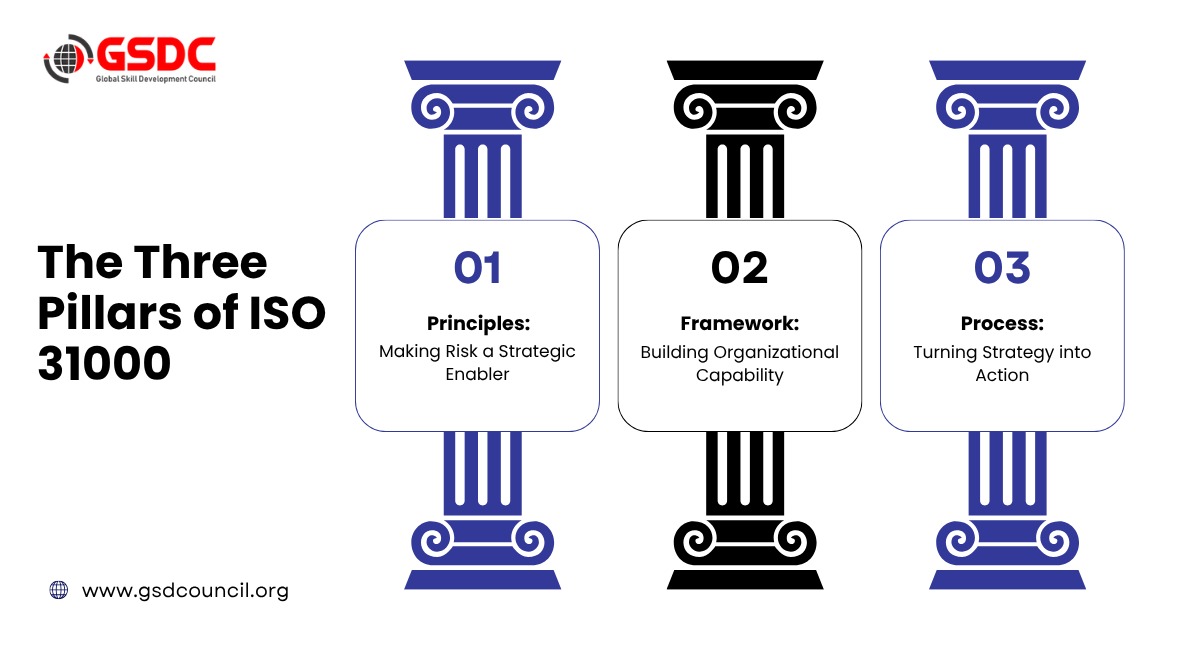
The ISO 31000 framework is built on three interconnected components that work together to improve organizational decision-making.
1. Principles: Making Risk a Strategic Enabler
The principles form the foundation of the entire framework.
ISO 31000 emphasizes that risk management should create and protect value rather than simply prevent losses.
This means organizations should integrate risk considerations into every important decision, including business strategy, investment planning, innovation initiatives, operational improvements, and market expansion.
Risk management should never operate in isolation.
Instead, it should support organizational objectives by helping leaders understand uncertainty before making important decisions.
Another important principle is that risk management must remain dynamic.
Business environments constantly evolve, and organizations must continuously adapt their risk management practices to reflect new realities rather than relying on outdated assumptions.
2. Framework: Building Organizational Capability
The framework translates these principles into organizational structures and governance.
Leadership commitment is the most important element of this pillar.
Risk management cannot succeed unless senior leadership actively supports it.
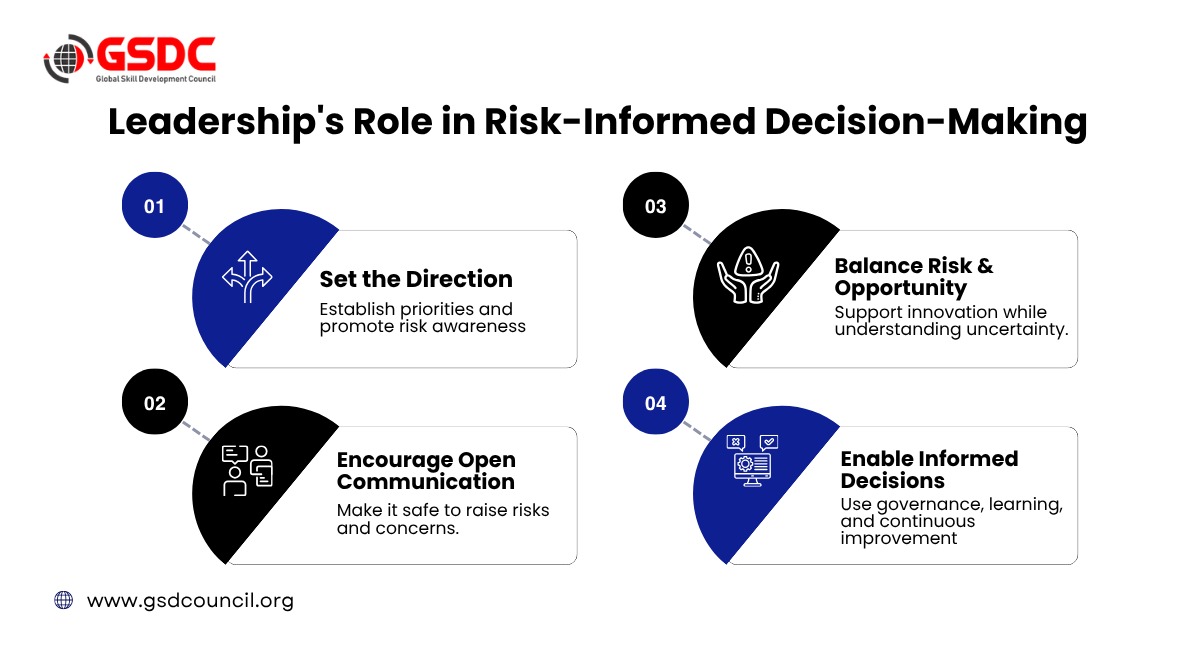
Executives are responsible for defining risk appetite, establishing governance structures, allocating resources, and ensuring accountability across the organization.
Without leadership involvement, risk management quickly becomes a compliance exercise rather than a strategic capability.
The framework also ensures that employees understand how risk responsibilities are distributed throughout the organization.
Clear reporting structures, defined responsibilities, and effective communication enable faster and more consistent decision-making during periods of uncertainty.
Ultimately, the framework creates an environment where employees no longer guess what level of risk is acceptable because organizational expectations have already been established.
3. Process: Turning Strategy into Action
The process represents the operational side of ISO 31000.
Unlike traditional annual risk assessments that quickly become outdated, ISO 31000 promotes a continuous cycle of improvement.
Organizations begin by establishing the context before identifying potential risks that could affect business objectives.
These risks are then analyzed, evaluated, treated, monitored, and regularly reviewed as business conditions evolve.
Communication and consultation remain essential throughout every stage of the process.
Risk management is not a one-time exercise but an ongoing conversation involving leadership, business units, operational teams, and other stakeholders.
Continuous monitoring ensures organizations can quickly adjust their responses whenever new information becomes available.
This iterative process allows businesses to remain agile while maintaining strong governance.
How ISO 31000 Reduces Analysis Paralysis
One of the greatest advantages of ISO 31000 is its ability to reduce analysis paralysis.
Many organizations hesitate when faced with uncertainty because they lack a structured decision-making approach.
ISO 31000 provides that structure.
Instead of relying solely on intuition or historical assumptions, organizations follow a consistent framework for evaluating uncertainty and selecting appropriate responses.
Leadership provides clear direction regarding acceptable risk levels, while operational teams understand when they can proceed independently and when escalation is necessary.
This clarity eliminates unnecessary hesitation and enables faster execution.
The framework also encourages organizations to evaluate outcomes continuously rather than waiting for annual reviews or audits.
If market conditions change or risks evolve, organizations can quickly adapt their strategies without abandoning governance principles.
Rather than attempting to eliminate every possible risk, ISO 31000 helps organizations understand which risks are worth taking and which require mitigation.
This balanced approach enables organizations to act decisively while remaining resilient in uncertain environments.
Risk-Informed Decision-Making vs. Traditional Decision-Making
Organizations that embrace ISO 31000 do more than improve their risk management frameworks; they fundamentally change the way decisions are made.
Traditional decision-making often depends on historical experience, fragmented information, and intuition. Risk assessments are frequently treated as annual compliance activities, conducted separately from strategic planning. When unexpected events occur, accountability becomes unclear, with different departments attributing responsibility to one another instead of focusing on solutions.
Risk-informed organizations take a different approach. Decisions are supported by cross-functional information, clearly defined responsibilities, and continuous risk informed decision making. Rather than viewing risk as an obstacle, these organizations consider it an essential factor in strategic planning and operational execution.
The difference becomes especially evident during periods of uncertainty. Organizations that embed risk into decision-making can adapt more quickly, protect their resources more effectively, and identify opportunities that competitors may overlook.
Instead of reacting to change, they are prepared to respond with confidence because risk has already been considered throughout the planning process.
Four Critical Success Factors for Implementing ISO 31000
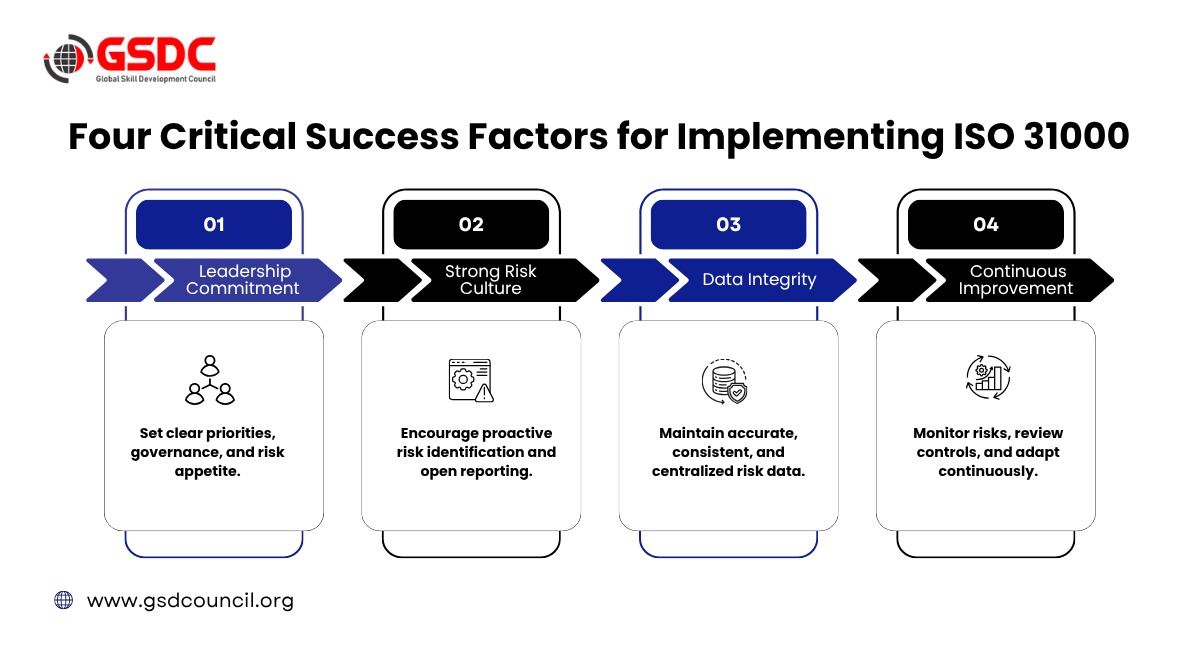
Successfully implementing ISO 31000 requires more than documenting policies or conducting periodic risk assessments. Organizations must establish the right culture, governance, and systems to ensure that risk management becomes part of everyday decision-making.
1. Leadership Commitment
Leadership commitment is the foundation of every successful risk management program.
Risk management cannot be delegated entirely to compliance teams or middle management. Senior executives and business leaders must actively demonstrate that risk-informed decision-making is a strategic priority.
This commitment is reflected through clear governance, resource allocation, defined risk appetite, and consistent communication across the organization.
When leadership visibly supports risk management, employees understand that identifying and discussing risks is encouraged rather than discouraged.
2. Building a Strong Risk Culture
A strong risk culture empowers employees at every level to recognize, communicate, and manage risks before they become significant problems.
Frontline employees often identify emerging risks long before senior leadership becomes aware of them. Organizations should therefore encourage employees to report concerns without fear of criticism or blame.
Creating this culture requires collaboration between business teams, operational leaders, and risk professionals. Instead of treating risk management as a separate department's responsibility, organizations should integrate it into everyday planning, project management, and decision-making.
A proactive culture helps organizations detect issues earlier while creating greater organizational resilience.
3. Ensuring Data Integrity
Reliable decision-making depends on reliable information.
Organizations cannot effectively manage enterprise risk if different departments maintain disconnected spreadsheets or inconsistent records.
ISO 31000 encourages organizations to establish centralized governance and risk management systems that provide a single source of reliable information.
Accurate, timely, and consistent data enables leaders to evaluate risks objectively while improving collaboration across departments.
Strong data governance also reduces duplication, improves reporting quality, and supports faster decision-making.
4. Continuous Monitoring and Improvement
Risk management should never remain static.
Business environments change constantly due to new technologies, evolving regulations, competitive pressures, and market disruptions.
ISO 31000 promotes continuous monitoring, regular reviews, and ongoing improvements rather than relying solely on annual assessments.
Organizations should regularly evaluate whether identified risks remain relevant, whether controls continue to be effective, and whether new uncertainties require additional attention.
This continuous improvement mindset allows organizations to remain agile while strengthening long-term resilience.
Building a Risk-Aware Organization
ISO 31000 helps organizations build a risk-aware culture where employees consider uncertainty as part of everyday decision-making rather than treating risk management as a compliance task.
This requires clear communication, collaboration between business and risk teams, and practical training on identifying and responding to risks.
Workshops, discussions, and scenario planning can reinforce these skills. Over time, risk-informed thinking becomes part of daily operations, supporting better decisions and stronger business resilience.
Build Expertise with the Certified ISO 31000:2018 Risk Manager
The Certified ISO 31000:2018 Risk Manager certification from GSDC helps professionals build practical expertise in identifying, assessing, evaluating, treating, and monitoring organizational risks. The program covers the ISO 31000:2018 principles, risk management framework, risk assessment techniques, risk treatment strategies, and governance integration.
Learners also gain practical exposure through expert-led sessions, practice exams, capstone projects, and an ISO 31000 auditing toolkit. With self-paced learning, SME connect sessions, and job support, the certification can help risk professionals, managers, consultants, auditors, and business leaders strengthen their risk management capabilities and support more informed organizational decision-making.
Conclusion
In today's evolving business environment, uncertainty is unavoidable, making risk-informed decision making essential. ISO 31000 provides a practical risk management framework for understanding uncertainty, integrating risk into strategic planning, and making informed decisions. By embedding risk management into leadership, governance, and daily operations, organizations can improve resilience, agility, and long-term value creation.

Related Certifications
Frequently Asked Questions
ISO 31000 helps organizations integrate risk management into decision-making and manage uncertainty effectively.
Yes. ISO 31000 is a flexible framework that can be adapted to organizations across industries and sizes.
Leaders can encourage open communication, early risk reporting, collaboration, and risk-informed decision making.
Measuring effectiveness can be challenging because successful risk prevention may result in fewer visible incidents.
No. ISO 31000 focuses on understanding and managing risks to support informed decisions and organizational objectives.
Stay up-to-date with the latest news, trends, and resources in GSDC
If you like this read then make sure to check out our previous blogs: Cracking Onboarding Challenges: Fresher Success Unveiled
Not sure which certification to pursue? Our advisors will help you decide!