Leadership’s Role in Risk-Informed Decision-Making

Written by Rohan Athalye
- Coaching, Mentoring, and Team Management: Understanding the Difference
- Designing an Effective Coaching Process
- Best Practices for Building Successful Coaching Programs
- Building a Coaching Culture in the Workplace
- Internal vs. External Coaching: Which Is Better?
- Coaching as a Leadership Mindset and Way of Life
- Conclusion
Organizations today are navigating constant change, rapid technology shifts, and evolving employee expectations. In this environment, technical skills alone aren’t enough people also need adaptability, self-awareness, resilience, and confidence.
That’s where professional coaching comes in. Unlike traditional training, coaching helps people discover their own solutions through meaningful conversations, active listening, and thoughtful questions. A professional coach supports individuals in improving performance, strengthening accountability, and taking greater ownership of personal growth. Career coaching can also help employees navigate career goals, transitions, and professional development.
As coaching becomes an important part of leadership development coaching and employee development, this webinar explored how coaching can improve individual performance, strengthen organizations, and contribute to long-term organizational development and Organizational Growth.
Why Professional Coaching Has Become a Business Necessity?
- Supports Adaptability: Helps employees navigate AI transformation, hybrid work, disruption, and changing performance expectations.
- Builds Resilience: Develops confidence, accountability, adaptability, and resilience in uncertain environments.
- Strengthens Relationships: Improves trust, communication, meaningful conversations, and psychological safety, supporting stronger employee engagement.
- Drives Behavioral Change: Focuses on applying knowledge, improving habits, and turning intentions into measurable results through effective performance management.
- Improves Decision-Making: Helps professionals overcome obstacles and make better decisions with limited information.
- Develops Leadership: Leadership coaching empowers leaders to encourage independent thinking, build stronger teams, and improve leadership capabilities.
- Builds Future-Ready Teams: Leadership development coaching helps organizations strengthen leadership capabilities, support continuous learning, and prepare employees for ongoing change and sustainable organizational growth.
Coaching, Mentoring, and Team Management: Understanding the Difference
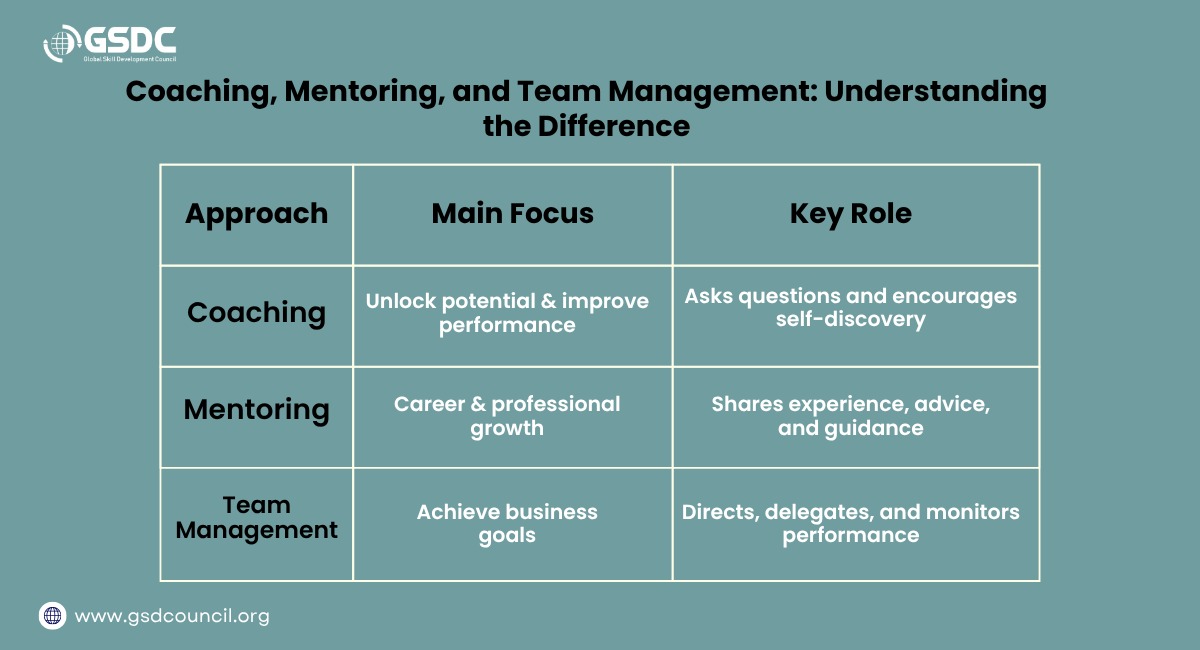
One of the most common misconceptions in professional development is treating coaching, mentoring, and team management as interchangeable concepts. Although they all contribute to employee growth, they serve very different purposes. Understanding these differences helps organizations choose the right approach for employee engagement, leadership development, and organizational development.
Coaching Unlocks Potential
Professional coaching focuses on helping individuals discover their own answers. Instead of providing advice, a professional coach asks powerful questions that encourage reflection, increase self-awareness, and help individuals identify solutions that work best for their unique situations.
The coach acts as a thinking partner rather than an expert. The responsibility for action and accountability always remains with the individual being coached.
Coaching primarily focuses on the present and future by improving performance, developing leadership capabilities, and encouraging behavioral change. Leadership coaching and leadership development coaching can be particularly valuable for building stronger decision-making, accountability, and leadership skills.
Mentoring Shares Experience
Mentoring follows a different approach. A mentor is typically someone with greater experience who shares personal insights, career guidance, and practical advice with someone less experienced.
For example, a senior finance executive mentoring an aspiring finance manager would share lessons learned throughout their own career. Unlike coaching, mentoring relies heavily on the mentor's expertise and personal experience.
Its primary objective is long-term career coaching, career development, and professional growth, helping employees build knowledge and confidence for future roles.
Team Management Drives Results
Team management is centered on achieving business objectives. Managers assign responsibilities, monitor performance, provide direction, and ensure organizational goals are met.
Unlike coaching, management often requires giving clear instructions and making decisions. It emphasizes accountability for outcomes, effective performance management, and achieving measurable business results rather than facilitating self-discovery.
Understanding these distinctions allows organizations to apply the right development approach based on employee needs rather than assuming one method fits every situation. Combining professional coaching, mentoring, and effective management can strengthen Organizational Growth, improve employee engagement, and support sustainable organizational growth.
Designing an Effective Coaching Process
Successful coaching does not happen by chance. Organizations must create a structured process that ensures both the coach and the individual being coached are aligned from the beginning.
Begin with Genuine Buy-In
One of the biggest mistakes organizations make is assigning coaching without involving the employee in the decision.
Employees should clearly understand why coaching is being offered, how it will benefit them, and what they hope to achieve. Genuine commitment creates a stronger foundation for meaningful progress.
Coaching should never be viewed as a corrective measure or a sign that someone has performance problems. Instead, it should be positioned as an opportunity for professional growth and organizational development.
Allow Individuals to Choose Their Coach
The relationship between the coach and the coachee plays a critical role in the success of professional coaching.
Many organizations now arrange chemistry sessions with multiple coaches before selecting one. These introductory conversations help determine compatibility, communication style, and trust.
A strong coaching relationship often produces better outcomes than simply assigning the most experienced professional coach.
Define Success Before Coaching Begins
Every coaching engagement should begin with a shared understanding of what success looks like.
Rather than setting vague objectives such as "become a better leader," organizations should establish observable behavioral goals. Examples include improving delegation, strengthening communication, increasing stakeholder collaboration, or developing better conflict management skills.
Clear success metrics make progress easier to monitor throughout the coaching journey and support effective performance management.
Respect Confidentiality
Confidentiality is one of the most important principles of professional coaching.
Employees must feel comfortable discussing challenges openly without worrying that personal conversations will be shared with managers or executives.
Organizations should focus their reviews on overall progress instead of requesting details about coaching conversations. Maintaining trust allows individuals to explore challenges honestly and encourages deeper self-reflection, supporting employee engagement.
Be Patient with the Process
Meaningful behavioral change rarely happens after a single coaching session.
Building trust often requires several conversations before individuals begin discussing deeper challenges or experimenting with new behaviors. Organizations should therefore view leadership coaching and leadership development coaching as long-term development investments rather than expecting immediate results.
Likewise, if coaching is not producing meaningful progress despite sustained effort, organizations should evaluate whether the coaching relationship, goals, or timing need to be adjusted instead of assigning blame.
Best Practices for Building Successful Coaching Programs
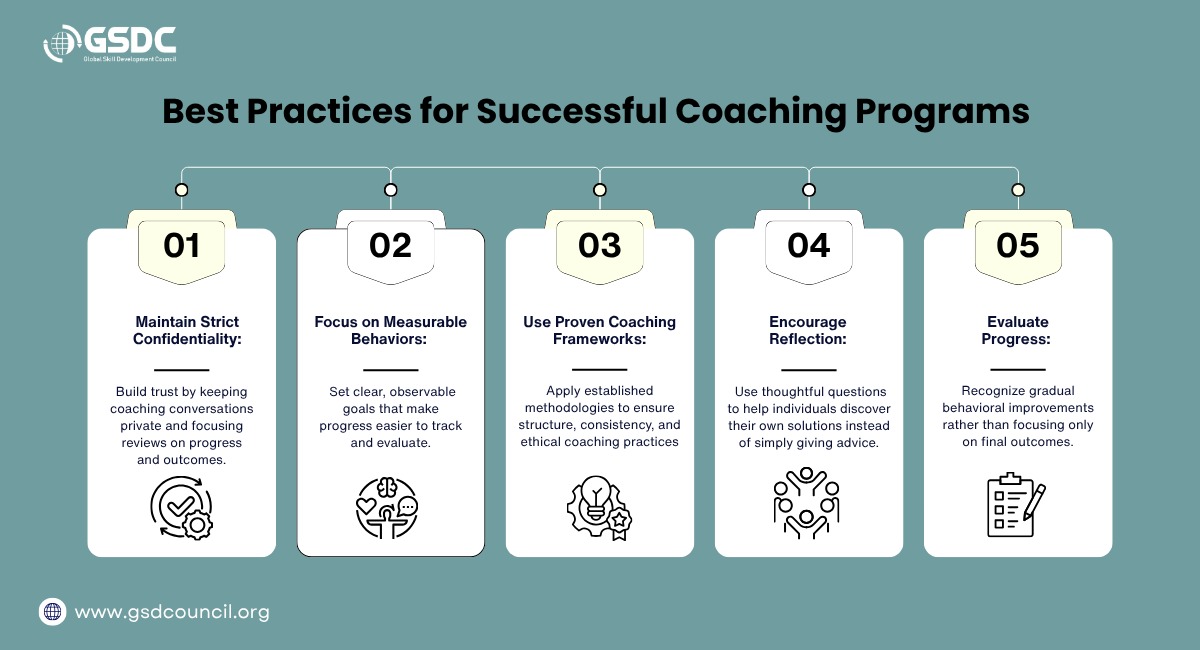
A coaching initiative delivers meaningful results only when it is supported by the right principles and organizational commitment. While every coaching engagement is unique, certain best practices consistently contribute to successful outcomes.
- Maintain Strict Confidentiality
Trust is the foundation of every coaching relationship. Employees should feel safe discussing their challenges, goals, and concerns without worrying that confidential conversations will be shared with managers or leadership.
Organizations should avoid asking coaches to disclose what was discussed during sessions. Instead, reviews should focus on overall progress and agreed-upon outcomes. This approach preserves psychological safety while still allowing stakeholders to monitor the effectiveness of the coaching engagement.
- Focus on Measurable Behaviors
Behavioral goals are easier to observe and evaluate than abstract qualities such as confidence or honesty.
For example, instead of defining success as "becoming a better leader," organizations can identify measurable outcomes such as:
- Improving delegation of responsibilities
- Conducting regular one-on-one conversations with team members
- Increasing cross-functional collaboration
- Demonstrating active listening during meetings
Behavior-based objectives make coaching more practical and help organizations assess progress objectively.
- Use Proven Coaching Frameworks
Effective coaching should be supported by recognized methodologies rather than relying solely on personal intuition.
Established coaching frameworks provide structure, consistency, and ethical guidelines that help coaches facilitate meaningful conversations while keeping the focus on the individual's development.
- Encourage Reflection Instead of Giving Advice
One of the defining characteristics of professional coaching is its emphasis on self-discovery.
Rather than telling individuals what to do, coaches encourage reflection through thoughtful questions. This approach helps people generate their own solutions, increasing commitment and long-term behavioral change.
- Evaluate Progress, Not Just Outcomes
Organizations often expect coaching to produce immediate transformation. However, behavioral development is a gradual process.
Even if an individual has not fully achieved every coaching goal, consistent progress toward desired behaviors represents meaningful success. Recognizing incremental improvements helps sustain motivation and reinforces continuous learning.
Building a Coaching Culture in the Workplace
A coaching culture delivers greater long-term value when coaching becomes part of everyday leadership. It encourages managers and employees to build learning, accountability, and growth through regular conversations. Psychological safety is essential, allowing employees to share ideas, challenges, and mistakes without fear of judgment.
Curiosity also matters, with leaders asking thoughtful questions instead of immediately providing solutions. Organizations can strengthen coaching cultures by training managers in effective coaching conversations and development skills.
Senior leadership must also model coaching behaviors such as active listening, reflection, and employee support. Ultimately, coaching should be viewed not as an HR initiative but as an organizational capability that strengthens leadership, engagement, and performance.
Internal vs. External Coaching: Which Is Better?
A common question organizations face is whether coaching should be delivered by internal leaders or external professional coaches.
The answer depends on the organization's objectives.
- Advantages of Internal Coaching
Internal coaches understand the organization's culture, values, and business environment. They are familiar with internal processes, leadership expectations, and workplace dynamics, making it easier to contextualize coaching conversations.
Internal coaching is also more accessible and often more cost-effective because organizations can leverage existing talent.
However, confidentiality may become a concern if employees worry that sensitive discussions could influence future performance evaluations or career decisions.
- Advantages of External Coaching
External coaches bring an unbiased perspective and extensive experience from working with multiple organizations and industries.
Because they are independent, employees often feel more comfortable discussing sensitive topics openly. External coaches can also introduce new ideas, challenge existing assumptions, and share proven practices from diverse organizational contexts.
Although external coaching generally involves higher costs, it is often preferred for senior executives, leadership transitions, and succession planning, where objectivity is particularly valuable.
Rather than choosing one approach exclusively, many organizations adopt a blended model. Internal coaches support ongoing development and culture-building, while external coaches provide specialized expertise for leadership development and executive coaching.
Coaching as a Leadership Mindset and Way of Life
The GSDC Certified Professional Coach Certification is designed to help professionals build practical coaching skills, strengthen leadership capabilities, and support personal and professional growth.
.jpeg)
The Certified Professional Coach Certification covers core coaching principles, active listening, powerful questioning, coaching models, goal setting, accountability, ethics, and coaching methodologies. It also helps learners apply coaching techniques in real-world situations and integrate coaching into leadership and organizational roles.
With self-paced learning, expert-led content, study materials, practice exams, capstone projects, and SME sessions, the certification provides a structured pathway for aspiring and experienced coaches. It is suitable for executive coaches, HR professionals, career coaches, team leaders, and organizational development specialists.
Conclusion
Professional coaching helps organizations strengthen leadership, improve performance, and adapt to change. By encouraging reflection, accountability, active listening, and psychological safety, coaching supports individual growth and stronger teams. Leaders can also adopt a coaching mindset by asking better questions and listening effectively.

Related Certifications
Frequently Asked Questions
Professional coaching fees vary by experience and certification, typically ranging from ₹7,000 to ₹30,000 per session.
Use measurable goals, pre- and post-coaching assessments, and 360-degree feedback to track improvement.
Internal coaching supports ongoing development, while external coaching offers greater objectivity, confidentiality, and specialized expertise.
Yes. Self-coaching through reflection and intentional questioning can support growth, though external coaches provide objective perspectives.
Some improvements may appear within a few sessions, while sustainable behavioral change typically takes several weeks or months.
Stay up-to-date with the latest news, trends, and resources in GSDC
If you like this read then make sure to check out our previous blogs: Cracking Onboarding Challenges: Fresher Success Unveiled
Not sure which certification to pursue? Our advisors will help you decide!