ISO 9001 Quality KPIs: Driving Performance Through Measurement
Written by Shalika Hewawasam
- Why Measuring More Doesn’t Always Mean Better Performance?
- Understanding the Role of KPIs in ISO 9001
- The ISO 9001 KPI Journey Begins with Leadership
- Quality Objectives Form the Foundation of Effective KPIs
- Management Review: Where KPIs Become Business Decisions
- Characteristics of Effective Quality KPIs
- Why Organizations Need Both Leading and Lagging Indicators
- Common KPI Mistakes That Limit Business Performance
- Turning KPI Dashboards into Decision-Making Tools
- Building a Culture of Continuous Improvement
- Strengthen Quality Performance with GSDC’s ISO 9001:2015 Lead Auditor Certification
- Conclusion
Organizations today collect more data than ever, with dashboards, reports, and meetings filled with performance metrics. Yet having more data does not always lead to better decisions. The key question is whether these measurements are actually improving business performance and supporting quality objectives.
This is where meaningful Key Performance Indicators (KPIs) become essential. Under ISO 9001, KPI ISO 9001 practices help organizations evaluate process performance, make informed decisions, identify improvement opportunities, and enhance customer satisfaction. Within a Quality Management System (QMS), key performance indicators (KPIs) provide measurable insights into whether processes are achieving their intended results and supporting quality objectives ISO 9001.
However, measuring everything is not the solution. The real value comes from selecting KPIs that align with business objectives, support decision-making, and drive continuous improvement. Effective quality management focuses on using relevant data to improve processes rather than simply collecting large volumes of information.
For organizations exploring what is quality management, meaningful KPIs demonstrate how measurement, decision-making, and improvement work together. When businesses adopt practical quality management strategies and focus on actionable insights, their QMS can become a strategic advantage instead of a compliance exercise.
This article explores how organizations can define quality KPIs that truly matter under ISO 9001 and use them to support quality objectives, strengthen quality management, and create a culture of continuous improvement.
Why Measuring More Doesn’t Always Mean Better Performance?
More metrics don’t always mean better decisions: Tracking too many KPIs can create information overload instead of meaningful insights.
- Focus on what matters
- Data collection isn’t enough
- Dashboards should drive action
- High-performing organizations use data strategically
- Create a continuous improvement cycle
- Turn data into an asset.
Understanding the Role of KPIs in ISO 9001
One of the biggest misconceptions about ISO 9001 is that KPIs belong only to performance evaluation.
In reality, meaningful KPIs are embedded throughout the Quality Management System (QMS). They support every stage of the organization's quality journey, from strategic planning to continual improvement.
ISO 9001 emphasizes several key activities:
- Establishing measurable quality objectives
- Monitoring and measuring process performance
- Analyzing results
- Conducting management reviews
- Driving continual improvement
These activities are connected through KPIs.
Rather than acting as isolated measurements, KPIs provide evidence of whether processes are achieving intended outcomes. They help management understand if quality objectives are being met and whether improvements are producing the desired business results.
Ultimately, ISO 9001 encourages organizations to measure what matters not simply what is easy to measure.
The ISO 9001 KPI Journey Begins with Leadership
Many businesses introduce Key Performance Indicators (KPIs) only after operational processes have been established. ISO 9001 takes a more strategic approach, where quality objectives ISO 9001 provide the foundation for selecting meaningful measurements.
The journey begins with leadership. Top management defines the organization's vision, understands customer expectations, evaluates the business context, and establishes strategic quality objectives. These objectives then guide operational processes and strengthen the organization's Quality Management System (QMS).
Once quality objectives are clearly defined, organizations can determine the key performance indicators (KPIs) needed to measure progress and success. This sequence is important because KPIs should support business goals rather than exist independently.
Effective quality management strategies therefore connect organizational goals, quality objectives, processes, and performance measurement. This approach ensures that KPI ISO 9001 practices contribute directly to continuous improvement and better business outcomes. A typical KPI journey under ISO 9001 looks like this.
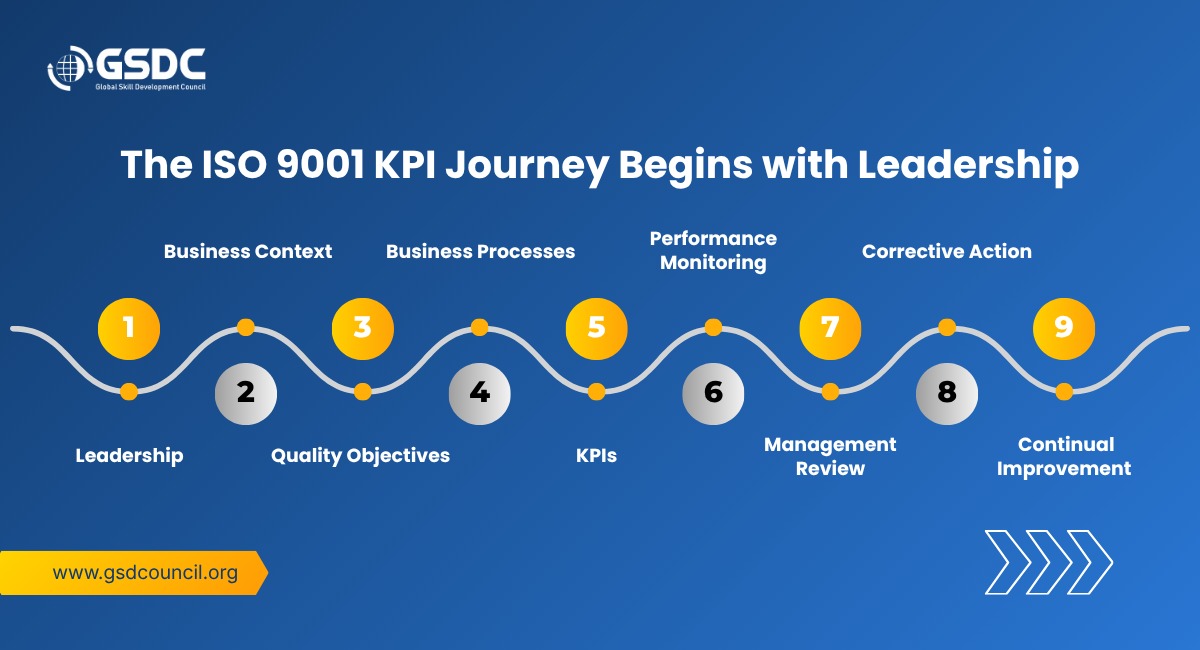
When KPIs are connected to organizational strategy from the beginning, they become valuable business management tools instead of compliance checklists.
Quality Objectives Form the Foundation of Effective KPIs
Every meaningful KPI starts with a clear objective.
Without knowing what the organization wants to achieve, measuring performance becomes meaningless.
ISO 9001 requires quality objectives to be:
- Consistent with organizational strategy
- Measurable
- Monitored regularly
- Communicated across the organization
- Updated whenever business needs change
For example, instead of creating a vague objective like "Improve customer satisfaction," an organization could establish a measurable objective such as reducing customer complaints by 20% within twelve months.
Once the objective is defined, appropriate KPIs can be selected to monitor progress.
This relationship can be summarized simply:
Objectives define the destination. KPIs indicate whether the organization is moving toward it.
Without measurable objectives, organizations cannot accurately evaluate improvement or business performance.
Management Review: Where KPIs Become Business Decisions
One of the most valuable aspects of ISO 9001 is the management review process.
Many organizations mistakenly view management review as a routine meeting for presenting reports.
Its actual purpose is much broader.
Management reviews allow leadership teams to evaluate whether the Quality Management System is achieving intended results.
Performance information collected through KPIs helps management:
- Identify emerging risks
- Allocate resources effectively
- Prioritize improvement initiatives
- Review quality objectives
- Strengthen customer satisfaction
In other words, KPIs themselves do not improve businesses.
Management decisions based on KPI insights are what create lasting improvements.
When organizations consistently review performance data and act upon it, quality management evolves from a compliance requirement into a competitive advantage.
Characteristics of Effective Quality KPIs
Not all KPIs contribute equally to business success. Effective KPIs are carefully designed to provide meaningful insights rather than simply track activity. A widely accepted approach is the SMARTER framework, which helps organizations create KPIs that drive measurable results.
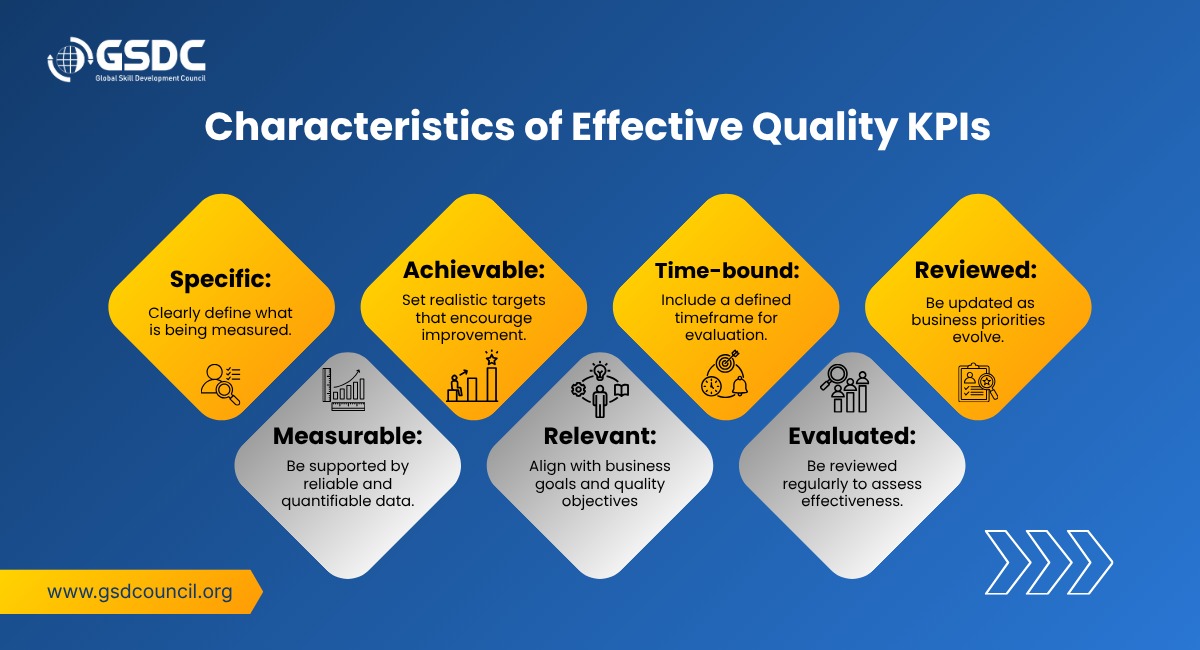
For example, instead of tracking the number of quality meetings held each month, a more meaningful KPI would be First Pass Yield (FPY) or Customer Complaint Rate, as these directly reflect process performance and customer satisfaction.
Ultimately, a KPI is only valuable if it helps management make better decisions and improve organizational performance.
Why Organizations Need Both Leading and Lagging Indicators
A balanced KPI system includes both leading and lagging indicators.
Leading indicators focus on activities that influence future performance. They provide early warnings and help organizations prevent problems before they occur. Examples include employee training completion, preventive maintenance schedules, supplier performance, and internal audit results.
Lagging indicators, on the other hand, measure outcomes that have already occurred. These include customer complaints, defect rates, product returns, and rework costs. They help organizations evaluate whether previous actions have been effective.
Relying only on lagging indicators means reacting to problems after they happen, while focusing only on leading indicators makes it difficult to verify whether preventive actions are delivering results.
Organizations that combine both types of indicators gain a complete picture of performance, enabling proactive decision-making and stronger continual improvement.
Common KPI Mistakes That Limit Business Performance
- Measuring Everything: Too many metrics create complexity and distract from what truly matters.
- No Clear Ownership: Lack of accountability can slow improvement efforts.
- Infrequent KPI Reviews: Reviewing metrics only during audits or meetings delays action.
- Using KPIs to Blame: Metrics should improve processes, not criticize individuals.
- Reactive KPI Management: Waiting for problems instead of identifying issues early limits performance.
- Lack of a Learning Culture: Blame discourages transparency, while learning supports improvement.
- The Right Approach: Focus on meaningful KPIs, assign ownership, review regularly, and use insights for continuous improvement.
Turning KPI Dashboards into Decision-Making Tools
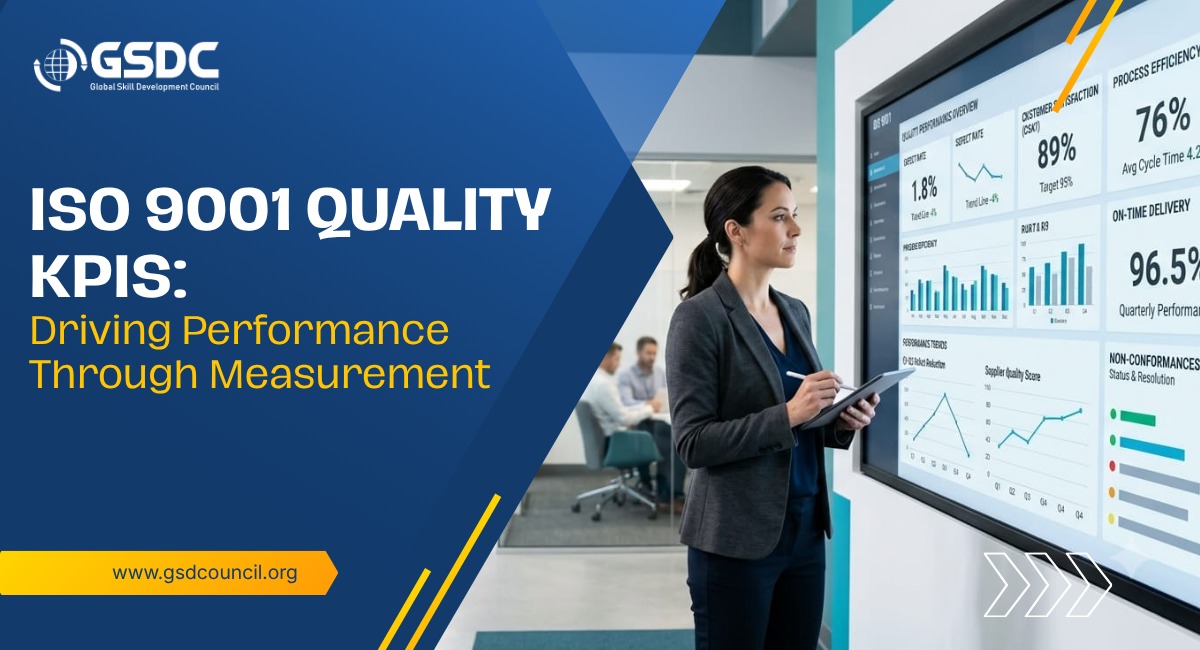
A KPI dashboard should do much more than display numbers. Within a Quality Management System (QMS), an effective dashboard highlights information that requires attention and helps leaders make timely, data-driven decisions.
Instead of overwhelming users with excessive charts and reports, a well-designed dashboard presents critical Key Performance Indicators (KPIs) in a simple and visual format. Traffic-light indicators green, amber, and red can help teams quickly identify areas performing well and those requiring corrective action.
Management review dashboards should also provide leadership with a comprehensive view of organizational performance. Relevant metrics may include:
- Customer satisfaction
- Process effectiveness
- Supplier performance
- Audit findings
- Quality objectives
- Risks and opportunities
- Improvement initiatives
The true value of a dashboard is not measured by how much information it displays but by whether it supports quality management and drives meaningful action. KPIs should help organizations evaluate progress toward quality objectives ISO 9001, identify gaps, and support continuous improvement.
For organizations implementing KPI ISO 9001 practices, the goal should be to turn data into decisions. A dashboard that only reports performance without influencing action becomes a reporting tool rather than a strategic quality management strategy.
Ultimately, effective key performance indicators (KPIs) should make performance easier to understand, decisions easier to make, and improvement easier to achieve.
Building a Culture of Continuous Improvement
ISO 9001 is built on the principle of continual improvement, and KPIs play a vital role in sustaining this cycle.
The improvement journey begins by measuring process performance. Organizations then analyze results to identify trends, root causes, and opportunities for improvement. Based on these insights, corrective actions are implemented and later verified to ensure they are effective.
Once successful improvements are standardized, organizations establish new performance targets and continue raising the benchmark. This ongoing cycle prevents complacency and encourages steady progress.
Over time, continual improvement becomes part of the organization's culture rather than a one-time initiative.
A strong quality culture develops when:
- Leadership provides clear direction.
- Employees understand their role in achieving quality objectives.
- Processes are measured consistently.
- Data is used to support learning rather than assign blame.
- Improvement becomes everyone's responsibility.
When these elements work together, quality evolves beyond compliance and becomes a competitive advantage.
Strengthen Quality Performance with GSDC’s ISO 9001:2015 Lead Auditor Certification

GSDC’s ISO 9001:2015 Lead Auditor Certification helps professionals build expertise in Quality Management Systems, quality auditing, risk-based thinking, and evidence-based decision-making. The ISO 9001:2015 Lead Auditor Certification covers process auditing, performance measurement, nonconformity management, corrective actions, and continual improvement, making it highly relevant for professionals looking to turn quality data and KPIs into actionable insights.
Conclusion
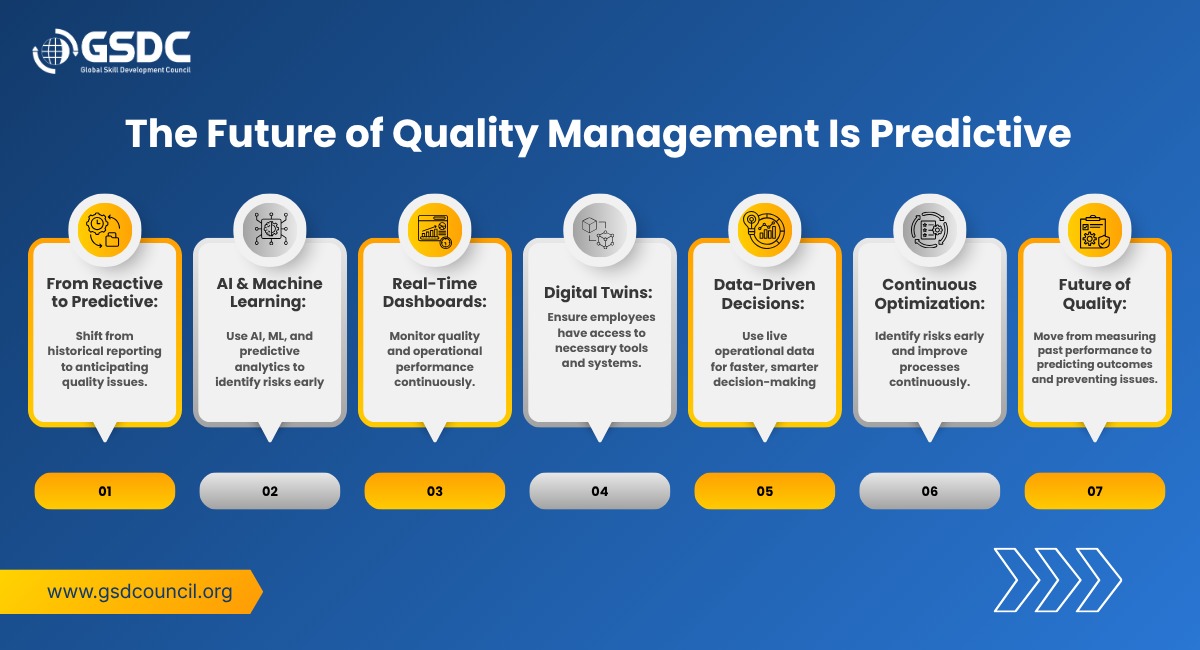
Meaningful key performance indicators (KPIs) are the foundation of an effective quality management system (QMS) under ISO 9001. Rather than collecting large volumes of data, organizations should focus on measurements that support quality objectives, improve processes, and enhance customer satisfaction. Aligning quality objectives ISO 9001 requirements with business goals, regularly reviewing performance, and using data to make informed decisions helps strengthen quality management and continuous improvement. As AI and predictive analytics reshape quality management strategies, businesses that measure what truly matters will be better equipped to improve performance, manage risks, and achieve sustainable operational excellence.

Related Certifications
Frequently Asked Questions
Key performance indicators (KPIs) help organizations measure process performance, evaluate quality objectives, and support continuous improvement within the quality management system (QMS).
An effective KPI ISO 9001 measurement is measurable, relevant, aligned with business objectives, and helps drive better decisions and quality management.
Leading indicators predict future performance, while lagging indicators measure results that have already occurred. Both support effective quality management strategies.
Management review uses KPI insights to make strategic decisions, allocate resources, evaluate quality objectives ISO 9001, and improve the quality management system (QMS).
Focus on meaningful key performance indicators (KPIs), assign clear ownership, review performance regularly, and use metrics to improve processes rather than blame individuals. This approach supports what is quality management in practice and strengthens continuous improvement.
Stay up-to-date with the latest news, trends, and resources in GSDC
If you like this read then make sure to check out our previous blogs: Cracking Onboarding Challenges: Fresher Success Unveiled
Not sure which certification to pursue? Our advisors will help you decide!