Will AI Replace HR? How AI Is Redefining the HR Role
Written by Matthew Hale
- What AI in HR Actually Means
- Where AI Is Already Changing HR
- 7 Real AI Use Cases Across the Employee Lifecycle
- Generative AI vs. Predictive AI vs. Agentic AI in HR
- How HR Teams Can Adopt AI Responsibly
- What AI Means for HR Careers
- The New Skills HR Professionals Need
- Advance Your HR Career
- The Bottom Line
Every few months, a new headline predicts the end of Human Resources as we know it. Chatbots answer employee questions. Algorithms screen resumes. Predictive models flag who's about to quit before they even update their LinkedIn. It's easy to look at that list and assume HR departments are next on the AI chopping block.
They're not, but they are being rebuilt from the inside out.
AI in HR is already handling a large share of the repetitive, rules-based work that used to eat up an HR professional's week. What's left, and what's growing, is the part of the job that requires judgment, empathy, and strategy. This piece walks through what AI in HR actually means, real use cases across the employee lifecycle, how the technology is evolving, and what it changes for HR careers.
What AI in HR Actually Means
Two terms get used interchangeably in this space, and the difference matters:
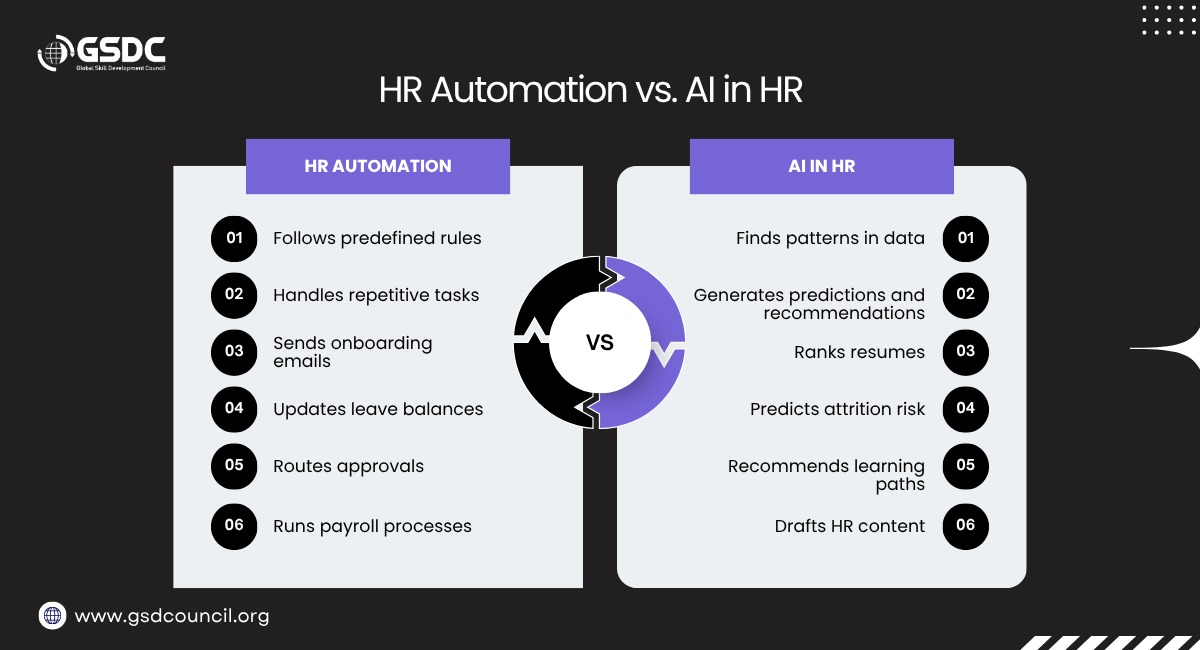
- HR automation is software that runs repetitive, rule-based tasks without a human triggering each step: sending onboarding paperwork, updating leave balances, routing approvals.
- AI in HR goes further. Rather than just following fixed rules, it identifies patterns in data and generates predictions, rankings, recommendations, or content: ranking resumes against a job spec, flagging attrition risk, or drafting a job description from a few bullet points.
In practice, most modern HR platforms blend both. A payroll system that auto-runs every month is automation. A tool that predicts which employees are likely to leave in the next 90 days is AI. The distinction matters because AI isn't simply "automation 2.0." It's starting to shape what HR recommends and decides, not just what HR processes. It's worth being precise here: AI produces statistical inference, not judgment in the human sense. That distinction is especially important in HR, where the outputs touch hiring, pay, and promotion decisions that still need a person accountable for the outcome.
Where AI Is Already Changing HR
Gartner's HR research makes a useful distinction: CHROs are turning to AI to improve strategic value, efficiency, and decision-making, but many organizations are implementing it quickly without following best practices, which limits the impact to marginal gains rather than transformation. In other words, the technology is real; the execution discipline is still catching up.
Josh Bersin, an HR industry analyst, has reported that HR job postings have increased roughly 60% over the past five years even as AI adoption accelerated, a sign that AI is reshaping HR roles rather than shrinking the profession outright. His analysis also points to a meaningful share of today's most administrative HR tasks (interview scheduling, basic records processing) as candidates for near-term automation, freeing people up for higher-value work.
7 Real AI Use Cases Across the Employee Lifecycle
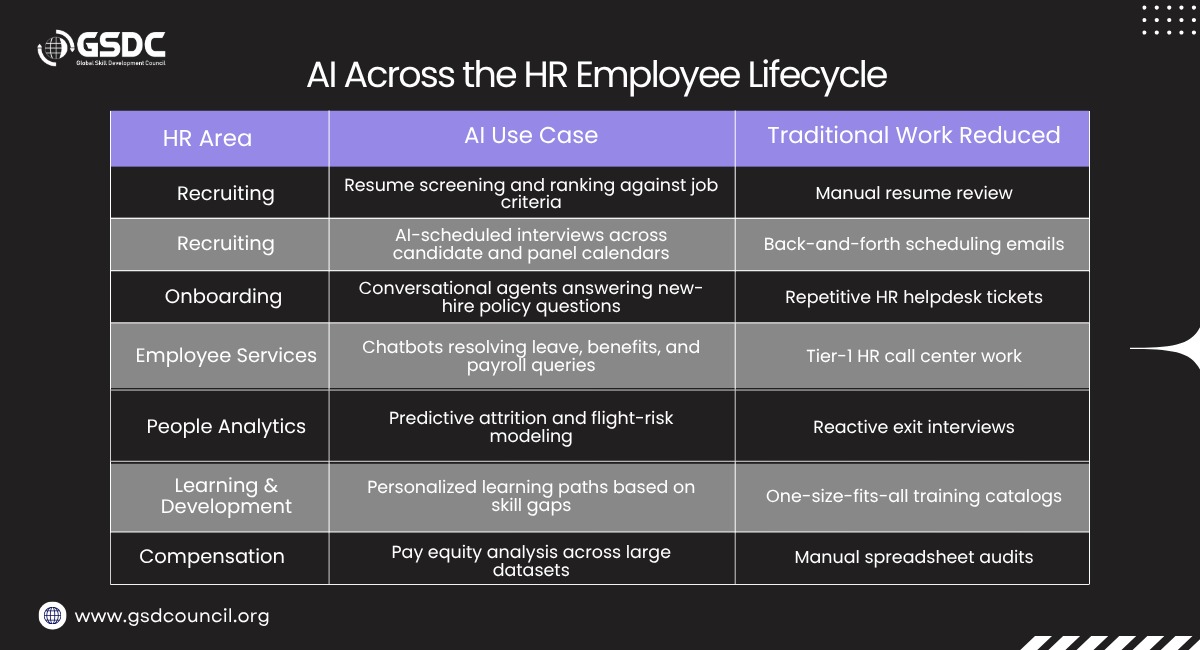
AI is showing up in real HR workflows in fairly consistent ways: it narrows a large volume of work down to a manageable set, and a person still makes the final call. Here's how that pattern plays out across seven areas of the employee lifecycle.
1. Recruiting: Resume Screening and Ranking
AI models are configured against job criteria (skills, experience, keywords, sometimes weighted by role level) and score incoming resumes against that rubric. A recruiter who used to open 300 resumes now opens the top 40 to 60 that cleared the bar.
What doesn't change: someone still has to build the rubric, decide which criteria matter, and periodically audit the model for bias, since these systems can unintentionally penalize non-traditional career paths, employment gaps, or resumes that don't use expected phrasing. Edge cases, like a career-changer with transferable skills or a resume that's strong but poorly formatted, still need a human look.
2. Recruiting: AI-Scheduled Interviews
This solves a pure logistics problem: matching candidate availability against multiple interviewers' calendars, time zones, and room or video-link bookings. These tools can also handle rescheduling and reminders automatically.
What it removes is the back-and-forth email chain. What it doesn't remove is judgment, like deciding which candidates to fast-track or handling a senior leader's calendar that needs manual finesse.
3. Onboarding: Conversational Agents for Policy Questions
New hires ask a lot of the same questions in their first weeks: how to set up direct deposit, what the dress code is, when healthcare coverage starts. A conversational agent trained on the employee handbook and internal policies can answer these instantly, any time, instead of the new hire waiting in a ticket queue.
This cuts down on repetitive tier-1 tickets, but it depends on the underlying knowledge base staying accurate. A chatbot answering from an outdated policy creates more confusion than it solves, so someone needs to own keeping that source of truth current.
4. Employee Services: Leave, Benefits, and Payroll Chatbots
Similar to onboarding bots, but for the ongoing employee lifecycle: how many PTO days are left, what the HSA contribution limit is, why a paycheck looks different this month. These handle the high-volume, low-complexity queries that used to fill HR call centers.
Escalation paths matter here. The system needs to reliably recognize when a question is too nuanced or too personal, such as a payroll error or a leave-of-absence edge case, and route it to a person instead of guessing.
5. People Analytics: Predictive Attrition Modeling
Instead of learning why someone left through an exit interview, models look at patterns, such as engagement survey trends, manager changes, tenure milestones, and workload signals, to flag employees at elevated flight risk before they resign. This shifts HR from reactive to proactive.
The catch: flight-risk scores are probabilistic, not diagnoses. A manager acting on a flawed or biased signal, for example, one that disproportionately flags employees from a particular team or demographic, can do real harm. These models need governance and shouldn't be the sole basis for action, which is why interpreting them well is increasingly a skill covered in HR certificate programs rather than something learned ad hoc.
6. Learning and Development: Personalized Learning Paths
Rather than everyone completing the same generic training catalog, AI can map an employee's current skills against their role or career goals and recommend a tailored sequence of courses. It's a shift from a training catalog to a training system.
This still depends on a well-curated content library, since personalization is only as good as the material behind it, and managers still need to sponsor and validate that the learning actually changes on-the-job performance.
7. Compensation: Pay Equity Analysis
AI can scan large compensation datasets to flag statistical disparities by gender, race, tenure, or role that would take an analyst weeks to find manually in spreadsheets. This surfaces patterns fast, but interpreting why a disparity exists (legitimate factors like experience or performance versus actual inequity) and deciding on remediation is still a human call, usually legal or comp-and-benefits, partly because of legal exposure.
The Pattern Across All Seven
Take resume screening as an example: AI reduces the volume of manual review, but someone still has to set the screening criteria, validate the results, review edge cases, and make the final call. That pattern, AI narrows the pile, and a person makes the decision, holds across nearly every row above.
Picture a 5,000-employee company. Instead of an HR team manually answering hundreds of leave and benefits questions every week, an AI assistant handles the routine ones, escalates the unusual cases, and gives HR a running record of what employees are actually asking about most. The HR team hasn't disappeared. Its workload has changed: less time spent repeating the same answer, more time spent noticing the pattern behind it and fixing the policy causing the confusion in the first place.
Generative AI vs. Predictive AI vs. Agentic AI in HR
AI in HR isn't one technology. It's a progression, and knowing where a tool sits on that spectrum matters for how much oversight it needs:
- Generative AI produces a first draft: job postings, interview questions, policy FAQs, performance review summaries, training content. It's fast and useful, but every output still needs a human editor, especially anywhere it touches pay, compliance, or a real person's career.
- Predictive AI doesn't write anything. It scores and ranks. Attrition risk models, pay equity flags, and candidate-fit scores fall here. These outputs are probabilities, not verdicts, and should be treated that way.
- Agentic AI is the newest and least mature layer: systems that carry out a multi-step workflow (like end-to-end onboarding or benefits enrollment) with minimal human triggering at each step. This is where governance matters most, because errors compound at scale instead of staying contained to one case.
For many HR teams, the first two stages are currently more mature than agentic AI. That's worth watching closely over the next few years, since agentic AI is also the layer with the least track record.
How HR Teams Can Adopt AI Responsibly
For teams building this out, a phased approach beats a big-bang rollout:
- Start with low-risk, high-volume tasks.
Interview scheduling, FAQ chatbots, and job description drafting are safe entry points; mistakes are easy to catch and low-stakes.
- Audit your data before scaling.
AI is only as reliable as the employee data feeding it. Clean, complete, and unbiased data has to come first.
- Keep a human in the loop for consequential decisions.
Hiring, pay, promotions, and terminations should always have human sign-off, not just an AI recommendation.
- Train managers, not just HR.
Much of the value shows up when managers use these tools directly, not when they're confined to a central HR team.
- Measure business outcomes, not usage.
Track hiring speed, retention, or manager satisfaction, not just how many people logged into the new tool.
Turning these five steps into lasting practice usually means investing in the people doing the work, not just the tools. That's part of why more HR teams are turning to structured programs like GSDC's HR professional offerings to build these skills deliberately, rather than leaving it to informal, on-the-job learning.
What AI Means for HR Careers
This is the question behind most searches on this topic, so it deserves a direct answer: no, the evidence doesn't support AI replacing human resources as a function. What it supports is a reshaping of the roles within it.
What's shrinking: manual resume screening, basic HR helpdesk handling, repetitive records and forms processing, interview and calendar coordination.
What's growing: AI governance and data quality oversight within HR, strategic workforce planning and org design, manager coaching and leadership development, employee relations and culture work, and "AI orchestration" (designing and managing the AI agents doing HR's tactical work).
A December 2025 Gartner survey of HR leaders found that 40% of organizations had already eliminated outdated HR roles to realign with this kind of AI-driven work, and the same research projects that, starting in 2028, AI will create more jobs than it eliminates overall, across the workforce it studied. That's a meaningful data point against the "AI kills HR" narrative: roles are being redesigned, not erased.
The New Skills HR Professionals Need
As HR roles shift toward AI governance, data literacy, and strategic advisory work, the skills employers are hiring for have changed with them. Job postings increasingly list capabilities most HR professionals weren't formally trained on:
- AI literacy: understanding what a tool can and can't reliably do, not just how to click through it
- HR analytics: reading dashboards and models well enough to question them, not just report them
- Responsible AI and governance: knowing where bias, error, or explainability risk shows up in an AI-driven decision
- Data interpretation: turning a pattern in the data into a policy or staffing decision
- Strategic workforce planning: designing roles and org structures around what AI has actually automated, not what it might someday automate
- Change management: helping managers and employees adopt these tools without eroding trust
None of these were core HR competencies a decade ago. Now they're closer to baseline expectations, and building them deliberately, rather than picking them up piecemeal on the job, is quickly becoming the difference between an HR career that keeps pace and one that doesn't.
Advance Your HR Career
HR professionals need more than experience alone to demonstrate the depth and breadth of their expertise. A professional credential can provide an additional way to formally recognize that knowledge and strengthen your professional profile.
The Global Skill Development Council (GSDC) Certified HR Professional credential is designed for HR professionals who want to validate their knowledge across core HR practices and demonstrate their commitment to professional standards.
Whether you're building your HR career, strengthening your professional profile, or looking to formally recognize your experience, the credential offers a structured way to showcase your capabilities.
The Bottom Line
AI in HR isn't a countdown to obsolescence. It's a redistribution of effort. The tactical, repetitive parts of the job are shrinking. The parts that require judgment, trust, and human connection are growing and becoming more valuable in the process.
AI doesn't make HR less human. It makes the human parts of HR more important.

Related Certifications
Frequently Asked Questions
HR automation is the use of software to handle repetitive, rule-based HR tasks (like payroll runs, onboarding paperwork, or leave approvals) without manual intervention at each step.
No. Evidence points to AI automating specific tactical tasks within HR, like scheduling or resume screening, while roles requiring judgment, strategy, and employee relations continue to grow. Gartner research projects that, starting in 2028, AI will create more jobs overall than it eliminates.
Common examples include AI resume screening, chatbot-based employee support, predictive attrition analytics, personalized learning recommendations, and AI-assisted job description writing.
HR is moving from an administrative, policy-enforcement function toward a strategic role focused on workforce planning, culture, AI governance, and business advisory work.
Yes, arguably more than before. As HR job descriptions increasingly expect AI fluency and data literacy alongside traditional HR skills, certification helps professionals demonstrate they've kept pace with the field. Programs like GSDC's HR certifications are built around these updated skill requirements.
Stay up-to-date with the latest news, trends, and resources in GSDC
If you like this read then make sure to check out our previous blogs: Cracking Onboarding Challenges: Fresher Success Unveiled
Not sure which certification to pursue? Our advisors will help you decide!