Deepfake Scams Are Fueling the Next Wave of Cybersecurity Jobs
Written by Matthew Hale
A finance employee at Arup, a British engineering firm, joined what looked like a routine video call with the company's CFO and several colleagues. The voice was right. The faces were right. By the time anyone realized every person on that call was an AI-generated deepfake, the employee had authorized 15 transfers totaling roughly $25 million to accounts in Hong Kong.
This wasn't a movie plot. It happened in early 2024, confirmed by Arup itself and reported by Hong Kong police, and it's becoming disturbingly common.
Deepfake scams and AI phishing attacks have moved from novelty to mainstream threat in barely two years. For anyone working in or entering the cybersecurity field, understanding this shift isn't optional anymore; it's the difference between staying relevant and being left behind.
Why This Matters Right Now
Generative AI didn't just give marketers better copywriting tools. It handed cybercriminals a production line for deception. Cloning a voice used to require hours of audio and technical skill. Today, three seconds of someone's voice is enough to generate a clone that's roughly 85% accurate, according to industry data compiled in ZeroThreat's 2026 deepfake and phishing statistics report. A convincing deepfake video can be produced for as little as a few hundred dollars.
That accessibility is exactly why deepfake fraud has grown so fast. The same report notes that deepfakes now account for 6.5% of all fraud attempts - a jump of more than 2,000% since 2022. Fintech and crypto firms have been hit hardest, with the crypto sector alone accounting for the vast majority of reported deepfake fraud cases.
The Numbers Behind the Panic
It's worth sitting with the scale of this for a moment. A quick snapshot of where things stand:
| Metric | Value |
| Increase in deepfake fraud attempts (2023) | 3,000% |
| Companies with anti-deepfake protocols in place | 13% |
| People who can reliably detect a deepfake | 1 in 10 |
| Average cost of a single deepfake fraud incident | ~$500K |
| Companies without a formal response plan | 80% |
Source: ZeroThreat, "Deepfake Attacks & AI-Generated Phishing: 2026 Statistics"
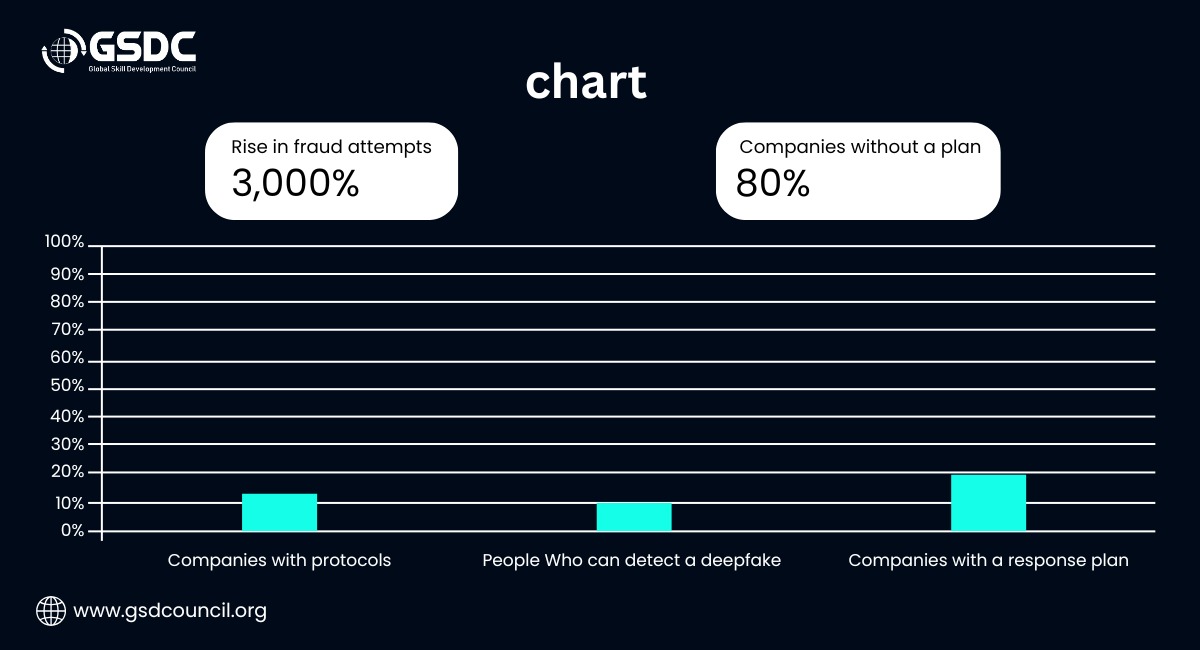
The biggest cybersecurity risk in 2026 isn't malware. It's believing what you see and hear.
The gap between exposure and preparedness is the real story here. Most organizations know the risk exists. Very few have actually built defenses for it.
AI phishing attacks tell a similar story. Traditional phishing was already expensive. Generative AI simply made it dramatically easier to scale.
IBM's 2024 Cost of a Data Breach Report, produced with the Ponemon Institute, put the average global breach cost at $4.88 million - the steepest year-over-year jump since the pandemic. Research cited in ZeroThreat's report found AI-generated phishing emails achieved a 54% click-through rate, versus just 12% for manually written ones. LLMs now write spear-phishing messages that perform on par with skilled human social engineers, free of the typos that used to give scams away. This is what AI cybersecurity teams are now up against on a daily basis.
AI-Powered Cyberattacks: A Few Examples Worth Knowing
Beyond the Arup case, a handful of incidents show how varied these attacks have become:
- A UK-based energy firm lost €220,000 in 2019 after attackers cloned the CEO's voice to authorize a wire transfer - one of the earliest documented voice-based deepfake frauds.
- In 2024, an employee at password manager LastPass was targeted with an AI-cloned voice of its own CEO over WhatsApp. The employee spotted the mismatch and reported it - a rare case where the human caught what the technology couldn't.
- New hires are especially vulnerable - employees are roughly 44% more likely to fall for phishing or social engineering within their first 90 days on the job.
Zoom out, and the pattern holds across cybercrime broadly. Verizon's 2026 Data Breach Investigations Report found a human element present in 62% of breaches, up from 60% a year earlier. And the FTC's Consumer Sentinel data showed U.S. consumers reported losing more than $12.5 billion to fraud in 2024, a 25% jump year-over-year. Deepfakes and AI phishing are a growing slice of an already large problem.
None of this means AI is only a weapon for attackers, though. It's also becoming the most effective tool defenders have.
Every convincing deepfake creates demand for someone who knows how to detect it.
How Generative AI Is Reshaping Cybersecurity Defense
This is where the conversation about generative AI security risks needs a second half - because the same technology creating the problem is also solving it.
So how can generative AI be used in cybersecurity? A few practical, already-deployed use cases:
- AI in fraud detection: Machine learning models flag anomalies in transaction patterns and login behavior far faster than manual review, catching fraud before funds move.
- Behavioral biometrics: AI systems analyze typing rhythm, speech patterns, and micro-expressions to flag synthetic media in real time.
- Automated phishing simulation: Security teams use generative AI to build realistic phishing tests that train employees against current tactics.
- Smarter email filtering: AI-powered filters learn from evolving attack patterns instead of relying on static blocklists.
- Continuous, AI-driven penetration testing: Always-on testing that mimics attacker behavior, replacing annual audits.
These generative AI cybersecurity use cases are exactly why demand for skilled professionals is climbing so fast. Building and managing these systems takes people, not just software.
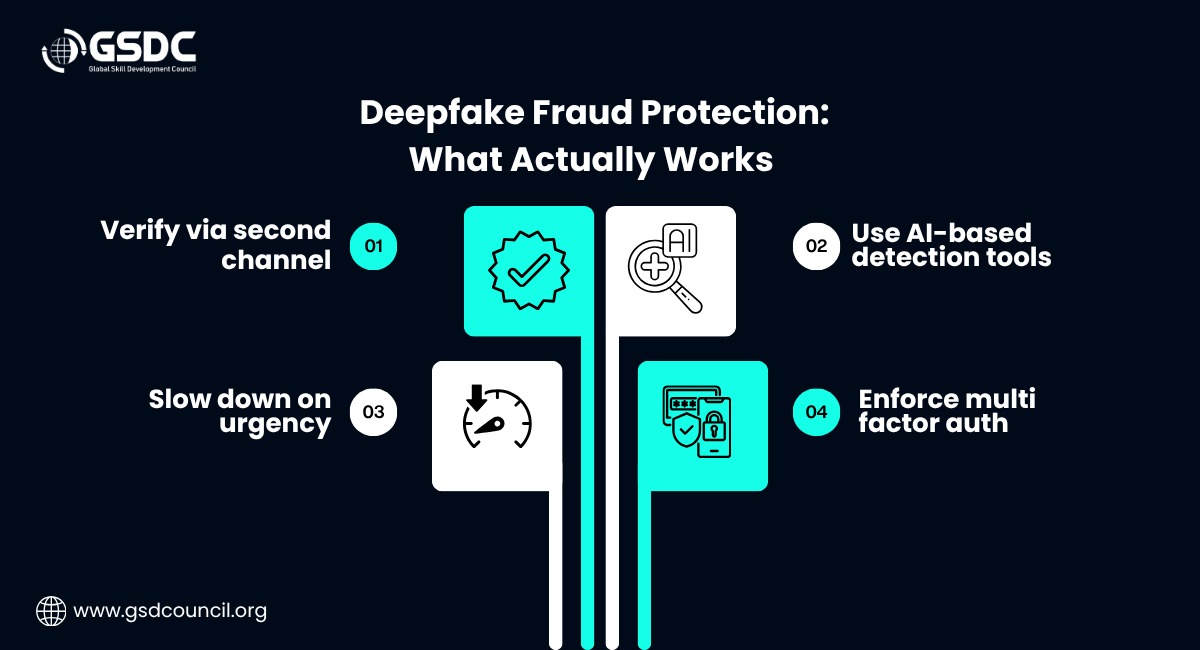
Deepfake Fraud Protection: What Actually Works
If you're wondering how to protect against deepfake phishing scams in practical terms, the strongest cyber defense recommendations are fairly consistent:
- Verify through a second channel. Any urgent financial request - especially over video or voice - should be confirmed through a separate, pre-established method, the way the LastPass employee did.
- Slow down on urgency. Deepfake scams rely on pressure. Pausing to verify measurably improves detection.
- Adopt AI-based detection of deepfake phishing attacks. Purpose-built tools catch synthetic media and digital identity fraud patterns invisible to the human eye or ear.
- Use multi-factor authentication everywhere, particularly for financial approvals - it remains one of the simplest, most effective barriers against deepfake voice fraud.
Even with all this, only a small share of companies currently have formal protocols in place. That gap is the opportunity.
The Career Story Nobody's Talking About Enough
Here's the part that matters if you're thinking about where to build a career: every one of these threats and defenses needs a human behind it. The rise in deepfake attacks and AI phishing is directly fueling one of the fastest-growing corners of the tech job market - organizations aren't just buying better software; they're hiring people who can configure it, interpret its output, and respond when it flags something real.
This is reshaping cybersecurity career paths in a few clear ways:
The scale of this shift shows up in the workforce data too. According to ISC2's 2025 Cybersecurity Workforce Study, 95% of security teams report at least one skills gap, and AI ranks as the single most-cited gap - ahead of cloud security, risk assessment, and application security. That's a direct signal of where hiring demand is heading.
- New specializations are emerging, including roles focused on AI threat detection, synthetic media forensics, and generative AI risk management that barely existed three years ago. Titles like AI security analyst are showing up in job postings that didn't exist in 2023.
- Cybersecurity skills are shifting. Employers now want AI/ML fundamentals and behavioral analytics alongside traditional network security know-how - even SOC analyst roles increasingly expect familiarity with AI-generated threats.
- Compensation reflects the demand. Cybersecurity analyst salary ranges vary by region, but AI-security expertise consistently commands a premium over generalist roles.
- The AI impact on cybersecurity jobs is additive, not replacing. AI automates detection and triage, but it's expanding the need for people who manage, audit, and improve these systems.
As AI becomes part of modern cybersecurity, structured learning can help professionals build practical skills faster than piecing together scattered resources. Industry-recognized certification programs provide one pathway for developing those capabilities.
Within the next few years, AI-generated identity fraud will likely become a routine risk for every organization - not just large enterprises. The cybersecurity professionals who understand both AI and defense strategy will be among the most valuable hires in the industry.
This is also why a Certification in Generative AI in Cybersecurity has started to matter more. It was built around the same shift this article has been describing: security professionals increasingly need to understand how generative models are used both to attack and to defend, not just one side of that equation. For anyone mapping out where to invest their learning time next, that kind of applied, dual-sided framing is worth knowing exists.
Where This Leaves Us
Cybersecurity has always been a race between attackers and defenders. Generative AI hasn't changed that. It has simply accelerated both sides.
The professionals who understand AI won't just respond to the next wave of attacks. They'll help define how organizations defend themselves in an AI-first world.
The threat is real. So is the opportunity to be the person who stops it.

Related Certifications
Stay up-to-date with the latest news, trends, and resources in GSDC
If you like this read then make sure to check out our previous blogs: Cracking Onboarding Challenges: Fresher Success Unveiled
Not sure which certification to pursue? Our advisors will help you decide!